The Fast Food Industry: The Best Books on How It Was Built, in Order
Fast food is best understood not as a kind of restaurant but as an industrial system: franchising to raise capital without owning stores, real estate as the actual product, a supply chain reorganised around uniformity, and a labour model designed so that no employee needs a skill. This path starts with the reporting that made the industry a public argument, goes back to how it was built and by whom, then follows the food, the workers and the suppliers, and ends with who it was sold to at home and abroad.
The Argument, Stated
BeginnerUnderstand the whole system at once — franchising, potato and beef supply, minimum-wage labour, marketing to children — and why fast food became a proxy fight about American life.
▸ Study plan for this stage
Pace: 2 to 3 weeks for about 670 pages. Fast Food Nation (385pp) in ten days — it is reported prose and moves — and Drive-Thru Dreams (288pp) in a week. Schlosser's slaughterhouse chapters contain detailed descriptions of industrial killing and of worker injuries.
- Schlosser's structural claim is that fast food is not a restaurant category but a system: franchising, standardised supply, engineered flavour, minimum-wage labour and marketing aimed at children, all interlocking.
- The book's method is following the inputs backward — the potato to Idaho, the beef to the packing plant, the flavour to a chemical works off the New Jersey Turnpike. Learn the method; it is more durable than any figure in the book.
- Chandler's Drive-Thru Dreams is a deliberate counterweight: fast food as genuine and widely loved American culture, built by immigrants and regional operators, not solely as an indictment.
- The disagreement between the two is about standing, not facts. Schlosser writes as a prosecutor of an industry; Chandler writes about people who like the food and work in it.
- Marketing to children is where the industry's defenders are weakest and Schlosser is strongest. Note how Chandler handles it.
- Reading these two together is the path's whole method in miniature: get the strongest indictment and the strongest sympathetic account before you look at any evidence yourself.
- Name the four subsystems Schlosser argues are load-bearing, and say which one he thinks would be hardest to change.
- Where does Chandler concede Schlosser's case, and where does he refuse it?
- Fast Food Nation was published in 2001. Which of its specific claims have been overtaken by events, and which have not?
- Why does the industry's relationship with children get treated as a separate moral question from its relationship with adults?
- If you had to choose one book to give someone who works at a counter, which would it be and what would you say about the other?
- Take one statistic from Fast Food Nation — an employment figure, a beef consumption figure, a marketing spend — find the source in the notes, and check whether the current equivalent supports or undercuts the original claim.
- List the five things Schlosser thinks are wrong with the industry. Then go through Drive-Thru Dreams and mark which of the five it engages, which it sidesteps, and which it disputes outright.
- Write one paragraph making Chandler's case as strongly as you can to someone who has just finished Schlosser, without conceding any of Schlosser's documented facts. This is the argument the rest of the path will test.
- Order something from a fast-food chain and write down every step of the transaction — the script, the timing, the ordering interface. You will use this again in the labour stage.
Next up: You have the argument and its rebuttal; now find out how the machine was actually assembled, which neither book stops long enough to explain.

The book that turned fast food into a subject, tracing the industry from Colorado Springs to the slaughterhouses and flavour laboratories that supply it. Start here: everything since is written with or against it.

A deliberately warmer counterweight, arguing that fast food is genuine American culture and not only exploitation. Read second, because a path that only stacks up indictments teaches you less than one that makes you weigh two readings.
How It Was Actually Built
BeginnerLearn the mechanics of the business — the franchise agreement, the real-estate model, standardised operations — and see how the McDonald brothers' Speedee system became a national machine.
▸ Study plan for this stage
Pace: 3 weeks for around 940 pages. Kroc's Grinding It Out (218pp) is short and takes two or three evenings. Love's McDonald's: Behind the Arches (521pp) is the substantial one — two weeks. Hogan's Selling 'em by the Sack (204pp) is an academic monograph and reads in a few days.
- The real business was real estate. Harry Sonneborn's insight — that McDonald's should hold the land and lease it to its own franchisees — is the single most important structural fact in the industry, and Love explains it properly where Kroc barely mentions it.
- Franchising solves a capital problem: national scale without owning the stores, funded by operators who take the risk. It also creates the enforcement problem that dominates the rest of the corporate story.
- The McDonald brothers' Speedee Service System — the redesigned kitchen, the eliminated menu, the divided labour — was the operational invention. Kroc bought it and scaled it, and Grinding It Out is written to obscure how much of it he did not invent.
- Read Kroc as a primary source and interrogate it accordingly: the brothers' side is largely absent by design, and the omissions are as informative as the content.
- Love's book is corporate history with access, so it is strong on mechanism and soft on conflict. Watch where the access is doing the writing.
- Hogan's White Castle predates McDonald's by three decades and had already solved standardisation, uniformity and the public's suspicion of ground beef. Kroc inherited a template.
- Suppliers were built as much as bought: the industry created its own dedicated producers for buns, potatoes and beef, which is why the supply chain in stage four is so concentrated.
- Explain the real-estate model in three sentences to someone who thinks McDonald's sells hamburgers.
- What did the McDonald brothers actually invent, and how does Grinding It Out handle their contribution?
- What problem was White Castle solving in the 1920s that McDonald's did not have to solve in the 1950s?
- Why does a franchisor need such elaborate control over an operator it does not employ, and what levers does Love show being used?
- Where does Love's account, written with company cooperation, most obviously stop short?
- Read Kroc's account of acquiring the business and Love's account of the same transaction side by side. Mark every point at which they differ, and write a paragraph on what Kroc is defending.
- Reconstruct the Speedee kitchen layout from the descriptions in Love and Hogan, on paper. Seeing the division of labour physically is what makes the deskilling argument in stage four obvious.
- Find a current franchise disclosure document for any chain and locate the terms on rent, royalty and required refurbishment. Then compare with the arrangement Love describes being invented.
- Hogan argues White Castle had to persuade the public that ground beef was safe. Find how it did so, and note how many of those techniques are still in use.
Next up: With the business model established, turn to the product itself and to the food science that makes a standardised meal both cheap and hard to stop eating.

Kroc's own memoir, and the founding text of the industry's self-image. Read it as a primary source, remembering that the McDonald brothers' side of the story is largely absent from it by design.
The definitive corporate history, and much better on the mechanics than Kroc is — especially Harry Sonneborn's insight that the company's real business was leasing land to its own franchisees. Published as McDonald's: Behind the Arches; the record carries the bare title.
White Castle in the 1920s, three decades before McDonald's, and the origin of the standardised burger chain. Read it last in this stage to see that Kroc inherited a template rather than inventing one.
The Food
IntermediateUnderstand food engineering as a discipline — the bliss point, mouthfeel, flavour chemistry — and follow the commodity crops and processing that make a cheap, consistent, shelf-stable meal possible.
▸ Study plan for this stage
Pace: 4 weeks for roughly 1,220 pages. Salt Sugar Fat (463pp) and Hooked (304pp) are one long argument in two volumes and are best read back to back — two and a half weeks. The Omnivore's Dilemma (450pp) in ten days, and the industrial-corn section in the first third is the part this stage needs.
- Moss's core reporting is that processed-food formulation is a deliberate optimisation problem, with the bliss point of sugar concentration, mouthfeel and vanishing caloric density as named engineering targets.
- The industry's own research is Moss's best evidence. He is not inferring intent; he is quoting internal documents and interviewing the scientists who did the work.
- Hooked pushes into the neuroscience of craving and into what the companies knew about it, and argues the food is engineered against the specific way appetite regulation fails.
- Pollan's industrial-corn chapters supply the agricultural economics beneath everything: subsidised commodity corn as feed, as sweetener and as frying oil, which is why the cheapest calories in America are the ones a fryer uses.
- Consistency is a product specification, not an accident. A fry must taste identical in two thousand locations, which requires flavour chemistry, controlled potato varieties and a locked-down supply chain.
- Reformulation has limits the companies name openly: cut salt and the product fails a taste panel, so the constraint on making the food healthier is competitive, not technical.
- Moss and Pollan explain different halves of the same low price. Moss explains why you want it; Pollan explains why it costs so little.
- What is the bliss point, who developed the concept, and how is it measured?
- Name three formulation techniques Moss documents and say what each is designed to defeat in the eater.
- How does subsidised commodity corn end up in a fast-food meal, by how many separate routes?
- What does Hooked add to Salt Sugar Fat, and where does Moss's addiction framing go further than his evidence?
- Why is a company's inability to unilaterally reduce salt or sugar a market problem rather than a technical one?
- Take the ingredient list off a fast-food product and identify every item that exists for texture, shelf life or flavour rather than nutrition. Then find the corn-derived ones using Pollan.
- Check a claim against its source: find the internal industry document or study Moss cites for the bliss point, follow the citation, and see how much of the popular version survives contact with the original.
- Trace one claim across two authors: Moss says the food is engineered to be craved; Pollan says the food is what happens when a country grows too much corn. Write which explanation better accounts for the price of a fried potato, and what each one leaves out.
- Read the flavour-laboratory chapter in Fast Food Nation from stage one again alongside Moss. Note what a decade of further reporting added and what Schlosser already had.
Next up: The food is engineered; so is the job, and the same standardisation runs back up the chain into the plants that supply the meat.
The reported history of how food scientists at the major processors deliberately optimised products for craving. The essential book on why the food tastes the way it does.

Moss's follow-up, on the neuroscience of processed-food craving and the industry's knowledge of it. Read directly after Salt Sugar Fat; together they are one long argument in two volumes.

Pollan's industrial-corn section explains the commodity economics underneath the whole fast-food supply chain — why the cheapest calories in America are the ones a fryer uses. Read third for the agricultural foundation.
The Workers and the Suppliers
IntermediateSee the labour system as an engineered product in its own right, and follow the industry's demands back up the chain into meatpacking and poultry.
▸ Study plan for this stage
Pace: 3 to 4 weeks for around 990 pages. Leidner's Fast Food, Fast Talk (278pp) is a sociological monograph and is worth a slow week. Genoways's The Chain (313pp) in a week, and McKenna's Big Chicken (400pp) in ten days. Genoways describes serious industrial injuries and a neurological illness among plant
- Leidner's finding is that the interaction itself is the manufactured product: the greeting, the upsell and the timing are scripted, and the scripting is what makes an untrained worker interchangeable.
- Routinisation is the labour counterpart to the Speedee kitchen in stage two. Deskilling was designed in, so that turnover is cheap rather than costly.
- Leidner's comparison case — an insurance sales force — is what makes the argument general. Scripted service work is not a fast-food peculiarity.
- Genoways follows pork processing at the line-speed frontier: what a faster line does to injury rates, to inspection and to the largely immigrant workforce that has no leverage to slow it.
- McKenna's subject is routine antibiotic use as the technology that made cheap uniform chicken possible, and the resistance problem that came with it. Growth promotion and disease control in crowded housing are entangled, which is why the practice was so hard to end.
- Vertical integration in poultry means the grower owns the barn and the debt while the company owns the birds and the feed — a franchise-like allocation of risk that should look familiar from stage two.
- The consumer-facing job and the plant job are the same system at different points, and reading them in one stage is the only way to see that.
- What does Leidner mean by the routinisation of interactive service work, and what does the script protect the employer from?
- How does line speed connect to injury rates, and what is the regulatory history Genoways traces?
- Why were antibiotics so difficult to remove from poultry production, and what actually changed the practice when it changed?
- Who bears the financial risk in a contract poultry operation, and how does that compare with a fast-food franchise agreement?
- Which of these three books most directly contradicts Chandler's sympathetic account from stage one, and on what evidence?
- Go back to the transaction you wrote down in stage one. Identify which lines were scripted, where the upsell sat, and how the timing was enforced. Then read Leidner's account of the same choreography.
- Check a statistic against its source: take one injury or line-speed figure from The Chain, find the agency data it rests on, and see whether the current published figure has moved.
- Trace one claim across two authors who disagree: McKenna treats the antibiotic era as a solvable regulatory failure; Genoways's account of pork suggests the pressure is structural and will reappear elsewhere. Write which reading the evidence in each book better supports.
- Find the supplier or animal-welfare policy published by a major chain and compare its commitments with what McKenna documents about how poultry is actually raised. Note what the policy is careful not to say.
Next up: Having seen the system from the inside out, the last stage asks who it was sold to and what happened when it was exported.
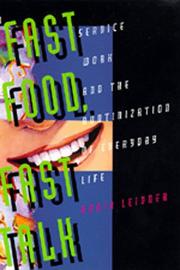
A sociologist's fieldwork inside McDonald's and an insurance sales force on the routinisation of service work — scripted interaction as a manufactured good. The best account of what the job is actually like structurally.

A year inside the pork processing industry, on line speeds, injury and immigrant labour. The direct answer to what standardised cheap meat costs the people who make it.

How routine antibiotics built the modern poultry industry that supplies the chicken sandwich and the nugget, and the resistance problem that followed. Closes the supply-chain stage with its longest-running consequence.
Who It Was Sold To, and Where It Went
BeginnerExamine fast food as a social and global institution — its particular relationship with Black America, and what happened when the model was exported into cultures with their own food traditions.
▸ Study plan for this stage
Pace: 2 to 3 weeks for about 420 pages. Chatelain's Franchise (163pp in this edition) is short and argumentatively dense — a week, read carefully. Watson's Golden Arches East (256pp) is an edited collection of ethnographies, best read one chapter a sitting over a week.
- Chatelain's argument is that fast-food franchising was promoted after the 1960s as Black capitalism and civil-rights-era economic empowerment, with federal and corporate encouragement, and that the bargain delivered ownership on terms that concentrated the risk locally.
- The book reframes the location question: the density of outlets in Black neighbourhoods is a history of policy and capital access, not of consumer preference.
- Chatelain is careful about the ambivalence — franchises funded scholarships, sponsored institutions and employed people where little else did. She does not offer a clean verdict, and you should not manufacture one.
- Watson's contributors, working in Beijing, Hong Kong, Taipei, Seoul and Tokyo, find local consumers reshaping McDonald's more than the reverse: it became a children's venue, a study hall, a place for women to sit alone.
- Golden Arches East is the standing rebuttal to simple cultural-imperialism accounts, and it is empirical rather than theoretical — the value is in the fieldwork.
- Localisation runs in both directions: the menu changes, and so does what the restaurant is socially for.
- Ending on these two books is deliberate. One shows the industry entangled with a domestic racial history, the other shows it failing to homogenise the places it entered.
- What did franchise ownership actually offer Black entrepreneurs in the 1970s, and what did it cost them?
- How does Chatelain's account change the meaning of outlet density in a given neighbourhood?
- Pick two of Watson's field sites. What did each set of consumers use McDonald's for that the company had not designed it for?
- Does Golden Arches East refute the cultural-imperialism thesis, or only complicate it? Answer with a specific chapter.
- After the whole path: is fast food best described as a food business, a real-estate business, a labour system or a cultural institution? Defend one and name what your answer cannot explain.
- Trace one claim across two authors who disagree: Schlosser's account of the industry's presence in poor neighbourhoods reads as predation; Chatelain's reads as a history of who was allowed to own capital. Set the two passages together and write out what changes when the standpoint changes.
- Take one Watson chapter and one claim from stage two about standardised operations. Write 200 words on what remained standard and what did not, using the chapter's own detail.
- Check a claim against the record: find the federal programme or corporate initiative Chatelain identifies as driving Black franchise ownership, look up its stated goals, and compare them with what she documents as the outcome.
- Write a one-page synthesis for someone starting the path tomorrow: what fast food is, in your own words, citing at least four books from these five stages by name.
- Return to Drive-Thru Dreams from stage one and reread its last chapter. Decide whether Chatelain's evidence strengthens or undermines it — the two books are more compatible than they first appear, and saying why is the test of the whole path.
Next up: The path ends with the system's social and global consequences, which is the right place to close because they are the part still being decided.

A Pulitzer-winning history of McDonald's and Black America, on franchising promoted as civil-rights-era economic empowerment and what that bargain actually delivered. The most original book on this path.

Anthropologists in Beijing, Hong Kong, Taipei, Seoul and Tokyo find that local consumers reshaped McDonald's more than it reshaped them. The right closing book, because it complicates the cultural-imperialism story the rest of the path implies.
Discussion
Keep reading
Paths that share books, cover the same subject, or open a related topic.