The Best Books to Learn Organizational Behavior, in Order
This curriculum builds a rigorous, layered understanding of organizational behavior—starting with the psychological and motivational foundations that explain individual behavior, then scaling up to teams, culture, and systemic organizational dynamics. Because the learner starts at an intermediate level, the path skips introductory textbooks and moves straight into canonical, research-backed works, progressively adding complexity and critical nuance across four stages.
The Human Core: Motivation & Individual Behavior
IntermediateUnderstand what drives people at work—intrinsic vs. extrinsic motivation, mindset, and the psychological needs that shape performance and engagement.
▸ Study plan for this stage
Pace: 8–10 weeks, ~40–50 pages/day (approximately 2–3 weeks per book, with overlap for reflection and exercises)
- Intrinsic vs. extrinsic motivation: Pink's framework of autonomy, mastery, and purpose as drivers of performance, especially in knowledge work
- Fixed vs. growth mindset: Dweck's theory of how beliefs about ability shape learning, resilience, and achievement
- The role of psychological needs: autonomy, competence, and relatedness in sustaining engagement and motivation
- Strengths-based management: Buckingham's evidence that focusing on what people do well (rather than fixing weaknesses) drives performance and retention
- The limitations of carrot-and-stick management: why traditional incentives fail for complex, creative work
- Mindset as a lever for organizational culture: how leaders can foster growth mindset to enable adaptation and innovation
- Individual differences in motivation: recognizing that people are motivated by different combinations of autonomy, mastery, purpose, and strengths
- The connection between motivation, engagement, and measurable business outcomes: retention, productivity, and innovation
- What are the three elements of intrinsic motivation according to Pink, and why do they matter more than external rewards in knowledge work?
- How does Dweck distinguish between fixed and growth mindsets, and what are the consequences of each for learning and performance?
- What does Buckingham mean by 'strengths-based management,' and how does it differ from the traditional approach of identifying and fixing weaknesses?
- How can a manager apply Pink's framework of autonomy, mastery, and purpose to redesign a role or team structure?
- What evidence does Dweck present for the claim that mindset can be changed, and what role do leaders play in fostering a growth mindset culture?
- According to Buckingham, what are the 'four keys' to managing talent, and how do they align with or challenge traditional HR practices?
- Motivation audit: Map your own work or a team member's role against Pink's three elements (autonomy, mastery, purpose). Identify which are present and which are missing, then propose one concrete change to strengthen each.
- Mindset reflection journal: Over 2 weeks, document moments when you or a colleague exhibited fixed vs. growth mindset. Analyze the triggers and outcomes, then practice reframing one fixed-mindset belief into a growth-oriented one.
- Strengths inventory: Using Buckingham's framework, list 5–7 strengths for yourself or a direct report. For each, identify a current role or project where it could be leveraged more fully, and propose a small experiment to test it.
- Manager conversation simulation: Role-play a feedback conversation using Dweck's growth mindset language (effort, process, learning) instead of fixed-mindset language (talent, innate ability). Record or write up the differences you notice.
- Organizational policy audit: Review one HR or management policy (hiring, performance reviews, incentives) through the lens of Pink, Dweck, and Buckingham. Identify misalignments with intrinsic motivation, growth mindset, or strengths-based approaches, and propose revisions.
- Case study application: Take a real or hypothetical scenario of low engagement or high turnover. Diagnose it using all three frameworks (motivation gaps, mindset barriers, underutilized strengths) and design a multi-lever intervention.
Next up: This stage establishes the psychological and motivational foundations of individual behavior, preparing you to explore how these dynamics play out in teams, cultures, and organizational systems—where alignment, conflict, and collective identity emerge.
A compelling, evidence-based introduction to intrinsic motivation that reframes why people work hard. It establishes the vocabulary of autonomy, mastery, and purpose that recurs throughout the field.
Dweck's growth vs. fixed mindset framework is foundational for understanding how individuals respond to challenge, feedback, and failure—critical context before studying teams and culture.

Grounded in Gallup's massive employee dataset, this book bridges individual motivation to managerial practice, showing how great managers unlock talent differently—a natural bridge to the team stage.
Team Dynamics: How Groups Really Work
IntermediateUnderstand the conditions that make teams effective or dysfunctional, including trust, conflict, psychological safety, and collective intelligence.
▸ Study plan for this stage
Pace: 4–5 weeks, ~40–50 pages/day (approximately 280–350 pages total across both books)
- The five dysfunctions model: absence of trust, fear of conflict, lack of commitment, avoidance of accountability, and inattention to results
- Trust as the foundation of team effectiveness—how vulnerability-based trust differs from competence-based trust
- Psychological safety as the prerequisite for teaming and collective learning in dynamic environments
- Healthy conflict and debate as essential to team performance, not a sign of dysfunction
- Collective intelligence and how teams learn together through iterative teaming, especially in uncertain or novel situations
- The role of interdependence, shared purpose, and clear accountability in team cohesion
- How team assessment and reflection create awareness and drive behavioral change
- Teaming as an ongoing process of collaboration and learning, not a fixed state
- What are the five dysfunctions of a team according to Lencioni, and how do they build on each other in a cascading pattern?
- How does Lencioni distinguish between vulnerability-based trust and competence-based trust, and why is the former critical for team effectiveness?
- What is psychological safety according to Edmondson, and how does it enable teams to learn and adapt in uncertain environments?
- Why does Edmondson argue that conflict and productive disagreement are necessary for high-performing teams, and how does this relate to Lencioni's dysfunction model?
- How can a team use the Five Dysfunctions assessment to diagnose its own problems and create a targeted improvement plan?
- What is the difference between teaming as a process versus team as a fixed entity, and why does this distinction matter for organizational learning?
- Complete the Five Dysfunctions Team Assessment (included in Lencioni's book) for a team you are part of or familiar with; identify which dysfunction is most acute and trace its root cause
- Conduct a vulnerability audit: identify one area where you or your team leader could model vulnerability or admit a mistake; practice doing so in a low-stakes setting and reflect on the response
- Map your team's interdependencies: create a visual diagram showing who depends on whom for what, then discuss with the team whether these dependencies are clear and whether accountability is explicit
- Run a 'conflict temperature check': ask team members to rate how comfortable they are with healthy debate on a scale of 1–10, then facilitate one structured disagreement on a real issue using ground rules (e.g., focus on ideas, not people)
- Design a team learning ritual: based on Edmondson's teaming principles, create a 15–30 minute weekly or bi-weekly reflection session where the team discusses what they learned, what surprised them, and what they'll do differently
- Interview a high-performing team leader about how they build trust and psychological safety; compare their practices to Lencioni's and Edmondson's frameworks
Next up: This stage establishes the foundational conditions for team effectiveness (trust, psychological safety, healthy conflict); the next stage will likely build on these conditions to explore how teams make decisions, solve problems, and drive organizational change at scale.
A widely-used model for diagnosing team failure. Its narrative format makes the concepts immediately applicable, and it sets up the vocabulary of trust and accountability needed for deeper reading.

Edmondson's research on psychological safety and dynamic teaming is the most rigorous academic treatment of how teams learn and collaborate under uncertainty—essential for understanding modern organizations.
Organizational Culture & Power
IntermediateGrasp how culture is formed, sustained, and changed, and how power, politics, and leadership shape the invisible rules people actually follow inside organizations.
▸ Study plan for this stage
Pace: 8–10 weeks, ~25–30 pages/day. Start with Schein's foundational framework (weeks 1–5, ~4–5 weeks for 300+ pages), then move to Kegan's applied model (weeks 6–10, ~3–4 weeks for 300+ pages). Build in 1 week for integration and reflection.
- Schein's three levels of culture: artifacts, espoused values, and basic underlying assumptions—and how to diagnose which level is driving behavior
- Culture formation through founder assumptions, critical incidents, and organizational learning; how culture becomes embedded and self-perpetuating
- The relationship between organizational culture and leadership: leaders both shape and are constrained by culture
- Culture change mechanisms: unfreezing, moving, and refreezing; why culture is resistant to change and what actually works
- Kegan's developmental model: how individuals grow through stages and how organizations can intentionally cultivate adult development
- The concept of 'immunity to change' and how organizational systems often unconsciously block the very growth they claim to want
- Psychological safety and vulnerability as prerequisites for cultural transformation and collective learning
- Power, politics, and informal norms: the gap between espoused culture and the actual culture people navigate daily
- What are Schein's three levels of organizational culture, and why is it difficult to access and change the deepest level?
- How do founders' assumptions become embedded in organizational culture, and what role do critical incidents play in reinforcing or shifting culture?
- What is the relationship between organizational culture and leadership? Can a leader change culture unilaterally, and if not, why?
- What does Kegan mean by 'immunity to change,' and how does this concept explain why well-intentioned organizational initiatives often fail?
- How can organizations intentionally cultivate adult development, and what conditions (psychological safety, vulnerability, etc.) must be in place?
- What is the difference between espoused values and actual culture, and how do informal power dynamics and politics maintain this gap?
- Artifact audit: Spend a day in an organization (your workplace, a client site, or even a university department) and document artifacts (physical space, rituals, language, stories, dress codes). Then infer the espoused values and basic assumptions. Write a 2–3 page diagnostic.
- Culture interview: Interview 3–5 people from the same organization at different levels (e.g., new hire, mid-level, senior leader) about 'how things really work here' and 'what happens when someone breaks the rules.' Identify where espoused values diverge from actual culture.
- Critical incident analysis: Identify a moment in an organization's history when culture visibly shifted (a merger, leadership change, crisis, etc.). Map how Schein's unfreezing-moving-refreezing model played out.
- Immunity to change mapping: Pick a real organizational goal (e.g., 'become more innovative' or 'improve psychological safety'). Use Kegan's framework to identify the hidden competing commitments and big assumptions blocking progress.
- Developmental conversation practice: Conduct a 30–45 minute conversation with a colleague or peer using Kegan's developmental listening approach—asking questions that invite reflection on their own growth edge rather than offering advice.
- Culture change proposal: Design a realistic 6–12 month culture change initiative for an organization you know, grounding it in Schein's change model and Kegan's developmental principles. Include how you'd unfreeze, what you'd move, and how you'd refreeze.
Next up: This stage equips you to see organizations as living systems shaped by invisible cultural forces and human development—preparing you to examine how strategy, structure, and systems must align with culture, and how to navigate organizational change as a leader or change agent.
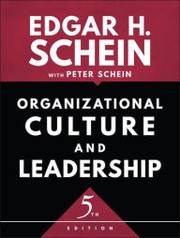
The definitive scholarly text on culture—Schein's three-level model (artifacts, espoused values, assumptions) is the standard framework used by researchers and practitioners alike. Read this before any other culture book.

Extends the culture conversation into developmental theory, showing how organizations can be designed to grow people's capacity—a sophisticated counterpoint to Schein's descriptive model.
Systems, Change & the Organization as a Whole
ExpertSynthesize individual, team, and cultural dynamics into a systems-level view of how organizations learn, resist change, and can be deliberately redesigned.
▸ Study plan for this stage
Pace: 8–10 weeks, ~40–50 pages/day. Start with "The Fifth Discipline" (4–5 weeks, ~30 pages/day), then move to "Thinking in Systems" (4–5 weeks, ~40–50 pages/day). Build in 1–2 weeks for integration and reflection exercises.
- Systems thinking as a discipline: moving from linear cause-effect to circular, feedback-driven understanding of organizational behavior
- The five disciplines of learning organizations: personal mastery, mental models, shared vision, team learning, and systems thinking as the integrating framework
- Reinforcing and balancing feedback loops: how organizations amplify or dampen change through system structure, not just individual effort
- Delays and non-linearity: why organizational change takes time and why intuitive solutions often fail or backfire
- Leverage points and system boundaries: identifying where small interventions create disproportionate impact versus where effort is wasted
- Archetypes and patterns: recognizing recurring system structures (e.g., shifting the burden, limits to growth) that repeat across organizations
- The learning organization vision: how deliberate redesign of mental models, structures, and feedback systems enables organizations to adapt and thrive
- Resistance to change as a system property: understanding how organizational structure, incentives, and defensive routines perpetuate the status quo
- What is systems thinking, and how does it differ from traditional linear problem-solving in organizational contexts?
- Explain the five disciplines in 'The Fifth Discipline' and how they work together to create a learning organization.
- Describe a reinforcing feedback loop and a balancing feedback loop in an organization you know; what outcomes do they produce?
- Why do delays in feedback and non-linear relationships make organizational change counterintuitive and difficult to manage?
- What are leverage points in a system, and how do you identify them? Give an example from an organizational archetype (e.g., shifting the burden, limits to growth).
- How can mental models and shared vision either enable or block organizational learning and change?
- Map a current or past organizational challenge as a causal loop diagram: identify reinforcing and balancing loops, delays, and feedback structures. Compare your intuitive solution to what the system structure suggests.
- Conduct a 'five disciplines audit' of an organization (real or case study): assess the maturity of personal mastery, mental models, shared vision, team learning, and systems thinking. Identify the biggest gap and design one intervention.
- Identify an organizational archetype from Meadows (e.g., shifting the burden, limits to growth, success to the successful) in a real system. Trace how the structure creates the pattern and propose a high-leverage intervention.
- Interview 3–5 people in an organization about a recent change initiative. Analyze their mental models and defensive routines. How do these explain resistance or slow adoption?
- Create a stock-and-flow diagram for a key organizational metric (e.g., employee engagement, customer retention, innovation pipeline). Identify the delays and feedback loops that shape its behavior over time.
- Design a 'learning lab' or pilot intervention in an organization: apply one discipline or leverage point from the books. Document assumptions, measure outcomes, and reflect on system dynamics that emerged.
Next up: This stage equips you to see organizations as dynamic, interconnected systems; the next stage will deepen your ability to diagnose and intervene in specific organizational subsystems—such as power structures, decision-making processes, and cultural change mechanisms—with precision and awareness of unintended consequences.

Senge's systems-thinking framework ties together all prior concepts—motivation, team learning, and culture—into a unified theory of the learning organization. Best read after the earlier stages to fully appreciate its synthesis.

A rigorous primer on systems dynamics that sharpens the analytical tools introduced by Senge, enabling the reader to model feedback loops, unintended consequences, and leverage points in real organizations.
Discussion
Keep reading
Paths that share books, cover the same subject, or open a related topic.