Systems thinking: see how everything connects
This curriculum builds systems thinking from the ground up — starting with vivid mental models and intuition, moving through rigorous frameworks, and culminating in advanced applications to organizations and global complexity. Each stage equips the reader with the vocabulary and conceptual tools needed to absorb the next, creating a genuine spiral of deepening understanding.
Foundations: Seeing the World as Systems
BeginnerDevelop an intuitive feel for feedback loops, unintended consequences, and why simple cause-and-effect thinking fails us in a complex world.
▸ Study plan for this stage
Pace: 8–10 weeks total: Weeks 1–5 for "Thinking in Systems" (~25–30 pages/day, including re-reading key diagrams and stock-and-flow sections); Weeks 6–10 for "The Fifth Discipline" (~20–25 pages/day, pausing to journal on each of Senge's five disciplines as they appear).
- Stocks and flows: understanding that stocks are the accumulations (water in a tub, money in an account, trust in a relationship) and flows are the rates that change them — the fundamental building blocks Meadows uses throughout 'Thinking in Systems'
- Feedback loops — reinforcing (R) vs. balancing (B): reinforcing loops amplify change (compound interest, population growth), while balancing loops seek a goal or equilibrium (a thermostat, predator-prey dynamics), as detailed in Meadows' early chapters
- System archetypes and unintended consequences: recurring loop structures — 'Limits to Growth,' 'Shifting the Burden,' 'Tragedy of the Commons' — that Meadows catalogs to explain why well-intentioned interventions so often backfire
- Delays and oscillation: time lags between an action and its effect cause overshoot and instability; Meadows illustrates this with commodity cycles and Senge reinforces it with the 'Beer Game' in 'The Fifth Discipline'
- Leverage points: Meadows' hierarchy of places to intervene in a system, from least effective (changing numbers/parameters) to most powerful (changing the goals, paradigms, or mindset that drive the system)
- The Fifth Discipline's five disciplines: Personal Mastery, Mental Models, Shared Vision, Team Learning, and Systems Thinking — with Systems Thinking as the integrating 'fifth discipline' that makes the other four coherent
- Mental models as invisible drivers: Senge argues that our unexamined assumptions about how the world works are themselves system structures; surfacing and testing them is a core systems-thinking skill
- The learning organization: Senge's vision of organizations that continuously expand their capacity to create results, built on the premise that linear, event-level thinking must be replaced with systemic, pattern-level thinking
- After reading Meadows, can you draw a causal-loop diagram for a real situation in your life (e.g., stress → sleep loss → reduced productivity → more stress) and correctly label every loop as reinforcing or balancing?
- Meadows argues that 'the behavior of a system cannot be known just by knowing the elements of that system' — what does she mean, and can you give two examples from the book where structure drives behavior in a counterintuitive way?
- What is a leverage point, and why does Meadows warn that pushing hard on low-leverage points (like changing numbers) is often not only ineffective but can make things worse?
- Senge introduces the 'Beer Game' to demonstrate how intelligent, well-meaning people create system-wide crises through local, linear decision-making — what specific system structure (delays + ordering loops) causes the bullwhip effect, and what would a systems thinker do differently?
- How do Senge's 'Mental Models' and Meadows' concept of 'paradigms as leverage points' reinforce each other? What shared claim are both authors making about the deepest source of systemic dysfunction?
- Both books warn against 'event-level' or 'reactive' thinking. Using one example from each book, explain the difference between seeing an event, seeing a pattern of behavior over time, and seeing the underlying system structure that generates both.
- Stock-and-flow mapping (Meadows, Chapters 1–3): Pick one real system you interact with daily (your energy levels, a project deadline, a household budget). Draw it as a stock-and-flow diagram on paper — label the stock, the inflows, the outflows, and any feedback loops. Redraw it after finishing the book to see how your model evolved.
- Loop labeling journal (Meadows, Chapters 2–4): Each day for one week, identify one reinforcing loop and one balancing loop you observe in the news, at work, or at home. Write two to three sentences explaining the structure and predicting what will happen if the loop is left unchecked.
- Play the Beer Game (Senge, Chapter 3): Run the simulation with a group (free versions exist online, e.g., the MIT Sloan Beer Game) or simulate it solo with index cards. Afterward, map the experience onto Senge's analysis — identify the delays, the local decision rules, and the moment the group shifted from event-thinking to systems-thinking.
- Archetype recognition exercise (Meadows, Chapter 5 + Senge, Chapter 6): Choose one system archetype from Meadows (e.g., 'Shifting the Burden') and find a real-world example from your own organization, community, or a current news story. Write a one-page analysis: draw the loops, name the symptomatic fix, name the fundamental solution, and explain why the fix undermines the solution over time.
- Mental models audit (Senge, Chapters 10–11): List five assumptions you hold about a system you work within (a team, a market, a family dynamic). For each, ask: 'What evidence would prove this assumption wrong?' Then identify which assumptions, if changed, would most shift your behavior — this is Senge's discipline of surfacing mental models in practice.
- Leverage-point intervention design (Meadows, Chapter 6): Take the stock-and-flow diagram you built in Exercise 1. Using Meadows' 12 leverage points as a checklist, identify the highest-leverage intervention available to you. Write a short memo (half a page) explaining why higher-leverage points are harder to act on politically and socially, drawing on at least one example from either book.
Next up: By internalizing stocks, flows, feedback loops, and mental models from Meadows and Senge, the reader has the structural vocabulary and intuitive feel needed to tackle more advanced or domain-specific systems literature — where these foundational concepts are assumed and applied to complex real-world challenges at scale.

The single most essential primer on systems thinking — introduces stocks, flows, feedback loops, and archetypes with clarity and warmth. Start here; everything else builds on this vocabulary.

Translates systems thinking into organizational life, introducing the 'learning organization' and classic system archetypes like 'fixes that fail.' Reads naturally after Meadows by showing the concepts in human and workplace contexts.
Mental Models: How We Misread Complexity
BeginnerUnderstand why human intuition is poorly wired for systems, and build a broader toolkit of mental models that complement systems thinking.
▸ Study plan for this stage
Pace: 6–8 weeks total: Weeks 1–4 cover "The Art of Systems Thinking" (~20–25 pages/day, 4–5 days/week); Weeks 5–8 cover "The Logic of Failure" (~15–20 pages/day, 4–5 days/week — slower pace to allow reflection on Dörner's dense case studies and simulations).
- Feedback loops: how reinforcing (positive) and balancing (negative) loops drive system behavior over time, as introduced in O'Connor's foundational framework
- Stocks and flows: the distinction between accumulations and the rates that change them, and why this gap confuses intuitive thinkers
- System archetypes: recurring structural patterns (e.g., 'fixes that fail', 'limits to growth') that O'Connor uses to show how the same dynamics appear across wildly different contexts
- Mental models as filters: O'Connor's argument that our internal maps of the world are always incomplete, and that updating them is a core systems-thinking skill
- Time delays and non-linearity: why cause and effect are often separated in time and space, making intuitive diagnosis unreliable
- Dörner's 'linear causality' bias: the human tendency to assume one cause → one effect, which catastrophically fails in complex, interconnected systems
- Side-effect blindness: Dörner's finding (from Tanaland and Lohhausen simulations) that poor decision-makers fixate on immediate goals and ignore ripple effects across the system
- The 'ballistic' decision style vs. iterative correction: Dörner's contrast between actors who fire-and-forget versus those who monitor feedback and adapt — and why the latter succeed in complex environments
- After reading O'Connor, can you identify and draw a reinforcing and a balancing feedback loop from your own daily life or work, labeling stocks, flows, and the delay between cause and effect?
- What does O'Connor mean when he says our mental models are 'maps, not territories'? How does this limitation explain why well-intentioned interventions so often backfire?
- In Dörner's simulation studies, what specific cognitive habits separated successful participants from those who caused system collapse — and which of those habits do you recognize in yourself?
- How does Dörner's concept of 'linear causality bias' connect to O'Connor's explanation of why feedback loops are counterintuitive? What do both authors agree is the core perceptual problem?
- Choose one of O'Connor's system archetypes (e.g., 'escalation' or 'tragedy of the commons'). Can you find a real-world example from Dörner's case studies that fits the same archetype?
- What does Dörner mean by 'repair service mentality', and how does it relate to O'Connor's warning about treating symptoms rather than underlying system structure?
- Loop mapping (O'Connor): Pick a problem you face at work or home. Draw it as a causal loop diagram — identify at least one reinforcing and one balancing loop, mark any time delays, and write one sentence explaining what the diagram reveals that your gut instinct missed.
- Archetype hunting (O'Connor): Over one week, collect three news stories or personal anecdotes. For each, identify which of O'Connor's system archetypes (if any) best describes the underlying structure. Write a short paragraph justifying your match.
- Simulation replay (Dörner): After reading each of Dörner's simulation chapters (Tanaland, Lohhausen), write a one-page 'after-action review' as if you were a participant: What decisions would you have made? Where would your linear thinking have led you astray?
- Side-effect audit (Dörner): Think of a real decision you or your organization made in the past year. List every intended effect. Then brainstorm at least five unintended second- and third-order effects. Compare your list to what actually happened.
- Mental model journaling (both books): Keep a weekly log of moments when your intuitive prediction about a situation turned out to be wrong. For each entry, use vocabulary from O'Connor and Dörner to diagnose *why* your mental model failed (e.g., ignored a feedback loop, assumed linear causality, overlooked a time delay).
- Cross-book synthesis (both books): Write a one-page essay answering: 'What is the single most important cognitive habit a systems thinker must break, and what should replace it?' Draw evidence from at least one specific passage or example in each book.
Next up: By internalizing why human intuition fails in complex systems — through O'Connor's structural vocabulary and Dörner's empirical evidence — the reader is now primed to move from diagnosis to methodology, ready to engage with more formal systems thinking tools and frameworks that translate these insights into structured analytical practice.

A practical, accessible bridge between the theory of Meadows and everyday decision-making — reinforces core concepts with exercises and real-world examples before moving to harder material.

A psychologist's landmark study of how intelligent people make catastrophic decisions in complex systems. Provides compelling empirical grounding for why interventions backfire, deepening the 'why' behind systems thinking.
Going Deeper: Dynamics, Leverage, and Modeling
IntermediateMove from qualitative understanding to semi-quantitative reasoning — learn to map system behavior over time, identify leverage points, and understand dynamic complexity.
▸ Study plan for this stage
Pace: 10–13 weeks total. Weeks 1–10: "Business Dynamics" by Sterman (~50–60 pages/day, 4–5 days/week — focus on Parts I–III deeply, skim advanced simulation chapters on first pass). Weeks 11–13: "Leverage Points" by Meadows (~15–20 pages/day; it is a short essay, so read it twice — once quickly for overvi
- Causal Loop Diagrams (CLDs): distinguishing reinforcing (positive) and balancing (negative) feedback loops and their roles in growth, oscillation, and stability
- Stock-and-Flow Diagrams: translating qualitative CLDs into semi-quantitative structures with accumulations (stocks) and rates (flows)
- Reference Mode Diagrams: plotting system behavior over time (BOT graphs) to anchor model purpose and scope before building structure
- Dynamic complexity vs. detail complexity: why systems surprise us through delays, nonlinearities, and feedback rather than sheer number of parts
- Archetypes of system behavior: exponential growth, goal-seeking, oscillation, S-shaped growth, overshoot-and-collapse — and the feedback structures that generate them
- Delays and their destabilizing effects: how information, material, and perception delays create oscillation and policy resistance
- Leverage Points (Meadows): the 12-level hierarchy from least to most effective — numbers, buffers, flows, feedback loops, information flows, rules, goals, paradigms, and the power to change paradigms
- Policy resistance and unintended consequences: why high-leverage interventions are often counterintuitive and why pushing harder on familiar solutions can make things worse
- Given a real-world problem (e.g., supply chain bullwhip effect or urban traffic congestion), can you draw a stock-and-flow diagram that captures the key accumulations, rates, and feedback loops — and sketch the expected behavior-over-time graph?
- What is the difference between a reinforcing and a balancing feedback loop, and how does each contribute to the canonical behavior modes described in Business Dynamics (exponential growth, oscillation, S-shaped growth)?
- How do delays — material, information, or perception — alter the behavior of a balancing loop, and what does Sterman's treatment of the inventory management model illustrate about this?
- Using Meadows' leverage point hierarchy, where would 'adding a new performance metric to a company dashboard' fall, and why is it less powerful than 'changing the goal the system is trying to achieve'?
- What does Sterman mean by 'policy resistance,' and how does the concept connect to Meadows' warning that intervening at low leverage points (e.g., tweaking numbers or flow rates) rarely produces lasting change?
- How would you use a reference mode diagram to scope and validate a system dynamics model before committing to a full stock-and-flow structure?
- CLD-to-SFD translation drill: Pick one of Sterman's worked examples (e.g., the commodity cycle or the epidemic model). First redraw the causal loop diagram from memory, then convert it into a full stock-and-flow diagram, labeling every stock, flow, auxiliary variable, and connector. Check against the book.
- Behavior-over-time journaling: Choose a real system you interact with (personal finances, a team's workload, a local ecosystem). Sketch a reference mode diagram showing how 2–3 key variables have behaved over the past 1–5 years. Then hypothesize which feedback structure from Business Dynamics best explains that pattern.
- Delay sensitivity thought experiment: Using the inventory-management or production-distribution system in Sterman, manually trace what happens to oscillation amplitude and period as you mentally 'lengthen' each delay in the system. Write a one-page narrative predicting the behavior change before checking Sterman's simulation results.
- Leverage point audit: Select a real policy or organizational intervention you know well (a workplace initiative, a public health campaign, a government regulation). Map it onto Meadows' 12 leverage points. Write a 300-word critique arguing whether it targets a high- or low-leverage point, and propose one higher-leverage alternative.
- Archetype recognition log: Over two weeks, collect 5 news stories or personal observations that exemplify a system archetype from Business Dynamics (e.g., 'Fixes that Fail,' 'Limits to Growth,' 'Escalation'). For each, draw the minimal CLD and annotate which loop is dominant and why.
- Integrated model critique: After finishing both books, choose one of Sterman's policy simulation results and re-evaluate it through Meadows' leverage point lens. Write a one-page memo: Does Sterman's recommended intervention target a high leverage point? What paradigm-level change, if any, would be needed for a more durable solution?
Next up: By mastering stock-and-flow modeling in Sterman and internalizing Meadows' leverage hierarchy, the reader has the structural and strategic vocabulary needed to tackle advanced topics — such as formal simulation, organizational learning, and large-scale system design — that characterize the next stage of the curriculum.
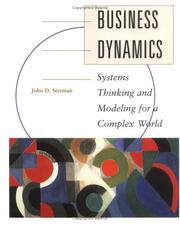
The definitive textbook on system dynamics, covering causal loop diagrams, stock-and-flow modeling, and simulation. Challenging but rewarding — best tackled after the intuition from earlier stages is solid.

Meadows' famous essay expanded — a concise, profound guide to where and how to intervene in a system for maximum effect. Pairs perfectly with Sterman by answering the 'so what do we do?' question.
Applications: Organizations, Society, and Global Systems
IntermediateApply systems thinking to real-world domains — corporate strategy, ecology, economics, and large-scale social change — and see how the frameworks predict and explain real outcomes.
▸ Study plan for this stage
Pace: 6–8 weeks total: Weeks 1–5 on "Limits to Growth" (~25–30 pages/day, including time to study the model runs and graphs carefully); Weeks 6–8 on "The Systems Thinker" (~20–25 pages/day, with reflection days built in after each chapter to apply concepts to a chosen real-world domain).
- Exponential growth vs. carrying capacity: how exponential growth in population and industrial output collides with finite resource stocks, as modeled in Limits to Growth
- Overshoot and collapse: the dynamic where a system exceeds its sustainable limits before feedback can correct it, illustrated by Limits to Growth's World3 model scenarios
- Stocks, flows, and feedback loops in global systems: how Limits to Growth operationalizes food, population, resources, pollution, and industrial output as interacting stocks and flows
- Scenario thinking and model uncertainty: using multiple plausible futures (standard run, stabilized world, etc.) rather than single-point predictions, as practiced throughout Limits to Growth
- Leverage points in organizations and society: Rutherford's application of Meadows-style leverage-point thinking to corporate strategy, team dynamics, and institutional change
- Mental models and system archetypes in practice: how The Systems Thinker shows recurring patterns (escalation, fixes that fail, tragedy of the commons) playing out in business and social contexts
- Delays and unintended consequences: how time lags between action and feedback cause policy resistance and counterintuitive outcomes in large-scale systems, addressed in both books
- Sustainable systems design: principles for restructuring organizational and global systems so that balancing feedback loops keep key variables within safe bounds
- According to Limits to Growth, what are the five major variables in the World3 model, and how do their interactions produce the 'standard run' overshoot-and-collapse scenario?
- What distinguishes the 'stabilized world' scenarios in Limits to Growth from the collapse scenarios, and what policy levers does the model suggest are most effective?
- How does The Systems Thinker translate abstract archetypes like 'fixes that fail' or 'escalation' into diagnosable patterns within organizations, and what interventions does it recommend?
- Both books address delays in feedback loops — how do Limits to Growth and The Systems Thinker each explain why delays make systems harder to manage, and what strategies do they offer?
- Using the frameworks from both books, how would you diagnose a real-world case of institutional policy resistance (e.g., a company repeatedly cutting costs only to lose market share)?
- What are the ethical and political implications raised by Limits to Growth's conclusion that voluntary limits on growth are necessary, and how does The Systems Thinker's organizational lens complement or complicate that argument?
- World3 scenario mapping: After finishing Limits to Growth, draw a causal loop diagram (by hand or digitally) capturing at least three of the five major variable clusters and label every feedback loop as reinforcing or balancing. Annotate which loops dominate in the 'standard run' vs. the 'stabilized world' scenario.
- Scenario narrative writing: Choose one of the alternative scenarios from Limits to Growth (e.g., doubled resources, pollution controls) and write a 1–2 page narrative explaining in plain language why that scenario plays out differently — focusing on which feedback loops change and when.
- Archetype hunting in the news: While reading The Systems Thinker, keep a running log of 5 real news stories (corporate, political, or ecological) and label each with the system archetype it best exemplifies (e.g., 'tragedy of the commons' for overfishing). Write two sentences explaining the match.
- Organizational system map: Pick an organization you belong to or know well. Using The Systems Thinker's frameworks, draw a stock-and-flow diagram of one key organizational challenge (e.g., employee burnout, budget cycles). Identify at least one leverage point and propose a concrete intervention.
- Cross-book synthesis essay: Write a 500-word essay arguing whether the leverage points needed to avoid the Limits to Growth collapse scenarios are primarily technical, political, or cultural — drawing specific evidence from both books.
- Delay audit: Identify a decision made in your workplace, community, or a historical case where a significant time delay between action and feedback led to an unintended consequence. Map the delay using a causal loop diagram and annotate what information was missing and when. Share your diagram with a peer for critique.
Next up: Mastering how systems thinking explains outcomes at the organizational and global scale — including overshoot, archetypes, and leverage points — equips the reader to move into more advanced or specialized territory, such as systems dynamics modeling, complexity theory, or domain-specific applications like urban planning or public health, where these same structural patterns appear with greater mat

The landmark application of system dynamics to global resource and population systems. Demonstrates the power of modeling at civilizational scale and shows how feedback loops drive long-run collapse or sustainability.

A focused, practical synthesis that consolidates the learner's toolkit and shows how to apply systems thinking to everyday decisions, organizations, and personal life — a useful consolidating read before the advanced stage.
Mastery: Complexity, Emergence, and Adaptive Systems
ExpertExtend systems thinking into complexity science — understand emergence, adaptation, and self-organization — and develop a sophisticated worldview for navigating irreducible uncertainty.
▸ Study plan for this stage
Pace: 8–10 weeks total: Weeks 1–5 cover "Complexity" by Waldrop (~25–30 pages/day, reading narratively as it is written in a story-driven style); Weeks 6–10 cover "Thinking in Complexity" by Mainzer (~15–20 pages/day, slower pace due to its dense, formal, and interdisciplinary depth). Reserve the final 3–
- Emergence: how macro-level patterns and behaviors arise from micro-level interactions without central control, as illustrated through the Santa Fe Institute narratives in Waldrop's 'Complexity'
- Self-organization: the spontaneous formation of ordered structures in complex systems — from ant colonies to economies — explored in both Waldrop and Mainzer
- Adaptive agents and co-evolution: how agents in a complex adaptive system (CAS) learn, adapt, and co-evolve with their environment, central to Waldrop's accounts of Holland's classifier systems and Arthur's economic models
- Edge of chaos: the productive tension between order and disorder where complex systems exhibit the richest behavior, a recurring theme in Waldrop's treatment of Langton and Kauffman's work
- Nonlinear dynamics and sensitive dependence: why small changes can cascade into large effects, and why prediction has fundamental limits, formalized in Mainzer's mathematical treatment
- Complexity in natural and social systems: Mainzer's cross-domain application of complexity science to physics, biology, cognitive science, economics, and society — demonstrating universality of complex-systems principles
- Irreducibility and limits of reductionism: why complex systems cannot be fully understood by decomposing them into parts, a philosophical thread running through both books
- Modeling complex systems: agent-based models, cellular automata, fitness landscapes, and computational simulations as tools for studying emergence and adaptation (Waldrop's narrative on the Santa Fe approach; Mainzer's formal frameworks)
- After reading Waldrop's 'Complexity', can you explain what a Complex Adaptive System is, name its defining properties, and give two concrete examples from the book drawn from different domains (e.g., economics and biology)?
- How does Waldrop use the stories of researchers like John Holland, Stuart Kauffman, and W. Brian Arthur to illustrate the shift from linear, reductionist science to complexity science — and what institutional role does the Santa Fe Institute play in that narrative?
- What does Mainzer mean by 'thinking in complexity', and how does he argue that nonlinear dynamics and self-organization apply across disciplines as different as quantum physics, neuroscience, and social systems?
- How do the concepts of the 'edge of chaos' and fitness landscapes (from Waldrop/Kauffman) relate to Mainzer's treatment of phase transitions and bifurcations — and what do they collectively say about how systems change?
- In what ways do both books challenge the assumption that more data and better models will eventually allow us to predict and control complex systems — and what alternative epistemic stance do they propose?
- How would you use the frameworks from both books to analyze a real-world system of your choice (e.g., a supply chain, an ecosystem, or a city) — identifying its agents, feedback loops, emergent properties, and adaptive dynamics?
- Emergence mapping: After finishing Waldrop's 'Complexity', choose one system described in the book (e.g., the economy as modeled by Arthur, or Kauffman's genetic networks). Draw a two-level diagram — micro agents/rules at the bottom, emergent macro properties at the top — and annotate the feedback loops that connect them.
- Edge-of-chaos journaling: As you read Waldrop, keep a running log of every example where a system is described as being 'at the edge of chaos.' After finishing the book, write a one-page synthesis: what conditions push systems toward that zone, and what happens when they fall to either side?
- Cross-domain complexity matrix: After completing Mainzer's 'Thinking in Complexity', build a table with domains (physics, biology, economics, cognition, society) as rows and complexity concepts (self-organization, nonlinearity, emergence, adaptation) as columns. Fill each cell with a specific example from Mainzer's text, then identify which patterns repeat across domains.
- Agent-based model sketch: Using the conceptual vocabulary from both books, design (on paper or in a tool like NetLogo) a simple agent-based model of a system you know well. Define: who the agents are, what rules they follow, what interactions occur, and what emergent behavior you hypothesize. Run or mentally simulate it and compare results to your prediction.
- Reductionism vs. complexity debate: Write a structured 500-word argument — first steelmanning the reductionist position, then rebutting it using specific evidence and reasoning from both Waldrop and Mainzer. Conclude with your own synthesis of where reductionism remains useful and where complexity thinking must take over.
- Real-world CAS audit: Select a real organization, ecosystem, or social phenomenon you have direct experience with. Apply the CAS diagnostic from both books: identify adaptive agents, feedback loops, emergent properties, fitness landscape pressures, and signs of self-organization or edge-of-chaos dynamics. Write a 1–2 page report and note where the frameworks illuminate — and where they fall short.
Next up: By internalizing emergence, adaptation, and irreducible uncertainty through Waldrop and Mainzer, the reader has built the conceptual vocabulary and epistemic humility needed to engage with applied and philosophical extensions of systems thinking — such as resilience theory, systems leadership, or the ethics of intervening in complex adaptive systems.

A narrative account of the birth of complexity science at the Santa Fe Institute — bridges systems dynamics with agent-based thinking, emergence, and adaptive systems in an engaging, story-driven way.

A rigorous philosophical and scientific treatment of complex systems across physics, biology, economics, and society — the capstone read that unifies everything and challenges the reader to think at the highest level of abstraction.
Discussion
Keep reading
Paths that share books, cover the same subject, or open a related topic.