Best Books on the Oil and Gas Industry, in Reading Order
Oil is simultaneously a physical business, a financial market and a foreign policy, and most books cover only one of the three. This path takes them in that order: first the barrels and refineries, so the jargon stops being an obstacle, then the century of history that produced today's companies and cartels, then the corporations and commodity traders who move the physical crude. The last two stages cover the shale revolution that rewrote the industry's economics and the petro-politics that follows the money, with the boosters and the critics read against each other rather than separately.
The business, technically
BeginnerUnderstand upstream, midstream and downstream — reserves, drilling, refining margins, crude grades, benchmarks and futures — well enough to read industry coverage without a glossary
▸ Study plan for this stage
Pace: Three to four weeks for 440 pages, read as a textbook rather than as a narrative. Oil 101 is organised in blocks — history, geology and exploration, drilling and production, transport, refining, products and specifications, then pricing and trading — and the last block is the one most readers skip a
- Upstream, midstream and downstream as the industry's own division of labour, and why a company's economics depend entirely on which segments it sits in
- Reserves classification — proved, probable, possible — and the fact that a reserve figure is a financial and regulatory statement as much as a geological one
- Crude quality: API gravity and sulphur content, so that light sweet and heavy sour are prices rather than adjectives, and why a refinery is built for a specific slate
- Refining as separation and conversion — the distillation cuts, then cracking and reforming — and the crack spread as the number that actually determines a refiner's profit
- Benchmarks and differentials: Brent, WTI and Dubai, why they exist, and what it means for a physical cargo to price at a benchmark plus or minus a differential
- Futures, contango and backwardation, and how the shape of the forward curve creates or destroys the economics of storing oil
- Hedging versus speculation, and why producers, airlines and refiners are all in the futures market for different reasons
- Natural gas as a separate business with separate physics — pipelines, liquefaction, regional rather than global pricing — which is why gas markets behave nothing like crude
- Define upstream, midstream and downstream, and name a company that operates in each.
- What makes a crude light or heavy, sweet or sour, and why does a refinery care?
- What is a crack spread, and how would a refiner hedge one?
- What is the difference between contango and backwardation, and what does each imply about the value of storage?
- Why is natural gas priced regionally when crude is priced globally, and what does LNG change about that?
- Draw the barrel: sketch a distillation column and label the cuts from light ends to residue, with a rough percentage yield for each. Do it from memory afterwards.
- Look up today's Brent and WTI prices and write down the spread. Then write one paragraph explaining what that specific number is telling you about where the physical barrels are.
- Take one week of oil coverage from a business newspaper and underline every term you could not have defined before this stage. The length of the list is the measure of what the book did.
- Work out, on paper, the rough revenue from one barrel of light sweet crude split into its major products at current product prices, and compare it with the crude price. That difference is the refining business.
Next up: With the physical and financial vocabulary in place, the history stops being a parade of company names and becomes legible as an argument about how the structure you have just learned came to exist.

The rare book that explains the whole chain, from geology and drilling to refinery cuts and how oil is priced and traded. Read it first and treat it as the reference: every narrative that follows assumes this vocabulary.
The century that built the industry
IntermediateTrace oil from Standard Oil through the Seven Sisters, OPEC and the price shocks to the modern energy transition, and see why the industry's structure looks the way it does
▸ Study plan for this stage
Pace: Ten to twelve weeks for about 1,400 pages, and there is no way to make The Prize short. At 885 pages it is the single largest commitment in the path; read it in its own parts over six to eight weeks, roughly a hundred pages a week, and do not attempt it alongside anything else. The New Map (512 page
- Rockefeller and Standard Oil: the refining monopoly, the 1911 breakup, and the direct descent of Exxon, Mobil, Chevron and Amoco from the pieces
- Churchill's decision to convert the Royal Navy from coal to oil before the First World War, which is where oil becomes a strategic rather than a commercial question
- The interwar cartel arrangements — the Red Line Agreement and the Achnacarry as-is agreement of 1928 — as the industry's own answer to chronic oversupply
- The Seven Sisters as a functioning system of concessions and quotas, and the concession terms that producing states later found intolerable
- The postwar Middle Eastern discoveries, above all Ghawar, and what a single field of that size does to the world's cost curve
- Mossadegh, nationalisation and 1953 as the template for the confrontation between producing states and international companies
- OPEC from 1960, the 1973 embargo, the 1979 shock and the 1986 collapse — and Yergin's argument that price shocks are always as much about spare capacity as about politics
- The New Map's update: American shale turning the United States into the largest producer, the rise of natural gas and LNG, Russian pipeline politics, Chinese energy strategy, and the transition as a geopolitical rather than merely environmental question
- How does the modern supermajor line-up descend from the 1911 Standard Oil breakup? Name the successors.
- What did the Achnacarry agreement try to do, and what problem was it responding to?
- Why did the 1973 embargo produce the price effect it did, when embargoes usually fail? What was true of the market that year?
- Yergin argues 1986 mattered as much as 1973. What happened, and why does he think so?
- In The New Map, what does Yergin identify as the main geopolitical consequence of American shale, and does the argument still hold?
- Build a single timeline from 1859 to the present marking every event Yergin treats as a turning point across both books. It is the most useful artefact you will produce in this path.
- Draw the descent chart from Standard Oil in 1911 to today's majors, including the mergers of the late 1990s. Ten minutes, and it makes the industry's structure permanently legible.
- For each of the four great price shocks, write three lines: what happened to supply, what happened to demand, and how much spare capacity existed beforehand. The pattern that emerges is Yergin's actual thesis.
- After The New Map, write 500 words on what Yergin gets right and wrong about the energy transition from the vantage of 2020. He is a self-described optimist about incumbency and it is worth marking where you disagree.
Next up: A century of history explains why the companies and cartels exist; the next stage goes inside two of them — the supermajor everyone can name and the trading houses almost nobody can.
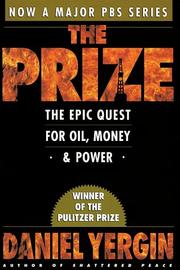
The definitive history of oil and the standard first serious book on the subject, connecting the business to two world wars and the shape of the twentieth century. Long, but nothing else replaces it.
Yergin's update on shale, the rise of natural gas, the climate transition and how they redraw the geopolitics of energy. Read it directly after The Prize to bring the same narrative to the present decade.
The companies and the traders
IntermediateUnderstand how a supermajor is actually run and how the largely invisible commodity trading houses profit from moving the physical barrels
▸ Study plan for this stage
Pace: Eight to nine weeks for well over a thousand pages. Private Empire is 704 pages of dense reporting and needs four to five weeks. The World for Sale follows — note that our catalogue holds it inside a two-book collection record bundled with Pitron's The Rare Metals War, so the listing looks odd; the
- ExxonMobil as an institution with a culture: the Operations Integrity Management System, the obsession with measurable discipline, and Coll's argument that this is what the company actually is rather than an oil business per se
- Lee Raymond and Rex Tillerson as two versions of the same job, and how the corporation's relationship with Washington changed between them
- A corporate foreign policy: Exxon's dealings in Aceh, Equatorial Guinea, Chad and Nigeria, conducted with states as a state-like actor with its own security and diplomacy
- Climate politics as a corporate operation — the funding of doubt and the internal science — and Coll's reported rather than editorialised handling of it
- The trading houses as the invisible half of the system: Vitol, Glencore, Trafigura and Cargill move the physical barrels the majors and the national companies produce
- How a trader actually makes money — arbitrage across geography, time and quality, using exactly the differentials, freight rates and curve shapes you learned in stage one
- The deal-making with regimes and rebel governments that Blas and Farchy document, and the regulatory and reputational reckoning that followed
- Marc Rich as the origin story: the invention of the spot market for crude, the trades with Iran during the hostage crisis and with apartheid South Africa, the 1983 indictment, the flight to Switzerland, and the 2001 presidential pardon
- What does Coll identify as the source of ExxonMobil's operating discipline, and where does he show it failing?
- In what concrete ways did ExxonMobil act like a state? Give two examples from the book.
- Explain how a commodity trader profits from a contango market. Use the mechanics from Oil 101.
- What did Marc Rich actually do that was indicted, and how much of it would be legal today?
- Why did the trading houses stay out of public view for so long, and what changed?
- Take one trade described in The World for Sale and reconstruct it on paper: the cargo, the origin, the destination, the price basis and where the margin came from. Doing this once converts trading from anecdote to mechanism.
- Write 300 words on the difference between how Coll and Ammann handle their subjects. Coll reports and withholds judgement; Ammann had extensive access to Rich and is often accused of sympathy. The contrast is a lesson in reading business books.
- List every country where Coll shows ExxonMobil negotiating directly with a government, and mark which negotiations the United States government was party to. The gaps are the argument of the book.
- Compare a major and a trader on one axis: capital employed, assets owned, barrels handled. The asymmetry is the reason this stage pairs them.
Next up: Both the majors and the traders were built for a world of scarce, distant oil — which is exactly the assumption the shale revolution in the next stage overturned.

A deeply reported portrait of ExxonMobil as an institution with its own foreign policy, discipline and risk culture. The best available answer to what an oil major is actually like from the inside, and reported rather than argued.

The history of the commodity traders — Vitol, Glencore, Trafigura — who buy and ship physical crude and metals, and the deals they cut with regimes. Read it after Coll: the majors are only half the system, and this is the half nobody reports on.

The biography of Marc Rich, who effectively invented the modern spot oil trade before being indicted and pardoned. The concentrated version of the previous book's argument, told through one contested career.
The shale revolution
IntermediateAssess fracking on its own terms — the technology, the wildcatters, the debt-funded economics and the environmental fight — and weigh the boosters against the sceptics
▸ Study plan for this stage
Pace: Five to six weeks for about 945 pages. The Boom (375 pages) first, in two weeks, as the even-handed account. The Frackers (432 pages) next, also two weeks, read as character-driven business journalism. Saudi America is only 138 pages and can be read in an evening — but read it last and read it slowl
- The technical combination that made shale work: horizontal drilling plus multi-stage hydraulic fracturing, neither of which was new alone, applied to source rock that was never previously considered a reservoir
- George Mitchell's decades in the Barnett Shale as the actual breakthrough, achieved by persistence and slickwater fracturing rather than by a single invention
- Why it happened in the United States first: private subsurface mineral rights, a deep service-company sector, thousands of independent operators, and an existing pipeline network
- Steep decline curves as the defining economic fact — a shale well produces most of its oil early, so the business requires continuous drilling and continuous capital
- The debt-funded treadmill McLean's book is about: negative free cash flow across the sector for years, and the question of whether shale as a class ever earned its cost of capital
- Aubrey McClendon and Chesapeake as the era's emblematic story of land acquisition, leverage and personal risk appetite
- The environmental fight in concrete terms: water use and disposal, induced seismicity, methane leakage, and what landowners living above the wells actually experienced
- Gold's balance versus Zuckerman's admiration versus McLean's scepticism — three books written from three temperaments about the same events, which is why the stage reads them in that order
- Explain horizontal drilling and hydraulic fracturing well enough that someone could repeat it back. What did Mitchell change that made it economic?
- Why did shale scale in the United States and not elsewhere, given that the geology is not unique?
- What is a shale well's decline curve, and what does its shape mean for a company's financing?
- What is McLean's core financial argument, and what would falsify it?
- Gold, Zuckerman and McLean cover overlapping ground. Where do they actually disagree about facts rather than about attitude?
- Sketch a shale well decline curve against a conventional one on the same axes. That single drawing explains most of the sector's financial behaviour.
- Take one company covered in The Frackers and look up what happened to it after 2013. Zuckerman's book was written near the top and the subsequent record is part of reading it.
- Write 200 words each stating Zuckerman's implicit case and McLean's explicit one, then a third 200 words saying which the last decade supports.
- List the environmental objections in The Boom and mark each as a resolved engineering problem, an unresolved one, or a dispute about acceptable risk. The three categories are usually collapsed in public argument.
Next up: Shale changed who produces the oil; the last stage follows the money to what oil does to the states that depend on it, including the one whose position shale most directly challenged.

The most balanced narrative of fracking, written by a Wall Street Journal reporter who covers both the engineering breakthrough and the landowners living with it. Start the stage here for the even-handed version.
The wildcatter story — Mitchell, McClendon, Hamm — and how a handful of outsiders reshaped global energy. Read it for the personalities and the risk appetite; it is admiring by temperament, which is the point of pairing it with what follows.

A short, sceptical argument that shale is a financially fragile business that has rarely earned its cost of capital. Deliberately last in the stage as the counterweight; whether the sceptics or the boosters were right is still genuinely contested.
Petro-politics
IntermediateConnect production to the states that depend on it — the resource curse, national oil companies, and the interests that shape energy policy
▸ Study plan for this stage
Pace: Four to five weeks for about 600 pages. Crude World (276 pages) is reportage organised by theme — scarcity, plunder, greed, desire — and reads in two weeks. Saudi, Inc. (320 pages) is corporate history and needs two to three weeks. Read them in that order deliberately: Maass makes the case against o
- The resource curse stated precisely: resource rents let a government fund itself without taxing citizens, which severs the fiscal link that historically produced accountability
- Dutch disease as the economic half of the mechanism — a resource boom raises the exchange rate and hollows out tradable industry
- Maass's country studies as the curse in human form: Equatorial Guinea, the Niger Delta, Venezuela, Iraq and Ecuador, reported from the places rather than from the models
- National oil companies as the dominant form of ownership worldwide — most of the world's reserves sit with NOCs, not with the majors from stage three
- Saudi Aramco's history from the 1933 concession through the gradual nationalisation of the 1970s to the 2019 listing, and Wald's argument that it is best understood as a commercial institution rather than a political instrument
- The technocratic continuity Wald emphasises — Yamani, Naimi and the professional cadre who ran the company across regime politics — which is her main evidence against a purely political reading
- Spare capacity as the actual instrument of Saudi power, connecting directly to Yergin's account of the price shocks two stages back
- The two books' disagreement as the path's closing tension: Maass sees oil as something that happens to a country, Wald sees an institution a country built, and both are describing real features of the same world
- State the resource curse mechanism in three sentences. What is the fiscal argument, and what is the political one?
- Which of Maass's country cases is the strongest evidence for the curse, and which is the weakest?
- Why do national oil companies hold most of the world's reserves, and what did the majors get in exchange for losing them?
- What is Wald's case that Aramco should be read as a company? Where does that reading strain?
- Where do Maass and Wald contradict each other, and where are they simply looking at different levels of the same system?
- Pick one oil-producing country and test the curse hypothesis against it yourself: revenue as a share of the government budget, non-oil exports, and tax receipts from citizens. The numbers are public and the exercise is decisive one way or the other.
- Write 500 words arguing that Maass overstates his case, using Wald as your evidence, then 500 arguing the reverse. Both are writable, which is the point.
- Trace one barrel from the ground to a consumer using every stage of this path: the geology and drilling from Oil 101, the concession history from Yergin, the operator from Coll, the trader from Blas and Farchy, the refining margin, the benchmark price. Two pages, and it is the exam for the whole path.
- Finish by writing your own answer to the question the path opened with — whether oil is best understood as a business, a market or a foreign policy. Name the book that most changed your mind.
Next up: This is the end of the path — the barrels, the century, the companies, the shale reversal and the politics — and the natural next step is the industry's own primary material: an annual report, a national oil company's reserve disclosure, and a week of the futures curve read with everything above behind it.
Reporting from the producing countries themselves on what oil wealth does to states and the people in them. It is the resource-curse argument in narrative form, and it is written from a clearly critical standpoint.

A business history of Saudi Aramco and the Saudi state, treating the world's most important oil company as a commercial institution rather than a symbol. It closes the path by returning to the corporate frame, and its more sympathetic reading of a national oil company is a useful check on the preceding book.
Discussion
Keep reading
Paths that share books, cover the same subject, or open a related topic.