The Best Books to Understand the Balkans
This curriculum traces Balkan history from the Ottoman foundations through nationalist fragmentation, the catastrophic Yugoslav wars, and the region's modern identity — building thematic and chronological fluency at each stage. Starting at an intermediate level, the path moves from broad regional narrative to specialized political and diplomatic depth, ensuring each book's vocabulary and frameworks prepare the reader for the next.
The Long Ottoman Shadow
IntermediateUnderstand the Ottoman imperial system, its multi-ethnic logic, and why its slow collapse set the stage for every subsequent Balkan crisis.
▸ Study plan for this stage
Pace: 8–10 weeks, ~40–50 pages/day. Begin with İnalcık (weeks 1–5, ~350 pages), then transition to Mazower (weeks 6–10, ~300 pages). Allocate 1–2 days per week for review and synthesis.
- The Ottoman millet system: how religious communities maintained internal autonomy while remaining subject to imperial authority, and why this model was fundamentally different from European nation-states
- Ottoman administrative and military structures: the devshirme system, the Janissaries, and the provincial governance hierarchy that held the empire together for centuries
- The logic of Ottoman expansion and consolidation (1300–1600): territorial acquisition, incorporation of diverse populations, and the establishment of Istanbul as the imperial center
- The concept of Ottoman decline and its causes: fiscal strain, military obsolescence, administrative rigidity, and the rise of provincial autonomy that weakened central control
- The relationship between Ottoman institutional weakness and Balkan nationalism: how the empire's inability to reform created power vacuums that nationalist movements exploited
- The long-term consequences of Ottoman rule in the Balkans: administrative boundaries, demographic patterns, religious divisions, and cultural legacies that persisted after Ottoman withdrawal
- The difference between Ottoman imperial logic (multi-ethnic, religiously plural, centralized) and the emerging European nation-state model (ethnically homogeneous, secular, competitive)
- How did the Ottoman millet system allow the empire to govern religiously and ethnically diverse populations, and what were its limitations as the empire weakened?
- What role did the devshirme system and the Janissaries play in maintaining Ottoman military and administrative dominance, and why did their effectiveness decline?
- Why was the Ottoman Empire able to expand and consolidate power from 1300–1600, and what structural factors began to undermine it in subsequent centuries?
- How did Ottoman administrative practices (taxation, provincial governance, religious autonomy) shape the territories that would later become the modern Balkan states?
- What is the relationship between Ottoman institutional decline and the rise of Balkan nationalism in the 18th and 19th centuries?
- How did the Ottoman imperial model differ fundamentally from the European nation-state model, and why was this difference crucial to understanding subsequent Balkan conflicts?
- Create a detailed organizational chart of Ottoman imperial administration (central government, provincial hierarchy, military structure) based on İnalcık's account, then annotate which elements remained functional vs. which deteriorated by the 19th century
- Map the territorial expansion of the Ottoman Empire from 1300–1600 using İnalcık's narrative; mark key conquest dates and note how each region was incorporated into the millet system
- Write a comparative analysis (2–3 pages) of how the Ottoman millet system governed a specific religious community (e.g., Orthodox Christians, Jews) versus how European nation-states governed their populations
- Trace one Balkan region (e.g., Serbia, Bulgaria, Greece) through both İnalcık and Mazower: document Ottoman administrative structures under classical rule, then track how Ottoman weakness in that region enabled nationalist movements
- Create a timeline of Ottoman institutional decline (fiscal crises, military defeats, administrative reforms) from İnalcık and Mazower, then connect each decline point to a subsequent Balkan nationalist movement
- Analyze a primary source document (e.g., Ottoman tax records, a millet charter, or a 19th-century traveler's account cited in Mazower) that illustrates either Ottoman multi-ethnic governance or its breakdown
Next up: This stage establishes why the Ottoman system's structural inability to adapt to modern state competition and nationalism made its collapse inevitable, preparing you to examine how specific Balkan nations seized independence and why their boundaries, rivalries, and internal divisions were shaped by Ottoman legacies.

The definitive scholarly introduction to Ottoman statecraft, society, and administration by the field's foremost authority — essential for understanding what the Balkans were before nationalism arrived.
A concise, elegant overview of the entire region from antiquity to the late 20th century; read second to place the Ottoman period in its full Balkan context before diving deeper.
Nationalism and the Unraveling of Empires
IntermediateGrasp how nationalist ideologies emerged, how the Great Powers exploited them, and how the Balkan Wars of 1912–13 and WWI reshaped the map.
▸ Study plan for this stage
Pace: 8–10 weeks, ~40–50 pages/day. Start with "Black Lamb and Grey Falcon" (4–5 weeks, given its ~1,100 pages and narrative density), then move to "The Sleepwalkers" (3–4 weeks, ~640 pages, more analytical). Build in 1–2 weeks for review and synthesis.
- Romantic nationalism and ethnic identity as political forces in the Balkans, particularly how West's travelogue reveals the deep historical grievances and competing national myths that fueled the region's instability
- The role of Great Power competition (Austria-Hungary, Russia, Ottoman Empire, Western Europe) in weaponizing Balkan nationalism and preventing unified regional development
- The Balkan Wars (1912–13) as a turning point: how nationalist movements overthrew Ottoman rule but then fought each other over territorial spoils, foreshadowing later conflicts
- The assassination of Archduke Franz Ferdinand and the July Crisis as the culmination of Balkan instability—how Clark traces the chain of decisions and miscalculations that turned a regional crisis into a continental war
- The concept of 'sleepwalking' into war: how rational actors, constrained by alliance systems and nationalist pressures, made incremental choices that collectively produced catastrophe
- How the post-WWI settlement (Treaty of Versailles, new nation-states) attempted to redraw the map along ethnic lines but created new grievances and instabilities that would echo through the 20th century
- How does Rebecca West use her journey through Yugoslavia to illustrate the historical roots of Balkan nationalism, and what role do competing national narratives play in her analysis?
- What were the immediate causes and consequences of the Balkan Wars (1912–13), and how did they alter the regional balance of power and European great-power calculations?
- According to Christopher Clark, what were the key decisions and miscalculations by European leaders in the July Crisis (1914), and how did Balkan instability trigger the broader conflict?
- How did Austria-Hungary and Russia use nationalist movements in the Balkans to advance their own strategic interests, and what were the limits of their control?
- What is Clark's argument about 'sleepwalking' into war—how do incremental choices and structural constraints explain the outbreak of WWI?
- How did the post-WWI redrawing of the map attempt to resolve Balkan nationalism, and what new tensions did it create?
- Create a timeline of key events from 1878–1918 (Congress of Berlin, Balkan Wars, July Crisis, WWI, Treaty of Versailles) and annotate each with the nationalist movements and great-power interests at play, using both West and Clark as sources.
- Map the territorial changes in the Balkans across three moments: 1878, 1913 (post-Balkan Wars), and 1920 (post-WWI). For each territory, note which ethnic/national group claimed it and which great power supported that claim.
- Read West's account of her visit to a specific Balkan region (e.g., Kosovo, Macedonia, Bosnia) and write a 500-word analysis of how she connects local history, national myth, and contemporary political tensions. Then cross-reference Clark's treatment of how those tensions played into the July Crisis.
- Construct a 'decision tree' of the July Crisis using Clark's narrative: for each key actor (Serbia, Austria-Hungary, Russia, Germany, France, Britain), identify their stated goals, constraints, and the decision points where different choices might have prevented war.
- Identify 3–4 competing national narratives in the Balkans (Serbian, Bulgarian, Greek, Austro-Hungarian, Ottoman) as presented in West's travelogue. Write a brief comparative analysis of how each nation justified its territorial claims and how these narratives conflicted.
- Write a 1,000-word synthesis essay: 'How did Balkan nationalism become a catalyst for European war?' Use West to ground the analysis in historical grievance and identity, and Clark to explain the mechanism by which regional instability triggered great-power conflict.
Next up: This stage establishes how nationalism, great-power competition, and regional instability in the Balkans produced the catastrophe of WWI; the next stage will likely examine how the post-war settlement's attempt to create nation-states along ethnic lines created new conflicts and how the Balkans remained a flashpoint throughout the 20th century, culminating in the 1990s wars.

A monumental travel narrative and historical meditation on Yugoslavia and its peoples; its rich cultural and political texture builds the intuition needed to understand why nationalism cut so deeply here.
Traces how Balkan nationalist tensions — especially the Serbian-Austrian conflict — ignited World War I; essential for understanding the international dimension of Balkan nationalism.
Yugoslavia: Rise, Rule, and Ruin
IntermediateFollow the full arc of the Yugoslav experiment — from its creation after WWI through Tito's communist federation and the seeds of its violent dissolution.
▸ Study plan for this stage
Pace: 4–5 weeks, ~40–50 pages/day
- The creation of Yugoslavia after WWI as a multinational state uniting South Slavic peoples
- Tito's rise to power during WWII and his break with Stalin in 1948
- The structure and ideology of Titoist communism: self-management, non-alignment, and federal balance
- The delicate ethnic and religious balance Tito maintained through centralized authority and suppression of nationalism
- Economic stagnation, regional inequality, and debt crises in the 1970s–80s that weakened federal cohesion
- The role of Tito's death (1980) in removing the unifying force that held the federation together
- Early warning signs of nationalist revival and republican assertiveness in the 1980s
- The institutional weaknesses and contradictions built into the Yugoslav system that made violent dissolution possible
- How did Yugoslavia emerge after WWI, and what were the main challenges in uniting its diverse ethnic and religious populations?
- What were the key events in Tito's rise to power, and how did his break with Stalin in 1948 shape Yugoslav communism?
- How did Titoist self-management and non-alignment differ from Soviet communism, and why were these policies important to Yugoslavia's identity?
- What economic and political crises emerged in the 1970s and 1980s, and how did they undermine federal unity?
- What role did Tito's death play in destabilizing Yugoslavia, and what nationalist movements emerged in its aftermath?
- What structural contradictions in the Yugoslav system made violent dissolution likely, and could it have been prevented?
- Create a timeline of Yugoslavia's major political events from 1918 to 1991, marking key turning points (creation, WWII, 1948 break with USSR, Tito's death, early 1980s crises)
- Map the ethnic and religious distribution of Yugoslavia's republics and autonomous provinces; annotate which regions had the most tension and why
- Write a 2–3 page comparative analysis: How did Tito's Yugoslavia differ from Soviet communism in theory and practice?
- Analyze West's portrayal of Tito as a leader: What were his greatest achievements, and what were his failures in holding the federation together?
- Create a chart tracking Yugoslavia's economic indicators (debt, inflation, unemployment) from the 1970s onward; explain how economic decline fueled political fragmentation
- Debate or write a short essay: Given the conditions West describes in the 1980s, was the violent dissolution of Yugoslavia inevitable, or could different political choices have prevented it?
Next up: This stage establishes the historical foundation and internal contradictions of Yugoslavia, preparing you to examine the specific nationalist movements, regional conflicts, and international interventions that triggered the wars of the 1990s in the next stage.

A thorough biography of Tito that doubles as a history of communist Yugoslavia, explaining how his personal authority held together what nationalism would later tear apart.
The Yugoslav Wars and Ethnic Cleansing
ExpertAchieve a granular, morally serious understanding of the 1990s wars in Slovenia, Croatia, Bosnia, and Kosovo — their causes, conduct, and international failures.
▸ Study plan for this stage
Pace: 8–10 weeks, ~40–50 pages/day, with 2–3 days per week for reflection and note-taking
- The structural causes of Yugoslav collapse: federal decay, economic crisis, nationalist revival, and the role of Milošević's rise
- The progression from political conflict to armed warfare: Slovenia's brief war, Croatia's protracted struggle, and the international non-intervention that enabled escalation
- The Bosnian War as a three-way ethnic conflict with genocidal intent: the siege of Sarajevo, Srebrenica, and the systematic targeting of civilians
- The role of historical grievances and collective memory in fueling ethnic nationalism, and how Kaplan's 'Balkan Ghosts' framing reflects Western misunderstandings of causation
- War crimes, crimes against humanity, and genocide as deliberate policy: the distinction between ethnic cleansing as a tactic versus genocide as intent
- International failures: the weakness of the UN, the delayed NATO intervention, the Dayton Accords as a flawed settlement, and the pursuit of war criminals through the ICTY
- The Kosovo War as a continuation and escalation: NATO's bombing campaign, the refugee crisis, and the precedent of humanitarian intervention without UN authorization
- The personal and individual dimension of atrocity: how perpetrators rationalized violence, and the long-term trauma inflicted on survivors and communities
- What were the primary structural factors that destabilized Yugoslavia in the 1980s, and how did Milošević's political strategy exploit these tensions?
- How did the wars escalate geographically and in intensity from Slovenia through Croatia to Bosnia, and what role did international non-intervention play in each phase?
- What is the distinction between ethnic cleansing as a military tactic and genocide as a crime of intent, and how do these concepts apply to specific events in Bosnia and Kosovo?
- How does Kaplan's 'Balkan Ghosts' explanation of the wars—rooted in ancient ethnic hatreds—compare to the structural and political explanations offered by Little, and what are the dangers of each framing?
- What were the key failures of international institutions (UN, NATO, the international community) in preventing or stopping the wars, and how did the Dayton Accords attempt to address them?
- Who were the major war criminals pursued by the ICTY, what specific crimes were they charged with, and what does Borger's 'The Butcher's Trail' reveal about the process of accountability?
- Create a detailed timeline of the Yugoslav wars (1991–1999) with key political, military, and diplomatic events marked; annotate it with the specific pages in each book where these events are discussed
- Write a 2–3 page comparative analysis of how Little, Kaplan, and Borger each explain the *causes* of the wars; identify where they agree, diverge, and what evidence each author prioritizes
- Map the geographic progression of the wars (Slovenia → Croatia → Bosnia → Kosovo) and mark major siege sites, massacre locations, and refugee flows; cross-reference with casualty figures and war crime indictments from each book
- Select one major war crime (e.g., Srebrenica, the Vukovar massacre, the shelling of Sarajevo) and trace its treatment across all three books; note how each author contextualizes it within broader patterns of violence
- Research and summarize the biography and indictment of one major figure pursued in Borger's 'The Butcher's Trail' (e.g., Ratko Mladić, Radovan Karadžić, Slobodan Milošević); write a 2–page profile connecting their actions to the events described in Little and Kaplan
- Conduct a close reading of Kaplan's 'Balkan Ghosts' prologue and introduction; write a critical essay (3–4 pages) evaluating his 'ancient hatreds' thesis in light of the structural explanations offered by Little and the evidence of deliberate policy presented by Borger
Next up: This stage equips you with a granular, evidence-based understanding of how political elites weaponized nationalism and how international institutions failed to prevent mass atrocity—foundations essential for examining post-war reconciliation, transitional justice, and the long-term legacies of the Balkans in contemporary Europe.

The companion book to the landmark BBC documentary series; a gripping, reported account of the political decisions and key actors that destroyed Yugoslavia — the best starting point for the wars.
A controversial but widely-read journalist's account of the region's ancient hatreds thesis; reading it here allows the learner to critically evaluate its arguments against the more rigorous history already absorbed.

Focuses on the hunt for war criminals after the Bosnian War, illuminating questions of justice, sovereignty, and international law that are the war's lasting legacy.
Southeastern Europe: Memory, Identity, and the Modern Era
ExpertSynthesize the region's history into a sophisticated understanding of how the Balkans are remembered, how states rebuilt, and where southeastern Europe stands today.
▸ Study plan for this stage
Pace: 8–10 weeks, ~40–50 pages/day (Glenny first: 4–5 weeks; Todorova second: 3–4 weeks)
- Nationalism as a driving force in Balkan state formation and conflict from 1804 onward, and how Great Powers exploited or constrained it
- The concept of 'Balkanism' as a Western imaginative construct that shaped perceptions of the region independently of historical reality
- Memory and collective identity as tools of state-building and sources of ongoing regional tension
- The role of Ottoman decline and European imperial competition in fragmenting the region politically and culturally
- How Balkan societies have negotiated modernity while managing inherited trauma, competing narratives, and external pressures
- The distinction between how Balkan peoples understand themselves versus how the West has represented them
- Post-Cold War reconstruction and the persistence of historical grievances in contemporary southeastern Europe
- How did nationalism function differently in the Balkans compared to Western Europe, and what role did Great Power intervention play in shaping its trajectory?
- What is 'Balkanism' according to Todorova, and how does it differ from Orientalism? What are its consequences for how the region is understood?
- How have Balkan states used historical memory and identity narratives to legitimize themselves, and where do these narratives conflict?
- What were the major turning points in Balkan history between 1804 and 2012, and how did each reshape the region's political and cultural landscape?
- How do Glenny's account of nationalism and war and Todorova's analysis of Western imaginaries together explain contemporary southeastern European politics and international relations?
- What unresolved historical tensions persist in the Balkans today, and how do competing memories of the past continue to influence state relations?
- Create a timeline mapping major Balkan nationalist movements, wars, and Great Power interventions (1804–2012) using Glenny; annotate each entry with the competing national narratives at play
- Write a comparative essay analyzing how two Balkan nations (e.g., Serbia, Bulgaria, Greece) construct their historical identity differently, using Glenny's narrative and Todorova's framework of Balkanism
- Identify and analyze 3–5 passages from Todorova where she deconstructs Western representations of the Balkans; explain how these misrepresentations shaped policy or international perception
- Conduct a 'memory audit': select one major historical event (e.g., the Balkan Wars of the 1990s) and document how it is remembered differently across two or three Balkan national historiographies versus Western accounts
- Create a visual map or diagram showing how Balkanism operates as a discursive system—what stereotypes, tropes, and assumptions does it bundle together, and what does it exclude or distort?
- Write a reflective essay: How do Glenny's material history and Todorova's cultural analysis complement each other? Where do they diverge, and what does each reveal that the other cannot?
Next up: This stage equips you with both a chronological command of Balkan political history and a critical vocabulary for interrogating how that history is narrated, remembered, and weaponized—preparing you to engage with more specialized regional studies, transnational perspectives, or contemporary policy debates grounded in historical literacy.
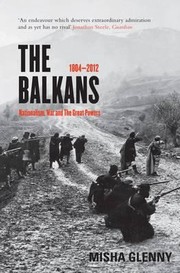
A sweeping, authoritative narrative from 1804 to the present by a veteran Balkans correspondent; at this stage it serves as a grand synthesis, connecting every thread the curriculum has built.

A landmark work of intellectual history examining how the West constructed the idea of 'the Balkans' as a space of backwardness — the essential critical capstone for any serious student of the region.
Discussion
Keep reading
Paths that share books, cover the same subject, or open a related topic.