The Best Books on Business Model Innovation, in Order
This curriculum builds a rigorous, practical mastery of business model innovation—starting with the essential frameworks and visual tools, then deepening into value proposition design and strategic reinvention, and finally tackling advanced theory and real-world transformation cases. Because the learner starts at an intermediate level, the path skips introductory business basics and moves quickly into the canonical canvases and models before escalating to competitive strategy and disruptive thinking.
The Core Canvases
IntermediateMaster the Business Model Canvas and Value Proposition Canvas as practical design tools, and build a shared vocabulary for every stage that follows.
▸ Study plan for this stage
Pace: 4–5 weeks, ~40–50 pages/day. Week 1–2: "Business Model Generation" (core chapters on BMC components); Week 3: "Business Model Generation" (patterns, case studies); Week 4–5: "Value Proposition Design" (VPC framework and application)
- The nine building blocks of the Business Model Canvas (Customer Segments, Value Propositions, Channels, Customer Relationships, Revenue Streams, Key Resources, Key Activities, Key Partnerships, Cost Structure)
- How to map and visualize a complete business model on a single page
- The distinction between customer jobs, pains, and gains as the foundation for value proposition design
- The Value Proposition Canvas as a tool to match product/service features with customer needs
- Business model patterns (e.g., multi-sided platforms, freemium, subscription) and when to apply them
- The iterative design process: how to test, validate, and pivot business models using these canvases
- How to use visual language and shared vocabulary to communicate business ideas across teams and stakeholders
- What are the nine building blocks of the Business Model Canvas, and how do they relate to each other?
- How do you use the Value Proposition Canvas to identify and resolve mismatches between what you offer and what customers actually need?
- What is the difference between customer jobs, pains, and gains, and why does this distinction matter for innovation?
- How can you apply business model patterns (such as multi-sided platforms or subscription models) to your own business or a case study?
- What is the relationship between the Business Model Canvas and the Value Proposition Canvas, and when would you use each one?
- How do you conduct a business model test or validation using these canvases, and what evidence would indicate success or the need to pivot?
- Map a real company (or your own business) onto the Business Model Canvas, filling in all nine blocks with specific details from their actual operations or strategy
- Create a Business Model Canvas for a hypothetical startup or new product line, then identify the riskiest assumptions and design a simple test for one of them
- Conduct a customer interview or survey focused on identifying jobs, pains, and gains for a specific customer segment, then document findings on the Gains/Pains side of the Value Proposition Canvas
- Build a Value Proposition Canvas for a product or service you know well, mapping features/benefits to the customer profile, and identify any gaps or misalignments
- Compare two competing business models (e.g., Netflix vs. traditional cinema) using the Business Model Canvas to understand their strategic differences
- Design a pivot or business model innovation for an existing company by modifying 2–3 blocks of the Canvas and justifying your changes with customer insights
- Facilitate a 30-minute workshop with peers or colleagues to co-create a Business Model Canvas for a shared project or idea, practicing the visual language and collaborative process
Next up: This stage equips you with a shared, visual language and mental models for analyzing and designing business models—the foundation necessary to explore deeper innovation strategies, competitive positioning, and ecosystem dynamics in subsequent stages.
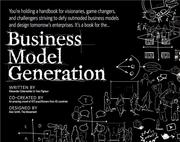
The foundational text that introduced the Business Model Canvas—reading this first establishes the nine-block framework and visual language that every subsequent book in this curriculum references or builds upon.

The direct sequel, zooming into the Customer Profile and Value Map; reading it second lets you immediately apply the canvas logic to the customer-facing core of any business model.
Strategy Through a Business Model Lens
IntermediateUnderstand how business models connect to competitive strategy, pricing power, and long-term value creation—moving from design tools to strategic thinking.
▸ Study plan for this stage
Pace: 4–5 weeks, ~40–50 pages/day (approximately 250 pages total)
- The Cascade framework: how winning aspiration flows through strategy, business model, and operations
- Competitive advantage through distinctive business model choices, not just product features
- The role of choice and trade-offs in strategy—what you do AND what you deliberately don't do
- How business model design determines pricing power, margin structure, and customer value capture
- The connection between strategic positioning and sustainable competitive advantage
- Integrating business model thinking into long-term value creation and shareholder returns
- The importance of testing and validating business model assumptions before full-scale execution
- How does the Cascade framework connect winning aspiration to business model design, and why is this connection critical for strategy execution?
- What is the relationship between business model choices and competitive advantage? Why can't competitive advantage be sustained through product features alone?
- How do strategic trade-offs and deliberate choices about what NOT to do shape a company's business model and pricing power?
- How does a well-designed business model create barriers to entry and protect long-term profitability?
- What role does customer value creation play in determining a company's business model, and how does this differ from value capture?
- How can a company test and validate its business model assumptions before committing significant capital to execution?
- Map the Cascade for a company of your choice: articulate its winning aspiration, strategy, business model, and operations. Identify where misalignment occurs and propose corrections.
- Conduct a competitive business model analysis: compare two competitors in an industry, mapping their key business model choices (pricing, distribution, value proposition, cost structure). Explain which business model creates more sustainable competitive advantage and why.
- Identify the deliberate trade-offs in a company's business model: what does it do exceptionally well, and what has it chosen NOT to do? Explain how these trade-offs protect its competitive position.
- Design a hypothetical business model for a new venture or market entry. Specify your winning aspiration, the strategic choices you'd make, and the business model elements (revenue model, cost structure, customer segments, distribution) that would support it.
- Analyze pricing power: select a company with a strong business model and explain how its business model design (not just product quality) enables it to command premium pricing or defend margins.
- Create a business model assumption validation plan: identify the 3–5 riskiest assumptions in a business model you're familiar with, and design low-cost experiments or tests to validate or refute them before scaling.
Next up: This stage grounds you in the strategic logic of business models—how they create competitive advantage and drive value—preparing you to explore how business models evolve, adapt, and transform in response to market disruption and technological change.
Bridges canvas mechanics to portfolio-level innovation strategy, showing how companies manage existing models while inventing new ones—a natural next step after mastering the individual canvases.

Introduces the strategic-choice cascade (winning aspiration, where to play, how to win) that gives business model decisions their competitive context and sharpens the 'why this model' question.
Disruption, Reinvention & New Logics
IntermediateRecognize the patterns by which industries get disrupted and learn the specific innovation moves—jobs-to-be-done, platform logic, freemium—that power transformative new business models.
▸ Study plan for this stage
Pace: 8–10 weeks, ~40–50 pages/day. Week 1–3: "The Innovator's Dilemma" (~400 pages); Week 4–6: "Competing Against Luck" (~350 pages); Week 7–10: "Platform Revolution" (~400 pages). Include 1–2 reflection days per week to synthesize concepts across books.
- Disruptive innovation: how entrenched firms fail when new competitors attack from below with simpler, cheaper solutions that eventually move upmarket
- The innovator's dilemma: incumbent firms' rational resource allocation processes paradoxically make them vulnerable to disruption
- Jobs-to-be-done theory: customers hire products to accomplish specific functional, emotional, or social jobs, not for product features alone
- Competing against luck: business model innovation succeeds when you deeply understand the job customers are trying to do and design the entire value chain around it
- Platform logic: networks of producers and consumers create exponential value through multi-sided coordination, differing fundamentally from linear pipeline business models
- Network effects and ecosystem orchestration: platform success depends on critical mass, trust mechanisms, and governance that balance openness with control
- Patterns of disruption: low-end disruption, new-market disruption, and how platforms often create entirely new markets by lowering barriers to participation
- What is the innovator's dilemma, and why do established firms with superior resources often lose to disruptive competitors?
- How does the jobs-to-be-done framework differ from traditional market segmentation, and why does it predict business model success more reliably?
- What are the key differences between low-end disruption and new-market disruption, and can you identify examples of each from the books?
- How do platform business models create value differently than traditional pipeline models, and what are the critical success factors for platform ecosystems?
- Why do network effects make platforms difficult to disrupt once they reach critical mass, and what governance mechanisms do successful platforms use?
- How would you apply the jobs-to-be-done framework to redesign a traditional industry's business model into a platform-based one?
- Map a real industry disruption (e.g., smartphones disrupting cameras, streaming disrupting video rental) using Christensen's framework: identify the incumbent, the disruptor, the initial low-end foothold, and the upmarket trajectory.
- Conduct a jobs-to-be-done analysis for a product you use regularly: interview 3–5 users, identify the core job they're hiring the product for, and map the functional, emotional, and social dimensions. Compare your findings to how the company markets the product.
- Analyze a platform business (Uber, Airbnb, YouTube, etc.): diagram the multi-sided network, identify the value proposition for each side, and assess the network effects and lock-in mechanisms.
- Redesign a traditional linear business model (e.g., a car rental company, a bookstore, a taxi service) as a platform: define the two or more sides, the coordination problem you're solving, and the critical mass needed to launch.
- Create a disruption scenario: choose an established industry and design a new entrant that uses jobs-to-be-done insights to attack from below. What would the incumbent's rational response be, and why might it fail?
- Compare two competing platforms in the same space (e.g., Uber vs. Lyft, Airbnb vs. VRBO): analyze their governance, trust mechanisms, and value capture strategies. Why does one dominate?
Next up: This stage equips you with the diagnostic tools to recognize *why* industries transform and *how* new business models disrupt incumbents; the next stage will focus on designing and executing your own business model innovation from first principles.

Establishes why successful incumbents fail against disruptive entrants—essential for understanding the external pressure that makes business model reinvention urgent rather than optional.

Introduces Jobs-to-be-Done theory, which reframes the customer insight layer of any business model and directly enriches the Value Proposition Canvas work done earlier.

Provides a rigorous framework for platform and ecosystem business models—the dominant new model architecture—showing how network effects replace traditional pipeline logic.
Advanced Transformation & Execution
ExpertApply business model innovation at the enterprise level—managing the tension between exploiting current models and exploring new ones, and leading the organizational change required.
▸ Study plan for this stage
Pace: 8–10 weeks, ~40–50 pages/day (approximately 2–3 weeks per book, with overlap for synthesis)
- Ecosystem thinking and value creation networks—understanding how your business model depends on partners, suppliers, and complementors, not just internal capabilities
- Co-innovation and orchestration—leading change across organizational boundaries and managing interdependencies with external actors
- The dual transformation framework—simultaneously defending the core business (Transformation A) while building new growth engines (Transformation B)
- Managing the explore-exploit tension—balancing incremental improvements to existing models with radical exploration of new ones without cannibalizing current revenue
- Organizational design for ambidexterity—structuring teams, incentives, and governance to enable both efficiency and innovation
- Stakeholder alignment and change leadership—securing buy-in from executives, boards, and teams when pursuing transformations that threaten existing power structures
- Scenario planning and strategic optionality—building flexibility into transformation roadmaps to adapt as market conditions and ecosystem dynamics shift
- How does Ron Adner's concept of the 'ecosystem' fundamentally change the way you assess business model innovation risks compared to viewing innovation as an internal capability problem?
- What is the difference between Transformation A and Transformation B in Scott Anthony's framework, and why is pursuing both simultaneously critical for enterprise survival?
- How do you identify and manage the 'co-innovation risk' when your business model innovation depends on partners or complementors making their own changes?
- What organizational structures, incentive systems, and governance mechanisms are necessary to enable a company to simultaneously exploit its current business model and explore new ones?
- How would you apply Adner's ecosystem perspective to diagnose why a specific business model innovation initiative in your organization succeeded or failed?
- What are the key stakeholder groups you must align when leading a dual transformation, and what are their conflicting incentives?
- Map your organization's current business model as an ecosystem: identify all partners, suppliers, complementors, and customers. For a proposed innovation, diagram how each actor's incentives and capabilities must shift. Identify which dependencies pose the highest co-innovation risk.
- Conduct a dual transformation audit of your organization: clearly define Transformation A (defending/optimizing the core) and Transformation B (building new growth). For each, outline the strategic intent, required capabilities, resource allocation, and timeline. Identify where they conflict.
- Design an organizational structure and governance model for your company that enables ambidexterity. Specify: separate P&Ls or shared resources? Separate leadership or integrated? How do you prevent the core business from starving the new venture, and vice versa?
- Create a stakeholder alignment map for a transformation initiative: identify executives, board members, frontline teams, and external partners. For each, articulate their incentives, concerns, and what you need them to believe or do. Develop a communication and engagement strategy.
- Write a 2–3 year transformation roadmap for a real business model innovation in your industry. Use Adner's ecosystem lens to identify critical dependencies and decision points. Build in scenario branches for different partner responses or market shifts.
- Case study analysis: Select a company that attempted dual transformation (e.g., a traditional player entering a new market). Using Adner and Anthony's frameworks, diagnose what went right and wrong. What ecosystem factors did they miss? How did organizational design enable or hinder them?
Next up: This stage equips you to lead enterprise-scale business model innovation by understanding ecosystems and managing organizational duality; the next stage will likely deepen your ability to navigate specific transformation contexts—such as industry disruption, digital transformation, or geographic expansion—and to build sustainable competitive advantage in transformed models.

Introduces ecosystem strategy and co-innovation risk, revealing why even a brilliant new business model can fail if the surrounding partner ecosystem isn't aligned—a blind spot most canvas work misses.

Provides a concrete playbook for how established companies simultaneously reposition their core and create a separate new-growth engine—the hardest and most important execution challenge in business model innovation.
Discussion
Keep reading
Paths that share books, cover the same subject, or open a related topic.