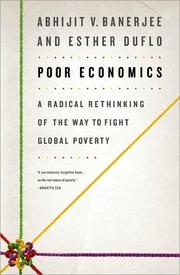
Poor Economics
Abhijit Banerjee, Esther Duflo · 2011 · 320 pages
As an Amazon Associate we earn from qualifying purchases. Some book links are affiliate links; you pay the same price and we may earn a small commission.
About this book
"Billions of government dollars, and thousands of charitable organizations and NGOs, are dedicated to helping the world's poor. But much of the work they do is based on assumptions that are untested generalizations at best, flat out harmful misperceptions at worst. Banerjee and Duflo have pioneered the use of randomized control trials in development economics. Work based on these principles, supervised by the Poverty Action Lab at MIT, is being carried out in dozens of countries. Their work transforms certain presumptions: that microfinance is a cure-all, that schooling equals learning, that poverty at the level of 99 cents a day is just a more extreme version of the experience any of us have when our income falls uncomfortably low. Throughout, the authors emphasize that life for the poor is simply not like life for everyone else: it is a much more perilous adventure, denied many of the cushions and advantages that are routinely provided to the more affluent"--
Appears in these reading paths
Best Books on Economic Development and Global Poverty, in Reading Order


Best Books on Public Policy, in Reading Order

Effective Altruism: Best Books to Read in Order
Microfinance and Financial Inclusion: The Best Books, In Order
Best Books on Development Economics and Global Poverty, in Reading Order

Global Health: The Best Books on Medicine, Poverty and Equity, in Order
Related reading guides
Reader reviews
Ratings and notes from readers — tagged with how deep into the subject they were.
Loading reviews…