Best Books on Economic Development and Global Poverty, in Reading Order
Development economics is a field where thoughtful people who have looked at the same countries reach opposite conclusions, so this path is organised around its three big disagreements rather than around a single story. You first settle what development even means and how much has already happened, then read the aid debate in the words of its principals, then descend to the household-level evidence that reframed the whole argument. The last stage raises the altitude again to institutions and industrial policy, where the strongest current dispute lives.
What development is, and what has already changed
BeginnerDefine development in terms broader than income, and get an accurate baseline for how much global poverty and mortality have actually fallen
▸ Study plan for this stage
Pace: Six weeks. Development as Freedom is 366 pages but is a sequence of arguments rather than a narrative — three weeks, roughly a chapter every two or three sittings, with time to restate each argument in your own words. The Great Escape is 376 pages and reads faster; two to three weeks. Read them in t
- The capability approach: development as the expansion of what people are able to do and be, with income as a means and not the thing being measured
- Sen's distinction between functionings — what a person actually does — and capabilities — the set of things they could do — which is where the whole argument about freedom lives
- The five instrumental freedoms Sen names: political freedoms, economic facilities, social opportunities, transparency guarantees and protective security, each reinforcing the others
- The famine argument: famines are entitlement failures rather than food-availability failures, and no substantial famine has occurred in a functioning democracy with a free press
- Deaton's long-run picture: two centuries of escape from poverty and early death, with the mortality gains driven substantially by public health and knowledge rather than only by income
- That escape leaves people behind by construction — the inequality Deaton describes is the signature of progress rather than a separate failure, which is an uncomfortable claim worth taking seriously
- Deaton's methodological scepticism: poverty lines, purchasing power parity conversions and national consumption surveys each involve choices, and the global poverty count is more fragile than its precision suggests
- Deaton's scepticism about foreign aid, stated here but not yet argued at length — it sets up the next stage rather than settling it
- What is a capability, and how does it differ from a resource on one side and from utility on the other? Give an example where two people with the same income have different capabilities
- State Sen's famine argument and its mechanism. What are the strongest objections to it?
- If inequality is a byproduct of some people escaping first, is it a problem or a success indicator? Give Deaton's answer and then your own
- Name two ways in which the global extreme-poverty count could be substantially wrong, using Deaton's account of how the number is built
- Write a one-sentence definition of development that you could defend against both authors
- Take Sen's five instrumental freedoms and score a single country you know well on each, in a paragraph apiece. The exercise exposes how much judgement the framework requires
- Write 300 words distinguishing 'has enough income to buy food' from 'is not undernourished', using Sen's vocabulary rather than paraphrasing it
- Look up the current headline figure for people in extreme poverty, then list every methodological choice standing behind that number, using Deaton. Aim for at least six
- Sketch the long-run income and life-expectancy series Deaton discusses and mark the periods where they move together and where they do not. The gaps are his argument about knowledge
- Pick a development intervention you have heard praised and evaluate it purely in capability terms rather than income terms. Note what changes
Next up: With a defensible definition of the goal and an accurate baseline of how much has already been achieved, you can read the aid debate as an argument about means rather than about whether progress is possible.
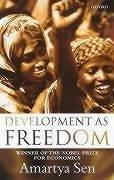
The argument that development should be measured as expanding what people are able to do and be, not as GDP growth — the conceptual foundation for the modern field. Read it first because it defines the goal every later book is proposing a means toward.
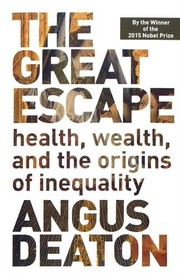
A Nobel laureate's account of two centuries of escaping poverty and disease, and of the inequality that escape leaves behind. It supplies the long-run data, and its scepticism about foreign aid sets up the next stage rather than pre-empting it.
The aid debate
IntermediateHear the case for a large aid push, the case that aid systematically fails, and the case that it actively harms recipients — each from its most prominent advocate
▸ Study plan for this stage
Pace: Seven weeks. The End of Poverty is 416 pages and takes two to three; read it first and read it charitably, because the temptation is to arrive already sceptical. The White Man's Burden is 436 pages and takes another two to three — read it directly after Sachs, since it is written substantially again
- The poverty trap and the big push: Sachs's claim that below a threshold, savings and investment cannot compound, so an external coordinated injection is required to escape
- Sachs's clinical-economics framing — differential diagnosis of a country's specific constraints — which is a better description of his method than the caricature of blanket spending
- The 0.7 per cent of national income aid target and the arithmetic Sachs uses to cost the end of extreme poverty, which is worth reconstructing rather than accepting
- Easterly's planners and searchers: planners specify a global solution and lack any feedback about whether it worked, searchers find what works locally because they face consequences
- The accountability argument underneath Easterly's case — aid agencies are not accountable to the people they serve, which is a structural claim rather than an accusation of bad faith
- Moyo's mechanism: government-to-government aid substitutes for the tax relationship between a state and its citizens, and a government funded from abroad has weaker reasons to be accountable at home
- Moyo's proposed alternatives — sovereign bond markets, foreign direct investment, trade access, remittances — and the fact that her empirical support and her chapter on Chinese investment are both contested
- The disaggregation problem that runs through all three: humanitarian relief, project aid, multilateral lending and direct budget support are entirely different objects, and arguments true of one are often false of another
- What is a poverty trap, and what observable evidence would demonstrate that a particular country is in one?
- Distinguish planners from searchers. Is this an analytic distinction that could be operationalised, or a rhetorical one?
- State Moyo's mechanism for how aid corrodes the state–citizen relationship. What evidence would test it, and does she supply any?
- Disaggregate 'aid' into at least four categories, then say which of each author's central claims survives the disaggregation
- Sachs's flagship demonstration project became the subject of a public evaluation dispute. What was actually at issue methodologically, and what does the episode show about evaluating an integrated intervention?
- Write each author's core claim as a single falsifiable proposition, then state what data would refute it. At least one of the three will resist this, and noticing which is the point of the exercise
- Build a table with rows for humanitarian relief, project aid, multilateral lending and budget support, and columns for Sachs, Easterly and Moyo. Fill in whether each author's argument applies to that row
- Take one real aid programme in one country and write 500 words analysing it three times — once through each author's frame. Note which frame produced the most useful questions
- Find where Sachs costs the end of extreme poverty, extract the assumptions in the arithmetic, and redo the calculation with your own assumptions
- Pick the single strongest claim in Dead Aid and spend an hour checking its source. Do the same for one claim in Easterly. The asymmetry, if there is one, is worth recording
Next up: The aid debate was conducted at the level of countries and decades — the next stage descends to households and to questions small enough to actually answer.
The clearest statement of the big-push position: extreme poverty is a trap that a coordinated, well-funded intervention can break. Read it first in this stage because the other two are written substantially against it.
The direct rebuttal, distinguishing planners from searchers and arguing that top-down aid lacks the feedback that makes anything work. Easterly and Sachs are the field's most famous opposing pair; reading them back to back is the point.
An African economist's argument that government-to-government aid entrenches bad governance and should be phased out in favour of capital markets and trade. It is a polemic with contested empirics, and it puts the strongest version of the abolitionist case on the table.
What poor households actually do
IntermediateReplace grand theory with measured behaviour — how the poor manage money, health and schooling, and what randomized evaluations can and cannot settle
▸ Study plan for this stage
Pace: Seven weeks. Poor Economics is 320 pages organised by problem — health, education, family, risk, credit, savings — and takes three weeks read a chapter at a time with the underlying studies looked up. Portfolios of the Poor is 283 pages and takes two; it is the most concrete book on the path and the
- The randomised evaluation as a method: what randomisation actually buys — a credible counterfactual and therefore internal validity — and what it does not buy, which is transferability to any other setting
- Banerjee and Duflo's deliberate refusal to answer the Sachs–Easterly question in its own terms, replacing one unanswerable question with many answerable ones
- The specific findings that changed practice: the sharp response of demand to small prices for preventive health products, the effect of tiny incentives on immunisation completion, teacher and provider absence, and microcredit's modest average effects against its extravagant claims
- The observation that when income rises the poor do not spend all of it on calories, and what that implies about models of poverty built on subsistence
- The financial diaries method in Portfolios of the Poor: a year of tracked cash flows for real households, which is a different kind of evidence from either a trial or a survey
- The triple whammy the diaries reveal — incomes that are small, irregular and unpredictable — which makes cash-flow management, not merely income level, the defining problem of poverty
- The informal financial instruments households actually use: rotating savings groups, money-guarding, reciprocal interest-free lending, and the finding that annual money turnover vastly exceeds annual income
- Collier's four traps — conflict, natural resource dependence, being landlocked with bad neighbours, and bad governance in a small country — as an argument that the remaining hard cases need different instruments from the rest of the developing world
- What does randomisation establish, and what does it not? Be precise about the difference between internal and external validity
- Name one finding in Poor Economics you believe transfers to other settings and one you doubt, and give your reasons in each case
- Portfolios of the Poor finds intense and sophisticated financial activity. What does that imply about how microcredit products should be designed, and about the premise that the poor need to be taught to save?
- State Collier's four traps and describe how you would determine which one a given country is in — using data available before the outcome is known
- Is Banerjee and Duflo's refusal to engage the big question a methodological virtue or an evasion? Argue both sides before deciding
- Take three trials described in Poor Economics and for each write out the exact question, the unit of randomisation, the outcome measured, and one thing the result does not establish. The fourth line is the hardest and the most valuable
- Reconstruct one household's cash flows from Portfolios of the Poor and total the money moving through it over the year. Compare that total to the household's annual income and write a paragraph on the ratio
- Design a randomised evaluation for a development question you actually care about, and write the pre-analysis plan: hypothesis, unit, sample, primary outcome, and what a null result would look like
- Choose one country Collier classifies and check its trajectory since the book was published against what his framework would have predicted
- Return to your table from the previous stage and add a row for 'evidence-based small interventions'. Ask whether Sachs, Easterly or Moyo has anything to say about it
Next up: Household evidence tells you what works inside a given economy but not why some economies grew and others did not — the last stage takes on that question, which is where the field's sharpest current disagreement sits.
The book that made randomized controlled trials the field's default tool, rebuilding development questions as small answerable ones. Read it after the aid debate: its whole method is a refusal to answer the Sachs–Easterly question in the terms they posed it.
Year-long financial diaries of households living on a few dollars a day, revealing sophisticated borrowing, saving and insurance behaviour. The most concrete book on the path, and the best corrective to abstractions about poverty.

Argues that the remaining hard cases are trapped by conflict, landlocked geography, resource dependence or bad governance, and need different instruments from the rest of the developing world. Read it as the bridge from household evidence back up to country-level policy.
Institutions and industrial policy
IntermediateEngage the current live dispute — whether growth comes from getting institutions right, or from a state deliberately steering agriculture, manufacturing and finance
▸ Study plan for this stage
Pace: Eight weeks. Why Nations Fail is 529 pages of historical sweep and takes three; read it critically from the start, keeping a list of cases you think are being made to fit. Bad Samaritans is 288 pages and takes two, read directly against Acemoglu and Robinson rather than after them. How Asia Works is
- Inclusive and extractive institutions as the central distinction, with the accompanying claim that political institutions are prior to economic ones
- Critical junctures and contingency: the argument that similar societies diverge at moments of shock depending on small pre-existing institutional differences
- Creative destruction and elite resistance to it — the mechanism that explains why extractive elites block growth-generating change even when growth would enrich them
- The standing objections to the framework: that inclusiveness is often identified from the outcome, that the definitions are elastic enough to accommodate any case, and that China is a persistent anomaly the theory handles by prediction rather than explanation
- Chang's historical claim: that Britain, the United States and later Japan and Korea all developed behind tariffs, subsidies and controls that they now discourage in others
- The 'kicking away the ladder' argument, and the honest counter-objection that selecting successful protectionists ignores the far larger set of protectionist failures
- Studwell's three-part recipe, and its sequencing: household-scale land reform first to maximise yield per hectare and generate a rural surplus, then manufacturing subsidised on condition of export performance, then finance directed to serve both rather than seeking its own returns
- Export discipline as Studwell's key mechanism — a subsidy conditional on selling into a competitive foreign market is a subsidy with an automatic performance test, which is what separates Korea from the Philippines
- Define an inclusive institution as Acemoglu and Robinson do, then try to apply the definition to a country using only information available before its growth outcome. What happens?
- China is the standard objection to Why Nations Fail. What is the authors' answer, and does it work as explanation or only as prediction?
- Is Chang's historical claim about protectionism in today's rich countries correct? And if it is, does the policy conclusion actually follow from it?
- State Studwell's three-part recipe precisely, including the order. Why does he insist land reform comes first?
- What does export discipline accomplish that a subsidy alone does not? Name a country where the discipline was absent and what happened
- Classify three countries with the inclusive-extractive framework using only pre-1960 evidence, then compare your classification to their subsequent growth. Record where the framework worked and where you were tempted to reason backwards
- Write 400 words on China as a test case for Why Nations Fail: state the anomaly plainly and then make the best defence of the theory you can
- Apply Studwell's three tests to a country he does not cover — Vietnam, Bangladesh and Ethiopia are the interesting ones — and write down a prediction with a date on it
- Return to Sen's definition of development from the first stage and ask whether a country that followed Studwell's recipe exactly would end up with what Sen is asking for. This is the most important question on the path and neither author answers it
- Write the closing essay: 1,500 words on what you would do with ten billion dollars to reduce global poverty, citing a book from every stage, and naming explicitly which of these authors would object to your plan and on what grounds
Next up: This closes the path; the natural continuations are the growth-empirics literature, the political economy of state capacity, the current debate over green industrial policy, and the journals where the randomised-evaluation programme is now arguing with itself.
The influential case that inclusive political and economic institutions explain long-run prosperity, argued across a very wide historical sweep. Its critics say the framework is too elastic to be falsified; read it knowing that, and it is still the reference point for institutional explanations.
Argues that today's rich countries developed behind tariffs and subsidies and now deny that ladder to others. The most readable heterodox challenge to free-trade orthodoxy, and deliberately placed against Acemoglu rather than after him.
A concrete three-part recipe — land reform, export-disciplined manufacturing, subordinated finance — tested against which East Asian states succeeded and which did not. Read it last: it is the most specific and testable claim in the field, and a fair place to end because you can check it against every country in the path.
Discussion
Keep reading
Paths that share books, cover the same subject, or open a related topic.