Understanding Rousseau: Best Books to Read, in Order
This curriculum builds a deep, structured understanding of Rousseau by moving from his own most accessible primary texts, through scholarly guides that unlock his core concepts, and finally into advanced critical and comparative works that situate him in the history of political philosophy. Because the learner starts at an intermediate level, we skip introductory surveys and go straight to Rousseau's own voice, supported at each stage by the best secondary literature.
Rousseau in His Own Words
IntermediateRead Rousseau's two most essential primary texts to build direct familiarity with his core arguments about nature, inequality, the social contract, and the general will—in the order he intended them to be understood.
▸ Study plan for this stage
Pace: 8–10 weeks, ~25–30 pages/day (accounting for dense philosophical prose requiring re-reading and annotation)
- Natural man vs. civil man: Rousseau's distinction between humanity in the state of nature (solitary, compassionate, free) and humanity corrupted by society and private property
- The origin of inequality: how private property, metallurgy, agriculture, and social institutions created artificial hierarchies absent in nature
- The social contract as a solution: the collective agreement by which free individuals surrender natural rights to gain civil rights and security
- The general will: the collective body politic's unified will that represents the common good and cannot be represented by individuals
- Sovereignty and inalienability: the people's sovereign power cannot be transferred, sold, or delegated to rulers without contradiction
- Freedom redefined: civil freedom is limited by the general will; moral freedom comes from obedience to laws we prescribe to ourselves
- The problem of legitimacy: how authority becomes legitimate only when it expresses the general will, not through force or tradition alone
- Rousseau's critique of existing governments: most states are illegitimate because rulers serve private interests, not the common good
- What does Rousseau mean by 'natural man' and how does he argue that compassion (pitié) and self-love (amour de soi) are humanity's fundamental traits before society?
- How does Rousseau trace the historical emergence of inequality from the state of nature through the invention of private property and metallurgy?
- What is the social contract according to Rousseau, and how does it differ from Hobbes's or Locke's versions in terms of what individuals gain and lose?
- What is the general will, why is it infallible according to Rousseau, and how can it be distinguished from the will of all?
- Why does Rousseau insist that sovereignty is inalienable and indivisible, and what does this imply about legitimate government?
- How does Rousseau reconcile individual freedom with obedience to the general will, and what does he mean by 'forced to be free'?
- Create a two-column chart comparing Rousseau's 'natural man' with 'civil man' across dimensions like freedom, compassion, inequality, and happiness—cite specific passages from the Discourse on Inequality
- Trace the historical narrative of the Discourse on Inequality: outline the stages from solitary natural humans to the establishment of government, noting which inventions (fire, tools, language, property) Rousseau identifies as turning points
- Write a 500-word dialogue between Rousseau and either Hobbes or Locke debating the state of nature and the legitimacy of the social contract, grounding arguments in actual text
- Map out the key concepts of The Social Contract (books I–IV) in a concept web showing how sovereignty, the general will, freedom, and law interconnect
- Identify and annotate 5–7 passages from The Social Contract where Rousseau addresses the problem of legitimacy; for each, write one sentence explaining how it answers 'Why should anyone obey government?'
- Construct a detailed outline of Book III of The Social Contract on government forms; explain which form Rousseau considers most compatible with the general will and why
Next up: This stage grounds you in Rousseau's own arguments, preparing you to evaluate how later thinkers (Kant, Hegel, Marx, modern democrats) interpreted, critiqued, or built upon his ideas about nature, legitimacy, and collective freedom.

This is the logical starting point: Rousseau's diagnosis of how civilization corrupts natural human goodness and produces inequality. It establishes the vocabulary—amour de soi, amour-propre, the state of nature—that every later work presupposes.
Rousseau's masterwork on legitimate political authority, the general will, and collective freedom. Reading it after the Second Discourse makes the problem it is solving—how to reconcile freedom with social life—fully intelligible.
Rousseau on the Self and Education
IntermediateExtend into Rousseau's vision of human development and moral psychology, understanding how his educational and autobiographical writings complete and deepen the political theory.
▸ Study plan for this stage
Pace: 8–10 weeks, ~40–50 pages/day (Emile first, then Confessions). Emile is dense philosophical text; allow 5–6 weeks for careful study. Confessions is more narrative; 3–4 weeks for engaged reading with reflection.
- Natural education and the stages of human development: how Rousseau's Emile moves from infancy through adulthood, emphasizing learning through experience and desire rather than authority
- The role of the tutor and negative education: how the educator shapes development by removing obstacles and allowing natural curiosity to flourish, rather than imposing knowledge
- Amour de soi vs. amour-propre: the distinction between healthy self-love rooted in nature and corrupted vanity rooted in social comparison, central to both Emile's upbringing and Rousseau's self-examination
- The social contract applied to education: how Emile is raised to be both free and virtuous, preparing him for citizenship and moral autonomy within society
- Rousseau's autobiographical self-justification in Confessions: how his own life narrative demonstrates the tension between natural inclination and social corruption, validating his educational philosophy
- Sentiment and conscience as moral guides: Rousseau's emphasis on inner feeling and the voice of conscience over abstract reason as the foundation for ethics
- Gender, sexuality, and Sophie: Emile's education toward marriage and the complementary but unequal role of women, revealing assumptions embedded in Rousseau's vision of human flourishing
- The corrupting influence of civilization: how both texts trace the gap between natural human goodness and the artificiality imposed by society, institutions, and vanity
- What does Rousseau mean by 'natural education' and how does it differ from traditional pedagogical methods? What role does the tutor play in Emile?
- Explain the distinction between amour de soi and amour-propre. How does this distinction shape Emile's upbringing and what does it reveal about Rousseau's moral psychology?
- How does Rousseau's account of his own life in Confessions illustrate the conflict between natural impulse and social corruption? What does he seek to justify or explain about himself?
- What is Rousseau's vision of how education prepares an individual for both freedom and virtue? How does Emile's development relate to Rousseau's broader political theory of the social contract?
- How does Rousseau's treatment of Sophie and female education in Emile reflect his assumptions about gender and human nature? What tensions or contradictions emerge?
- What role does sentiment, conscience, and inner feeling play in Rousseau's moral philosophy as presented in both Emile and Confessions? How does this differ from rationalist ethics?
- Create a detailed timeline of Emile's development from infancy to adulthood, noting the key lessons, challenges, and turning points at each stage. Annotate with page references and explain how each phase prepares him for the next.
- Write a comparative character sketch: describe the ideal tutor as Rousseau envisions him in Emile, then analyze how Rousseau himself acts as a 'tutor' to the reader through his confessions—what does he teach through self-disclosure?
- Trace the concept of amour-propre through both texts. Collect 4–5 specific examples from Emile showing how vanity corrupts development, and 3–4 passages from Confessions where Rousseau recognizes his own amour-propre at work. Write a synthesis paragraph on how this concept unifies his thought.
- Design an alternative education for Emile: identify 2–3 moments where Rousseau's tutor intervenes or withholds intervention, then argue whether you agree with the choice and propose what you would do differently. Ground your argument in Rousseau's own principles.
- Read the section on Sophie (Book V of Emile) carefully and write a critical analysis: what does Rousseau's vision of female education reveal about the limits or contradictions in his philosophy of natural human development?
- Compose a 'dialogue' between Emile (as an adult, having completed his education) and the Rousseau of Confessions: what would they say to each other about the gap between theory and lived experience, between natural inclination and social reality?
Next up: Having internalized Rousseau's psychology of the self, his vision of moral development, and the tensions between nature and society in both educational and autobiographical form, you are prepared to examine how these insights apply to Rousseau's direct political and social criticism—moving toward his analysis of inequality, property, and the corruptions of modern civilization.
Rousseau's treatise on raising a free, uncorrupted human being is the practical counterpart to The Social Contract. Reading it here shows how his political ideals are grounded in a philosophy of natural human development.
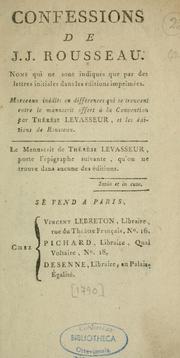
Rousseau's autobiography illuminates the personal experience behind his ideas about authenticity, freedom, and the corrupting gaze of society—making his philosophical concepts feel lived rather than abstract.
The Best Scholarly Guide
IntermediateConsolidate and clarify the primary texts with the single most authoritative and readable scholarly introduction to Rousseau's thought as a unified system.
▸ Study plan for this stage
Pace: 6–8 weeks, approximately 25–35 pages per day. Wokler's "Rousseau" (~200 pages) over 2 weeks, then Levine's "The General Will" (~150 pages) over 2–3 weeks, with 2–3 weeks for integration, review, and exercises.
- Rousseau's conception of natural freedom vs. civil freedom and the social contract as a solution to their tension
- The general will as the foundation of legitimate political authority and how it differs from the will of all
- The role of amour-de-soi (self-love) and amour-propre (vanity) in Rousseau's account of human nature and social corruption
- The relationship between individual sovereignty and collective sovereignty in Rousseau's political system
- Rousseau's critique of civilization and his vision of authentic human flourishing
- The concept of the legislator and the conditions necessary for establishing a just political order
- How Rousseau's thought forms a unified system connecting his anthropology, ethics, and politics
- How does Rousseau resolve the apparent paradox that humans are born free yet everywhere in chains, and what role does the social contract play in this resolution?
- What is the general will, and how does Levine distinguish it from the will of all? Why is this distinction crucial to Rousseau's political theory?
- How do amour-de-soi and amour-propre function in Rousseau's account of human nature, and what role do they play in social corruption and moral development?
- What are the conditions under which a political order can be legitimate according to Rousseau, and what is the legislator's role in establishing these conditions?
- How does Wokler present Rousseau's thought as a unified philosophical system, and what are the key connections between his anthropology, ethics, and politics?
- What does Rousseau mean by authentic freedom, and how is it different from natural freedom or the freedom of the state of nature?
- Create a detailed concept map showing how amour-de-soi, amour-propre, natural freedom, civil freedom, and the general will interconnect in Rousseau's system
- Write a 2–3 page comparative analysis: how does Wokler's presentation of Rousseau's unified system help clarify or deepen your understanding of the general will as Levine explains it?
- Develop a dialogue between Rousseau and one of his predecessors (Hobbes, Locke, or Montesquieu) on the nature of legitimate political authority, grounding your argument in specific passages from both Wokler and Levine
- Construct a detailed outline of Rousseau's solution to the problem of reconciling individual sovereignty with collective sovereignty, citing key arguments from both texts
- Analyze a contemporary political or social problem (e.g., representation, legitimacy, individual rights) through the lens of Rousseau's general will and the conditions Levine identifies for its proper functioning
- Write a critical reflection: where does Rousseau's system succeed in unifying his anthropology and politics, and where does it face tensions or contradictions? Support your answer with evidence from both Wokler and Levine
Next up: This stage establishes Rousseau's thought as a coherent philosophical system grounded in his distinctive anthropology and political theory, preparing you to engage critically with specialized scholarly debates, historical interpretations, and applications of Rousseau's ideas in subsequent stages.

Wokler was one of the foremost Rousseau scholars of the twentieth century, and this concise guide synthesizes the political, educational, and personal dimensions of Rousseau's thought with exceptional clarity—ideal for cementing what the primary texts opened up.

Levine provides a rigorous philosophical analysis of the general will—Rousseau's most contested and influential concept—tracing its logic and its long afterlife, which deepens understanding precisely at the point most readers find hardest.
Critical and Comparative Depth
ExpertEngage with advanced scholarly debates about Rousseau's place in the liberal and republican traditions, his tensions and contradictions, and his lasting influence on political philosophy.
▸ Study plan for this stage
Pace: 8–10 weeks, ~25–30 pages/day, with 1–2 weeks per book for deep engagement and synthesis
- Shklar's distinction between Rousseau's liberalism and republicanism: how he bridges competing traditions
- The tension between natural compassion (pitié) and amour-propre in Rousseau's account of human nature and social corruption
- Neuhouser's genealogical method: tracing how inequality emerges from natural human capacities and social development
- The role of private property and metallurgy as pivotal moments in Rousseau's narrative of inequality
- Rousseau's critique of Hobbes and Locke: his alternative account of the state of nature and the social contract
- The problem of reconciling individual freedom with collective sovereignty in Rousseau's political theory
- Rousseau's influence on subsequent liberal, republican, and radical political traditions
- The relationship between Rousseau's historical narrative (Discourse on Inequality) and his prescriptive theory (Social Contract)
- How does Shklar argue that Rousseau belongs to both liberal and republican traditions, and where do these commitments potentially conflict?
- What is Neuhouser's genealogical approach to inequality, and how does it differ from other interpretations of the Discourse on Inequality?
- How do pitié (natural compassion) and amour-propre (self-esteem dependent on others' opinions) function as explanatory mechanisms in Rousseau's account of human development?
- What role do private property and technological development (metallurgy) play in Rousseau's narrative of the origins of inequality?
- How does Rousseau's critique of the state of nature in Hobbes and Locke inform his own alternative account of natural man?
- What are the major tensions or contradictions in Rousseau's political philosophy, and how do Shklar and Neuhouser address them?
- Create a detailed comparison chart: map Shklar's liberal vs. republican readings of Rousseau against specific passages from the Social Contract and Discourse on Inequality
- Reconstruct Neuhouser's genealogical narrative of inequality step-by-step; write a 2–3 page synthesis explaining how natural capacities transform into social vices
- Write a critical dialogue between Shklar and Neuhouser on a single contested point (e.g., the role of amour-propre or the inevitability of inequality)
- Trace Rousseau's influence: select one later political philosopher (Kant, Hegel, Marx, or a modern republican theorist) and write a 3–4 page essay on how they engage with Rousseau's ideas
- Identify and analyze 3–4 key passages from the primary texts (Social Contract, Discourse on Inequality) that exemplify the tensions Shklar and Neuhouser discuss
- Construct a debate outline: prepare arguments for and against the claim that Rousseau is fundamentally a liberal, using evidence from both secondary sources
Next up: This stage equips you with sophisticated frameworks for evaluating Rousseau's coherence and legacy, preparing you to either engage with specialized monographs on particular aspects of his thought (e.g., aesthetics, education, religion) or to situate him within broader histories of modern political philosophy.

Shklar's landmark study exposes the deep tension in Rousseau between the natural individual and the citizen—a tension that runs through all his works—and is essential reading for anyone who wants to move beyond surface-level understanding.

Neuhouser offers the most philosophically rigorous recent account of Rousseau's theory of social inequality and amour-propre, connecting the Second Discourse to the political and educational works in a way that rewards readers who have now read all the primary texts.
Discussion
Keep reading
Paths that share books, cover the same subject, or open a related topic.