Understanding Edward Said: Best Books to Read in Order
This curriculum moves from Said's own landmark texts — read in the order he developed his ideas — through the postcolonial theoretical tradition he inspired, and finally into critical and contextual works that situate, challenge, and extend his legacy. Because the learner starts at an intermediate level, the path skips introductory cultural-studies primers and opens directly with Said's most accessible major work before tackling his denser theoretical writing and the broader field he shaped.
Said in His Own Voice
IntermediateRead Said's two most essential and accessible books in the order he wrote them, grasping his core argument about representation, power, and the colonial imagination before encountering secondary commentary.
▸ Study plan for this stage
Pace: 10–12 weeks, ~40–50 pages/day (with 2–3 days/week for reflection and exercises). Allocate 4–5 weeks to Orientalism, 2–3 weeks to The Question of Palestine, and 3–4 weeks to Culture and Imperialism.
- Orientalism as a system of representation and knowledge production that constructs the Orient as the West's subordinate Other, enabling colonial domination
- The relationship between knowledge, power, and representation: how Western scholarship, literature, and art created the Orient rather than merely describing it
- Contrapuntal reading and worldliness: the practice of reading texts in their full historical and imperial context, recognizing multiple perspectives simultaneously
- The colonial imagination and its persistence: how Orientalist frameworks continue to shape Western attitudes toward the Middle East and Islam after formal colonialism ends
- Palestine as a concrete case study where Orientalist representation directly enabled dispossession and erasure of indigenous presence and narrative
- The role of culture (literature, music, philosophy) as a site of imperial domination and resistance, not merely as aesthetic or entertainment
- Secular criticism and intellectual responsibility: the critic's duty to expose how culture naturalizes power relations and to imagine alternative futures
- How does Said define Orientalism, and what does he mean by calling it a 'system of representation' rather than simply a collection of false beliefs about the East?
- What is the relationship between knowledge production (scholarship, literature, art) and colonial power in Said's argument? How does knowing the Orient enable controlling it?
- How does Said use the concept of 'contrapuntal reading' and what does he mean by reading texts 'worldly'? Why does this matter for understanding imperialism?
- In The Question of Palestine, how does Said apply the concept of Orientalism to the Israeli-Palestinian conflict? What does he mean by the erasure of Palestinian presence?
- How does Culture and Imperialism extend the argument of Orientalism? What role does culture—novels, opera, philosophy—play in justifying and sustaining empire?
- What does Said mean by 'secular criticism' and why does he insist that intellectuals have a responsibility to challenge how culture naturalizes domination?
- After reading Orientalism's introduction and first two chapters, select one canonical Western text about the Orient (e.g., a passage from Flaubert, Burton, or a 19th-century travel account) and analyze how it constructs the Orient as passive, exotic, or inferior. Identify the specific rhetorical moves that Said would call Orientalist.
- Create a timeline mapping the historical evolution of Orientalism from the 18th century onward, noting key figures (Napoleon, Renan, Disraeli) and events. Annotate how political and military interests shaped scholarly and literary representations.
- Read a contemporary news article or political speech about the Middle East or Islam. Identify Orientalist tropes, stereotypes, and assumptions embedded in the language. How does modern discourse still rely on the frameworks Said critiques?
- Engage in contrapuntal reading: select a passage from Culture and Imperialism about a canonical novel (e.g., Jane Austen, Dickens) and a passage from the novel itself. Write a short analysis showing how the novel's narrative depends on, but obscures, imperial contexts (slavery, colonialism, extraction).
- Research the historical context of Palestinian dispossession (1948, 1967, refugee camps) using primary sources. Then re-read Said's arguments in The Question of Palestine about erasure and narrative. Write a reflection on how Orientalist representation enabled and continues to justify this dispossession.
- Conduct a 'Said-inspired' close reading of a cultural artifact (film, advertisement, museum exhibit, textbook) that represents non-Western peoples. Analyze how it constructs knowledge, authority, and difference. What alternative representations or narratives are absent?
Next up: This stage equips you with Said's own analytical framework and historical arguments, preparing you to engage critically with secondary scholarship, postcolonial theory, and contemporary applications of Said's ideas in the next stage.
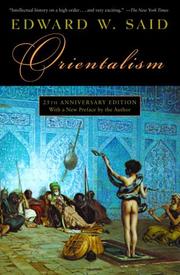
The foundational text of postcolonial studies; Said's argument that 'the Orient' is a Western discursive construction must be understood first-hand before any secondary literature makes full sense.
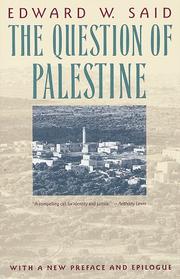
Written immediately after Orientalism, this book applies Said's representational critique to a concrete political case, showing how his theory works on the ground and introducing his concept of the 'permission to narrate.'
Said's major sequel to Orientalism, extending the argument to the novel, opera, and other cultural forms; reading it third cements the full arc of his thinking on culture as a site of imperial power.
Said on Criticism, Identity, and the Intellectual
IntermediateUnderstand Said's humanist and critical-theoretical commitments — his ideas about the role of the intellectual, exile, and secular criticism — which are essential for reading him as more than a postcolonial theorist.
▸ Study plan for this stage
Pace: 8–10 weeks, ~25–30 pages/day (alternating between both texts; allow 1–2 weeks per book with overlap for synthesis)
- The intellectual as exile and outsider: Said's vision of the intellectual as someone who speaks truth to power from a position of non-belonging
- Secular criticism and humanism: Said's defense of humanistic values and secular critique against both religious dogmatism and postmodern relativism
- Contrapuntal reading: the practice of reading texts in relation to their historical contexts and competing narratives, not in isolation
- Identity as constructed and contested: how Said's own life in Out of Place demonstrates identity as fractured, multiple, and shaped by displacement
- The intellectual's responsibility to the public sphere: the duty to address urgent social and political questions beyond academic specialization
- Worldliness and secular interpretation: the commitment to grounding criticism in material history and social reality rather than abstract theory
- Affiliation vs. filiation: the distinction between biological/inherited bonds and chosen intellectual and political commitments
- The role of autobiography in intellectual work: how personal experience (exile, displacement, cultural hybridity) informs and legitimizes critical thought
- What does Said mean by the intellectual as an 'exile' and 'outsider,' and why does he consider this position essential rather than marginal?
- How does Said defend secular criticism and humanism against postmodern skepticism, and what does he see as the stakes of this defense?
- What is contrapuntal reading, and how does Said use it as a method for understanding texts and cultures in relation to power?
- How does Out of Place illustrate Said's theoretical ideas about identity, displacement, and the formation of the intellectual?
- What is the difference between filiation and affiliation, and how does this distinction shape Said's understanding of intellectual community?
- Why does Said insist that criticism must be 'worldly' and engaged with public concerns, and what does he criticize about purely academic or specialized criticism?
- Map Said's argument in Representations of the Intellectual: create an outline showing how he moves from defining the intellectual's role to discussing exile, then to secular criticism. Annotate where he addresses counterarguments.
- Close-read one of Said's key essays or lectures in Representations (e.g., the opening lecture) and identify: (a) his central claim, (b) the historical examples he uses, (c) the audience he addresses. Reflect on how the form of the lecture shapes his argument.
- Track the concept of 'exile' across both texts: collect 5–7 passages from Representations and 5–7 from Out of Place that define or exemplify exile. Compare how the concept functions theoretically vs. autobiographically.
- Practice contrapuntal reading: select a canonical Western text (e.g., a novel, essay, or historical document) and read it alongside a non-Western text or perspective on the same theme. Write a 2–3 page analysis showing how each challenges or contextualizes the other.
- Analyze a passage from Out of Place where Said reflects on his own identity (e.g., his relationship to Palestine, Egypt, Lebanon, or England). Identify how personal experience becomes the ground for theoretical insight about identity and displacement.
- Write a short essay (3–4 pages) responding to this prompt: 'What does Said's vision of the intellectual demand of us today?' Use specific examples from both texts to ground your argument.
Next up: By understanding Said's humanist commitments, his theory of the intellectual's responsibility, and the autobiographical foundations of his thought, you are now equipped to engage with his major works on culture, imperialism, and Orientalism—where these principles of secular criticism, worldliness, and contrapuntal analysis become the tools for reading power into the archive of Western representati
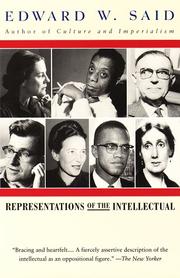
Said's Reith Lectures distill his ethical vision of the public intellectual as an exile and outsider; short and lucid, this is the best entry point into his self-understanding as a thinker.
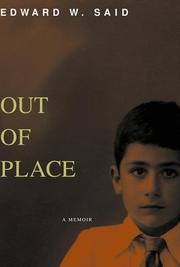
Said's memoir illuminates the biographical roots of his ideas about exile, identity, and belonging, giving the theoretical work an indispensable human dimension.
The Postcolonial Tradition Said Inspired
IntermediateSituate Said within the broader postcolonial canon by reading the two thinkers most closely associated with him, seeing how Bhabha and Spivak extend, complicate, and sometimes dispute his framework.
▸ Study plan for this stage
Pace: 12–14 weeks, ~25–30 pages/day (with 2–3 days per week for review, synthesis, and exercises)
- Frantz Fanon's theory of violence and decolonization as existential and psychological liberation, not merely political transfer of power
- Homi Bhabha's concept of hybridity and mimicry as ambivalent colonial encounters that destabilize the binary of colonizer/colonized
- The third space as a liminal zone where meaning is negotiated and new cultural identities emerge beyond fixed categories
- Gayatri Spivak's critique of postcolonial reason: how Western intellectual frameworks (including Said's) can inadvertently reproduce colonial hierarchies
- The subaltern's inability to speak and the ethical problem of representation—how postcolonial intellectuals risk speaking for the voiceless
- Spivak's strategic essentialism and the tension between identity politics and the deconstruction of stable identity categories
- How Bhabha and Spivak extend, complicate, and sometimes contest Said's Orientalism by foregrounding agency, ambivalence, and epistemic violence
- How does Fanon's analysis of violence in *Wretched of the Earth* differ from liberal or gradualist accounts of decolonization, and what psychological role does he assign to violence?
- What does Bhabha mean by mimicry and hybridity, and how do these concepts challenge the fixed binary of colonizer and colonized that Said's Orientalism might imply?
- How does Bhabha's concept of the third space offer a different framework for understanding colonial encounters than Said's notion of Orientalism?
- What is Spivak's central critique of postcolonial reason, and how does she argue that postcolonial intellectuals risk reproducing colonial epistemic violence?
- What does Spivak mean by 'Can the subaltern speak?' and what are the ethical implications of this question for postcolonial scholarship and activism?
- How does Spivak's concept of strategic essentialism attempt to navigate the tension between political identity claims and poststructuralist critiques of essential identity?
- Close-read one passage from *Wretched of the Earth* on violence and one from Said's *Orientalism* on representation; write a 2–3 page comparative analysis of how each theorist frames the colonized subject's agency and resistance.
- Create a visual map or concept diagram showing how Bhabha's mimicry, hybridity, and third space complicate or extend Said's binary framework of Orientalism; annotate with specific textual examples from *The Location of Culture*.
- Write a critical response essay (4–5 pages) applying Spivak's 'Can the subaltern speak?' to a specific historical or literary example of colonial representation; reflect on whether the subaltern's voice is recoverable or whether representation always risks epistemic violence.
- Conduct a comparative table analysis: list key concepts from each text (Fanon's violence, Bhabha's hybridity, Spivak's subaltern) and trace how each author engages with or revises Said's Orientalism; note points of agreement and disagreement.
- Write a dialogue or debate between Said, Bhabha, and Spivak on the question: 'Can postcolonial intellectuals represent the colonized without reproducing colonial power?' Use direct quotes and specific arguments from all three texts.
- Select one literary or historical text (e.g., a colonial novel, memoir, or archival document) and analyze it through the lenses of Fanon's violence, Bhabha's hybridity, and Spivak's subaltern critique; write a 5–6 page analysis showing how each framework reveals different dimensions of colonial encounter.
Next up: This stage grounds you in the postcolonial canon's internal debates and refinements, preparing you to engage with contemporary applications of postcolonial theory to specific regions, literatures, and political movements in the next stage.

Said's most important predecessor; reading Fanon's analysis of colonial violence and consciousness first shows exactly what Said inherited and where he departed from a more revolutionary framework.
Bhabha's concepts of hybridity, mimicry, and the 'third space' are the most influential postcolonial response to Said; reading it here lets the learner see how the field evolved beyond Orientalism.

Spivak's rigorous, demanding critique of both Said and Bhabha from a feminist and Marxist perspective represents the field's most challenging internal debate, best tackled after the prior two books.
Critical Perspectives on Said
ExpertEngage with the most serious scholarly assessments of Said's work — both sympathetic and critical — to understand his blind spots, contested legacy, and enduring relevance.
▸ Study plan for this stage
Pace: 4–5 weeks, ~25–30 pages/day. Week 1–2: Richard King's "Orientalism and Religion" (~200 pages); Week 3–4: Valerie Kennedy's "Edward Said" (~150 pages); Week 5: Review, synthesis, and written reflection.
- King's critique of Said's secular bias and neglect of religion as a constitutive force in Orientalism
- The relationship between religious discourse, colonial power, and Orientalist representation
- Kennedy's assessment of Said's intellectual genealogy and theoretical influences (Gramsci, Foucault, Fanon)
- Contested interpretations of Said's concept of 'strategic essentialism' and its political implications
- Said's blind spots regarding gender, sexuality, and non-Western agency in postcolonial theory
- The evolution and refinement of Said's ideas across Orientalism, Culture and Imperialism, and Humanism and Democratic Criticism
- How Said's work has been appropriated, misread, and productively challenged by subsequent scholars
- The tension between Said's humanistic universalism and identity-based postcolonial politics
- What is King's primary argument about the limitations of Said's Orientalism, and how does his focus on religion complicate Said's secular framework?
- How do Kennedy and King differ in their assessment of Said's intellectual debts and theoretical foundations?
- What does Kennedy identify as Said's major blind spots, and what evidence does she provide from his texts?
- How have feminist and queer scholars critiqued Said's work, and what does Kennedy say about gender in his analysis?
- In what ways does Kennedy argue that Said's later work (Culture and Imperialism, Humanism and Democratic Criticism) represents a departure from or refinement of his earlier positions?
- What is the relationship between Said's concept of worldliness and the critiques leveled by King and Kennedy?
- Create a two-column chart: 'King's Critiques of Said' vs. 'Kennedy's Critiques of Said.' Identify overlaps and divergences in their assessments.
- Close-read a passage from King on religion and Orientalism (e.g., his discussion of Islam in colonial discourse), then trace how this argument challenges a specific claim in Said's Orientalism.
- Write a 500-word response: 'What would Said say to King's critique about religion?' Argue from Said's perspective using evidence from Kennedy's intellectual biography.
- Annotate Kennedy's discussion of Said's gender blindness with references to specific texts (Orientalism, Culture and Imperialism). What evidence supports or complicates her argument?
- Construct a genealogy of Said's ideas: map his intellectual influences (Gramsci, Foucault, Fanon, etc.) as Kennedy presents them, and note where King's religious critique might have enriched this genealogy.
- Debate exercise: Prepare arguments for and against the proposition 'Said's humanism is compatible with identity-based postcolonial politics.' Use Kennedy's analysis of his later work as evidence.
Next up: This stage equips you with a sophisticated, nuanced understanding of Said's limitations and contested legacy, preparing you to either apply his revised framework to specific case studies, engage with alternative postcolonial theorists who address his blind spots, or develop your own critical intervention in postcolonial studies.

King extends Said's framework to the study of religion and 'mysticism,' demonstrating the method's power in a new domain while also sharpening its limits.
A clear, comprehensive scholarly overview of Said's entire body of work that maps the debates, critiques, and reception — ideal as a capstone that ties all prior reading together.
Discussion
Keep reading
Paths that share books, cover the same subject, or open a related topic.