The Best Books to Understand Bertrand Russell
This curriculum moves from Russell's most accessible and celebrated popular writing, through his core philosophical and ethical works, and finally into his technical contributions to logic and the foundations of mathematics. Because the learner starts at an intermediate level, we skip purely introductory overviews and instead let Russell speak for himself, supplemented by one authoritative scholarly guide at the advanced stage.
Russell the Public Thinker
IntermediateGrasp Russell's voice, values, and central concerns about human life, society, and happiness — building the personal and intellectual context needed for his harder works.
▸ Study plan for this stage
Pace: 12–14 weeks, ~25–30 pages/day (mix of reading and reflection)
- Russell's diagnosis of unhappiness: fear, envy, and the pursuit of false values in modern life
- The role of intellectual curiosity and wonder as antidotes to despair and narrow-mindedness
- Russell's vision of happiness grounded in love, work, and engagement with ideas rather than status or possessions
- His critique of conventional morality, religion, and social institutions as sources of unnecessary suffering
- The relationship between individual psychology and social/political structures in shaping human flourishing
- Russell's commitment to reason, free thought, and the examined life as prerequisites for authentic living
- How personal experience, intellectual development, and moral conviction shaped his public positions
- What does Russell identify as the primary sources of unhappiness in modern life, and how does he distinguish between legitimate and false needs?
- How does Russell argue that intellectual curiosity and wonder function as remedies for despair, boredom, and social conformity?
- What is Russell's conception of happiness, and how does it differ from conventional notions of success, wealth, or social status?
- What are Russell's main criticisms of organized religion, traditional morality, and institutional power, and what alternative values does he propose?
- How do Russell's personal experiences and intellectual journey (as revealed in the Autobiography) illuminate his public arguments about human flourishing?
- What role does Russell assign to reason, free speech, and individual autonomy in creating a better society?
- As you read *The Conquest of Happiness*, keep a 'diagnosis journal': for each chapter, identify one source of unhappiness Russell discusses and write a paragraph on whether you observe it in your own life or society.
- Select three essays from *Unpopular Essays* that challenge your existing beliefs. For each, write a one-page response articulating Russell's argument, your initial objection, and what aspect of his reasoning you find compelling or problematic.
- Create a visual timeline or mind map tracing Russell's intellectual and personal development across the Autobiography (Vol. 1), marking key turning points, influences, and how they connect to his later public positions.
- Write a comparative analysis (2–3 pages) showing how a single theme (e.g., the critique of convention, the value of reason, or the pursuit of happiness) appears across all three books and evolves or deepens.
- Engage in a 'Russell dialogue': choose one of Russell's controversial positions from *Unpopular Essays* and write out a debate between Russell and a thoughtful critic, staying true to his actual arguments.
- Reflect in writing on one area where Russell's vision of human flourishing conflicts with your own values or assumptions, and explore whether his reasoning shifts your perspective.
Next up: This stage establishes Russell as a thinker deeply invested in human welfare and rational critique, preparing you to engage with his more technical philosophical works on logic, epistemology, and metaphysics—which are animated by the same commitment to clarity, truth-seeking, and the liberation of the mind from dogma.
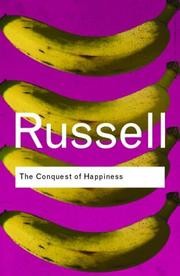
Russell's most beloved popular work; it introduces his clear, witty prose style and his empirical, unsentimental approach to ethics and the good life — the perfect entry point for an intermediate reader.
A collection of short, sharp essays on politics, education, and the dangers of dogmatism; reading it second reveals how Russell applies philosophical rigour to everyday social questions.
Russell's own account of his life ties together his personal relationships, political activism, and intellectual development, giving essential biographical scaffolding before diving into his philosophy.
Philosophy of Mind, Knowledge, and Science
IntermediateUnderstand Russell's epistemology and his theory of how we know the external world — the philosophical core that underpins both his popular writing and his technical logic.
▸ Study plan for this stage
Pace: 8–10 weeks, ~25–30 pages/day (approximately 2–3 weeks per book with time for reflection and exercises)
- Appearance vs. Reality: Russell's distinction between how things seem to us and how they actually are, and why this matters for philosophy
- Acquaintance and Description: The two fundamental ways we know things—direct acquaintance with sense-data and indirect knowledge through descriptions
- Sense-Data and the Problem of Perception: How Russell grounds knowledge in immediate sensory experience while accounting for illusion and error
- The External World Problem: How we can justify belief in a mind-independent physical world beyond our private sense-experiences
- Logical Construction and Inference: Russell's method of constructing knowledge of complex objects (like physical objects and other minds) from simpler elements
- The Role of Logic and Analysis: How logical analysis reveals the true structure of our knowledge and dissolves philosophical confusion
- Induction and Scientific Knowledge: How we move from particular observations to general laws and the limits of inductive reasoning
- Universals and Abstract Objects: How we know abstract entities like numbers, properties, and logical truths
- What is Russell's distinction between 'appearance' and 'reality,' and why does he think philosophy must grapple with this distinction?
- Explain the difference between knowledge by acquaintance and knowledge by description. Give concrete examples from Russell's work of each type.
- What is the problem of the external world, and how does Russell attempt to solve it using sense-data and logical construction?
- How does Russell account for perceptual error and illusion while maintaining that sense-data are the foundation of knowledge?
- What role does logical analysis play in Russell's epistemology, and how does it help resolve philosophical problems?
- According to Russell, how can we have knowledge of things we do not directly experience (e.g., other minds, the distant past, physical objects as they are in themselves)?
- Analyze a perceptual experience (e.g., looking at a table from different angles) and distinguish between the sense-data you experience and the inferred physical object. Write a 1–2 page reflection on what you can claim to know with certainty at each stage.
- Take a claim about the external world (e.g., 'There is a computer in front of me') and break it down into sense-data and logical inferences, following Russell's method of logical construction.
- Identify an instance of perceptual illusion or error in your own experience and explain how Russell's theory of sense-data accounts for why the illusion occurs while preserving the reliability of sense-data themselves.
- Write a dialogue between Russell and a skeptic about the external world, where Russell defends his position using acquaintance, description, and logical construction.
- Create a concept map showing how Russell's key epistemological concepts (acquaintance, description, sense-data, inference, universals) relate to and support each other.
- Select a passage from 'Our Knowledge of the External World' where Russell constructs knowledge of a complex object from simpler elements, and annotate it to show the logical steps and assumptions involved.
Next up: This stage equips you with Russell's foundational epistemology and his method of logical analysis, which you will now apply to his philosophy of language, metaphysics, and his critique of traditional philosophy in subsequent stages.
Russell's clearest and most concise statement of his epistemological views; written for a general audience yet philosophically rigorous, it is the ideal bridge from his popular essays to his deeper philosophy.
A more demanding follow-up that introduces logical analysis as a philosophical method, showing how Russell believed logic could dissolve traditional metaphysical puzzles — essential preparation for his logical writings.
Ethics, Politics, and Society
IntermediateEngage with Russell's systematic thinking on morality, power, and political organisation, seeing how his analytic method shapes his social philosophy.
▸ Study plan for this stage
Pace: 8–10 weeks, ~40–50 pages/day (accounting for Russell's dense analytical prose and the need for reflection on social arguments)
- Power as a fundamental social force: Russell's definition of power and its role in shaping human institutions, hierarchies, and social change
- The balance between power and liberty: how Russell argues for limiting concentrations of power while preserving individual freedom
- Rationality and irrationality in social organization: Russell's critique of how tradition, custom, and emotion override logical analysis in politics and morality
- The analytic method applied to ethics: how Russell breaks down moral questions into constituent parts rather than appealing to abstract principles or religious authority
- Sexual morality and social convention: Russell's challenge to traditional sexual ethics and his argument for rational, consent-based approaches to marriage and relationships
- The relationship between individual desire and social stability: Russell's examination of how personal fulfillment and collective order can coexist
- Institutional design for human flourishing: Russell's vision of how political and social structures should be reformed to promote both individual liberty and social welfare
- What is Russell's definition of power, and what are the main forms of power he identifies in *Power: A New Social Analysis*?
- How does Russell argue that power should be distributed and limited in a rational society, and what dangers does he identify in concentrated power?
- What is Russell's critique of traditional sexual morality in *Marriage and Morals*, and on what grounds does he challenge conventional marriage practices?
- How does Russell apply his analytic method to moral questions, and how does this differ from appeals to religious authority or abstract ethical principles?
- According to Russell, what role should individual desire and personal fulfillment play in a well-ordered society, particularly regarding marriage and sexuality?
- How does Russell connect his analysis of power in the political sphere to his arguments about morality and personal relationships?
- Map Russell's forms of power (military, economic, political, ideological) using contemporary examples from current events; identify which forms dominate in a specific institution you know well
- Write a 2–3 page analysis of a traditional social institution (e.g., a workplace hierarchy, a religious organization, or a family structure) using Russell's framework of power distribution and rationality
- Create a dialogue between Russell and a defender of traditional sexual morality, articulating both positions clearly and identifying where their disagreement is fundamentally empirical vs. normative
- Outline Russell's argument for why rational analysis should replace tradition in one specific moral domain (e.g., divorce, premarital relationships, or gender roles); identify potential counterarguments
- Construct a thought experiment testing Russell's claim that individual liberty and social stability can coexist; explore where tensions arise and how Russell's proposals would handle them
- Compare Russell's vision of rational social organization in *Power* with his prescriptions for personal relationships in *Marriage and Morals*; identify consistencies and tensions in his overall philosophy
Next up: This stage grounds Russell's method in concrete social and personal domains, preparing you to examine how his analytic approach extends to epistemology, metaphysics, and the foundations of knowledge itself in the next stage.
Russell's most sustained work of political philosophy; reading it after the epistemology stage shows how he applies the same analytical clarity to social structures and human motivation.
A provocative, historically important work on ethics and social convention that illustrates Russell's willingness to follow argument wherever it leads, regardless of orthodoxy.
Logic and the Foundations of Mathematics
ExpertComprehend Russell's revolutionary contributions to mathematical logic, the theory of descriptions, and the logicist programme — the technical heart of his intellectual legacy.
▸ Study plan for this stage
Pace: 12–14 weeks, ~40–50 pages/day, with 1–2 days per week for review and exercises. Allocate 4–5 weeks to *Introduction to Mathematical Philosophy*, 5–6 weeks to *The Principles of Mathematics*, and 2–3 weeks to Monk's biography for contextual integration.
- The theory of descriptions: how Russell's analysis of definite descriptions resolves logical and philosophical puzzles about reference and meaning
- Logicism: the thesis that mathematics is reducible to logic, and the technical apparatus Russell developed to defend it
- Classes, sets, and the paradoxes: understanding the logical foundations of set theory and how Russell's type theory addresses self-referential contradictions
- Propositional functions and quantification: the formal machinery underlying Russell's logical system and its application to mathematical reasoning
- The relationship between logic and language: how Russell's work reveals the structure of reality through careful logical analysis
- Russell's philosophical method: how technical logical innovation serves broader epistemological and metaphysical goals
- The historical and intellectual context of Russell's work: how early 20th-century mathematics and philosophy shaped his revolutionary approach
- What is the theory of descriptions, and how does it solve the problem of reference for expressions like 'the present King of France'?
- What is logicism, and what are the main technical steps Russell takes in *Introduction to Mathematical Philosophy* to reduce arithmetic to logic?
- Explain the paradoxes that motivated Russell's type theory. How does the distinction between different logical types resolve these paradoxes?
- What are propositional functions, and how do they serve as the foundation for Russell's treatment of classes and quantification?
- How does Russell's analysis of the foundations of mathematics differ from earlier approaches (e.g., Frege's), and what philosophical advantages does his system offer?
- What role does the theory of descriptions play in Russell's broader logicist programme, and why did he consider it philosophically significant?
- Work through Russell's analysis of definite descriptions in *Introduction to Mathematical Philosophy*: take 5–10 examples (both from the text and your own) and formally parse them using Russell's three-part analysis (existence, uniqueness, predication).
- Reconstruct the logical derivation of basic arithmetic (addition, multiplication, the natural numbers) from pure logic as presented in *Introduction to Mathematical Philosophy*, writing out key steps in symbolic form.
- Study the paradoxes discussed in *The Principles of Mathematics* (especially the class paradox and the paradox of the predicate): write a 2–3 page explanation of each paradox and how Russell's type theory resolves it.
- Create a detailed comparison chart mapping concepts across the two Russell texts: identify which ideas appear in both, how they evolve, and where *The Principles* deepens or revises *Introduction*.
- Solve 10–15 logical puzzles using Russell's framework: take sentences with ambiguous scope, quantifier interactions, or reference problems, and show how his theory of descriptions clarifies them.
- Read Monk's biography chapters on Russell's development of his logical system (1890–1910) and write a 3–4 page synthesis connecting the biographical narrative to the technical concepts you've studied, explaining how Russell's philosophical motivations shaped his logical innovations.
Next up: This stage equips you with mastery of Russell's technical logical apparatus and the foundational arguments for logicism, preparing you to examine how he applied these tools to epistemology, metaphysics, and the philosophy of language in subsequent stages.
Written by Russell himself while in prison, this is the most accessible entry into his logical work — it explains the ideas of Principia Mathematica in plain prose, making it the right first step into his technical thought.
Russell's first major logical treatise, less symbolic than Principia and still largely readable; it lays out the full logicist vision and is best tackled after the Introduction has built the necessary intuitions.

Monk's definitive scholarly biography (Volume 1) contextualises Russell's logical breakthroughs within his life and times, providing the critical perspective needed to assess his achievements and limitations at the close of the curriculum.
Discussion
Keep reading
Paths that share books, cover the same subject, or open a related topic.