Best Books on the History of Economic Thought, in Reading Order
Economics did not descend from the sky as a set of equations; it was argued into existence by moral philosophers, pamphleteers and civil servants responding to the crises of their own time. This path moves from a readable tour of the great economists, to a fuller narrative history, to the primary sources, to the twentieth-century fight between Keynes and Hayek that still structures policy, and finally to the technical history of the theory itself.
The tour
BeginnerMeet the major figures as people with problems to solve — Smith, Malthus, Ricardo, Marx, Veblen, Keynes, Schumpeter — and get a working sense of what each was reacting against.
▸ Study plan for this stage
Pace: 3 weeks for 342 pages, about 20 pages a sitting. The Worldly Philosophers is written in chapter-length portraits, so one economist per session is the natural rhythm and gives you time to hold each figure's problem in mind before Heilbroner moves on. Do not skip the opening chapter on why there were
- Heilbroner's founding premise: economics became possible only once a market society existed, because tradition and command had previously answered the questions economists ask
- Smith's system as Heilbroner presents it — self-interest disciplined by competition, the division of labour as the engine of growth, and a moral philosopher's suspicion of merchants throughout
- Malthus and Ricardo as the gloomy successors who turned Smith's optimism into iron laws about population, rent and the shrinking share going to profit
- Marx's arrival as an inversion: the same classical apparatus of value and accumulation turned into a prediction of the system's collapse
- Veblen as the outsider who described consumption as display and business as sabotage of industry, and who fits no school at all
- Keynes as the man who argued that an economy could settle at an equilibrium with mass unemployment and simply stay there
- Schumpeter's creative destruction and his gloomy forecast that capitalism would be undone by its own success, which is the mirror image of Marx's prediction
- Heilbroner's own thesis, stated in the closing chapters, that the great tradition of worldly philosophy has been replaced by technical modelling and that something was lost in the exchange
- What problem was each of Heilbroner's economists actually trying to solve? Answer for Smith, Ricardo, Marx, Keynes and Schumpeter in one sentence each — this is the single most useful thing to take from the book.
- Why does Heilbroner insist there could be no economics before market society? What were tradition and command answering that price signals later answered?
- Ricardo and Marx use much of the same machinery — a labour theory of value, a theory of rent, an account of the falling rate of profit — and reach opposite political conclusions. Where does the divergence begin?
- Schumpeter and Marx both predicted capitalism's end from opposite directions. What did each think would do the killing?
- Heilbroner argues economics stopped being worldly philosophy. Is that a loss, or the normal maturing of a field into a science?
- Build a one-page timeline of the figures Heilbroner covers, with each economist's dates, the crisis or condition they were responding to, and their central claim. You will annotate this sheet for the rest of the path.
- Write 150 words on Malthus's argument and then note what he did not anticipate. The failure mode of his prediction is instructive about all economic prediction.
- For any three economists, write down what Heilbroner clearly admires and what he clearly does not. He is a warm writer with definite politics and reading him for that is part of the training.
- Pick the figure you found least convincing and write half a page arguing their side better than Heilbroner does.
- List every economist you have heard of who does not appear in the book. Backhouse and Nasar will fill most of those gaps; note which they do not.
Next up: Heilbroner gives you memorable people and a rough map; the next stage replaces the portrait gallery with a continuous history that includes the figures and centuries he skips.

The classic introduction, in print since 1953, and still the most enjoyable way into the subject. It is a book of portraits rather than theory, which is exactly what you want before the theory.
A proper narrative history
BeginnerReplace Heilbroner's sketches with a continuous account of how ideas developed, including the figures and periods he passes over.
▸ Study plan for this stage
Pace: 7-8 weeks for about 940 pages. Backhouse's The Ordinary Business of Life covers two and a half millennia in 384 pages, so it is dense per page — three weeks, and treat the pre-1750 chapters as genuinely new material rather than a preamble. Grand Pursuit is 558 pages of biographical narrative and rea
- The long prehistory Heilbroner omits — scholastic doctrines on just price and usury, mercantilist pamphleteering, the Physiocrats and their vision of agriculture as the sole source of surplus
- Backhouse's insistence that economic ideas were always tied to contemporary policy disputes rather than developing as pure theory
- The marginal revolution of the 1870s, arrived at independently by Jevons, Menger and Walras, and why value shifted from labour embodied to utility at the margin
- Marshall's synthesis and the founding of economics as a professional academic discipline with a textbook, a journal and a training
- Nasar's organising claim: that the nineteenth century's great intellectual change was the belief that poverty was not a permanent condition of humanity but something that could be abolished
- The Fisher chapters as the underrated part of the book: monetary theory, debt deflation, and a reputation destroyed by one wrong prediction in 1929
- Sen as Nasar's endpoint, which reframes the whole narrative around capability and freedom rather than around output
- The difference between a survey that traces arguments (Backhouse) and a narrative that traces people (Nasar), and what each systematically misses
- What did the Physiocrats believe about where value originates, and how did Smith both borrow from and reject them?
- Why did three economists in three countries arrive at marginal utility within a few years of each other? Backhouse offers an answer — is it a good one?
- Nasar frames the era as the discovery that poverty could be ended. Whose work actually supports that framing, and which of her subjects would have rejected it?
- Compare Backhouse's treatment of Keynes with Nasar's. Where does the analytical survey see something the biography cannot, and vice versa?
- The marginal revolution moved value from production to preference. What did economics gain in tractability and what did it lose in its ability to talk about exploitation and distribution?
- Extend your timeline sheet backwards to the scholastics and mercantilists, adding for each period the policy dispute Backhouse says the ideas were serving.
- Write 300 words explaining marginal utility and diminishing marginal utility to someone who has read only Heilbroner. Being able to teach it is the test.
- Take Fisher's debt-deflation account from Nasar and write a paragraph on how well it describes 2008. She invites the comparison; make it yourself.
- For one figure covered by both books, write a paragraph on where Backhouse and Nasar emphasise differently, and say which account you would give a beginner.
- List the five most important economists you can now name that Heilbroner did not cover, with one sentence each on their contribution.
Next up: Two secondary accounts is enough second-hand reading; the next stage puts you in front of the founding text itself, where the received summaries start to look unreliable.
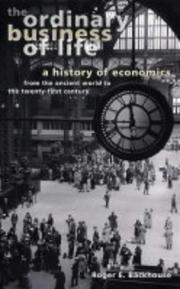
A historian's survey running from the ancient world to the late twentieth century, far more complete than Heilbroner and still written for the general reader. Published in Britain as The Penguin History of Economics.
Narrows to the century in which economists came to believe poverty could be abolished, from Marx and Marshall through Keynes to Amartya Sen. Nasar's biographical method makes the ideas stick where a survey cannot.
Go to the sources
IntermediateRead the founding text directly, and understand what Smith was actually arguing about — which is not what either of his modern camps claims.
▸ Study plan for this stage
Pace: 6-7 weeks. Do not attempt to read The Wealth of Nations cover to cover. Give three to four weeks to a serious sampling: Book I chapters 1-7 on division of labour, value and price, the pin factory and the invisible hand passage in Book IV chapter 2, Book IV's attack on the mercantile system, and Book
- The pin factory and the division of labour as Smith's actual opening move, with productivity rather than markets as the first subject of the book
- That the invisible hand appears exactly once in The Wealth of Nations, in a passage about domestic versus foreign investment, and does not carry the general theorem later attributed to it
- Smith's repeated hostility to merchants and manufacturers — the passage on people of the same trade seldom meeting without a conspiracy against the public — which sits in the same book as the case for free trade
- His endorsements of public education, public works, progressive taxation of luxury and regulation of banking, which complicate every attempt to enlist him for laissez-faire
- The relationship to The Theory of Moral Sentiments, and the so-called Adam Smith Problem of reconciling sympathy with self-interest, which Rothschild treats as a nineteenth-century invention
- Rothschild's central historical claim: that Smith and Condorcet were Enlightenment political thinkers, and that the conservative and technical Smith of the nineteenth century is a construction
- Her recovery of Condorcet, and the argument that a whole strand of Enlightenment economic thought was written out after the French Revolution made it dangerous
- The general lesson about canonical texts: what the reception history does to a book is a separate object of study from the book itself
- Read the invisible hand passage in its full context in Book IV. What is the claim actually about, and how far does it license the general use the phrase now carries?
- Collect Smith's own list of proper functions of the sovereign from Book V. Is this the programme of a laissez-faire economist?
- Rothschild argues the nineteenth century rewrote Smith. What specific evidence does she offer, and can you verify any of it against the passages you have read?
- Smith attacks merchants and defends free trade in the same work. Are these positions in tension, or is the second a consequence of the first?
- Both the political left and right claim Smith. Having read him directly, what does each side have to ignore to do so?
- Copy out the invisible hand paragraph in full, then write a paragraph of your own on what it would take for the sentence to support the modern theorem. This single exercise is worth the whole stage.
- Assemble a page of quotations from Smith that a market liberal would use, and a page a social democrat would use. Both pages should be easy to fill, which is the finding.
- Read the first three chapters of Book I and write 250 words on Smith's account of why specialisation raises output, without using the phrase division of labour.
- Take one of Rothschild's claims about how Smith was later read and check it against a modern textbook or popular article. Write half a page on what you find.
- Write a short note on Condorcet's position as Rothschild presents it, and on why it disappeared from the canon.
Next up: Having seen how thoroughly a founding text can be reshaped by its readers, you are ready for the twentieth-century argument in which two rival readings of markets became rival governments.
There is no substitute for reading Book I and the famous passages on the invisible hand in their real context, where they sit alongside attacks on merchants and defences of public education. Sample it rather than grinding straight through.

Recovers Smith and Condorcet as Enlightenment political thinkers and shows how thoroughly the nineteenth century rewrote them. Read it immediately after Smith, while you can still check her claims against the text.
The great twentieth-century argument
IntermediateFollow the Keynes–Hayek dispute from the 1930s through the Mont Pelerin Society to the policy revolutions of the 1980s, and see how an academic disagreement became a governing ideology.
▸ Study plan for this stage
Pace: 14-16 weeks — the longest stage by far, and the one to pace deliberately. Wapshott's Keynes Hayek first, three weeks, for the personalities and the shape of the dispute. Skidelsky's John Maynard Keynes next; this is the major biography and should be given four to five weeks, read for the intellectua
- Keynes's core claim in the General Theory: that aggregate demand determines output, that an economy can rest at an underemployment equilibrium, and that saving and investment are decided by different people for different reasons
- Hayek's Austrian alternative: that credit expansion distorts the structure of production over time, and that recession is the necessary correction of malinvestment rather than a demand shortfall
- The deeper Hayekian argument that runs beneath the macroeconomics — dispersed knowledge, prices as signals, and the claim that no planner can assemble what the market computes
- Skidelsky's picture of Keynes as a Bloomsbury moralist and Treasury insider, and his reading of the General Theory as a book about uncertainty rather than about fiscal stimulus
- Burgin on the Mont Pelerin Society: how a defeated position was rebuilt through institutions, funding and patient organisation, and how Hayek's cautious classical liberalism gave way to Friedman's more confident and popular version
- Stedman Jones on the transmission from seminar to statute — think tanks, journalists, sympathetic politicians — and the argument that the 1970s crisis created the opening rather than the ideas creating themselves
- Appelbaum's charge that the ascent of economists into policymaking produced measurable costs in inequality, deregulation and a narrowed conception of what policy is for
- The unresolved core: whether the 1980s vindicated Hayek, whether 2008 vindicated Keynes, and the fact that serious economists still disagree about both
- State the Keynesian and the Austrian explanation of a recession, each in its strongest form and in the terms its own proponents use. Then say what evidence would distinguish them.
- Skidelsky insists the General Theory is about uncertainty. How does that reading change what Keynesian policy is supposed to be for, compared with the textbook multiplier version?
- Hayek's knowledge argument and his business cycle theory are logically separable. Which has worn better, and does accepting one commit you to the other?
- Burgin and Stedman Jones both describe an intellectual movement organising for influence. Is that an indictment, or simply what any successful set of ideas has to do? Ask the same question of the Keynesian consensus it replaced.
- Appelbaum argues economists were given too much authority. What would the counterargument be, and what would the counterfactual policy record have looked like?
- Three of the five books in this stage are broadly critical of the market-liberal turn. What is the strongest defence of that turn, and where in these books can you find it stated fairly?
- Write two one-page accounts of the same downturn — 1929, 1979 or 2008 — one strictly Keynesian and one strictly Hayekian. Do not indicate which you prefer.
- From Skidelsky, extract the sequence of Keynes's own changes of mind from the Treatise on Money to the General Theory, and note what problem each change was meant to solve.
- Build a timeline from 1947 to 1990 with three tracks — institutions founded, books published, policies enacted — using Burgin and Stedman Jones. Draw an arrow only where a documented link exists.
- Take one specific policy Appelbaum criticises, find the economic argument originally made for it, and write a paragraph stating that argument sympathetically before stating his objection.
- Read the Keynes-Hayek Economica exchange itself if you can find it, and write half a page on whether Wapshott's summary is fair to both.
- Write a page on what you think would actually settle the dispute, and then on why it has not been settled.
Next up: You have now seen the ideas as politics; the final stage strips the personalities out and examines the analytical machinery on its own terms.
The accessible dual account of the rivalry that organises modern macroeconomics. Start the stage here for the personalities and the stakes.

The standard biography, and the best available explanation of what the General Theory was trying to do and why. Skidelsky treats the economics as inseparable from the man and the moment.

An archival history of how Hayek, Friedman and the Mont Pelerin Society rebuilt the case for markets after 1945. It shows the losing side of Wapshott's story organising for a rematch.

Traces how those ideas travelled from seminar rooms into the Thatcher and Reagan governments. Read it after Burgin — same movement, later chapter, more attention to politics.

A journalist's account of the decades in which economists took over policymaking, and of what that cost. The right closing book for this stage because it asks whether the whole discipline earned its authority.
The technical history of the theory
IntermediateWork through the internal development of economic analysis — value theory, marginalism, general equilibrium — at the level a graduate course would expect.
▸ Study plan for this stage
Pace: 12-14 weeks for over 1,200 demanding pages. Blaug's Economic Theory in Retrospect is a graduate text with algebra and diagrams and cannot be read quickly — six to seven weeks at roughly 100 pages a week, working the reasoning rather than reading past it. Sandmo's Economics Evolving takes five to six
- Blaug's method, which is the point of the book: reconstruct each historical theory in modern analytical terms and then ask whether the argument is valid, not merely whether it was influential
- His distinction between absolutist and relativist history of economics — judging theories against present knowledge versus against their own context — and his open preference for the first
- Classical value theory worked through properly: labour theories of value, Ricardo's invariable measure problem, rent as a differential surplus, and where each construction breaks
- The transformation problem in Marx, set out formally, and what its unresolved status does and does not imply for the rest of Marx's system
- The marginal revolution as an analytical event: diminishing marginal utility, the equimarginal principle, and the shift from cost-based to demand-based explanations of price
- Walras and general equilibrium — existence, the tâtonnement story, and how much of modern theory is a working-out of this one construction
- Sandmo's fuller treatment of the twentieth century: welfare economics, public economics, information and uncertainty, and game-theoretic approaches Blaug covers only lightly
- The recurring theme that theories are usually abandoned for internal analytical reasons as often as for empirical failure, which is uncomfortable for anyone who thinks economics is straightforwardly a science
- State Ricardo's problem of an invariable measure of value precisely, and explain why it cannot be solved within his framework.
- Set out the transformation problem formally. What exactly is it that fails to transform, and which parts of Marx's argument survive the failure?
- Blaug advocates judging past theories by present standards. What does that method see clearly, and what does it systematically distort about why people believed what they did?
- Explain what a Walrasian general equilibrium is and what has to be assumed for one to exist. Then say which of those assumptions you think does the most damage in application.
- Where does Sandmo revise or extend Blaug's account, and are the differences analytical or a matter of what each thinks worth covering?
- After the whole path: has economics progressed in the way a science progresses, or has it changed subject repeatedly while keeping the name? Argue it from the analytics, not from the politics.
- Work through Blaug's reconstruction of Ricardian rent with pencil and paper until you can derive the differential rent result unaided.
- Do the same for the marginal productivity theory of distribution, and write 200 words on what it assumes about factor markets.
- Set out the transformation problem numerically with a small example of your own construction, and show where the two aggregate equalities fail to hold simultaneously.
- For any three theories Blaug examines, write one line each on whether it was displaced by evidence, by internal inconsistency, or by a change in what economists wanted to explain.
- Take your timeline sheet from stage one and, now that you have finished, annotate each figure with the analytical contribution rather than the biography. The difference between the two versions of that sheet is a fair measure of what the path taught you.
Next up: You finish able to read a modern economics paper as the current move in an argument that is two and a half centuries old, and to tell which of its assumptions are results and which are inheritances.

The standard advanced text, which reconstructs each historical theory in modern terms and asks whether it holds up. Demanding, and it assumes you can follow the analytics.

A more recent and slightly gentler counterpart to Blaug, strong on the marginal revolution and on twentieth-century developments Blaug treats briefly. Finish here for the most current scholarly synthesis.
Discussion
Keep reading
Paths that share books, cover the same subject, or open a related topic.