The obvious plan for this subject is to read the great economists in chronological order, starting with Adam Smith. It is the wrong plan, and it is where most attempts die. Eighteenth and nineteenth-century economic writing was aimed at readers who already knew the controversy it was intervening in, and without that context the prose is simply long. Take a narrative overview first and the primary sources become readable, because you know what each author is arguing against.
The second thing to sort out early is that this subject has two literatures. One is the history of ideas, written for general readers, organised around personalities. The other is history of economic analysis, written for economists, organised around technical problems. Both are worth having; mixing them at random produces the impression that the subject is either gossip or algebra.
The narrative overviews
The worldly philosophers by Robert L. Heilbroner is still the standard entry point, and has introduced more people to this subject than everything else in the path combined. It is also old, its coverage stops well short of the present, and its portraits are shaped by the mid-century context in which it was written. Read it for momentum, not for the last word.
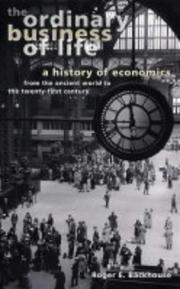
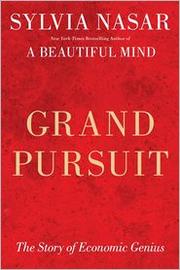
The Ordinary Business of Life by Roger E. Backhouse is the more even-handed survey, running from the ancient world forward and treating economics as an evolving practice rather than a relay of geniuses. Grand Pursuit by Sylvia Nasar narrows to the modern era and is the most enjoyable of the three, built around individual lives from Marx and Marshall through Keynes to Amartya Sen. Nasar's selection is a point of view, and specialists have argued with it.
Smith, properly
Now The Wealth of Nations. Go in knowing that it is long, digressive, and that the two passages everyone quotes are unrepresentative of the whole — Smith spends far more time on wages, institutions and the failures of merchants than on anything resembling market triumphalism. Economic Sentiments by Emma Rothschild reads Smith alongside Condorcet and puts him back into the political argument of his own moment, which is the fastest correction to the version of Smith you have absorbed secondhand.
The argument that defined the twentieth century
Keynes Hayek by Nicholas Wapshott is the accessible dual narrative of the rivalry. Then the depth: John Maynard Keynes by Robert Jacob Alexander Skidelsky is the definitive life, and our catalogue holds it under the author's full formal name.
The other side of that argument gets three books that do not fully agree. The Great Persuasion by Angus Burgin traces the Mont Pelerin circle and argues for a real discontinuity between the early and later generations. Masters of the universe by Daniel Stedman Jones treats the transmission of those ideas into Anglo-American policy as a deliberate and well-funded project. The Economists' Hour by Binyamin Appelbaum is the journalistic account of what followed, and is openly critical of it. These are three different explanations of the same transformation, written from different positions. Read them as a set and the disagreement is the point.
The technical histories
Economic theory in retrospect by Mark Blaug is the classic scholarly treatment, organised around the analytical content of each theory rather than around biography. It assumes intermediate economics and will be hard going without it. Economics Evolving: A History of Economic Thought by Agnar Sandmo is the friendlier modern equivalent and the better choice if you have the mathematics but not the specialism.
You can stop after the narrative overviews and Smith and still have gained something real. The two technical books are for readers who want to see how the analysis was actually built. The full path carries the study plan for each stage.
Follow the full ordered path here: The History of Economic Thought: A Reading Order.
Ready to learn something deeply?
Build a reading path — free