Best Books on the Great Migration, in Reading Order
This curriculum traces the Great Migration from its roots in Southern oppression through its transformation of Northern and Western cities and its lasting imprint on American culture, politics, and identity. Starting with vivid narrative history, the path moves through sociological depth, intimate memoir, and finally specialized scholarship — each stage building the conceptual and historical vocabulary needed for the next.
Foundations: The Story and the Stakes
BeginnerUnderstand what the Great Migration was, why it happened, and grasp its human scale through compelling narrative before encountering deeper analysis.
▸ Study plan for this stage
Pace: 4–5 weeks, ~40–50 pages/day (approximately 300 pages total; allows time for reflection and note-taking)
- The Great Migration was the movement of approximately 6 million African Americans from the rural South to urban centers in the North, Midwest, and West between 1916 and 1970
- Push factors (Jim Crow laws, racial violence, economic exploitation, sharecropping) and pull factors (industrial jobs, relative freedom, educational opportunities) drove individual and family decisions to migrate
- The three protagonists—Ida Mae, George, and Robert—represent different routes, timelines, and outcomes of the migration, illustrating its diversity and complexity
- Migration was fundamentally a personal and family decision rooted in the desire for dignity, safety, and economic opportunity, not merely a demographic statistic
- The Great Migration reshaped American cities, culture, and demographics while creating new forms of racial segregation and tension in the North
- Migrants faced discrimination, exploitation, and cultural displacement even as they built new communities and achieved upward mobility
- What were the primary push and pull factors that motivated African Americans to leave the South during the Great Migration?
- How do the life stories of Ida Mae, George, and Robert illustrate different experiences and outcomes within the Great Migration?
- What specific challenges did migrants face upon arriving in Northern cities, and how did they overcome them?
- How did the Great Migration change the demographic, cultural, and political landscape of American cities?
- What does Wilkerson mean by 'the warmth of other suns,' and how does this phrase capture the migrants' aspirations and experiences?
- How did the Great Migration create new forms of racial segregation and inequality in the North, despite migrants' hopes for freedom?
- Create a timeline of the Great Migration (1916–1970) marking key events, policy changes, and historical moments that affected migration patterns; annotate with how these events appear in Wilkerson's narrative
- Trace the three protagonists' journeys on a map, noting their starting points, destinations, routes taken, and major life events; write a 1–2 page reflection on what their geographic choices reveal about their priorities and constraints
- Conduct a 'character interview' exercise: write 5–7 interview questions you would ask Ida Mae, George, or Robert about their migration decision, then answer them based on Wilkerson's account
- Identify 3–4 passages in the book that powerfully illustrate the human stakes of migration; annotate each with your response and explain why it moved you or changed your understanding
- Research one Northern city mentioned in the book (Chicago, Detroit, Los Angeles, etc.) and create a 1-page profile of its African American community during the migration era, connecting it to details from Wilkerson's narrative
- Write a 2–3 page personal reflection: If you had been a young African American in the Jim Crow South, would you have migrated? What would have influenced your decision? Use specific examples from the book to ground your reasoning
Next up: This stage establishes the human stories and emotional stakes of the Great Migration, preparing readers to engage with deeper historical analysis, structural causes, and long-term consequences in subsequent stages.
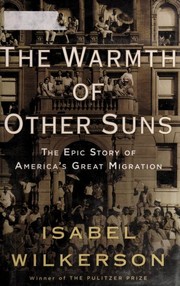
The essential starting point — a Pulitzer Prize-winning narrative that follows three real migrants across decades, making the causes, journeys, and destinations viscerally real before any other reading.
The Cities They Remade
BeginnerSee how migrants reshaped specific Northern cities — Chicago, Harlem, Detroit — and how those cities both welcomed and brutally constrained the newcomers.
▸ Study plan for this stage
Pace: 4–5 weeks, ~40–50 pages/day. Start with "Black Metropolis" (2–3 weeks, given its dense sociological analysis), then move to "The Promised Land" (2 weeks). Build in time for reflection between books.
- The spatial and economic structure of Black Chicago: how migrants navigated segregation, housing discrimination, and occupational stratification in the South Side
- The concept of the 'Black Belt' and 'ghetto' as both community and constraint: how concentrated settlement enabled cultural institutions but also reinforced racial boundaries
- The role of institutions (churches, businesses, newspapers, social organizations) in building parallel economies and social life within segregated cities
- The Great Migration as a push-pull phenomenon: why Southern conditions (sharecropping, Jim Crow violence) drove migration and what Northern cities promised (jobs, freedom, dignity) versus what they actually delivered
- The tension between opportunity and oppression: how Northern cities offered economic mobility and relative freedom compared to the South, yet maintained systematic racial discrimination through redlining, employment barriers, and police violence
- Detroit and Harlem as distinct urban experiences: how different industries (auto manufacturing vs. entertainment/services), migration patterns, and local policies shaped each city's Black community differently
- The role of individual agency and family networks in migration decisions: how personal stories reveal both structural forces and human choice
- What were the main push factors (conditions in the South) and pull factors (conditions in Northern cities) that drove the Great Migration, as illustrated in 'The Promised Land'?
- How did residential segregation and housing discrimination shape the economic and social life of Black communities in Chicago, Detroit, and Harlem, according to 'Black Metropolis'?
- What institutions (economic, religious, cultural) did Black migrants establish in Northern cities, and what role did they play in building community life under segregation?
- How did the promise of the North differ from the reality that migrants encountered, and what does this reveal about Northern racism versus Southern racism?
- Compare the experiences of Black migrants in Chicago, Detroit, and Harlem: what were the key differences in opportunity, industry, and community formation?
- What does 'Black Metropolis' suggest about the relationship between segregation and Black institutional development—did segregation enable or hinder community building?
- Create a two-column chart: 'South (Push Factors)' vs. 'North (Pull Factors)' based on Lemann's narratives. Include specific examples of violence, economic conditions, and promises from both books.
- Map the South Side of Chicago using details from 'Black Metropolis': identify the Black Belt boundaries, key institutions (churches, businesses, newspapers), and segregation lines. Annotate with quotes about how geography shaped daily life.
- Write a 2–3 page comparative profile of three cities (Chicago, Detroit, Harlem) using both books: for each, note the dominant industry, migration sources, key institutions, and the specific forms of racial constraint migrants faced.
- Select one family narrative from 'The Promised Land' (e.g., the Starks or another featured family) and trace their migration journey. Write a 1–2 page analysis of how their individual choices were shaped by structural forces described in 'Black Metropolis'.
- Create a timeline of key events and conditions (1910–1970) that shaped the Great Migration and urban Black life, pulling dates and events from both books. Annotate with turning points in policy, violence, or economic opportunity.
- Conduct a close reading of one chapter from 'Black Metropolis' on a specific institution (church, business, newspaper) and one family story from 'The Promised Land' that intersects with that institution. Write a 2–page analysis of how individual agency and institutional structure interact.
Next up: This stage grounds you in the lived reality of specific Northern cities and the tension between promise and constraint; the next stage will likely examine the long-term consequences of segregation, deindustrialization, and systemic inequality that emerged from the patterns established during the Great Migration era.
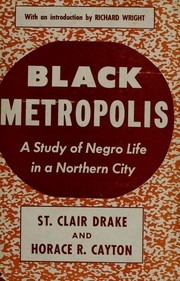
A landmark sociological portrait of Chicago's South Side — the single greatest destination of the Migration — revealing the vibrant community and the iron cage of the 'Black Belt' that migrants built and were confined to.
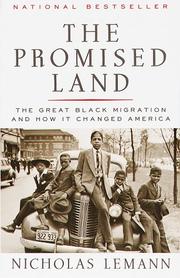
Focuses on the Mississippi-to-Chicago corridor through individual lives, bridging Wilkerson's narrative style with sharper policy analysis of housing, welfare, and urban politics.
Culture, Identity, and the Harlem Renaissance
IntermediateUnderstand how the Great Migration ignited an explosion of Black artistic, intellectual, and political life, and how migrants forged a new African American identity in the urban North.
▸ Study plan for this stage
Pace: 6–8 weeks total: Weeks 1–4 for "When Harlem Was in Vogue" (~25–30 pages/day, including time to pause on key figures and movements); Weeks 5–8 for "Blues People" (~15–20 pages/day, with slower, more reflective reading to absorb Baraka's musicological and sociological arguments).
- The Great Migration as cultural catalyst: how the mass movement of Black Southerners to Northern cities created the demographic and psychic conditions for the Harlem Renaissance
- The 'New Negro' ideology: the shift from accommodation to assertive Black identity, pride, and self-representation, as traced by Lewis through Harlem's intellectual and artistic circles
- Patronage, politics, and the double bind: how the Renaissance was shaped — and constrained — by white patrons, publishers, and audiences, and the tension this created for Black artists seeking authentic expression
- Intra-racial class and ideological conflict: the debates between figures like Du Bois, Garvey, and Locke over the direction of Black political and cultural life, as documented in Lewis's narrative
- Blues as a socio-historical document: Baraka's central argument that African American music is not merely aesthetic but a direct record of the social, economic, and spiritual conditions of Black life
- The continuum from African roots to American blues: Baraka's tracing of how enslaved Africans' musical traditions were transformed by the experience of slavery, Reconstruction, and migration into distinctly American forms
- Music and assimilation vs. resistance: Baraka's analysis of how different musical forms (field hollers, work songs, classic blues, urban blues) reflect varying degrees of accommodation to or rejection of white American culture
- The urban North as creative crucible and site of disillusionment: how both Lewis and Baraka show that Northern cities promised liberation but also imposed new forms of alienation, commercialization, and identity negotiation
- According to Lewis in 'When Harlem Was in Vogue,' what specific social, political, and economic conditions produced by the Great Migration made Harlem the epicenter of Black cultural life in the 1920s?
- How does Lewis portray the tension between 'uplifting the race' through respectable art and the raw, vernacular expression found in jazz clubs and rent parties — and which figures embodied each side of this debate?
- What is Baraka's core thesis in 'Blues People' about the relationship between the social position of African Americans and the music they produced, and how does migration factor into that argument?
- How does Baraka distinguish between the blues as a music of resistance rooted in Black communal experience and the later commercialization of blues and jazz for white audiences — and what does he see as lost in that transition?
- Taken together, how do Lewis and Baraka present the tension between cultural authenticity and mainstream (white) acceptance as a defining challenge of African American artistic life in the early-to-mid 20th century?
- How did the Great Migration, as depicted across both books, reshape African American identity — not just geographically, but psychologically, politically, and artistically?
- Migrant-to-artist mapping: After reading Lewis, create a one-page visual map connecting at least six major Harlem Renaissance figures (e.g., Langston Hughes, Zora Neale Hurston, Marcus Garvey, Alain Locke) to their Southern or Caribbean origins, their ideological positions, and their art forms — tracing how their migrant backgrounds shaped their work.
- Close-reading journal: Select two passages from 'When Harlem Was in Vogue' that illustrate the tension between Black artistic autonomy and white patronage. Write a 300-word reflection on how Lewis frames this tension and whether he sympathizes with any particular position.
- Listening log with Baraka as guide: Using 'Blues People' as your analytical lens, listen to three recordings that span Baraka's musical continuum (e.g., a field holler or early spiritual, a classic Delta blues, and an urban Chicago blues). For each, write a short paragraph applying Baraka's framework: What social conditions does this music reflect? Who is the intended audience?
- Debate preparation: Stage a written debate (500–700 words total) between a fictional Du Bois-aligned 'Talented Tenth' advocate and a Garveyite, using evidence drawn specifically from Lewis's account of their real-world conflict. Then add a third voice — Baraka's — weighing in on whether either vision adequately honored the blues tradition.
- Comparative thesis essay: Write a 600–800 word essay arguing how Lewis's Harlem Renaissance and Baraka's blues history are telling the same story from different angles. What does each book see that the other misses? Use at least two specific examples from each book.
- Timeline synthesis: Build a dual-track timeline from roughly 1910–1950. On one track, plot key events from Lewis (migration waves, the Renaissance's rise and decline, the Depression's impact). On the other, plot Baraka's musical milestones. Annotate three points where the two tracks directly illuminate each other.
Next up: By establishing how the Great Migration forged new Black cultural and political identities through art, music, and intellectual debate, this stage lays the essential foundation for examining the structural and socioeconomic realities — housing, labor, segregation — that shaped and constrained those same migrant communities in the urban North.
The definitive account of the Harlem Renaissance — the cultural flowering that was a direct product of the Migration — showing how art, literature, and politics became tools of self-definition for a newly urbanized people.

Traces how the blues and jazz — carried North by migrants — transformed into the foundation of American popular music, connecting cultural identity to the geographic journey already established.
Structural Forces: Race, Housing, and Inequality
IntermediateAnalyze the systemic mechanisms — redlining, restrictive covenants, white flight — that shaped where migrants could live and work, and understand how those structures created inequalities that persist today.
▸ Study plan for this stage
Pace: 6–7 weeks, ~40–50 pages/day. Start with "The Color of Law" (approximately 480 pages over 3 weeks), then move to "Family Properties" (approximately 400 pages over 3–4 weeks). Build in review and reflection time at the end of each book.
- Redlining as federal policy: How the Home Owners' Loan Corporation (HOLC) systematized racial discrimination in mortgage lending through color-coded maps, making it official government practice rather than individual prejudice
- Restrictive covenants: Legal mechanisms that explicitly prohibited property sales to Black families and other minorities, enforced through courts and neighborhood associations, creating segregated enclaves by law
- White flight and suburban development: How federal housing subsidies (FHA loans, VA loans) were deliberately directed to white suburban developments while being denied to Black neighborhoods, accelerating segregation and wealth accumulation disparities
- Predatory lending and contract selling: The exploitative practices documented in 'Family Properties' where Black families were sold homes on unfavorable contracts with hidden terms, leading to dispossession and financial ruin
- Intergenerational wealth gaps: How exclusion from homeownership and equity-building during the post-WWII boom created lasting economic disadvantages that compound across generations
- The myth of 'natural' segregation: Understanding that residential segregation was not organic or inevitable but deliberately engineered through policy, law, and institutional practice
- Persistence of structural inequality: How historical policies created geographic and economic patterns that continue to disadvantage Black communities today, even after formal legal changes
- What was the HOLC and how did its color-coded maps institutionalize racial discrimination in lending? How did this differ from informal prejudice?
- Explain the mechanism of restrictive covenants: How did they work legally, who enforced them, and what made them so difficult to challenge?
- How did federal housing policies (FHA loans, VA loans, suburban development subsidies) systematically direct wealth to white families while excluding Black families? Provide specific examples from the books.
- What were the predatory practices of contract selling documented in 'Family Properties,' and how did they differ from traditional mortgages? Why were Black families particularly vulnerable to these schemes?
- How do the historical policies described in both books explain current racial wealth gaps and residential segregation? What evidence do the authors provide that these are structural rather than individual failures?
- Compare the mechanisms of exclusion across the two books: How did legal/governmental tools (redlining, covenants) work alongside market-based exploitation (contract selling) to achieve segregation?
- Map your own neighborhood: Research the HOLC maps for your city or a nearby city (available online through the University of Richmond's Mapping Inequality project). Identify which areas were redlined, compare to current demographic and economic data, and write a 2–3 page analysis of how historical maps correlate with present-day inequality.
- Trace a restrictive covenant: Find an actual restrictive covenant from a property deed in your state or region (many are available through county records or historical societies). Transcribe it, identify the specific prohibitions, and research when/if it was formally removed. Reflect on what it meant to live under such legal restrictions.
- Contract selling case study: Using 'Family Properties' as your primary source, select one family's story (e.g., the Shelleys or another featured family) and create a detailed timeline showing: (a) the contract terms, (b) what they were promised vs. what happened, (c) the financial impact, (d) legal attempts to challenge it. Present findings in a 3–4 page case study.
- Comparative policy analysis: Create a chart comparing redlining, restrictive covenants, and contract selling across three dimensions: (1) Who benefited? (2) Who was harmed? (3) What legal/institutional mechanisms made it possible? Write a 2-page synthesis explaining how these three tools worked together as a system.
- Interview or oral history project: If possible, interview someone (family member, community elder, or local historian) who lived through or witnessed the effects of these policies. Record their account and write a 2–3 page reflection connecting their experience to the structural mechanisms described in the books.
- Document analysis: Select 3–5 primary source documents referenced in either book (e.g., HOLC guidelines, FHA underwriting standards, contract selling agreements, court decisions). Annotate them for language that reveals assumptions, biases, or explicit discrimination. Write a 2-page analysis of how the language of policy encoded racial hierarchy.
Next up: This stage establishes the structural foundations of segregation and inequality, preparing you to examine how these systems were resisted, challenged, and sometimes reformed—and how communities built power and resilience in response to these constraints.

Provides the clearest, most rigorous account of how federal, state, and local governments deliberately segregated American cities — essential for understanding the structural ceiling migrants hit after arriving.

A deeply researched case study of Chicago's contract-buying predatory housing schemes that stripped Black migrant families of wealth, showing the Color of Law's abstractions through devastating human stories.
Legacy and Long View
ExpertSynthesize the Migration's full arc — its political consequences, its second wave, and its contested legacy — and engage with the scholarly debates that define the field today.
▸ Study plan for this stage
Pace: 8–10 weeks, ~40–50 pages/day (with 2–3 days per week for synthesis and reflection)
- Structural racism and institutional gatekeeping: how postwar housing policy, urban renewal, and redlining created second ghettos despite legal desegregation
- The criminalization of blackness: how crime statistics were weaponized to justify segregation and police control, obscuring systemic inequality
- The second wave of the Great Migration: its different character, destinations, and economic/social outcomes compared to the first wave
- White flight and suburban development: the deliberate spatial reorganization of American cities that reinforced racial hierarchy after 1945
- The role of data, science, and expertise in legitimizing racial inequality: how ostensibly neutral metrics became tools of racial control
- Contested periodization and causality: scholarly debates over when the Migration 'ended' and what forces drove demographic change
- The persistence of migration-era patterns: how early 20th-century movements shaped late 20th-century inequality and contemporary segregation
- How did postwar urban policy in cities like Chicago create a 'second ghetto' that was legally different but functionally similar to pre-war segregation?
- What is Khalil Gibran Muhammad's central argument about the relationship between crime statistics and the construction of racial categories in American thought?
- How did the second wave of the Great Migration differ from the first wave in terms of destinations, timing, and economic opportunities?
- What role did white flight and suburban development play in reshaping American cities, and how did federal policy enable or accelerate this process?
- How do Hirsch and Muhammad each use historical evidence to challenge the idea that segregation was simply the result of individual prejudice or 'natural' demographic sorting?
- What unresolved scholarly debates exist about the causes, periodization, and long-term consequences of the Great Migration?
- Create a detailed timeline of Chicago's urban transformation from 1940–1970 using Hirsch's evidence, marking key policy decisions, demographic shifts, and spatial changes
- Analyze a primary source document (census data, policy memo, or newspaper article) from Muhammad's book and explain how it was used to construct or reinforce racial categories
- Map the geography of segregation: using Hirsch's case studies, draw or digitally create a map showing redlined neighborhoods, urban renewal sites, and white flight patterns
- Write a 1,500-word comparative essay: How do Hirsch's and Muhammad's explanations of segregation and inequality differ in scope, methodology, and historical causation?
- Conduct a 'data audit': select one crime statistic or demographic claim from Muhammad's book and trace how it was collected, interpreted, and deployed in policy or public discourse
- Debate preparation: develop arguments for and against the proposition that 'the Great Migration was fundamentally a story of structural constraint rather than individual choice,' using evidence from both books
Next up: This stage equips you to recognize how migration patterns, institutional racism, and the weaponization of data created the contemporary American landscape—preparing you to examine how these historical forces continue to shape present-day inequality, policy debates, and social movements.
A landmark work of urban history showing how Chicago's postwar urban renewal programs deliberately dismantled migrant communities, forcing a reckoning with the Migration's unfinished and often tragic legacy.

Examines how crime statistics and social science were weaponized against Black migrants to justify segregation and stigma — the ideal capstone for understanding how the Migration's story was told, distorted, and contested.
Discussion
Keep reading
Paths that share books, cover the same subject, or open a related topic.