Between roughly 1915 and 1970, about six million Black Americans left the South for cities in the North, Midwest, and West. It is one of the largest internal movements of people in American history, and it is usually taught as a paragraph. The reason to read it properly is that it explains the shape of the twentieth-century American city — where people live, what they own, and why the wealth gap persisted after formal segregation ended.
The order that works is: the human story of leaving, then what the arrival cities actually were, then the policy machinery that decided what migrants could buy and where. Start with policy and the numbers stay abstract; start with the migration and the policy books become infuriating in the right way.
The leaving
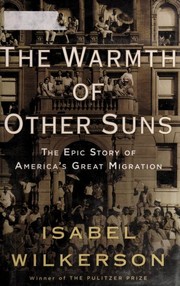
Begin with The Warmth of Other Suns. Isabel Wilkerson follows three people out of the South along the three main migration routes — a sharecropper's wife to Chicago, a fruit picker to Los Angeles, a doctor to Harlem — across decades, built from over a thousand interviews. It is the book that turned the migration into a narrative people could hold, and it establishes the essential point that these were individual decisions made under threat, not a demographic drift.
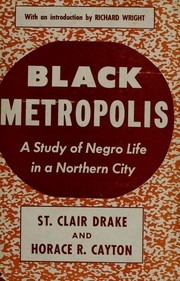
Then read Black metropolis, the 1945 sociological study of Chicago's South Side by St. Clair Drake and Horace Cayton. It is a period document and a landmark of urban sociology, describing a Black city-within-a-city with its own churches, businesses, press, and class structure. Nothing conveys as precisely what migrants built once they arrived.
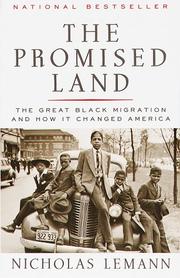
The Promised Land, Nicholas Lemann's history, connects the Mississippi Delta to Chicago and then to federal policy, following the migration into the debates over welfare, the War on Poverty, and the making of urban policy. It is the book that carries the story past arrival.
What the cities became
When Harlem was in vogue gives you the cultural flowering the migration made possible — David Levering Lewis on the Harlem Renaissance, its writers and patrons, and the tensions between artistic ambition and white sponsorship. Blues people is Amiri Baraka's argument that the music itself is a historical record: the movement from country blues to urban blues to bebop tracks the movement of people, and the changes in the form encode the changes in the conditions. It is polemical and it is worth reading as an argument.
How the cities were built to contain them
This is where the path turns. The Color of Law is Richard Rothstein's documentation that residential segregation in the North was not incidental but produced by government — federal mortgage insurance that redlined Black neighbourhoods, public housing sited to reinforce racial boundaries, and enforced restrictive covenants. It is the single most useful book here for understanding why the migration did not translate into accumulated wealth.
Family Properties narrows to Chicago and to the contract-buying schemes that stripped equity from Black homebuyers denied conventional mortgages — Beryl Satter writes partly through her own father's records as a lawyer who fought them. Making the second ghetto is Arnold Hirsch's account of how postwar Chicago's ghetto was actively reconstructed through urban renewal and public housing decisions, a scholarly complement to Rothstein's national picture.
Close with The condemnation of blackness, Khalil Gibran Muhammad's history of how crime statistics were produced and interpreted to racialise Black urban populations from the late nineteenth century onward — the intellectual scaffolding under the policing patterns that followed.
Read in this order and the migration reads as cause rather than backdrop. Follow the full path to keep it in sequence, or browse the site's other history hubs for adjacent ground.
Follow the full ordered path here: The Great Migration: A Reading Order That Makes Sense.