Procurement and Purchasing: Best Books on Sourcing and Supplier Management
This curriculum builds from solid procurement fundamentals through strategic sourcing and supplier management, then advances into contract law, cost negotiation, and world-class supply chain strategy. Because the learner starts at an intermediate level, the first stage quickly establishes a shared professional vocabulary before moving into increasingly sophisticated frameworks and deal-making techniques across four tightly sequenced stages.
Procurement Foundations & Professional Framework
IntermediateEstablish a rigorous, end-to-end understanding of the procurement cycle, key terminology, and best-practice processes used by procurement professionals worldwide.
▸ Study plan for this stage
Pace: 8–10 weeks, ~40–50 pages/day (mix of dense technical content and reference material)
- The complete procurement cycle: need identification, sourcing, negotiation, contracting, execution, and performance management
- Strategic vs. tactical procurement and how they differ in scope, timeline, and organizational impact
- Supplier relationship management (SRM) and supplier segmentation strategies (e.g., Kraljic matrix)
- Cost analysis and total cost of ownership (TCO) versus price-only evaluation
- Risk management in procurement: identifying, assessing, and mitigating supply chain risks
- Procurement governance, compliance, and ethical frameworks (including professional standards like CIPS/APICS)
- Key procurement metrics and KPIs for measuring performance and value creation
- Contract types, terms, and negotiation strategies for different procurement scenarios
- Walk through a complete procurement cycle for a strategic purchase (e.g., manufacturing equipment). What are the key stages, and what decisions must be made at each?
- How would you use the Kraljic matrix to segment suppliers, and why does segmentation matter for procurement strategy?
- What is total cost of ownership (TCO), and how does it differ from unit price? Give a real example where TCO would change your supplier selection.
- Describe three different types of procurement contracts (e.g., fixed-price, cost-plus, time-and-materials) and when you would use each.
- What are the main categories of supply chain risk, and what mitigation strategies would you employ for each?
- How do procurement professionals balance cost reduction with supplier relationship building, and what are the trade-offs?
- Map out a real or hypothetical procurement cycle for a product or service relevant to your industry. Document each stage, key stakeholders, decision points, and success criteria.
- Conduct a Kraljic matrix analysis for 8–10 suppliers or product categories in your organization (or a case study). Classify each quadrant and propose a relationship/strategy for each.
- Calculate total cost of ownership for two competing supplier proposals, including hidden costs (quality, delivery, support, risk). Compare to unit price alone.
- Draft a contract negotiation strategy for a strategic supplier relationship, including your walk-away price, key terms, and negotiation priorities.
- Identify and assess three supply chain risks in a procurement scenario (e.g., geopolitical, quality, capacity). Develop a mitigation plan for each.
- Create a procurement KPI dashboard with 6–8 metrics (cost savings, on-time delivery, quality, supplier performance, cycle time, etc.). Define targets and how you'd track them.
Next up: This stage equips you with the foundational frameworks and language of procurement, enabling the next stage to build specialized expertise in areas like strategic sourcing, supplier development, or category management.
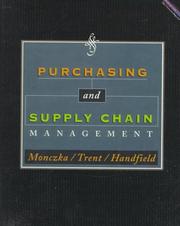
The definitive academic-yet-practical textbook on procurement; it maps the entire purchasing process from requisition to payment and sets the vocabulary for everything that follows.
A hands-on reference covering policies, procedures, and tools; reading it second reinforces Monczka's framework with immediately actionable checklists and templates.
Strategic Sourcing & Supplier Management
IntermediateMove beyond transactional buying to think strategically about supply markets, portfolio segmentation, supplier selection, and long-term relationship management.
▸ Study plan for this stage
Pace: 8–10 weeks, ~40–50 pages/day (approximately 3 books, 300–350 pages total). Allocate 2–3 weeks per book with overlap for synthesis.
- Supply market analysis and competitive landscape assessment to identify sourcing opportunities and risks
- Portfolio segmentation (e.g., Kraljic matrix) to classify suppliers and tailor management strategies by spend category
- Supplier selection criteria and evaluation frameworks beyond price, including capability, stability, and cultural fit
- Strategic negotiation and contracting to lock in value and manage risk over the supplier lifecycle
- Relationship management models and governance structures for different supplier tiers (strategic partners, preferred, transactional)
- Category management as a structured approach to optimize spend, quality, and innovation within specific procurement categories
- Transition from cost-focused to value-focused procurement mindset and metrics
- How would you use supply market analysis to identify which suppliers to prioritize for a new product category, and what data sources would you consult?
- Explain the Kraljic matrix and how you would classify your organization's top 10 suppliers. What management approach would you apply to each quadrant?
- What are the key differences between transactional and strategic supplier relationships, and how do you decide which suppliers warrant each approach?
- Walk through a category management process: how would you segment a category, set objectives, evaluate suppliers, and measure success?
- Describe a supplier negotiation scenario where you balance price, quality, and relationship investment. What trade-offs would you make and why?
- How would you design a supplier governance structure (e.g., steering committees, KPIs, review cadence) for a strategic supplier partnership?
- Conduct a supply market analysis for one of your organization's key categories: identify 5–8 potential suppliers, map their strengths/weaknesses, and assess market concentration and risk.
- Build a Kraljic matrix for your current supplier base (or a hypothetical portfolio of 15–20 suppliers). Classify each supplier and propose a tailored management strategy for each quadrant.
- Create a supplier scorecard with 8–12 weighted criteria (cost, quality, delivery, innovation, financial stability, etc.). Score 3–5 real or hypothetical suppliers and justify your rankings.
- Design a category management plan for one procurement category: define scope, set spend/quality/innovation targets, evaluate suppliers, and outline a 12-month roadmap.
- Develop a supplier relationship charter for a strategic partner: define governance (meetings, escalation, KPIs), communication cadence, and joint value creation initiatives.
- Simulate a strategic negotiation: prepare a business case, identify trade-offs (price vs. volume commitment vs. innovation support), and document the outcome and rationale.
Next up: This stage equips you with the strategic frameworks and relationship disciplines needed to move into advanced topics such as supply chain risk management, global sourcing complexity, and digital transformation in procurement—where you'll apply these segmentation and management models at scale and across geographies.

Introduces modern sourcing strategy, category management, and digital tools; it bridges the gap between basic procurement and true strategic thinking.

The most comprehensive guide to segmenting the supply base, designing governance models, and building collaborative supplier partnerships — a natural next step after sourcing strategy.

Deepens the sourcing toolkit with a rigorous category-by-category methodology; reading O'Brien's two books back-to-back creates a complete strategic sourcing system.
Contracts, Negotiation & Cost Management
IntermediateMaster contract structuring, cost and price analysis, and negotiation tactics so you can protect value and drive savings at the deal table.
▸ Study plan for this stage
Pace: 8–10 weeks, ~40–50 pages/day (mix of reading and active note-taking). Week 1–3: "Getting to Yes" (300 pages); Week 4–5: transition & review; Week 6–10: "Negotiation for Purchasing Professionals" (250+ pages) with concurrent case study work.
- Principled negotiation: separating people from the problem, focusing on interests rather than positions
- BATNA (Best Alternative to Negotiated Agreement) and its role in establishing negotiating power and walk-away points
- Objective criteria and standards as anchors for fair, defensible agreements in contract discussions
- Value creation vs. value claiming: expanding the pie before dividing it, especially in supplier negotiations
- Contract structuring fundamentals: terms, conditions, risk allocation, and cost drivers that protect organizational interests
- Cost and price analysis techniques: distinguishing between cost-plus, fixed-price, and market-based pricing models
- Negotiation tactics specific to procurement: managing supplier relationships, handling objections, and securing favorable payment/delivery terms
- Psychological and behavioral dynamics in negotiations: anchoring, reciprocity, and building trust without compromising leverage
- What is the core difference between positional and principled negotiation, and why does this distinction matter in supplier contract talks?
- How do you identify and strengthen your BATNA before entering a procurement negotiation, and what role does it play in your opening position?
- Describe the process of moving from positions to interests in a negotiation—how would you apply this to a supplier disagreement over price?
- What are the main components of a well-structured contract from a cost and risk perspective, and how do they protect your organization?
- How do you conduct a cost analysis versus a price analysis, and when would you use each approach in procurement?
- What are three specific negotiation tactics from the readings that help you claim value while maintaining supplier relationships for future deals?
- Role-play negotiation: conduct a mock supplier negotiation (with a colleague or mentor) using principled negotiation principles from 'Getting to Yes'; record your approach to separating people from the problem and identifying underlying interests.
- BATNA mapping exercise: for a real or hypothetical procurement scenario, document your BATNA, your target outcome, and your walk-away point; explain how this shapes your opening offer and reservation price.
- Contract clause audit: take a recent or sample contract from your organization and identify cost drivers, risk allocations, and payment/delivery terms; rewrite 2–3 clauses to better protect your interests using concepts from O'Brien's book.
- Cost vs. price analysis case study: obtain a supplier quote (real or realistic) and perform both a cost analysis (breaking down labor, materials, overhead) and a price analysis (comparing to market benchmarks); document your findings and negotiation strategy.
- Negotiation transcript analysis: record or write out a negotiation scenario (real or role-played); review it against the frameworks in both books and identify moments where you moved from positions to interests, used objective criteria, or claimed/created value.
- Interest-mapping workshop: for an upcoming or past procurement negotiation, create a two-column chart of your interests vs. the supplier's interests; brainstorm 3–5 options that satisfy multiple interests on both sides (expanding the pie).
Next up: This stage equips you with the negotiation mindset and contract fundamentals to protect value at the deal table; the next stage will build on this foundation by introducing supplier relationship management, performance metrics, and strategic sourcing approaches that sustain value over the contract lifecycle.
The foundational text on principled negotiation; its interest-based framework is essential before studying procurement-specific negotiation tactics.

Applies negotiation theory directly to supplier deals, covering power dynamics, concession planning, and multi-party scenarios — the procurement-specific complement to Fisher.
Advanced Supply Chain Strategy & World-Class Procurement
ExpertSynthesize everything into enterprise-level supply chain strategy, risk management, and the leadership practices that distinguish world-class procurement organizations.
▸ Study plan for this stage
Pace: 8–10 weeks, ~40–50 pages/day (mix of dense strategic material and case studies)
- Enterprise-level supply chain strategy and alignment with business objectives
- Strategic supplier relationship management and tiered vendor governance
- Risk identification, mitigation, and resilience planning across the supply network
- Lean principles applied to procurement processes and supply chain operations
- Total Cost of Ownership (TCO) and value-based procurement decision-making
- Organizational design and leadership competencies for world-class procurement
- Performance measurement frameworks and KPIs for supply chain excellence
- Change management and continuous improvement in procurement transformation
- How do you align procurement strategy with overall corporate strategy and competitive advantage?
- What are the key differences between transactional, relational, and strategic supplier partnerships, and when should each be used?
- How would you design a comprehensive supply chain risk assessment and mitigation plan for a multi-tier, global supply network?
- What are the core principles of lean supply chain management, and how do you eliminate waste in procurement and logistics?
- How do you calculate and optimize Total Cost of Ownership beyond unit price, and what role does it play in supplier selection?
- What organizational structures, skills, and leadership practices distinguish world-class procurement functions from operational ones?
- How do you design and implement a balanced scorecard or KPI framework to measure supply chain performance and drive accountability?
- Map your organization's (or a case study company's) current supply chain to its business strategy; identify 3–5 strategic misalignments and propose corrections
- Conduct a supplier segmentation analysis using the Lysons framework; classify suppliers by strategic importance and risk, then design differentiated relationship strategies for each segment
- Build a comprehensive risk register for a supply chain (real or hypothetical); identify 10–15 risks, assess probability/impact, and develop mitigation and contingency plans
- Perform a lean value stream mapping exercise on a procurement or logistics process; identify non-value-added steps and design a lean redesign
- Calculate Total Cost of Ownership for 2–3 supplier options for a critical category; include direct costs, quality, delivery, risk, and lifecycle factors
- Design an organizational structure and competency framework for a world-class procurement function; specify roles, reporting lines, and required skills at each level
- Create a balanced scorecard with 12–15 KPIs across financial, operational, customer, and learning perspectives for a supply chain function; set targets and define accountability
Next up: This stage equips you with the strategic frameworks and leadership mindset needed to architect and govern enterprise supply chains; the next stage will likely focus on emerging technologies (AI, blockchain, digital transformation) and future-ready procurement models that amplify these foundational strategies.
A rigorous advanced text covering global sourcing, risk, ethics, and sustainability — it challenges the reader to think at the C-suite level about procurement's strategic role.

Connects procurement decisions to lean operations and total cost of ownership, completing the journey from buyer to strategic supply chain leader.
Discussion
Keep reading
Paths that share books, cover the same subject, or open a related topic.