Powerlifting: the best books to build strength safely, in reading order
This curriculum takes an aspiring powerlifter from zero knowledge to advanced programming mastery across four progressive stages. It begins by building a foundational understanding of strength training principles and movement, then drills into the technique of each of the three competition lifts, before graduating to elite-level programming and sport-specific strategy. Each stage's books are sequenced so that vocabulary, concepts, and physical intuition developed in earlier reads make later, denser material immediately actionable.
Foundations of Strength
BeginnerUnderstand the core principles of barbell training, basic movement patterns, and the logic of progressive overload before touching sport-specific powerlifting material.
▸ Study plan for this stage
Pace: 8–10 weeks, ~40–50 pages/day (mix of reading and review). Week 1–4: Starting Strength (primary text, ~350 pages); Week 5–8: Practical Programming (primary text, ~300 pages); Week 9–10: Review, integration, and practical application.
- The five fundamental barbell movements: squat, bench press, deadlift, overhead press, and power clean—their biomechanics, proper form, and why they form the foundation of strength training
- Progressive overload as the primary driver of strength adaptation: adding weight, reps, or sets systematically over time to force the body to adapt
- The concept of linear progression and when it works: how beginners can add weight nearly every session, and why this window is limited
- Recovery and adaptation: sleep, nutrition, and rest days are non-negotiable components of the training equation, not afterthoughts
- Program design logic: why full-body routines work best for beginners, how to structure frequency and volume, and the relationship between intensity and volume
- The difference between absolute strength and other qualities: why powerlifting prioritizes maximal strength over muscle size or endurance
- Coaching cues and movement standards: how to identify and correct common form breakdowns that limit progress or cause injury
- Explain the biomechanics of the squat, bench press, and deadlift. Why does Starting Strength emphasize a specific depth, grip, or bar path for each?
- What is progressive overload, and why is it the central principle of strength training? How does it differ from just 'working out'?
- Describe linear progression. Why can beginners add weight almost every session, and what signals that linear progression is ending?
- How do recovery (sleep, nutrition, rest days) and training interact? Why does Rippetoe argue that recovery is as important as the workout itself?
- Design a beginner full-body program using the five fundamental movements. Justify your choices for frequency, sets, reps, and progression scheme based on Practical Programming.
- What are the most common form errors in the squat, bench press, and deadlift, and how do you correct them? Why do these errors matter?
- Film yourself performing the squat, bench press, and deadlift with an empty bar or light weight. Compare your form against the cues in Starting Strength (depth, bar path, foot position, etc.). Identify 2–3 specific form issues and practice correcting them daily for one week.
- Create a written 12-week linear progression program for a beginner. Specify: exercises, sets/reps, starting weights, weekly progression increments, and deload weeks. Justify each decision using principles from Practical Programming.
- Track your own training for 4 weeks using a simple spreadsheet: date, exercise, weight, reps, sets, sleep hours, and subjective recovery. Analyze the data to identify correlations between recovery metrics and performance. Write a one-page reflection.
- Perform a movement analysis: pick one lift (squat, bench, or deadlift) and identify the three most common form breakdowns described in Starting Strength. For each, write down the coaching cue that fixes it and practice the correction 5 times.
- Calculate your estimated 1RM using a rep-max formula (e.g., Epley or Brzycki). Then design a 4-week progression to test a new 1RM. Track how closely your actual max matches the prediction.
- Read a case study or forum post of someone struggling with a lift (e.g., stalled squat, weak bench). Diagnose the problem using Starting Strength and Practical Programming principles, and write a 3-step corrective plan.
Next up: This stage establishes the unshakeable foundation—the barbell movements, progressive overload, and program design logic—that sport-specific powerlifting training (technique refinement, peaking, competition strategy) depends on; without mastery of these basics, advanced programming will fail.
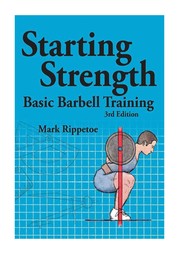
The single best entry point for barbell training: it teaches the squat, deadlift, press, and bench from first principles with rigorous technique cues. Reading this first gives the beginner the biomechanical vocabulary and movement intuition that every later powerlifting book assumes.

Directly follows Starting Strength by explaining how and why training stress, recovery, and adaptation work — novice, intermediate, and advanced models included. Understanding these programming concepts early prevents the beginner from jumping into complex templates before they are ready.
The Three Lifts — Technique Deep Dive
IntermediateDevelop precise, competition-legal technique on the squat, bench press, and deadlift through the eyes of elite coaches and world-record holders.
▸ Study plan for this stage
Pace: 4–5 weeks, ~25–30 pages/day. "Squat Every Day" (2–3 weeks), then "Deadlift Dynamite" (2 weeks). Allocate 3–4 days per week for technique practice between reading sessions.
- Squat positioning: foot placement, knee tracking, torso angle, and depth standards for competition legality
- The squat as a trainable skill requiring daily practice and neurological adaptation, not just strength accumulation
- Deadlift setup mechanics: stance width, shin angle, hip height, and bar path over mid-foot
- Pavel's tension principles: full-body tightness, breathing, and bracing for maximal force production in the deadlift
- Individual variation in technique based on limb proportions, mobility, and leverages
- Competition rules and judging standards for squat depth and deadlift lockout
- Progressive overload and autoregulation within technically sound movement patterns
- What are the key postural checkpoints for a legal competition squat, and how do they differ from a partial squat?
- According to Perryman, why is daily squat practice beneficial for technique development, and what does 'trainable skill' mean in this context?
- Describe the deadlift setup sequence from foot placement through bar engagement, using Pavel's framework
- How do individual limb proportions and mobility affect optimal squat and deadlift positioning?
- What is the relationship between breathing, bracing, and tension in maximizing deadlift performance?
- How do you identify and correct common technical faults in your own squat and deadlift?
- Film yourself performing 5 squats from multiple angles (front, side, rear). Compare your depth, knee tracking, and torso angle against the technical standards in Perryman's book.
- Perform daily squat practice for 2 weeks: 3–5 sets of 3–5 reps at 60–70% of your max, focusing on one technical cue per session (e.g., foot pressure, knee position, depth).
- Record a deadlift setup and breakdown each step: foot placement, shin angle, hip position, and bar contact. Verify each point matches Pavel's setup sequence.
- Conduct a mobility assessment (ankle dorsiflexion, hip flexion, thoracic extension, shoulder mobility) and identify which limitations affect your squat or deadlift positioning. Spend 5–10 minutes daily on the most limiting area.
- Perform 3 maximal-effort deadlifts with deliberate tension cues: full-body tightness, breath-hold, and lat engagement. Rate the quality of each rep and note which cues had the greatest effect.
- Work with a training partner or coach to identify one technical fault in your squat and one in your deadlift. Film corrective drills and practice them 3x per week for 2 weeks, then reassess.
Next up: Mastering the technical foundations of the squat and deadlift positions you here prepares you to apply periodized programming and intensity management in the next stage, where you'll learn how to structure training cycles that preserve technique while building competition-ready strength and power.
Challenges conventional wisdom about recovery and frequency, building a more nuanced mental model of how the body adapts to repeated squat practice. Reading this after the basics reframes fatigue and volume in a way that prepares the lifter for higher-frequency programming.

Andy Bolton was the first man to deadlift 1,000 lbs; this book is the most thorough single-lift resource on deadlift mechanics, setup, and programming available, making it essential reading before advancing to full meet preparation.
Programming for Powerlifting
IntermediateLearn how to build and manipulate a full powerlifting training cycle, understand periodization models used by competitive lifters, and begin thinking like a coach.
▸ Study plan for this stage
Pace: 4–5 weeks, ~25–30 pages/day (approximately 150–170 pages total). Read in focused 45–60 minute sessions, 5–6 days per week, allowing time for note-taking and reflection on programming principles.
- Mechanistic Tension, Muscle Damage, and Metabolic Stress as the three primary drivers of hypertrophy and strength adaptation
- Dose-Response Relationships: how training volume, intensity, and frequency interact to produce measurable adaptations
- Periodization Models (Linear, Undulating, Block) and their application to powerlifting-specific goals
- Autoregulation and RPE-based training as tools for managing fatigue and optimizing individual responses
- Exercise Selection and Hierarchy: primary lifts vs. accessory work and their role in a complete program
- Fatigue Management and Recovery: how to structure deloads, manage accumulated fatigue, and prevent overtraining
- Individual Variability in Response to Training: why cookie-cutter programs fail and how to adjust based on individual characteristics
- What are the three primary mechanisms of strength and hypertrophy adaptation, and how does each manifest in training?
- How do volume, intensity, and frequency interact in a dose-response relationship, and what happens when any one variable is pushed too high?
- What are the main periodization models (linear, undulating, block), and when would you choose each for a competitive powerlifter?
- How can you use RPE and autoregulation to adjust a program in real-time based on an athlete's readiness and fatigue levels?
- What distinguishes primary lifts from accessory work, and how should the ratio between them change across a training cycle?
- How do you recognize signs of accumulated fatigue and overtraining, and what deload strategies does Israetel recommend?
- Design a 12-week linear periodization cycle for a raw powerlifter preparing for a competition, specifying volume, intensity, and exercise selection for each phase.
- Take a standard 'cookie-cutter' powerlifting program and rewrite it using autoregulation (RPE targets) instead of fixed percentages; explain your adjustments.
- Map out the dose-response relationship for a single lift (e.g., back squat) across a 4-week block: specify sets, reps, intensity, and predicted adaptation outcome.
- Create a deload week protocol based on Israetel's fatigue management principles; justify each component (volume reduction, intensity adjustment, exercise selection).
- Analyze your own training data (or a sample athlete's) and identify whether volume, intensity, or frequency is the limiting factor in progress; propose a programming adjustment.
- Write a brief coaching cue document for a lifter explaining why their program includes both heavy singles and higher-rep accessory work, grounded in the three mechanisms of adaptation.
Next up: This stage establishes the scientific foundation and practical frameworks for building training cycles; the next stage will apply these principles to sport-specific periodization, competition preparation, and advanced coaching strategies for competitive powerlifters.

Translates sports science into immediately applicable powerlifting programming principles (specificity, overload, fatigue management, variation) in plain language. It is the best modern bridge between Zatsiorsky's theory and week-to-week training decisions.
Elite Mastery & Competition Strategy
ExpertSynthesize everything into a competition-ready mindset: peaking for a meet, managing long-term athletic development, and learning from the world's strongest lifters.
▸ Study plan for this stage
Pace: 8–10 weeks, ~40–50 pages/day (with review cycles for dense technical sections)
- Periodization models (linear, undulating, block) and their application to peaking for competition
- Neuroendocrine adaptation and the role of CNS fatigue in long-term athletic development
- Biomechanical analysis of the three powerlifts to optimize technique and reduce injury risk
- Training load management: quantifying intensity, volume, and density to avoid overtraining
- Conjugate method and concurrent training principles for simultaneous strength and power development
- Deload protocols and recovery strategies essential for elite-level competition preparation
- Individual variation in response to training stimuli and customizing periodization to your profile
- Competitive strategy: timing peak performance, managing psychological readiness, and competition-day logistics
- How do block periodization and undulating periodization differ, and when would you choose each for a competition peak?
- Explain the relationship between CNS fatigue and overtraining syndrome—how do you detect and prevent it?
- What biomechanical principles from Supertraining would you apply to fix a sticking point in your squat, bench, or deadlift?
- Design a 12-week peaking cycle for a powerlifting meet using concepts from Supertraining; justify your exercise selection and load progression.
- How does the conjugate method balance strength, power, and hypertrophy, and why is this important for elite lifters?
- What are the key differences between training load quantification methods (e.g., RPE, RIR, percentage-based) and how do you choose one?
- Analyze a video of your own lift (squat, bench, or deadlift) using Supertraining's biomechanical framework; identify 2–3 technique cues to improve bar path, joint angles, or force application.
- Create a detailed 16-week periodization plan for your next competition, specifying mesocycle goals, exercise rotation, intensity/volume targets, and deload weeks based on Supertraining principles.
- Calculate your training load for a full week using the methods discussed in Supertraining (e.g., tonnage, intensity zones, or RPE-based scoring); identify which sessions pushed you closest to overtraining.
- Conduct a case study: select a world-class powerlifter (Hafthor Björnsson, Cailer Woolam, etc.) and reverse-engineer their likely periodization strategy using Supertraining concepts; write a 2–3 page analysis.
- Design and execute a 4-week deload block following Supertraining's recovery protocols; track subjective readiness, sleep quality, and performance metrics to validate its effectiveness.
- Perform a biomechanical self-assessment of your weakest lift; propose 3–4 accessory exercises grounded in Supertraining's mechanical analysis to address the limiting factor.
Next up: This stage equips you with the scientific and technical foundation to design and execute elite-level competition peaking, setting the stage for the next phase—whether that involves competing at the highest levels, coaching others through similar cycles, or exploring specialized topics like injury prevention or sport-specific nutrition for powerlifting.

The most comprehensive and rigorous text on strength and conditioning science ever written — dense, demanding, and transformative. Placed last because it requires all prior conceptual scaffolding to be fully understood and applied to powerlifting training.
Discussion
Keep reading
Paths that share books, cover the same subject, or open a related topic.