Acceptance and Commitment Therapy: The Best Books on ACT, in Order
ACT is a behavioural therapy that does not try to argue you out of unwanted thoughts or get rid of anxiety. It works instead on psychological flexibility — noticing thoughts as thoughts, dropping the struggle with feelings, and acting on what you actually value while the discomfort is still present. The literature splits cleanly into two halves that are usually shelved together and should not be read the same way: trade self-help books written for the person doing the work, and clinical texts written for therapists. This path reads the accessible books first, then Hayes's own account of the model, then the practitioner texts, then the theory underneath — and it is a way of understanding the model, not a substitute for treatment, which is worth saying plainly if you are reading it because something is genuinely wrong.
The Self-Help Entry Point
BeginnerLearn the six core ACT processes — defusion, acceptance, contact with the present moment, self-as-context, values, committed action — in the plainest form anyone has written them.
▸ Study plan for this stage
Pace: Six to eight weeks, and slower than the page counts imply. The Happiness Trap is 288 pages but is built around exercises that only work if you actually do them over days rather than reading past them — three weeks. The Confidence Gap is two weeks. The Reality Slap is 208 pages and covers bereavement
- The six ACT processes as Harris names them in The Happiness Trap: defusion, acceptance, contact with the present moment, self-as-context, values, committed action. Everything later on this path assumes this vocabulary.
- The central claim of The Happiness Trap: the effort to feel good is itself a major cause of feeling bad. ACT does not aim at symptom reduction, and that is a genuine difference from the cognitive therapy most readers arrive with.
- Defusion is not disputing a thought. In ACT you change your relationship to the thought without evaluating whether it is true — which is exactly what a CBT thought record does instead.
- Experiential avoidance: the pattern of organising a life around not feeling something. Harris's struggle switch is the plainest picture of it anyone has drawn.
- Values are directions, not goals. The Confidence Gap turns on this — you can act on a value while frightened, and confidence is described as a consequence of acting rather than a prerequisite.
- The Reality Slap is where the acceptance half has to carry the load alone, because nothing about the situation can be reframed or fixed. It is the honest test of whether the model holds.
- Harris is a GP turned ACT trainer, not the originator of the model. He is presenting Hayes's work, simplified deliberately, and stage two is where you meet the original.
- Name the six processes and give a concrete instance of each from your own week, not from the book's examples.
- What is the difference between defusing from a thought and disputing it, and what does ACT claim disputing costs you?
- Harris argues that avoidance is workable in the short term and expensive in the long term. Where in your own behaviour does that trade-off actually show up?
- The Confidence Gap inverts the usual order of confidence and action. What is the argument, and what would count as evidence against it?
- In The Reality Slap, what is left to do when a situation cannot be changed at all? State it without using the word acceptance.
- Run the struggle switch from The Happiness Trap for a full week on one recurring unpleasant feeling: note the feeling, note what you did to get rid of it, and note what that cost you in time and behaviour. This is the book's central diagnostic and it does not work as a thought experiment.
- Do Harris's defusion exercises as written — the I'm having the thought that... form, and the silly-voice repetition — on one specific sticky thought, at least twice a day for a week. Record whether the thought's frequency changed and whether its grip did, separately, because ACT predicts different answers to those two questions.
- Complete the values clarification exercise in The Happiness Trap for two life domains, then write down one small committed action per domain and schedule it. Keep the sheet; you will compare it against Hayes's version of the same exercise in stage two.
- Take one situation from The Confidence Gap where you have been waiting to feel ready, and act before the feeling arrives. Write down the prediction beforehand and the outcome after — this is the only way to test the book's core claim.
- After The Reality Slap, apply the book's own distinction to one unfixable thing in your life: what part of this is workable, and what part is not? Write both columns.
Next up: With the vocabulary and the basic exercises in your hands, you can read the model's originator without needing him to be gentle about it.
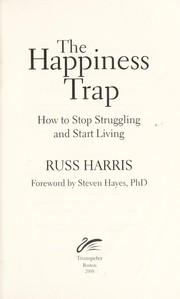
The best-selling ACT book in the world and the right first one: Harris is a GP-turned-trainer who writes for readers with no psychology background, and the central argument — that trying to feel good is what makes people feel bad — lands in the first fifty pages. Everything later on this path assumes you already have the vocabulary this book teaches.

The same model aimed at performance and self-doubt rather than at distress, which is where most people first meet the idea that you can act before you feel ready. Read it second because it shows the processes doing work in an ordinary, non-clinical setting.

Harris on grief, illness and loss — the situations where the acceptance half of ACT has to carry the weight and no reframe is available. It is the hardest of his self-help books and belongs after the other two, because it is the honest test of whether the model holds up when nothing can be fixed.
Hayes in His Own Words
IntermediateGet the model from the person who built it, and see how the ACT view of language and suffering differs from the cognitive therapy it grew out of.
▸ Study plan for this stage
Pace: Six to seven weeks. Get Out of Your Mind and Into Your Life is 206 pages but is a workbook — worked properly it takes four to six weeks, and skimming it defeats the point. A Liberated Mind is 448 pages of narrative and argument, three weeks at a normal reading pace. Both are written for a general re
- Hayes's workbook presents the same six processes as a protocol rather than as advice. What Harris paraphrases, Hayes gives you as the exercise a therapist would actually run.
- ACT's account of language: the reason ordinary problem-solving turns toxic when pointed inward is that human language solves problems by identifying and removing things, and that operation does not work on your own experience.
- Cognitive defusion techniques in their original forms — word repetition until meaning drains, thoughts as objects, thoughts sung or narrated — and Hayes's argument that these work through process rather than persuasion.
- Self-as-context: the observer position distinct from the content of thought. This is the process most often skipped by readers and the one the theory in stage five is designed to explain.
- A Liberated Mind supplies the intellectual history — why a behaviour analyst ended up writing about values — which the workbook deliberately leaves out.
- Hayes is the model's originator and an interested party in the arguments about its evidence base. Read A Liberated Mind as the founder's account, not as a neutral review of the literature.
- How does Hayes explain why ordinary problem-solving fails when applied to your own thoughts and feelings?
- Which of the six processes did Harris's version teach you badly or thinly, now that you have Hayes's original exercises for it?
- What is self-as-context, and what exercise in the workbook is supposed to produce the experience of it rather than the idea?
- In A Liberated Mind, what did Hayes's own panic disorder change about the research programme he then ran?
- Where does A Liberated Mind make claims about ACT's evidence that you would want to check independently, given who is making them?
- Work Get Out of Your Mind and Into Your Life straight through in order, writing in it, one chapter every two or three days. Do not read ahead to the values chapters — the book's sequence is the therapy's sequence.
- Do the word-repetition defusion exercise exactly as Hayes writes it, timed, and then do it with a genuinely loaded word about yourself. Note the difference between the two, because that difference is what the exercise is measuring.
- Complete Hayes's values work and set it beside the values sheet you produced from The Happiness Trap in stage one. Where the two disagree, work out whether Harris's format simplified something or whether you answered one of them for an audience.
- Keep a two-column log for two weeks while working the book: what you did to control an internal experience, and what you did that moved toward a value. Hayes's whole argument is that these two columns compete for the same hours.
- Read the chapter of A Liberated Mind on Hayes's own panic alongside the workbook chapter on acceptance, and mark where the personal account explains why a particular exercise is built the way it is.
Next up: You now have the model as its author states it, which is the prerequisite for reading the books written for the people who deliver it.
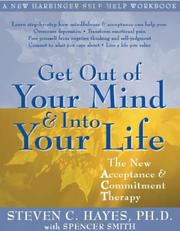
Hayes's own workbook, and the bridge between the trade books and the clinical ones: still written for a general reader, but with the exercises presented as the therapy protocol rather than as tips. Read it after Harris so you can see how much of ACT is exercise rather than explanation.

Hayes's late, more personal account of the same model, framed around his own panic disorder and the research programme that came out of it. It supplies the intellectual history — why a behaviour analyst ended up writing about values — that the workbook leaves out.
The Practitioner's Core Texts
IntermediateMove from understanding ACT as a reader to seeing it as a therapy that has to be delivered — session structure, case conceptualisation, and what actually gets said in the room.
▸ Study plan for this stage
Pace: Eight to ten weeks. This is where the path stops being self-help: all three books are written for clinicians delivering the therapy, and they assume a professional context, supervision and a caseload. ACT Made Simple (265 pages) is the training manual and takes three weeks. The Hayes, Strosahl and W
- The hexaflex as a clinical map: Harris's ACT Made Simple walks the six processes one at a time with session transcripts, which is the first time on this path you see what is actually said in a room.
- Case conceptualisation in ACT terms — identifying which process is blocked for this person rather than treating a diagnosis. This is the skill the clinical text is organised around.
- The Hayes, Strosahl and Wilson book is the foundational professional text and the reference for the model. It is catalogued here under its bare title; the second edition, subtitled The Process and Practice of Mindful Change, is the same record.
- Functional contextualism: the philosophical stance underneath, in which a thought is evaluated by what it does in context rather than by whether it is true. It is stated in the clinical text and explained in stage five.
- The therapeutic stance matters as much as the technique — ACT asks the therapist to be in the same position as the client rather than above it, which is why Learning ACT is built out of competency exercises rather than lectures.
- Learning ACT, by Luoma, Hayes and Walser, is a skills-training workbook and the right place for a non-clinician to stop. Its exercises assume you have clients to practise on.
- Reading these books does not qualify anyone to deliver the therapy, and nothing in them substitutes for treatment or supervision.
- Take one transcript from ACT Made Simple and say which of the six processes the therapist is working, line by line. Where does the transcript switch processes?
- How does an ACT case conceptualisation differ from a diagnosis-led treatment plan? Answer from the Hayes, Strosahl and Wilson text.
- What does functional contextualism commit you to that a truth-based account of cognition does not?
- Where does the clinical text argue that ACT differs from traditional CBT, and how strong is the evidence it cites for that difference?
- Which competencies in Learning ACT could you not practise without clients, and what does that tell you about the limits of reading your way into this?
- Take one transcript from ACT Made Simple and annotate every therapist line with the process it targets. Then cover the therapist's lines and write your own before comparing — this is the exercise the book is built for.
- Build an ACT case conceptualisation using the clinical text's own framework, on a composite or published case rather than on a person you know: fused content, avoided experience, stated values, unworkable action.
- Read the same clinical problem twice — once in ACT Made Simple's practical treatment, once in the Hayes, Strosahl and Wilson chapter — and list what the manual left out. That gap is what makes the clinical text worth its difficulty.
- Work through two of Learning ACT's competency exercises with another reader, taking both roles in turn, and note where your own fusion shows up while playing therapist. Luoma, Hayes and Walser treat that as data, not failure.
- Write half a page on whether you are reading this stage as a practitioner or as an interested reader, and decide explicitly whether you will continue into stage four's protocol books or stop here.
Next up: With the general model and its delivery in hand, the next stage tests how much of ACT is a single stance and how much changes when it meets a specific presentation.

The standard training book for clinicians new to ACT, and the point where this path stops being self-help. Harris walks the hexaflex process by process with transcripts and scripts. Read it before the primary clinical text — it is the manual that makes that text readable.
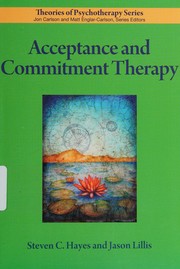
The short APA primer in the Theories of Psychotherapy series, written by Hayes with Jason Lillis — 168 pages covering the model's philosophy, the six core processes and the evidence base. It is the compact statement of the approach by the person who built it, and the right thing to read before the full clinical manual (Hayes, Strosahl and Wilson's Acceptance and Commitment Therapy: The Process and Practice of Mindful Change), which is a separate and much longer book.
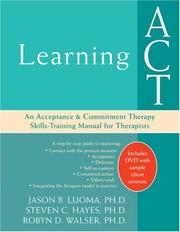
A skills-training workbook for therapists, built around competency exercises rather than exposition — Luoma, Hayes and Walser assume you have read the theory and want to practise it. The right place to stop if you are not a clinician.
ACT Applied to Specific Problems
IntermediateSee the model adapted to particular presentations, and judge how much of ACT is a general stance versus a protocol that changes by diagnosis.
▸ Study plan for this stage
Pace: Eight to ten weeks. The Mindfulness and Acceptance Workbook for Anxiety (288 pages) is written for the reader and, worked properly, takes four to six weeks. Acceptance and Commitment Therapy for Anxiety Disorders (304 pages) is its practitioner counterpart and is a clinical text — two to three weeks
- Forsyth and Eifert's workbook is self-help; Eifert, Forsyth and Hayes's Acceptance and Commitment Therapy for Anxiety Disorders is the practitioner manual for the same protocol. Reading the pair back to back is the clearest available demonstration of what a therapist adds that a book cannot.
- ACT's treatment of avoidance is genuinely different from exposure-based CBT: the aim is willingness to have the anxiety in the service of a value, not habituation to the feared stimulus. The two look similar in the room and are justified differently.
- Anxiety is not the target. In these books the target is the life the anxiety has narrowed, which is why outcome is measured in behaviour rather than in symptom scores.
- Trauma-Focused ACT is where the model has to answer its hardest question: whether acceptance is the right advice for distress that is a proportionate response to real harm. Harris addresses it directly rather than assuming it away.
- Harris's trauma work adds stabilisation and grounding work before the standard processes, which tells you something about the limits of the plain hexaflex under high arousal.
- Across all three books the protocol changes at the margins and the stance does not — which is the evidence for the claim that ACT is a general model rather than a family of manuals.
- State precisely how ACT's approach to an avoided situation differs from graded exposure, using Forsyth and Eifert's own language.
- What does the practitioner text supply that the workbook does not, when both are running the same protocol?
- In Trauma-Focused ACT, what does Harris add before the six processes, and why is that addition necessary?
- Is acceptance an appropriate stance toward distress caused by ongoing harm? Give Harris's answer and say whether you find it sufficient.
- Across this stage, what changed by presentation and what stayed constant? Answer specifically enough to name chapters.
- Work the Forsyth and Eifert workbook's willingness and values chapters over four weeks, keeping their own worksheets rather than substituting your own format.
- Read one chapter of the workbook and the corresponding chapter of Eifert, Forsyth and Hayes's practitioner text on the same day, and list every clinical decision the practitioner version makes that the workbook simply asserts.
- Take one avoided situation and write two plans for it: an exposure hierarchy as CBT would build it, and an ACT willingness plan as the workbook builds it. The differences on paper are small and the rationales are not — write both rationales out.
- Map Trauma-Focused ACT's stabilisation material onto the plain hexaflex from stage two and mark exactly where Harris says the standard sequence would fail.
- Write a paragraph on which of these three books you would put in a non-clinician's hands and which you would not, and why.
Next up: Having seen the model bend and hold across three presentations, the last stage asks what it is actually derived from.
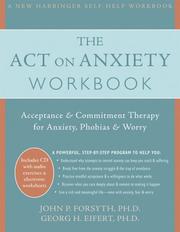
Forsyth and Eifert's self-help workbook — the most-used ACT book for anxiety and the clearest demonstration that ACT's approach to avoidance is genuinely different from exposure-based CBT. Written for the reader, not the therapist, so it works alongside the clinical books above.

The practitioner counterpart to the workbook, by Eifert, Forsyth and Hayes: the same protocol with the clinical reasoning restored. Reading the pair back to back shows exactly what a therapist is doing that a workbook cannot.

Harris's clinician's guide to using ACT with trauma, and the place where the model has to answer its hardest question — whether acceptance is appropriate advice for someone whose distress is a response to real harm. Read it last in this stage; it assumes the full hexaflex.
The Theory Underneath
IntermediateUnderstand relational frame theory, the account of human language that ACT is derived from, and why its proponents insist the therapy is not just mindfulness with values attached.
▸ Study plan for this stage
Pace: Eight to ten weeks, and this is the hardest stage on the path. Relational Frame Theory (285 pages) is technical behaviour analysis written for researchers — expect four to six weeks and expect to reread; it assumes familiarity with operant conditioning, stimulus equivalence and the vocabulary of exp
- Relational frame theory: a post-Skinnerian account of how humans learn to relate arbitrary stimuli in ways that transfer function between them — the technical claim behind everything ACT says about language.
- Derived relational responding is the mechanism that makes human suffering different in kind: a word can acquire the properties of the thing it names without any direct experience, which is why thoughts hurt.
- Defusion, self-as-context and values all have RFT translations. Reading the theory after the practice is deliberate, because the theory is unreadable without the phenomena it explains already in front of you.
- Hayes, Barnes-Holmes and Roche are making a basic-science argument and are open advocates for it; RFT is not a settled consensus in psycholinguistics, and the book is the case for a position, not a survey of the field.
- Wilson's Mindfulness for Two is about the therapeutic relationship itself — what ACT looks like once you stop treating it as a set of techniques — and is the most philosophically serious book on the path.
- Wilson is the third author of the founding clinical text, so Mindfulness for Two is an insider's revision of that book's emphasis rather than an outsider's critique.
- Things Might Go Terribly, Horribly Wrong, by Wilson and DuFrene, returns the whole formalised apparatus to plain language and personal example in about a hundred pages.
- What is a relational frame, and what makes derived relations different from directly trained associations?
- Give the RFT account of why a defusion exercise works. Does it match the reason Hayes gave for it in the workbook?
- Which claims in Relational Frame Theory are experimental findings and which are theoretical extensions? Mark the seam.
- What does Wilson say the therapist is doing in Mindfulness for Two that the technique manuals in stage three do not describe?
- After the theory, does Things Might Go Terribly, Horribly Wrong read as a simplification or as the same thing said without machinery? Which suggests the theory is doing real work?
- Take one defusion exercise you actually ran in stage one or two and write its RFT description in the book's own terms — frames, transformation of function, context. If you cannot, you have found the chapter to reread.
- Read the experimental chapters of Relational Frame Theory with a pen and mark each study by what it demonstrated and what it did not; the book's argument moves fast across that line.
- Reread one session transcript from ACT Made Simple after Mindfulness for Two, and mark every moment where Wilson would say the relationship rather than the technique is carrying the work.
- Read Things Might Go Terribly, Horribly Wrong in one or two sittings immediately after finishing Relational Frame Theory, and note the passages where you can now see the formal machinery under the plain language.
- Write a final page comparing the three levels you have now read at — trade self-help, clinical manual, basic science — and state what each one gets wrong when read as if it were one of the others.
Next up: This is the end of the path: you have the model, its delivery, its applications and the science it claims to rest on, which is a way of understanding ACT and still not a substitute for treatment.
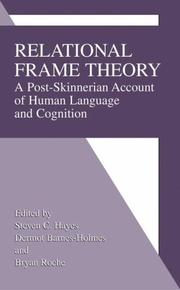
The basic-science book behind the whole enterprise: a post-Skinnerian account of how language and cognition arise from learned relations between arbitrary stimuli. It is technical behaviour analysis and hard going, but it is what distinguishes ACT from every other third-wave therapy — read it only after the clinical texts have given you the phenomena it explains.

Wilson, the third author of the founding clinical text, on the therapeutic relationship itself — what ACT looks like when you stop treating it as a set of techniques. The most philosophically serious book on the list.

Wilson and DuFrene's short trade book, and a deliberate last stop: it returns everything the theory has formalised to plain language and personal example. Read it after Relational Frame Theory to test whether the abstraction changed how the simple version reads.
Discussion
Keep reading
Paths that share books, cover the same subject, or open a related topic.