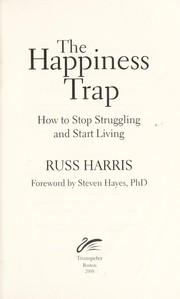
Two books open this subject, and the right one depends on why you are reading. If you are a reader hoping ACT will help with your own anxiety, low mood or stuckness, start with The Happiness Trap. Russ Harris wrote it for non-specialists, it is by a wide margin the best-selling ACT book, and it gets the model across without jargon. If you are a therapist, counsellor or trainee, skip it and start with ACT made simple — also Harris, but written for clinicians, with session structure, metaphors and worksheets.
One thing to say plainly first. Acceptance and commitment therapy is a clinical treatment, and nothing on this shelf is a substitute for care from a qualified professional. A self-help book can teach you the model and give you exercises to try; it cannot assess you, and on its own it is not the right tool for trauma, psychosis, active suicidal thinking or a substance problem. The practitioner books below assume training and supervision, not just reading.
Reading for yourself
After The Happiness Trap, Harris has two narrower books for particular difficulties. The confidence gap applies the same model to fear, self-doubt and performance; The reality slap is about loss, grief and the moments the model is hardest to apply. Both are short and neither repeats the first book at length.
Get Out of Your Mind and Into Your Life is Steven Hayes writing his own model for general readers, and it is a workbook rather than a narrative — heavy on exercises, worksheets and odd-sounding language drills, which some readers find powerful and others find laborious. A Liberated Mind is his later and much more readable trade book: part memoir, including his own panic disorder, part account of how the approach was built. It explains ACT well but gives you far less to actually do.
For anxiety specifically, The mindfulness & acceptance workbook for anxiety by John Forsyth and Georg Eifert is the structured, week-by-week self-help programme. Things might go terribly, horribly wrong by Kelly Wilson and Troy DuFrene covers similar ground in a shorter, essayistic register — good if workbooks put you off, weaker if you want a plan.
Reading as a practitioner
ACT made simple is the standard first clinician text for a reason: it is explicitly a how-to. Follow it with Learning ACT by Jason Luoma, Steven Hayes and Robyn Walser, which is a skills-training manual built around competency exercises and rating scales — it is designed to be worked through with practice partners or a supervisor rather than read in an armchair.
For the theory in a compact form, Acceptance and commitment therapy by Hayes and Jason Lillis is the roughly 200-page primer in the American Psychological Association's Theories of Psychotherapy series. Do not confuse it with the long Hayes, Strosahl and Wilson clinical manual of nearly the same name, which is a different and much heavier book and is not in this list.
Then the treatment-specific manuals. Acceptance and Commitment Therapy for Anxiety Disorders by Georg Eifert and John Forsyth is a session-by-session protocol. Trauma-Focused ACT is Harris again, applying the model to trauma at considerable length. Mindfulness for two by Kelly Wilson and Troy DuFrene is the least protocol-driven of the three: it is about the therapeutic relationship itself and what mindfulness means inside the room.
The theory underneath
Relational frame theory by Hayes, Dermot Barnes-Holmes and Bryan Roche is the behaviour-analytic account of human language that ACT was built on. It is an academic monograph, technical from the first pages, and written for researchers. Read it last, or not at all — whether RFT is a necessary foundation for practising ACT well is genuinely argued about within the field, and a great deal of competent ACT is delivered by people who have never opened it.
Work through the full reading path in order and you will know which of these books is for you and which you can safely leave on the shelf.
Follow the full ordered path here: The Best Books on Acceptance and Commitment Therapy, in Order.