The collapse of the Soviet Union: books to read, in order
A nuclear superpower dissolved in about two years without a civil war, and historians still disagree about why: economic exhaustion, the nationalities question, or Gorbachev's own choices. This path opens with a short analytical frame and a reporter's ground-level account, works through Gorbachev and the reform project, then takes the endgame of 1990-91 in detail, and finishes with the competing explanations and the wreckage of the 1990s. The disagreement is the point — the last stage is deliberately a set of incompatible arguments.
The Shape of the Thing
BeginnerGet a compact causal account of the collapse and a vivid sense of what the last Soviet years actually felt like, before committing to any one explanation.
▸ Study plan for this stage
Pace: 3 weeks. Armageddon Averted first — it is short, forceful and can be finished in two or three evenings, and it gives you a thesis to test against everything after it. Then Lenin's Tomb, which is long and reads as reporting; give it two weeks. Kotkin is arguing that the system was destroyed from with
- The Brezhnev-era settlement and the specific ways the planned economy was failing by the 1980s — oil revenue, the arms burden, agricultural imports
- Kotkin's argument that the collapse was elite-driven and ideologically caused rather than a response to defeat or external pressure
- Why there was no civil war: the absence of an armed defender of the system and what that implies about who believed in it
- Glasnost's effect on historical memory — Memorial, the archives, the recovery of the Stalin period — and the delegitimising work it did
- The miners' strikes of 1989-91 and organised labour as an unexpected political actor
- Nationalism in the republics as a mobilising force, introduced here and argued about for the rest of the path
- Reporting versus analysis: what a correspondent on the street can establish and what requires archives
- State Kotkin's thesis in one sentence. What does he say the elite believed, and why did believing it destroy the system?
- Why did no significant group fight to preserve the Soviet Union? Give an answer that is not simply that everyone had stopped believing.
- Where does Remnick's reporting supply evidence that supports Kotkin, and where does it show something Kotkin's frame cannot easily accommodate?
- Kotkin barely credits Western pressure. Sketch the strongest case for the opposite view and say what evidence would decide it.
- By the end of this stage, what is your provisional explanation of the collapse? Write it down and date it — you will revise it three times.
- Write Kotkin's causal chain as five numbered steps, then go through Lenin's Tomb marking a specific reported episode against each step. Note any step for which you can find no evidence in Remnick.
- Build a timeline of 1985-1991 with three tracks: economic indicators, political reforms, and street-level events. The stage's argument is about which track leads.
- Take one claim about the Soviet economy's condition in 1985 — growth rate, oil dependence, defence share of output — and trace it to the source Kotkin cites. Write down how contested that figure is.
- Pick one person Remnick interviews and write out what their testimony establishes and what it merely illustrates. The distinction is the skill this stage is teaching.
Next up: One thesis and one eyewitness account in hand, the path now examines the man whose choices both books put at the centre.
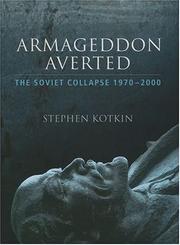
A short, forceful analytical history arguing the Soviet system was destroyed from within by its own elite acting on its own ideology. Start here: it takes two evenings and gives you a thesis to test everything else against.
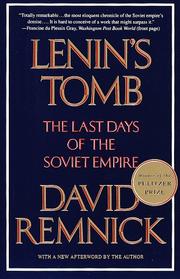
Remnick's reporting from Moscow through the final years, and the best book on the path for texture — the archives opening, the miners' strikes, the coup as it happened on the street. Read second, so Kotkin's argument acquires a country.
Gorbachev and the Reform Project
IntermediateUnderstand what perestroika and glasnost were actually meant to achieve, why partial economic reform made things materially worse, and how far the outcome followed from Gorbachev's intentions.
▸ Study plan for this stage
Pace: 4-5 weeks. The Gorbachev Factor first, then Perestroika itself, then Taubman's biography — our catalogue's record shortens the display title, but this is the full-scale modern life written with post-Soviet archival access and interviews with Gorbachev himself. Read Brown's book as the strongest stat
- Perestroika as an economic programme: cooperatives, enterprise autonomy, the Law on State Enterprise, and why partial reform made shortages worse
- Glasnost as a political instrument aimed at the party bureaucracy, and the way it escaped its intended function
- Democratisation: the 1989 Congress of People's Deputies, contested elections, and the deliberate weakening of the party's monopoly
- The nationalities question, which Gorbachev consistently underestimated, and the Baltic republics as the first test
- The Sinatra doctrine and the decision not to use force in Eastern Europe in 1989
- Brown's agency argument against structural explanations, and what kind of evidence could settle a counterfactual of that kind
- The problem of a reformer's own account: what Gorbachev in 1987 could say, and what he later said he had meant
- What was perestroika actually trying to achieve, in Gorbachev's own words in 1987? Quote the aim, then say what he did instead.
- Explain why partial economic reform produced worse shortages than either the old system or a full transition would have. Name the mechanism.
- Brown says Gorbachev was decisive; Kotkin says the elite and the ideology were. Identify one specific decision where the two readings give incompatible accounts.
- Taubman had archival access and Gorbachev's own testimony decades later. Where does the biography show Gorbachev revising his own history?
- Was the Soviet system reformable? Answer it as Gorbachev believed in 1987, then as the evidence suggests, and say what separates the two answers.
- List every major reform measure from 1985 to 1990 with its stated purpose and its actual effect, in three columns. The third column is the argument of this stage.
- Read the first thirty pages of Perestroika and mark every assumption about the system that later proved false. Then find where Taubman says Gorbachev abandoned each one.
- Take Brown's counterfactual — a different General Secretary — and write out what Ligachev or Romanov would plausibly have done in 1986, 1988 and 1990. Then say honestly whether your version is reasoning or storytelling.
- Trace the word 'socialism' through Perestroika and then through Taubman's account of Gorbachev in 1991. Write a paragraph on what changed and when.
- Revise the explanation you dated in stage one. Write down which book moved it and on what specific evidence.
Next up: The reform project explained, the next stage takes the two years in which it lost control of the country.
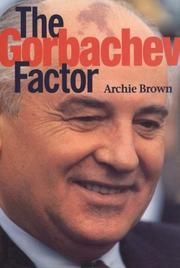
The classic case for Gorbachev's decisive personal agency — that a different General Secretary would have produced a different history. The strongest statement of the great-man reading, and the one Kotkin implicitly denies.

Gorbachev's own 1987 manifesto, written while he still believed the system was reformable. Read it here as a primary source: its confidence is the most revealing thing about it.

The full-scale modern biography, with post-Soviet archival access and interviews with Gorbachev himself. It closes the stage by weighing Brown's claim against a complete life. The record shortens the title from Gorbachev: His Life and Times.
The Endgame, 1990-1991
IntermediateFollow the last two years closely — the Baltic and Ukrainian independence movements, the August coup, Yeltsin's rise, and the Belovezha agreement — and be able to say when dissolution became unavoidable.
▸ Study plan for this stage
Pace: 5 weeks. The Last Empire first, then Collapse, and read them consecutively and deliberately — Zubok is openly arguing with Plokhy, and reading them back to back is the sharpest way to see how a live historiographical dispute is conducted. Plokhy makes the nationalities argument with Ukraine's Decemb
- The war of laws and the parade of sovereignties: republics claiming precedence for their own legislation from 1990
- The Baltic independence movements, the January 1991 crackdowns in Vilnius and Riga, and the limits of force once the centre would not use it fully
- The Novo-Ogaryovo process and the draft union treaty the August coup was launched to prevent
- The August 1991 coup: who organised it, why it failed within three days, and what its failure transferred to Yeltsin
- Russia against the Union — Yeltsin's use of Russian institutions to hollow out Soviet ones
- Ukraine's December referendum and Plokhy's case that it made any union impossible
- Belovezha and the formal dissolution, and the question of when the outcome had actually become unavoidable
- Set out Plokhy's argument and Zubok's argument in one sentence each. Where exactly do they disagree — on facts, on weighting, or on what counts as a cause?
- Why did the August coup fail so quickly? Give an institutional answer rather than a personal one.
- What did the Ukrainian referendum change, in strictly practical terms, about what a union treaty could contain?
- Matlock was a participant with privileged access. Where does that make his account more valuable than the historians', and where less?
- At what date did dissolution become unavoidable? Name the date, name the event, and say what would have had to be different.
- Revise your explanation again. Has the nationalities argument or the economic argument gained ground with you, and on what evidence?
- Build a month-by-month timeline of 1990-91 and mark every republic's declaration, every centre-republic negotiation and every use of force. Then mark where Plokhy and where Zubok locate the point of no return.
- Take a single event — the August coup, or Belovezha — and write Plokhy's account and Zubok's account in parallel columns. List every fact they agree on, then explain how the same facts produce different conclusions.
- Check one economic figure Zubok uses about 1991 — the budget deficit, grain imports, hard-currency reserves — against the source he cites, and write down how firm it is.
- Read O'Clery's hour-by-hour account of 25 December and then write the same day as Plokhy's framework would present it. The difference between drama and cause is the point of the exercise.
- Write the union treaty that might have held the country together in mid-1991, then list, using Plokhy, every republic that would not have signed it.
Next up: The narrative is finished; the last stage is deliberately a set of incompatible explanations for what you have just read.

The best narrative of the final five months, and the book that most seriously advances the nationalities argument, with Ukraine's December referendum as the decisive act. Read it first in this stage.

The most recent major account, emphasising economic breakdown and elite behaviour over nationalism, and openly arguing with Plokhy. Reading them consecutively is the sharpest way to see the historiographical fault line.
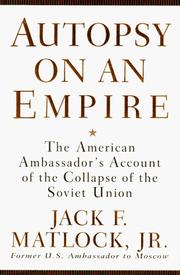
The last American ambassador to the USSR, writing from inside the diplomacy with access nobody else had. A primary account that is also a serious history.
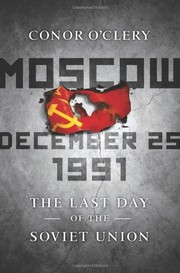
The final day told hour by hour, with the Gorbachev-Yeltsin relationship at its centre. A short, dramatic close to the narrative before the arguments begin.
Why It Happened, and What Followed
IntermediateWeigh the incompatible explanations — ideological exhaustion, imperial overstretch, the informal social order, elite self-enrichment — and understand why the 1990s aftermath shapes how Russians read the collapse today.
▸ Study plan for this stage
Pace: 6 weeks — the longest and most demanding stage. The Soviet Tragedy first as the most deterministic reading; then A Failed Empire for the Cold War and imperial-overstretch dimension; then Yurchak's Everything Was Forever, Until It Was No More, which is the most original book on the path and the slowe
- Malia's ideological determinism: that socialism as conceived could not work and the collapse was implicit in the founding
- Imperial overstretch — the arms burden, Afghanistan, the cost of the Eastern bloc and of client states in the developing world
- Yurchak's 'hypernormalisation': late Soviet citizens reproducing the system's forms while being indifferent to its content, and why that makes both the stability and the sudden collapse intelligible
- The performative shift — the argument that the ritual constative meaning of authoritative discourse had drained away while its form was scrupulously maintained
- Loans-for-shares, voucher privatisation, and the making of the oligarchs
- The 1990s as experienced: mortality, savings destroyed, and why the collapse is remembered by many Russians as a robbery rather than a liberation
- Oral history as evidence — what Alexievich's method establishes, and its known editorial shaping
- State each of the four explanations — ideological, imperial, social-order, elite self-enrichment — in one sentence, and say what evidence would count for and against each.
- Malia argues from 1917 and Yurchak from the 1970s. Are their accounts actually incompatible, or do they answer different questions?
- What does Yurchak mean by saying the collapse felt both inevitable and astonishing? Explain the mechanism, not just the paradox.
- Freeland describes privatisation as it happened. Which decisions were unavoidable given the situation in 1992, and which were choices with beneficiaries?
- Alexievich's interviews are edited and arranged. Does that make them less reliable as evidence, or is the arrangement itself the argument?
- Give your final explanation of the collapse. Which of these authors do you now think is most nearly right, and which single piece of evidence would most damage your position?
- Build a table with the four explanations as rows and, as columns, the evidence each cites, the evidence each cannot account for, and the prediction each would have made in 1985. Fill it in from the books.
- Take one specific event — the August coup — and write four short accounts of it, one from each explanatory frame. Note which frame handles it worst.
- Trace the claim about Soviet defence spending as a share of output across Zubok and Malia to their sources, and write down how wide the plausible range actually is and what that does to the overstretch argument.
- Read three of Alexievich's testimonies and then find the corresponding structural fact in Freeland — a privatisation, a savings collapse, a factory closure. Write a paragraph on what the oral history adds to the economic account and what it cannot establish.
- Return to the explanation you first wrote in stage one and to both revisions. Write a final version, and beneath it list every book that changed your mind and the specific evidence that did it.
- Write the strongest one-paragraph attack on your own final position, using material from the author you find least persuasive.
Next up: This closes the path: you can now place any account of 1991 inside the argument between these four explanations and say what it is committed to.

The strongest ideological argument: that the system failed because socialism as conceived could not work, and that the collapse was implicit from 1917. Start the stage with the most deterministic reading available.
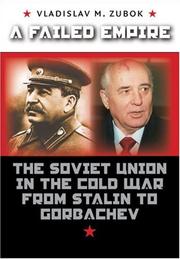
Zubok's earlier book, on Soviet foreign policy from Stalin to Gorbachev, supplying the Cold War and imperial-overstretch dimension the domestic narratives leave thin.
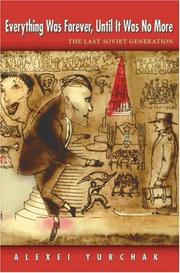
An anthropologist's account of how late Soviet citizens inhabited a system they neither believed nor opposed — which is why the collapse felt simultaneously inevitable and astonishing. The most original book on this path.
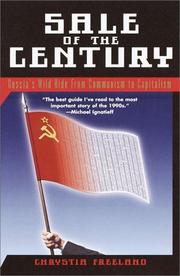
The privatisation of the Russian economy and the making of the oligarchs, reported as it happened. It explains why, for many Russians, the collapse is remembered as a robbery rather than a liberation.

Alexievich's oral history of ordinary post-Soviet lives, assembled from hundreds of interviews and awarded the Nobel Prize. The right closing book on the whole path: it returns the argument to the people the arguments are about. Note the catalogue files it as one word, Secondhand, rather than the hyphenated form used on some editions.
Discussion
Keep reading
Paths that share books, cover the same subject, or open a related topic.