Social Research Methods: The Best Books on Designing a Study, in Order
This path is about research design: turning a vague interest into a question a study could actually answer, choosing a design capable of answering it, and knowing what that design can and cannot license you to conclude. Its centre of gravity is inference and measurement — sampling, comparison, causal identification, questionnaire construction, experiments in the field and research using digital trace data. A boundary worth stating up front, because the two overlap and the site carries both: the companion path on qualitative research methods covers the craft of doing qualitative work — interviewing technique, fieldnotes, coding, thematic and grounded-theory analysis — in detail. This path covers design across the whole methodological range, including how qualitative and quantitative work fit together in a mixed design and what standards of inference each is held to, but it does not teach you to run an interview or code a transcript. If your question is how do I design a study, start here. If it is how do I do the fieldwork and analyse it, start there. Several of these are long-running textbooks catalogued at older editions; for the design classics that matters little, but for anything on survey practice or digital data, get the current edition.
Asking a Question a Study Could Answer
BeginnerBefore any method, learn to formulate a researchable question and to see the difference between a topic, a question and a claim that a reader would need evidence for. By the end you should be able to state a research question, the puzzle motivating it and what evidence would count against your expected answer — and to distinguish a descriptive question from a causal one, which determines everything downstream. This stage assumes no statistics.
▸ Study plan for this stage
Pace: Six to eight weeks for 1,111 pages, and none of it requires statistics. Booth, Colomb and Williams's The Craft of Research is 311 pages - catalogued here with its series name appended to the title - and it is not a methods book at all, which is why it comes first: it moves you from a topic to a ques
- The difference between a topic, a research question and a claim a reader would demand evidence for
- The puzzle: what makes a question worth answering, as distinct from merely unanswered
- Descriptive versus causal questions, and why that distinction determines every downstream design decision
- Design as a logical structure - what arrangement of observations could rule out the rival explanations - rather than as a menu of techniques
- The epistemological commitments hidden inside a method choice, which Bryman is unusually direct about
- Stating in advance what evidence would count against your expected answer, which is the single best defence against a study that can only confirm
- Reading a textbook as a reference rather than a narrative, which is a skill in itself on a path with this much page count
- Take a topic you care about and produce a question, then a claim. What did each step have to add?
- What makes your question a puzzle rather than merely a gap? Whose expectation does the answer disturb?
- Is your question descriptive or causal? Name three design consequences that follow from the answer.
- De Vaus treats design as logic. For one design he covers, state what arrangement of observations it uses and what rival explanation that arrangement rules out.
- What evidence would count against your expected answer, and could the design you have in mind actually produce it?
- Write your question three ways - as a topic, as a question, and as a claim with reasons - following Booth, Colomb and Williams's own sequence. Then show the third version to someone outside your field and ask what evidence they would want. The gap between what you would offer and what they ask for is usually where the study needs redesigning.
- Take de Vaus's four design types in turn and, for each, write one sentence saying what your question would look like if it had to be answered by that design. Three of the four will be uncomfortable, and the one that is not is your design.
- Use Bryman and Teevan's chapters on epistemology to name the commitments implicit in the design you just chose. Write them down explicitly. A study whose author cannot state them tends to defend the wrong things when challenged.
- Write the falsification sentence - 'I would abandon this expectation if I observed X' - and pin it above your desk. Rewriting it at the end of each stage of this path is the cheapest quality control available.
Next up: With a researchable question in hand, the next stage sets out the actual designs available and forces the choice to be justified against the question and the constraints rather than by convention.
Booth, Colomb and Williams on moving from a topic to a question to a claim supported by reasons and evidence. Not a methods book at all, which is why it comes first: most weak studies are weak because the question was never sharpened, and no design fixes that.

The clearest short treatment of design as a logical structure rather than a set of techniques — experimental, longitudinal, cross-sectional and case study, each matched to the kind of question it can answer. The best second book on the path.
The standard comprehensive survey text, covering quantitative, qualitative and mixed strategies with equal seriousness, and the reference to keep beside you for the rest of the path. Bryman is unusually good on the epistemological commitments hidden inside method choices.
The Design Menu
IntermediateLearn the main designs and what each one buys and costs: cross-sectional survey, panel and longitudinal, experiment and quasi-experiment, comparative and case study, and mixed-methods combinations. By the end you should be able to justify a design choice against the question and the constraints — access, time, ethics, money — rather than by discipline convention, and to say honestly what a chosen design will fail to establish.
▸ Study plan for this stage
Pace: Eight to ten weeks for 1,058 pages, and one of the three books dominates the count. Creswell and Creswell's Research Design is 271 pages and is the framework for choosing among qualitative, quantitative and mixed approaches, plus the standard reference on mixed designs specifically - what sequencing
- The main designs and what each buys and costs: cross-sectional survey, panel and longitudinal, experiment and quasi-experiment, comparative and case study
- Mixed-methods design as sequencing and integration decisions rather than as a label attached to using two methods
- Design under real constraints - negotiated access, no randomisation, a client with a deadline - and why the textbook design is often unavailable
- Evaluation research as a distinct genre with its own standards, which Robson treats seriously and most methods texts skip
- Yin's replication logic across multiple cases, which is a different thing from sampling
- Analytic versus statistical generalisation: what a case study generalises to, and what it does not
- Case selection as a design decision with consequences, foreshadowing the selection arguments in the next stage
- Stating a design's limits in advance, which is what distinguishes a chosen design from a defaulted one
- For your question, name the design you would choose and the design you would choose if you had twice the budget. What exactly does the money buy?
- What does integration mean in a mixed design, and at what point in a study does it happen? Give a concrete example from Creswell and Creswell.
- Robson's settings rarely permit randomisation. Which quasi-experimental options remain, and what do you give up with each?
- How does Yin's replication logic differ from sampling? What claim is a second case supposed to support?
- Distinguish analytic from statistical generalisation, and say which one your intended study would be making.
- Name three things your chosen design will not be able to establish. If you cannot, you have not chosen it.
- Write a one-page design justification for your own question: the design, the alternatives rejected, the constraint that decided it, and the limits accepted. Then rewrite it as if a reviewer had asked why not the design you rejected. Doing both drafts is the exercise.
- Take Yin's case-selection criteria and apply them to a real study you admire. Say why those cases and not others, and whether the author's stated reason matches the one you would infer from the design.
- Design the same study twice from Robson's chapters: once under ideal conditions and once under a real constraint you actually face. Then list the inferences you lost in the second version. This is the most honest thing you can do before starting fieldwork.
- For a published mixed-methods paper, identify where the two strands actually meet - in sampling, in analysis, in interpretation, or nowhere. Creswell and Creswell's point is that many papers labelled mixed never integrate at all, and checking one for yourself makes it stick.
- Draw a table of the designs in this stage with columns for the question type it suits, what it establishes, and the threat it cannot rule out. The third column is the one that matters and it is what the next stage is about.
Next up: A design is only as good as the inference it licenses, and the next stage takes up the central methodological dispute in the social sciences about what any of these designs can actually prove.
Creswell's framework for choosing among qualitative, quantitative and mixed-methods approaches, and the standard reference on mixed designs specifically — what sequencing and integration actually mean in practice rather than as a label.

Design under real constraints: applied and evaluation research in organisations and services, where randomisation is usually impossible and access is negotiated. The corrective to textbook designs that assume conditions you will not have.
The defence of the case study as a design with its own logic of inference rather than as a small sample, including case selection, multiple-case replication logic and the analytic-versus-statistical generalisation distinction. Read it before the inference stage, which argues with it.
Inference: What a Study Can Actually Prove
IntermediateGet inside the central methodological argument in the social sciences: whether qualitative and quantitative research share one logic of inference or two. King, Keohane and Verba say one, and their book is the most influential statement of that position; the Brady and Collier volume is the organised rebuttal, arguing that the framework imports quantitative assumptions and undervalues process-based evidence. Read both — this is a genuine unresolved dispute, and knowing where you stand on it determ
▸ Study plan for this stage
Pace: Four to five months for 1,665 pages, the intellectual centre of the path. King, Keohane and Verba's Designing Social Inquiry is 272 pages and comes first: the most cited methods book in political science, arguing that qualitative research should be held to the same inferential standards as quantitat
- The one-logic claim: define the observable implications of a theory, avoid selecting on the dependent variable, increase the number of observations
- Causal-process observations as evidence of a different kind from data-set observations, which is Brady and Collier's central contribution
- Selection on the dependent variable - what goes wrong, and the cases where critics argue it does not
- The four validities: internal, external, construct and statistical-conclusion, and the fact that improving one routinely costs another
- Specific threats to internal validity - history, maturation, regression to the mean, attrition - and which quasi-experimental design rules out which
- Confounding and selection as the two mechanisms behind most spurious empirical claims
- What regression does and does not license, and the conditions a coefficient needs before it can be read causally
- Where you stand in the one-logic-versus-two dispute, because it determines what you will accept as a finding
- State King, Keohane and Verba's core prescriptions. Which of them apply straightforwardly to a five-case comparative study, and which do not?
- What is a causal-process observation, and how is it supposed to license an inference that adding cases would not?
- Explain selection on the dependent variable with a concrete example. Then give the strongest defence of a study that does it deliberately.
- Name the four validities and give a design decision that improves one at the expense of another.
- For a quasi-experimental design of your choice, list the threats to internal validity it rules out and the ones it leaves standing.
- Take a published empirical claim and identify whether the risk is confounding, selection, or measurement. What would each require to fix?
- Read the two sides consecutively and write a two-column brief: what King, Keohane and Verba prescribe, and what Brady and Collier say goes wrong when you follow it. Then write a third column with your own position and the reason. A methods reader who cannot state their position on this dispute will accept the wrong things as findings.
- Take one study from your own field and audit it against the validity typology from Cook, Campbell and Shadish - all four validities, threat by threat. It is tedious and it is the single most useful exercise on this path.
- Reproduce one of Bueno de Mesquita and Fowler's worked examples with their own numbers, then change the assumed selection process and see the estimate move. Watching a coefficient shift under a stated assumption is worth more than any amount of prose about confounding.
- Apply the observable-implications instruction to your own expected answer: write down five things that should be true if you are right, at least two of which would be observable in data you could actually get. If you cannot produce five, the theory is vaguer than it feels.
- Take Yin's case-study logic from the previous stage and test it against the King, Keohane and Verba framework. Yin claims a distinct logic of inference and they deny there is one; deciding which is right for your own design is the practical form of this whole dispute.
Next up: Inference assumes measurement, and the final stage turns to how data is actually produced - questionnaires, surveys, field experiments, and behaviour observed through platforms nobody designed as an instrument.
The single most cited methods book in political science, arguing that qualitative research should be held to the same inferential standards as quantitative work: define the observable implications, worry about selection on the dependent variable, increase the number of observations. Read it first, and read it as an argument.

The book-length reply, edited by Brady and Collier, introducing causal-process observations as a distinct kind of evidence and challenging the previous book's treatment of case selection. The pairing is the point; neither book is complete without the other.
Shadish, Cook and Campbell — the standard technical reference on validity, and the source of the internal, external, construct and statistical-conclusion validity vocabulary everyone uses. The place to learn the specific threats each quasi-experimental design does and does not rule out.

The most current and most readable book here on quantitative reasoning: correlation and causation, confounding, selection, regression, and how to interrogate an empirical claim. Read after the validity material, as the applied version of it.
Getting the Data
IntermediateMove to execution — how measurement is actually built, and what changes when data comes from a platform rather than an instrument. By the end you should understand total survey error as a framework, know why question wording and order can move a result more than the phenomenon does, be able to describe how a field experiment handles noncompliance and spillover, and understand the ethical position of research on data people did not know was being collected. This stage is the most technical on the
▸ Study plan for this stage
Pace: Four to five months for 1,854 pages, the most technical stage on the path and the one where edition currency matters most - survey practice and digital methods have both moved substantially, so get current editions here even where the older printings served in earlier stages. Bradburn, Sudman and Wa
- Total survey error as a single framework: coverage, sampling, nonresponse and measurement error traded against each other under a fixed budget
- Question wording, order and response-option effects, which can move a result by more than the phenomenon being measured does
- Satisficing and acquiescence as respondent behaviours the instrument creates, not properties of the population
- Nonresponse bias as distinct from a low response rate, and why the second does not automatically imply the first
- Noncompliance in a field experiment, and what intention-to-treat estimates versus a treatment-on-the-treated estimate
- Interference between units and spillover, and why they break the assumption most experimental analysis rests on
- Readymade data versus custom-made data: what platform traces measure, what they systematically miss, and who is absent from them
- The ethics of research on data people did not know was being collected, and the frameworks Salganik offers for reasoning about it
- Give three ways a question's wording could move a result, with the evidence for each from Bradburn, Sudman and Wansink.
- Under a fixed budget, would you buy a larger sample or a higher response rate? Argue it in total-survey-error terms.
- Why is a low response rate not the same problem as nonresponse bias? What would you need to know to tell them apart?
- A field experiment has 40 per cent noncompliance. What can you still estimate, and under what assumption?
- Name three things platform trace data measures well and three it measures badly. Who is missing from it, and does that matter for your question?
- What makes research on unwitting subjects ethically different from research on consenting ones, and what does Salganik propose you do about it?
- Write ten questionnaire items for your own study, then rewrite each one after reading the corresponding chapter in Bradburn, Sudman and Wansink. Then have five people answer both versions and ask them what they thought each item meant. This is a two-day exercise and it will change your instrument more than any other single thing on this path.
- Take a published survey estimate and decompose the total survey error for it as far as the documentation allows - who was covered, who was sampled, who responded, what was measured. The gaps you cannot fill are the point.
- Work through one of Gerber and Green's analyses with their own numbers, then recompute it as if compliance were lower. Seeing the intention-to-treat and treatment-on-the-treated estimates diverge in your own arithmetic is what makes the distinction stick.
- Design a spillover-aware version of a field experiment you would want to run: what is the unit of randomisation, and what would leak between units? Then say what you would have to measure to detect the leak.
- Take one of Salganik's digital-age examples and ask the four validity questions from the previous stage of it. Platform data is strong on one validity and weak on another, and naming which is the bridge between the two stages.
- Write the ethics section of your own proposal before you write the methods section, using Salganik's framework. Doing it in that order occasionally kills a design, which is the argument for doing it in that order.
Next up: This closes the design path. If your next step is fieldwork - running the interviews, writing the notes, coding the transcripts - that craft is the subject of the companion path on qualitative research methods.
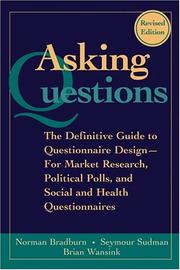
Bradburn, Sudman and Wansink on the practical craft of questionnaire design, with the evidence on how wording, order and response options shape answers. The most immediately usable book on the path, and the one that will change what you do first.

The authoritative treatment of the total survey error framework — coverage, sampling, nonresponse and measurement error considered together rather than separately. Technical, and the reference for anyone who will actually field a survey.

Gerber and Green's standard text on designing, analysing and interpreting randomised experiments outside the laboratory, including the awkward realities of noncompliance, attrition and interference between units. The clearest bridge from the inference stage to real fieldwork.

The right book to end on: social research in the digital age — observing behaviour through platform data, asking questions at scale, running experiments in live systems, and the ethics of all three. It reframes every earlier chapter for a setting the older textbooks were not written for, and it is free to read online.
Discussion
Keep reading
Paths that share books, cover the same subject, or open a related topic.