Academic writing made clear: essential books for students and scholars
This curriculum takes a writer from the ground up — starting with clear, plain prose, then building toward argument and structure, and finally mastering the conventions and craft of publishable academic work. Each stage assumes the skills of the previous one, so reading in order is essential for steady, compounding growth.
Foundations: Writing with Clarity
BeginnerDevelop a clean, precise writing habit by eliminating clutter, vagueness, and passive constructions — the bedrock of all good academic prose.
▸ Study plan for this stage
Pace: 8–10 weeks, ~25–30 pages/day (approximately 2–3 weeks per book with time for exercises and revision practice)
- Clarity through simplicity: choosing short, common words and eliminating unnecessary jargon (Zinsser's 'clutter' principle)
- Active voice as the default: understanding why passive constructions obscure meaning and how to identify and revise them (Williams & Strunk)
- Sentence structure and rhythm: crafting sentences that flow logically and emphasize key ideas through word order and length variation
- Precision in word choice: selecting specific, concrete words over vague abstractions and synonyms (Zinsser's 'specificity' and Williams's 'concrete subjects and verbs')
- Eliminating redundancy and weak constructions: recognizing and removing intensifiers, hedging language, and nominalizations that dilute meaning
- The reader-centered perspective: writing with the reader's comprehension as the primary goal, not the writer's convenience
- Revision as essential craft: treating editing as a discipline that transforms first drafts into clear, precise prose
- Grammar and mechanics as tools for clarity: understanding rules not as arbitrary constraints but as means to guide readers through your ideas
- What does Zinsser mean by 'clutter,' and how does it differ from complexity? Provide three examples of clutter from your own writing and explain how to eliminate it.
- Why does Williams argue that passive voice obscures agency and responsibility? How do you identify a passive construction, and what is the revision process?
- How does Strunk's principle of 'vigorous writing' relate to the use of active voice and concrete nouns? Explain with examples.
- What is the relationship between word choice and reader comprehension? How do Zinsser's principles of specificity and Williams's emphasis on 'concrete subjects and verbs' work together?
- How do sentence length and variety contribute to clarity and emphasis? Demonstrate this by revising a paragraph with monotonous sentence structure.
- What role does revision play in achieving clarity according to these three authors? How does their approach to editing differ, and where do they align?
- Read and annotate one chapter from Zinsser per week, marking examples of clutter and clarity. Rewrite one cluttered passage from the book into Zinsser's style.
- Collect 5–10 sentences from your own academic writing (or sample texts). Identify passive constructions, nominalizations, and weak verbs. Revise each using Williams's framework for strong subjects and verbs.
- Practice the 'sentence surgery' exercise: take a paragraph of 8–10 sentences and reduce it to 5–6 sentences without losing meaning. Focus on eliminating redundancy and weak constructions.
- Write a 500-word essay on any academic topic. Revise it three times: first for passive voice (convert to active), second for word choice (replace vague words with specific ones), third for sentence variety (vary length and structure).
- Create a personal 'clutter list' of your habitual weak constructions (e.g., 'it is,' 'there are,' 'in order to'). Search for these in your writing and replace them with stronger alternatives from Strunk's rules.
- Analyze a published academic article (1–2 pages). Identify how the author uses active voice, concrete subjects, and varied sentence structure. Compare it to a poorly written sample using the principles from all three books.
Next up: Mastering clarity and precision in sentence-level writing provides the foundation for the next stage, where you will learn to organize these clear sentences into coherent paragraphs, arguments, and larger structures that guide readers through complex ideas.

The single best starting point for any serious writer: Zinsser teaches ruthless clarity and economy of language, habits that directly transfer to academic writing. Reading this first resets bad writing instincts before they get reinforced.

Bridges the gap between general clear writing and the specific demands of formal prose, with practical sentence-level techniques. It builds directly on Zinsser's principles and introduces the reader to academic register.
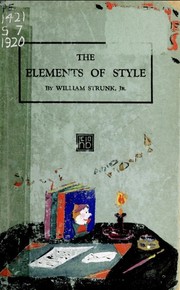
A compact, canonical reference for grammar and style rules that every academic writer is expected to know. Best read third, as a checklist to consolidate what the first two books taught.
Argument & Structure: Thinking Like a Scholar
BeginnerLearn how to construct a logical, evidence-based argument and organize it into a coherent paper or thesis structure.
▸ Study plan for this stage
Pace: 6–8 weeks, ~25–30 pages/day (alternating between the two books to reinforce concepts in practice)
- The 'They Say / I Say' framework: how to position your argument in conversation with existing scholarship and opposing views
- Templates for academic writing: using sentence starters and formulaic structures to organize claims, counterarguments, and responses
- The research question as the foundation: how to develop a focused, answerable question that drives your entire argument
- Evidence-based reasoning: selecting, evaluating, and integrating sources to support claims rather than merely citing them
- Logical structure and coherence: organizing arguments into thesis, supporting paragraphs, and counterargument sections that build toward a conclusion
- Distinguishing between summary, analysis, and argument: moving beyond reporting what sources say to making your own scholarly contribution
- The role of counterargument and concession: acknowledging opposing views to strengthen rather than weaken your position
- What does the 'They Say / I Say' framework mean, and why is positioning your argument in relation to existing scholarship essential to academic writing?
- How do you develop a strong research question, and what makes one question more suitable for academic inquiry than another?
- What is the difference between summarizing a source and analyzing it, and how do you integrate evidence into your argument rather than just inserting quotes?
- How should you structure a paragraph or section to move from claim to evidence to analysis, and what role does a topic sentence play?
- Why is acknowledging counterarguments important, and how do you concede a point without undermining your own thesis?
- What are the key differences between the planning, research, and drafting stages, and how does each stage inform the next?
- Read a scholarly article and map its argument using the 'They Say / I Say' framework: identify what existing views the author is responding to, what the author's own position is, and how the author supports it.
- Write three different thesis statements for a topic of interest, then evaluate each one using Booth's criteria for a good research question (is it answerable? does it matter? is it appropriate in scope?).
- Take a paragraph from a source text and rewrite it three ways: (1) as pure summary, (2) as summary with analysis, (3) as evidence integrated into your own argument using a 'They Say / I Say' template.
- Outline a 5–7 page argument on a topic you care about, using Graff's templates to draft topic sentences and transitions that show how each paragraph responds to or builds on the previous one.
- Write a 2–3 page draft section that includes a claim, at least two pieces of evidence, analysis of that evidence, and a concession to a counterargument—then revise it to strengthen the logical flow.
- Conduct a mock peer review of a classmate's draft (or your own earlier draft) using Booth's checklist for research-based writing: Does the thesis answer a real question? Is the evidence sufficient and well-chosen? Does the argument hold together logically?
Next up: Mastering argument structure and evidence-based reasoning here prepares you to tackle more advanced concerns like style, voice, and rhetorical effectiveness—learning not just how to build a sound argument, but how to make it persuasive and memorable to your specific audience.
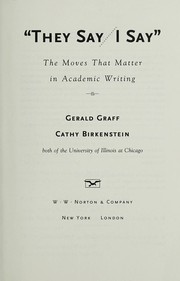
Introduces the essential moves of academic argumentation — entering a scholarly conversation, staking a claim, and responding to counterarguments — using memorable templates. This is the most practical bridge between general writing and academic writing.
Teaches how to frame a research question, build an evidence-based argument, and structure a full paper from start to finish. It deepens the argumentative skills from Graff by grounding them in the full research process.
Academic Style & Discipline-Specific Conventions
IntermediateMaster the tone, citation practices, and genre conventions that distinguish publishable academic writing from student essays.
▸ Study plan for this stage
Pace: 4–5 weeks, ~25–30 pages/day. Week 1–2: Belcher's structural and planning chapters (Part 1). Week 2–3: Belcher's drafting and revision strategies (Parts 2–3). Week 3–4: Sword's style and voice chapters. Week 4–5: Sword's discipline-specific conventions and final synthesis.
- The journal article as a distinct genre with predictable rhetorical moves (Belcher's IMRAD framework and variations across disciplines)
- How to diagnose and eliminate academic hedging, jargon, and passive voice while maintaining scholarly authority (Sword's 'style diagnosis' approach)
- Citation practices as a form of scholarly conversation—how to integrate sources smoothly and signal your contribution (Belcher's integration strategies)
- Discipline-specific conventions in tone, structure, and evidence presentation (Sword's field-by-field analysis)
- The revision process as a tool for developing voice and clarity, not just correcting errors (Belcher's recursive drafting model)
- How to write with confidence and personality while meeting academic standards (Sword's 'lively academic writing' philosophy)
- The relationship between audience awareness and stylistic choices in academic publishing
- Strategies for managing the tension between accessibility and disciplinary precision
- What are the key structural elements of a journal article in your discipline, and how do they differ from the IMRAD model?
- How can you identify hedging, jargon, and passive constructions in your own writing, and what are effective strategies for revision?
- What does it mean to integrate sources as part of an academic conversation rather than simply citing them?
- How do tone, sentence structure, and vocabulary choices differ across disciplines, and what does 'stylish' academic writing look like in your field?
- How can you develop a distinctive academic voice while adhering to the conventions of your discipline?
- What revision strategies from Belcher and Sword would be most effective for moving from a draft to a publishable manuscript?
- Analyze the structure of 3–4 published journal articles in your target journal using Belcher's IMRAD framework (or discipline-specific variant). Map where each rhetorical move occurs and note deviations from the standard model.
- Conduct a 'style diagnosis' on a 2–3 page section of your own writing using Sword's techniques: highlight hedging language, passive constructions, and jargon, then revise for clarity and voice.
- Rewrite a paragraph from a published article to eliminate one major stylistic problem (e.g., excessive hedging, buried main clause, or weak verb choice). Compare your revision to the original and reflect on what changed.
- Create a discipline-specific 'style guide' for yourself by collecting 5–6 exemplary sentences from published articles in your field and annotating what makes them effective (tone, structure, vocabulary, citation integration).
- Draft the introduction and one body section of a journal article on a topic you know well, then revise using Belcher's drafting checklist and Sword's sentence-level revision strategies.
- Interview or email a scholar in your discipline about their approach to academic style and citation practices. Document their advice and compare it to Belcher's and Sword's recommendations.
Next up: This stage equips you with the rhetorical and stylistic tools to write publishable work; the next stage will focus on navigating the submission, peer review, and revision process to move that polished manuscript toward actual publication.
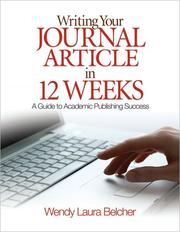
A structured, week-by-week guide to transforming a draft into a submission-ready journal article, covering framing, literature reviews, and revision. It applies everything learned so far to the real-world target of publication.
Based on analysis of thousands of published articles, Sword shows how top scholars write with elegance and engagement without sacrificing rigor. Reading this after Belcher helps writers move beyond correctness toward genuine voice.
Advanced Craft: Thesis, Revision & the Writing Life
ExpertDevelop a sustainable writing practice, master long-form academic projects like theses and dissertations, and refine work through deep revision.
▸ Study plan for this stage
Pace: 8–10 weeks, ~40–50 pages/day with 2–3 days per week dedicated to writing practice and revision exercises
- Writing as a craft and iterative process: embracing drafting, revision, and rewriting as central to academic work rather than polishing a finished product
- The sociology of academic writing: understanding audience, disciplinary conventions, and how social context shapes what counts as 'good' writing
- Overcoming psychological barriers to writing: managing perfectionism, procrastination, and the anxiety that blocks sustained academic output
- Establishing a sustainable writing practice: building consistent habits, protecting writing time, and treating writing as a regular discipline rather than inspiration-dependent activity
- Thesis and dissertation writing as a long-form project: structuring complex arguments, managing scope, and maintaining coherence across extended work
- Revision as deep intellectual work: moving beyond copyediting to rethinking structure, evidence, and argument at multiple levels
- The writing life as a professional identity: integrating writing into your daily work rhythm and building accountability systems that sustain productivity
- What does Becker mean by 'writing as thinking' and how does this perspective change the way you approach academic writing?
- How do disciplinary conventions and audience awareness shape the choices you make in structure, tone, and evidence presentation?
- What are the main psychological obstacles to sustained academic writing, and what practical strategies does Silvia recommend to overcome them?
- How should you approach revision differently at the macro level (argument and structure) versus the micro level (sentences and clarity)?
- What does a sustainable daily or weekly writing practice look like, and how can you protect it from competing demands?
- How do you manage the scope and coherence of a long-form project like a thesis or dissertation across multiple drafts?
- Complete a 'writing audit': track your actual writing time and output for one week, then identify barriers and design a realistic daily writing schedule using Silvia's principles
- Write a 500-word reflective piece on your discipline's conventions (genre, citation style, argument structure) by analyzing 2–3 published articles in your field
- Draft a thesis or chapter outline using Becker's approach: write out your main argument, then sketch how evidence and sub-arguments support it before writing prose
- Revise a previous piece of your own writing in two passes: first macro-level (reorganize sections, strengthen argument), then micro-level (clarity, flow, word choice)
- Conduct a 'reverse outline' of a published academic article: extract the main claim of each paragraph to see how the author structures and develops ideas
- Set up a writing accountability system (writing group, daily log, or partnership) and commit to it for 4 weeks, documenting what works and what doesn't
Next up: This stage equips you with both the philosophical foundation (writing as craft and social practice) and the practical systems (daily habits, revision strategies, long-form project management) needed to tackle independent research projects and contribute to scholarly conversations in your field.
A candid, witty diagnosis of the institutional and psychological forces that make academic writing bad — and how to fight them. It is best read at this stage, when the writer has enough experience to recognize every trap Becker describes.
Provides the productivity framework and daily writing habits needed to sustain long projects like dissertations and books. It closes the curriculum by ensuring all the craft skills learned can actually be deployed consistently.
Discussion
Keep reading
Paths that share books, cover the same subject, or open a related topic.