Salman Rushdie Reading Order: Where to Start
This curriculum traces Salman Rushdie's literary world from an accessible entry point through his magnum opus, his most controversial work, and finally his memoir — building the reader's feel for his magical realism, postcolonial themes, and intertextual richness at each stage. Starting at an intermediate level, the path respects prior reading experience while steadily deepening engagement with Rushdie's style, history, and personal mythology.
Entry Point: Finding Rushdie's Voice
IntermediateGet a feel for Rushdie's storytelling style — his wit, fabulism, and cultural layering — through a shorter, more accessible novel before tackling his denser masterworks.
▸ Study plan for this stage
Pace: 6–8 weeks total: Weeks 1–2 for "Haroun and the Sea of Stories" (~25–30 pages/day, it's short and fast-moving); Weeks 3–8 for "The Moor's Last Sigh" (~20–25 pages/day, allowing time to pause and re-read dense passages). Reserve the final 3–4 days of each book for reflection, note review, and journali
- Fabulism and Magical Realism: How Rushdie blends the fantastical seamlessly into realistic or semi-realistic settings — the Ocean of the Streams of Story in Haroun, the supernaturally accelerated aging and painted worlds in The Moor's Last Sigh — as a vehicle for political and emotional truth.
- Storytelling as a Political Act: In Haroun, the silencing of Rashid Khalifa is a direct allegory for censorship and the suppression of narrative; in The Moor's Last Sigh, Moraes's life story is itself an act of resistance against erasure and forgetting.
- Cultural Layering and Hybridity: Both novels draw on multiple cultural traditions simultaneously — Haroun weaves South Asian oral tradition, Western fantasy, and Mughal imagery; The Moor's Last Sigh layers Goan-Jewish-Hindu-Muslim heritage, Spanish Reconquista history, and postcolonial Indian politi
- The Unreliable or Compromised Narrator: Moraes Zogoiby ('the Moor') narrates his own story under duress, aging at double speed and writing against time — Rushdie uses this to question whose version of history we trust and why.
- Family as Microcosm of Nation: The da Gama-Zogoiby family in The Moor's Last Sigh mirrors the contradictions, violence, and beauty of India itself; the family's decline tracks the decay of a pluralist, syncretic national ideal.
- Rushdie's Prose Style — Wit, Wordplay, and Excess: Both books showcase Rushdie's love of puns, invented names, comic digression, and baroque accumulation of detail. Recognizing this style as deliberate and meaningful (not mere ornamentation) is central to reading him well.
- Loss, Exile, and Nostalgia: Haroun fears losing his father's gift; the Moor is literally exiled from his homeland. Rushdie — himself living under fatwa during the writing of both books — embeds personal displacement into both narratives.
- Allegory and Real-World Referents: Haroun's Chup/Gup conflict maps onto real political binaries (silence vs. speech, darkness vs. light); The Moor's Last Sigh contains a thinly veiled portrait of Bal Thackeray and the rise of Hindu nationalism in Bombay.
- In Haroun and the Sea of Stories, what does the Ocean of the Streams of Story represent, and how does the threat of its pollution function as an allegory for censorship or the suppression of imagination?
- How does Rushdie use the device of Moraes Zogoiby's double-speed aging in The Moor's Last Sigh to shape the novel's narrative urgency, and what does it suggest about the relationship between personal history and historical time?
- Both novels feature a protagonist who is in some way 'damaged' or limited — Haroun by his father's silence, the Moor by his accelerated life and deformed hand. How do these physical or circumstantial constraints become sources of narrative power rather than mere obstacles?
- Identify at least two moments in either novel where Rushdie uses humor or wordplay to deliver a serious political or philosophical point. What is the effect of this tonal blending, and would the point land differently if made seriously?
- The Moor's Last Sigh is deeply concerned with the idea of a syncretic, pluralist India being destroyed by sectarian nationalism. Which specific characters, settings, or plot events carry this theme, and how does the novel's ending comment on it?
- How do the two books in this stage complement each other as an introduction to Rushdie's voice — what does Haroun teach you about reading The Moor's Last Sigh, and what does The Moor's Last Sigh retroactively reveal about the stakes in Haroun?
- Wordplay Inventory: As you read, keep a running log of Rushdie's puns, invented names, and portmanteau words (e.g., 'Khattam-Shud,' 'Moraes/Moor,' place names in Haroun). After finishing both books, write a one-page reflection on what patterns you notice — what do the names signal about character, theme, or tone?
- Allegory Mapping: Draw a two-column chart for each book. On the left, list fantastical or fictional elements (the Chup/Gup war, the Moor's paintings, the character of 'Mainduck'). On the right, write the real-world political or historical referent you believe each maps onto. Use footnotes or an author's note if available to check your readings.
- Comparative Voice Exercise: Find one passage of roughly one page from Haroun and one from The Moor's Last Sigh that you feel best captures Rushdie's narrative voice. Write a 300-word close reading of each, focusing on sentence rhythm, tonal register, and the interplay of the comic and the serious.
- Family Tree and Nation Diagram: For The Moor's Last Sigh, construct a detailed family tree of the da Gama-Zogoiby line, annotating each member with their cultural/religious background and their symbolic role in the novel's allegory of India. Note where the family's internal conflicts mirror external historical events.
- Personal Displacement Journal: After finishing both books, write a 400–500 word personal reflection on a time you felt caught between two cultures, identities, or 'stories.' Then re-read the opening and closing pages of each book and note how Rushdie's own sense of exile shapes the emotional texture of the narrative.
- Anticipation Prep for Next Stage: Before moving on, write down three unanswered questions or unresolved ideas these two books left you with — about Rushdie's style, his politics, or his worldview. Keep this list as a lens to bring to the denser masterworks ahead.
Next up: Mastering Rushdie's playful-yet-political voice, his allegorical method, and his cultural layering in these two novels gives the reader the interpretive toolkit and stylistic stamina needed to navigate the greater structural and historical complexity of his landmark masterworks.

Written for Rushdie's son, this slim allegorical fable introduces his playful language, love of myth, and defense of storytelling itself — a perfect, low-friction first encounter with his prose.

A rich family saga spanning Indian and Moorish history, it builds the reader's stamina for Rushdie's maximalist style and prepares the intuition needed for Midnight's Children.
The Magnum Opus: Midnight's Children
IntermediateFully engage with Rushdie's most celebrated novel — understanding its historical allegory, magical realism, and narrative ambition as the cornerstone of his entire body of work.
▸ Study plan for this stage
Pace: 5–6 weeks, ~25–30 pages/day — read in three natural phases: Part One (Saleem's ancestry & birth, ~200 pp.) in weeks 1–2, Part Two (the Midnight's Children's Conference & political upheaval, ~250 pp.) in weeks 3–4, and Part Three (the Emergency & dissolution, ~150 pp.) in weeks 5–6, leaving time at t
- Magical Realism as Political Language: How Rushdie uses supernatural elements (telepathy, the Midnight's Children's Conference, Saleem's all-smelling nose) not as fantasy escapism but as a precise metaphorical vocabulary for India's postcolonial condition.
- Historical Allegory & the 'Midnight' Conceit: The one-to-one and many-to-one mappings between Saleem Sinai's personal biography and the history of independent India (1947–1977), including Partition, the 1965 and 1971 wars, and Indira Gandhi's Emergency.
- Unreliable Narration & Memory: Saleem's explicit acknowledgment of his own errors, contradictions, and self-serving distortions — and what Rushdie argues this says about how nations construct their own founding myths.
- Chutnification of History: The novel's central metaphor of pickling — preserving, distorting, and fermenting the past — as a theory of storytelling, memory, and historiography.
- Polyphonic & Digressive Narrative Structure: The Scheherazade-like, parenthesis-within-parenthesis prose style, its debt to oral storytelling traditions (Arabian Nights, the Mahabharata), and how form mirrors the chaos of a newly independent, plural nation.
- Postcolonial Identity & Hybridity: Saleem as a figure of impossible hybridity — Hindu, Muslim, British, Indian — and the novel's interrogation of whether a unified national identity is achievable or even desirable.
- The Body as Nation: The sustained conceit of Saleem's cracking, leaking, fragmenting body as an embodiment of India's own fractures — and what it means that both Saleem and the nation are simultaneously 'handcuffed to history.'
- Intertextuality & Literary Allusion: Rushdie's dense web of references to Laurence Sterne's Tristram Shandy, Günter Grass's The Tin Drum, Gabriel García Márquez's One Hundred Years of Solitude, and Indian epic traditions — and how these shape the novel's ambitions.
- How does Rushdie use Saleem Sinai's birth at the exact moment of Indian independence to establish the novel's central argument about the relationship between private lives and public history — and where does that argument break down or become ironic?
- Saleem openly admits to factual errors (e.g., misremembering the date of Gandhi's assassination). What is the narrative and philosophical effect of these deliberate mistakes, and what does Rushdie suggest about the reliability of any historical account?
- Trace the 'chutnification' metaphor from its literal appearance in Padma's pickle factory to its function as the novel's governing theory of memory. How does this metaphor complicate a straightforward reading of the novel as historical fiction?
- How do the supernatural gifts of the Midnight's Children — ranging from Saleem's telepathy to Parvati-the-witch's magic — collectively function as an allegory for the squandered promise of post-independence India?
- In what ways does the novel's prose style (its digressions, interruptions by Padma, self-corrections, and nested stories) itself enact the themes of fragmentation, plurality, and the impossibility of a single authoritative narrative?
- How does Rushdie represent Indira Gandhi's Emergency (1975–1977) through the 'Widow' and the Midnight's Children's sterilization? What does this episode argue about the relationship between political authoritarianism and the suppression of individual and collective memory?
- Annotated Timeline: Build a two-column timeline as you read — one column for events in Saleem's personal life, one for the corresponding real Indian historical events. At the end, write a one-page reflection on where the parallels are tight, where they are loose, and what Rushdie gains from the looseness.
- Narrative Voice Journal: After each major section (Parts One, Two, and Three), write a short passage (200–300 words) in Saleem's voice about a real event from your own country's or family's history, deliberately including at least one 'admitted error.' Reflect on how the exercise changes your relationship to that event.
- Metaphor Tracking — The Cracking Body: Keep a running log of every instance where Saleem's physical deterioration (cracking skin, leaking sinuses, fragmenting self) is described. At the end of the novel, map these moments onto the political timeline you built in Exercise 1 and write a paragraph analyzing the pattern.
- Intertextual Comparison: Read the opening 30 pages of Günter Grass's The Tin Drum (Oskar's birth and his decision to stop growing). Write a 400-word comparative note on how both novels use a child's body as a register of national trauma, and what each author's choice of 'magical' gift reveals about their respective political critiques.
- The Midnight's Children's Conference Debate: Choose three Midnight's Children with different gifts and write a 1-page dramatic dialogue in which they debate what to do with their powers for India's future. Use this as a lens to articulate the novel's competing visions of postcolonial possibility.
- Close-Reading the Pickle Jars: Select the passage in which Saleem describes the process of pickling (in the novel's final chapters) and write a 500-word close reading focusing on diction, syntax, and imagery. Argue specifically for how the language of preservation and transformation encodes Rushdie's theory of what fiction does to history.
Next up: Midnight's Children establishes the full toolkit — magical realism, unreliable narration, historical allegory, and hybrid identity — that Rushdie will stress-test, darken, and controversially extend in his subsequent novels, making it the essential baseline for understanding both his artistic evolution and the escalating real-world stakes of his work.
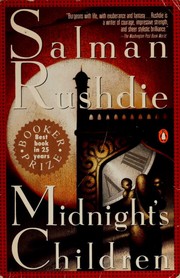
The Booker Prize winner and the heart of this curriculum: a child born at the moment of Indian independence whose life mirrors the nation's. Everything read before has prepared the reader for its scope and density.
The Controversial Work: Faith, Blasphemy & The Fatwa
IntermediateRead the novel that changed Rushdie's life and sparked a global crisis, and understand the literary, political, and religious forces it unleashed.
▸ Study plan for this stage
Pace: 6–8 weeks total. Weeks 1–6: Read "The Satanic Verses" at roughly 80–100 pages per week (the novel runs ~550 pages) — slow down for the dream sequences and do not rush the dense allegorical passages. Week 7: Read "Is Nothing Sacred?" (a short lecture essay, ~15 pages) in one sitting, then re-read it
- Magical realism as a vehicle for theological and political critique — how Rushdie blurs the boundary between the miraculous and the mundane to interrogate religious truth claims
- The dual-protagonist structure: Gibreel Farishta and Saladin Chamcha as allegorical opposites — faith vs. secular assimilation, the sacred vs. the profane
- The dream sequences and their function: Mahound, Ayesha, and the 'Satanic Verses' episode as fictional reimaginings of Islamic sacred history, and why this framing matters legally and literarily
- Hybridity, migration, and identity: the novel's core argument that selfhood — like culture and religion — is always a hybrid, contested, and mutable construction
- Blasphemy vs. literary freedom: the distinction Rushdie draws between artistic provocation and deliberate sacrilege, and why that distinction was rejected by his critics
- The Fatwa of 1989: Ayatollah Khomeini's death sentence as a political and theological act, its global consequences, and what it revealed about the clash between Enlightenment free-speech norms and religious authority
- Sacred literature and its social contract: in 'Is Nothing Sacred?', Rushdie's argument that literature occupies a quasi-sacred space of its own — a 'secular definition of transcendence'
- The relationship between storytelling and power: how 'Is Nothing Sacred?' reframes the controversy as a question about who controls narrative and meaning in pluralist societies
- In 'The Satanic Verses', what is the literary and thematic purpose of the Mahound dream sequences, and how does Rushdie use Gibreel's unstable consciousness to frame them as fiction-within-fiction rather than direct theological assertion?
- How do the contrasting fates of Gibreel Farishta and Saladin Chamcha dramatize Rushdie's ideas about faith, doubt, and the immigrant experience in Britain?
- What does Rushdie mean in 'Is Nothing Sacred?' when he describes literature as 'the one place in any society where, within the secrecy of our own heads, we can hear voices talking about everything in every possible way'? How does this idea respond directly to the controversy surrounding 'The Satanic Verses'?
- How does 'The Satanic Verses' use the concept of hybridity — cultural, religious, and personal — to challenge both Western racism and Islamic fundamentalism simultaneously?
- In 'Is Nothing Sacred?', Rushdie proposes a 'secular definition of the sacred.' What are its components, and is it a convincing answer to those who felt their faith was attacked?
- What were the specific political and historical conditions of 1988–1989 that made the reception of 'The Satanic Verses' so explosive, and how does the novel itself anticipate or reflect those tensions?
- Close-reading annotation: Select one complete dream-sequence chapter from 'The Satanic Verses' (e.g., 'Mahound' or 'Ayesha') and annotate every passage where Rushdie signals fictionality or unreliable narration — then write a one-page argument for why these signals do or do not constitute a meaningful literary defense of the text.
- Comparative character journal: Keep a running two-column log as you read, tracking Gibreel and Saladin's choices, transformations, and symbolic roles chapter by chapter. At the end, write a 500-word synthesis on what their divergent arcs say about Rushdie's view of faith and modernity.
- Debate preparation: Write two short position papers (250 words each) — one defending the Ayatollah's claim that the novel is a deliberate attack on Islam, one defending Rushdie's claim in 'Is Nothing Sacred?' that literature must be free to explore all territory. Then write a 100-word reflection on which argument you find harder to make and why.
- Contextual research exercise: Using only sources outside the two books, research the timeline of the Fatwa (1989 to the 2022 attack on Rushdie) and create a one-page annotated timeline. Then return to 'Is Nothing Sacred?' and identify three specific passages that read differently in light of what you now know.
- Sacred vs. secular mapping: After reading 'Is Nothing Sacred?', list every metaphor or analogy Rushdie uses to describe what literature does. Group them into categories (e.g., spiritual, political, psychological). Assess whether his 'secular sacred' is a coherent philosophical position or a rhetorical strategy.
- Creative response: Write a 400–600 word fictional scene — in Rushdie's style of magical realism — in which a character must choose between a story that is true and a story that is sacred. Reflect briefly on what the exercise taught you about the novel's central tension.
Next up: Grappling with how "The Satanic Verses" and "Is Nothing Sacred?" forced Rushdie to articulate a philosophy of literature under existential pressure prepares the reader to explore how that philosophy matured across his later novels and memoirs, where the themes of identity, storytelling, and survival become even more explicitly autobiographical.
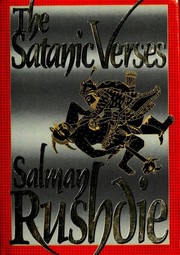
The novel at the center of the fatwa controversy — a dazzling, difficult exploration of faith, migration, and identity. Reading Midnight's Children first makes its ambitions and techniques fully legible.

A short, essential essay in which Rushdie directly addresses the role of literature versus religion — a vital companion piece that contextualizes The Satanic Verses controversy in his own words.
The Memoir: Life, Art & Survival
ExpertUnderstand Rushdie the man — his years in hiding, his creative philosophy, and the attack that nearly killed him — completing the portrait of one of literature's most embattled voices.
▸ Study plan for this stage
Pace: 10–12 weeks total: ~6–7 weeks for "Joseph Anton" (~30–35 pages/day, given its 656-page length and density) and ~3–4 weeks for "Knife" (~20–25 pages/day, allowing time for slower, more reflective reading of its emotionally intense material). Budget extra time for journaling and re-reading key passage
- The fatwa as a literary and political event: how Khomeini's 1989 decree transformed Rushdie from novelist into symbol, and how 'Joseph Anton' reconstructs that transformation from the inside
- The third-person self: Rushdie's deliberate choice to narrate 'Joseph Anton' in the third person as 'Rushdie,' creating critical distance from trauma and raising questions about identity, selfhood, and the act of memoir-writing itself
- The pseudonym 'Joseph Anton' (drawn from Conrad and Chekhov) as a meditation on literary lineage, borrowed identity, and the writer's relationship to his own name and heritage
- Freedom of expression as a lived, embodied struggle: how both books move the abstract principle of free speech into the visceral reality of safe houses, bodyguards, severed relationships, and a near-fatal knife attack
- The creative will under siege: how Rushdie continued to write, publish, and imagine during the fatwa years ('Joseph Anton') and how the act of writing 'Knife' itself became an act of survival and defiance after the 2022 Chautauqua attack
- 'Knife' as a dual anatomy — of the attack and of the attacker — and Rushdie's unflinching attempt to understand the mind of the man who tried to kill him, including an imagined dialogue with him
- The body as text: in 'Knife,' Rushdie's detailed reckoning with his physical injuries (the lost eye, the damaged hand) mirrors his career-long theme that literature is written in flesh as much as in ink
- Love, marriage, and human connection as counterweights to violence: the role of Eliza Griffiths (Rachel Eliza Griffiths) in 'Knife' as witness, anchor, and the embodiment of the life worth surviving for
- In 'Joseph Anton,' why does Rushdie choose to write about himself in the third person, and what does this narrative strategy reveal about the relationship between the private self and the public persona under extreme duress?
- How does 'Joseph Anton' portray the tension between Rushdie's need for state protection and his resentment of the constraints that protection imposed — and what does this tension say about the price of survival?
- In 'Knife,' Rushdie structures the book partly around an imagined conversation with his attacker. What is the literary and psychological function of this device, and does it resolve or deepen the moral questions it raises?
- Both books deal with the theme of the writer's identity being hijacked — by the fatwa, by the pseudonym, by the attack. How does Rushdie reclaim authorial selfhood across the two narratives?
- How does 'Knife' reframe the injuries to Rushdie's eye and hand not merely as physical trauma but as symbolically loaded wounds for a man whose life's work is seeing and writing?
- Taken together, how do 'Joseph Anton' and 'Knife' construct a philosophy of artistic resilience — and what, according to Rushdie, does literature owe to the risks taken in its name?
- Narrative voice experiment: Take a significant personal memory and write two versions of it — one in first person, one in third person (as Rushdie does in 'Joseph Anton'). Reflect in writing on how the shift in pronoun changes your relationship to the events, your sense of vulnerability, and your control over the story.
- Pseudonym archaeology: Research the two authors behind 'Joseph Anton' — Joseph Conrad and Anton Chekhov — and write a one-page note on what each represents in Rushdie's literary imagination. Then re-read the opening pages of 'Joseph Anton' with those associations in mind and annotate what the name choice signals about Rushdie's self-understanding as a writer.
- Parallel timeline: Create a side-by-side chronological chart of (a) key events in 'Joseph Anton' (the fatwa, safe-house moves, publication of subsequent novels, diplomatic breakthroughs) and (b) the global political context (Cold War's end, 9/11, the rise of political Islam). Use this to analyze how world history shaped the personal narrative.
- Close reading of the imagined dialogue: In 'Knife,' locate the section where Rushdie imagines confronting his attacker. Write a 500-word critical analysis of the rhetorical and emotional strategies Rushdie uses — what he chooses to say, what he withholds, and what the exercise costs him as a narrator.
- Survival and creativity audit: Compile a list of every creative work Rushdie mentions writing or publishing during the fatwa years in 'Joseph Anton.' For each, note the circumstances under which it was written. Write a short reflection on what this list reveals about the relationship between constraint and artistic output.
- Comparative memoir essay: Write a 750–1,000-word essay arguing how 'Joseph Anton' and 'Knife' function as companion texts — identifying at least three thematic or structural echoes between them and making a case for what the two books together say that neither could say alone.
Next up: By inhabiting Rushdie's life from the inside — his fears, his philosophy, his wounds, and his refusals — the reader is now equipped to return to his fiction with a fully biographical and political lens, reading his novels not just as imaginative acts but as dispatches from a writer who has paid for every word in full.
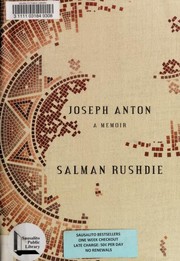
Rushdie's memoir of the decade he spent in hiding under a fatwa, written in the third person — a gripping, reflective account that reframes everything the reader has encountered in his fiction.

His most recent memoir, written after the 2022 knife attack that left him partially blind — a meditation on violence, survival, and the act of writing itself, bringing the curriculum to a powerful, present-day close.
Discussion
Keep reading
Paths that share books, cover the same subject, or open a related topic.