Learn Esperanto: Best Books to Read, in Order
This curriculum takes a complete beginner from zero Esperanto to confident, fluent use of the language through a carefully sequenced path: first building core grammar and pronunciation, then expanding vocabulary and reading ability, and finally deepening cultural fluency and expressive range. Each stage builds directly on the last, ensuring no learner is thrown into the deep end before they are ready.
Foundations: First Steps in Esperanto
BeginnerUnderstand Esperanto's logical grammar system, master pronunciation, and hold basic conversations using the 16 fundamental rules of the language.
▸ Study plan for this stage
Pace: 2–3 weeks, ~20–25 pages/day, with daily practice sessions of 15–20 minutes
- Esperanto's 16 fundamental grammar rules and their logical structure
- Pronunciation system: vowels, consonants, and stress patterns in Esperanto
- Word formation through prefixes, suffixes, and root combinations
- Basic sentence construction and word order in Esperanto
- Essential vocabulary for everyday conversations and greetings
- Colloquial expressions and conversational patterns in Esperanto
- Verb conjugation system and tense formation
- Noun and adjective agreement rules
- Can you explain the 16 fundamental rules of Esperanto grammar and how they create a logical, regular system?
- How do you correctly pronounce Esperanto vowels and consonants, and where does stress fall in words?
- How do you form new words using Esperanto's prefix and suffix system, and what do common affixes mean?
- Can you construct and understand basic sentences in Esperanto, including questions and negations?
- What are the essential vocabulary items and colloquial expressions needed for everyday conversations?
- How do verb conjugation and tense formation work in Esperanto, and how do they differ from English?
- Daily pronunciation drills: record yourself saying Esperanto words and sentences, comparing to native speaker audio
- Create flashcards for the 16 fundamental rules with examples, review 10–15 minutes daily
- Build 20–30 new words each day using the prefix/suffix system; write sentences using each new word
- Transcribe and translate 3–5 short colloquial dialogues from the book; practice reading aloud with correct intonation
- Write 5–10 original sentences daily using new grammar rules and vocabulary, focusing on conversational contexts
- Participate in or simulate basic conversations (with a language partner, tutor, or yourself) using phrases from the book
- Complete all in-book exercises and drills, checking answers against provided keys
- Create a personal reference sheet of colloquial expressions organized by context (greetings, questions, responses)
Next up: This stage establishes the grammatical foundation and conversational confidence needed to move into intermediate reading and writing, where you'll encounter more complex sentence structures, nuanced vocabulary, and authentic Esperanto texts.
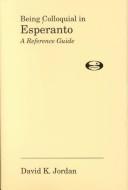
A free, widely used reference that bridges formal grammar and real spoken Esperanto. Read it alongside or just after the Teach Yourself course to understand how the language actually sounds in use.
Grammar Mastery: Understanding the System
BeginnerInternalize Esperanto's complete grammatical structure—affixes, correlatives, and word-building—so you can construct and decode virtually any word or sentence.
▸ Study plan for this stage
Pace: 4–5 weeks, ~25–30 pages/day, with 2–3 days per week dedicated to grammar drills and exercises
- Esperanto's regular agglutinative morphology: how roots, prefixes, and suffixes combine predictably to build meaning
- The complete system of correlatives (ki-, ti-, i-, ĉi-) and how they function across parts of speech
- Noun declension: the -o ending, accusative -n, and plural -j, and how they stack and interact
- Verb conjugation: infinitive -i, present -as, past -is, future -os, conditional -us, and the imperative
- Adjective agreement: -a ending, accusative -n, plural -j, and how adjectives modify nouns
- Affixes: the core prefixes (mal-, dis-, ek-, re-) and suffixes (-ulo, -ino, -ejo, -ado, -ema) and their productive use
- Sentence structure and word order: how Esperanto's flexibility differs from English and how grammar signals relationships
- Practical word-building: constructing new words from known roots using affixes and correlatives
- How do Esperanto's affixes (prefixes and suffixes) combine with roots to create new words, and what are the most common productive affixes?
- Explain the correlative system: what are the four main series (ki-, ti-, i-, ĉi-), and how do they function across different parts of speech?
- What are the rules for noun declension in Esperanto, and how do the -o, -n, and -j endings combine in different contexts?
- How do Esperanto verbs conjugate? Describe the forms for infinitive, present, past, future, conditional, and imperative.
- How do adjectives agree with nouns in Esperanto, and what happens when an adjective modifies a plural or accusative noun?
- Given a complex Esperanto sentence, can you identify the grammatical role of each word and explain how the grammar signals meaning?
- Complete all grammar exercises in Reed's chapters on affixes and correlatives; build a personal reference chart of the 20–30 most productive affixes with examples
- Noun declension drills: write out the four forms (nominative singular, accusative singular, nominative plural, accusative plural) for 30 common nouns
- Verb conjugation practice: conjugate 20 common verbs across all six tenses and moods, then use each form in a simple sentence
- Correlative mapping: create a 4×5 grid showing all correlative forms (ki-, ti-, i-, ĉi- across -o, -u, -e, -a, -am) and write example sentences for each
- Word-building challenge: given 10 Esperanto roots, construct 5 new words from each using different affixes; verify against a dictionary
- Sentence analysis: take 15–20 sentences from Reed's examples or a simple Esperanto text, parse each word grammatically (part of speech, case, tense, etc.), and explain how grammar conveys meaning
Next up: Mastering Esperanto's systematic grammar equips you to recognize and construct any word form, preparing you to move into practical communication—reading real texts, writing fluently, and engaging in conversation with confidence in your grammatical foundation.
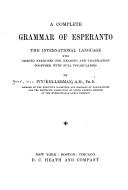
The classic English-language reference grammar, comprehensive and precise. Read it after Richardson to consolidate and fill any remaining grammatical gaps with authoritative detail.
Reading & Vocabulary: Into Authentic Esperanto
IntermediateRead real Esperanto texts with confidence, dramatically expand vocabulary, and develop an intuitive feel for natural Esperanto style and idiom.
▸ Study plan for this stage
Pace: 4–5 weeks, ~20–25 pages/day (approximately 100–120 pages total; allows time for re-reading passages and vocabulary consolidation)
- Recognizing and internalizing authentic Esperanto narrative voice and stylistic patterns through Piron's prose
- Building intermediate vocabulary through context and repeated exposure to thematic word families (adventure, emotion, description, dialogue)
- Understanding how Esperanto's regular morphology enables rapid vocabulary expansion (root + affix combinations)
- Parsing complex sentence structures and subordinate clauses in authentic narrative without constant dictionary lookup
- Identifying and using idiomatic expressions and colloquial speech patterns that distinguish natural Esperanto from textbook language
- Developing reading fluency by engaging with plot-driven narrative that sustains motivation across longer passages
- What are the main events of Gerda's journey in 'Gerda Malaperis!', and how does Piron use descriptive language to convey her emotional state?
- How does Piron employ Esperanto's affixation system (prefixes and suffixes) to create new words, and how can you use this pattern to infer meaning of unfamiliar words?
- What idiomatic or colloquial expressions appear in the dialogue, and how do they differ from formal written Esperanto?
- Identify 3–5 complex sentences from the text and explain how subordinate clauses, relative pronouns, and conjunctions structure the meaning
- How does Piron's narrative style (tone, pacing, vocabulary choices) contribute to the adventure/mystery atmosphere of the story?
- Read 20–25 pages daily without stopping to look up every word; mark unfamiliar words and review them in batches after each reading session
- Create a 'vocabulary journal' organized by thematic clusters (e.g., travel, emotions, descriptions, character actions) and add 10–15 new words per day with example sentences from the text
- Reread one chapter aloud to internalize rhythm, intonation, and natural phrasing; record yourself and listen back to identify pronunciation patterns
- Write a 150–200 word summary of each chapter in Esperanto, using vocabulary and sentence structures encountered in that chapter
- Select 5–10 sentences per chapter that exemplify Piron's style or contain interesting constructions; analyze their grammar and rewrite them using synonyms to deepen understanding
- Engage in 'close reading' of 2–3 key passages (e.g., moments of high emotion or complex description); annotate them with grammatical notes and stylistic observations
Next up: Completing 'Gerda Malaperis!' establishes a solid foundation in reading authentic Esperanto narrative and builds a working vocabulary of 1,500+ words, preparing you to tackle more challenging texts with varied genres, specialized vocabulary, and complex narrative structures in the next stage.

A graded reader written entirely in Esperanto by one of the language's most celebrated authors, introducing vocabulary gradually through a compelling mystery story. The ideal bridge from grammar study to real reading.
Discussion
Keep reading
Paths that share books, cover the same subject, or open a related topic.