Learn Welsh: Best Books to Read, in Order
This curriculum takes a complete beginner from zero Welsh to confident conversational and grammatical fluency across four carefully sequenced stages. Each stage builds directly on the last — starting with sound and survival phrases, moving through core grammar, expanding vocabulary and reading, and finally deepening fluency with authentic Welsh-language resources.
First Sounds & Survival Welsh
BeginnerMaster Welsh pronunciation, the alphabet, and basic everyday phrases so that everything read and heard from this point forward sounds correct in your head.
▸ Study plan for this stage
Pace: 4–5 weeks, ~20–30 minutes daily (audio-focused) + 30 minutes written practice 3–4 times per week
- Welsh phonetic system: vowel sounds (a, e, i, o, u, w, y), consonant mutations, and stress patterns from Teach Yourself Welsh's audio foundation
- The Welsh alphabet and letter pronunciation, including how Welsh orthography differs from English (e.g., dd, ll, rh, ch as single sounds)
- Mutation system basics (soft, nasal, aspirate) and how mutations affect word beginnings in common phrases from Colloquial Welsh
- Core survival phrases: greetings, introductions, basic courtesies, and essential questions (Shwmae? Helô, Sut mae? Diolch yn fawr) from both texts
- Sentence structure fundamentals: VSO (verb-subject-object) word order and how it differs from English, using Colloquial Welsh's early dialogues
- Listening comprehension: training your ear to recognize Welsh sounds and intonation patterns through Teach Yourself Welsh's audio package
- Reading-to-sound mapping: connecting written Welsh to its correct pronunciation so future reading feels natural
- Can you pronounce all 28 Welsh letters correctly and identify which ones represent single sounds (like ll, dd, ch, rh)?
- What are the three main types of Welsh mutations (soft, nasal, aspirate) and can you recognize them in common words like 'pen' becoming 'ben' or 'pen' becoming 'mhen'?
- Can you greet someone appropriately in Welsh, ask how they are, introduce yourself with basic information, and thank them—all with correct pronunciation?
- Why does Welsh use VSO word order, and can you construct a simple sentence like 'Dw i'n dysgu Cymraeg' (I am learning Welsh) with correct pronunciation?
- Can you listen to a short Welsh audio passage and identify individual words and sounds, even if you don't understand the full meaning?
- What are the key differences between English and Welsh pronunciation (e.g., how 'w' and 'y' function as vowels, how 'ch' and 'll' sound), and why does mastering these matter for future learning?
- Daily audio listening: Complete one lesson from Teach Yourself Welsh's audio package each day, focusing on pronunciation drills and repeating after the speaker until your accent matches
- Alphabet mastery: Write out the Welsh alphabet daily and practice pronouncing each letter aloud; record yourself and compare to the Teach Yourself Welsh audio to catch pronunciation errors
- Mutation recognition drill: Using Colloquial Welsh's early dialogues, highlight all mutated words (e.g., 'ben' from 'pen', 'mhen' from 'pen'), write out the base form, and practice saying both versions aloud
- Survival phrase flashcards: Create physical or digital flashcards for 20–30 essential phrases from both books (greetings, introductions, courtesies); practice daily with audio pronunciation from Teach Yourself Welsh
- Shadow speaking: Play short dialogues from Colloquial Welsh and speak along simultaneously, matching the speaker's intonation, stress, and rhythm—do this 3–4 times per week for 10–15 minutes
- Phonetic transcription: Take 5–10 sentences from Colloquial Welsh's early units, write them in phonetic notation (or your own sound-spelling system), then read them aloud to verify your pronunciation understanding
- Listening comprehension log: After each Teach Yourself Welsh lesson, write down 3–5 words or phrases you heard and understood, then check them in the book to reinforce sound-to-spelling connections
Next up: By mastering Welsh sounds, the alphabet, and survival phrases in this stage, you'll have the phonetic foundation and core vocabulary needed to move into the next stage with confidence, where you can focus on grammar structures and sentence building without worrying whether words sound correct in your head.

The single best all-in-one entry point for English speakers: it opens with a thorough pronunciation guide covering Welsh's unique sounds (ll, ch, rh, vowel length) before introducing greetings, numbers, and simple sentences. Starting here prevents fossilised mispronunciation.

Pairs perfectly after Teach Yourself because it focuses heavily on spoken, everyday Welsh — the contractions and mutations that real speakers use — reinforcing pronunciation while adding a first layer of conversational grammar.
Core Grammar Foundations
BeginnerUnderstand Welsh sentence structure, verb-subject-object word order, the mutation system, verb-nouns, and present/past/future tenses well enough to construct original sentences.
▸ Study plan for this stage
Pace: 6–8 weeks, ~25–30 pages/day, focusing on chapters 1–8 of Modern Welsh (approximately 200–240 pages covering grammar fundamentals)
- Welsh VSO (Verb-Subject-Object) word order and its contrast with English SVO structure
- The mutation system: soft mutation (treiglad meddal), nasal mutation (treiglad trwynol), and aspirate mutation (treiglad llaes) and when each applies
- Verb-nouns (berfenwau) as the base form of verbs and how they function in Welsh sentences
- Present, past, and future tense formation using auxiliary verbs (bod, gwneud) and verb-nouns
- Personal pronouns (fi, ti, fe/hi, ni, chi, nhw) and their role in verb conjugation
- Prepositions and their mutations, especially common ones like i, ar, yn, gan
- Noun gender (masculine/feminine) and its effect on mutations and article usage
- Basic sentence construction: affirmative, negative, and interrogative forms
- How does Welsh word order differ from English, and why is VSO structure fundamental to Welsh grammar?
- Explain the three main types of mutations in Welsh and provide examples of when each one occurs.
- What is a verb-noun (berfenw) and how does it differ from a conjugated verb form?
- How do you form present, past, and future tense in Welsh using auxiliary verbs and verb-nouns?
- What role do personal pronouns play in Welsh verb conjugation, and how do they affect sentence structure?
- How do prepositions trigger mutations, and what are the most common prepositions you need to know?
- Why is noun gender important in Welsh, and how does it affect mutations and article usage?
- How do you construct negative and interrogative sentences in Welsh, and what structural changes occur?
- Daily mutation drills: practice soft, nasal, and aspirate mutations with 20–30 common nouns until automatic recall
- Sentence construction practice: write 10–15 original sentences daily in present, past, and future tense using different verb-nouns and pronouns
- Pronoun substitution exercises: take model sentences and systematically replace pronouns to see how verb forms and mutations change
- Preposition practice: create sentences using the top 15 prepositions, noting which trigger mutations and how
- Negative and interrogative transformation: convert affirmative sentences into negative and question forms, identifying structural patterns
- Conjugation tables: build and memorize conjugation tables for 5–10 high-frequency verbs (bod, gwneud, mynd, dod, etc.)
- Reading comprehension with annotation: read passages from Modern Welsh and annotate word order, mutations, and tense markers
- Peer or tutor feedback sessions: share written sentences weekly to identify mutation and word-order errors before they become habits
Next up: This stage equips you with the structural backbone of Welsh—word order, mutations, and tense formation—enabling you to move into the next stage with confidence to expand vocabulary, learn more complex sentence patterns (subordinate clauses, conditionals), and engage with authentic Welsh texts.

The definitive reference grammar for Welsh, written accessibly for learners. Read it cover-to-cover at this stage (not just as a reference) to get a complete map of how Welsh works — mutations, prepositions, pronouns, and tense formation all explained in one place.
Building Vocabulary & Reading Fluency
IntermediateExpand vocabulary to 2,000+ words, read simple to intermediate Welsh prose confidently, and understand how literary and spoken registers differ.
▸ Study plan for this stage
Pace: 8–10 weeks, ~40–50 pages/day with active vocabulary practice
- Expanding active vocabulary from ~1,000 to 2,000+ words through systematic study of thematic word families and contextual usage in Intermediate Welsh
- Recognizing and applying grammatical structures specific to intermediate Welsh (compound tenses, subjunctive mood, soft mutations in different contexts)
- Understanding the distinction between literary Welsh (Cymraeg Llenyddol) and spoken Welsh (Cymraeg Llafar) as presented in King's explanations and example texts
- Reading fluency development through exposure to authentic intermediate-level prose passages, dialogues, and short narratives in Intermediate Welsh
- Mastering mutation patterns and their grammatical triggers to read and produce Welsh with greater accuracy
- Building confidence with idiomatic expressions and colloquialisms that appear in both registers
- Developing strategies for inferring meaning from context when encountering unfamiliar vocabulary
- What are the key differences between literary Welsh and spoken Welsh, and how does Intermediate Welsh by Gareth King illustrate these distinctions?
- Can you identify and explain the grammatical structures (e.g., compound tenses, subjunctive) presented in Intermediate Welsh and use them correctly in original sentences?
- How do soft mutations function in different grammatical contexts, and what triggers them in the examples from Intermediate Welsh?
- After reading a passage from Intermediate Welsh, can you infer the meaning of unfamiliar words using context clues and your expanding vocabulary base?
- What are 50+ new vocabulary items you've learned from Intermediate Welsh, and can you use them in sentences that reflect both literary and spoken registers?
- How has your reading speed and comprehension of intermediate Welsh prose improved by the end of this stage?
- Complete all vocabulary lists and thematic word-family exercises in Intermediate Welsh; create flashcards or a digital vocabulary journal organized by topic (e.g., family, work, emotions, travel)
- Work through every grammar explanation and example in Intermediate Welsh; for each structure (compound tenses, subjunctive, mutations), write 5–10 original sentences demonstrating correct usage
- Read each prose passage and dialogue in Intermediate Welsh aloud to build fluency; record yourself and compare pronunciation with native speaker audio if available
- Create a comparison chart identifying 20–30 examples where literary and spoken Welsh differ (vocabulary, verb forms, expressions) based on King's explanations and example texts
- Translate 10–15 short paragraphs from the English explanations in Intermediate Welsh back into Welsh to reinforce active vocabulary and grammar
- Conduct weekly timed reading exercises using passages from Intermediate Welsh; track your reading speed (words per minute) and comprehension accuracy to measure fluency gains
Next up: Mastery of 2,000+ words, grammatical structures, and register awareness from Intermediate Welsh prepares you to engage with authentic Welsh literature, media, and conversation at an upper-intermediate level, where you can begin reading longer texts and participating in more nuanced discussions.

King's follow-up to his beginner work tackles the trickier intermediate structures — the periphrastic tenses, relative clauses, and formal mutations — that learners plateau on without explicit instruction.
Authentic Welsh & Deep Fluency
ExpertRead and engage with authentic Welsh texts, understand dialectal variation between North and South Welsh, and develop the cultural and literary context to speak Welsh with genuine fluency and confidence.
▸ Study plan for this stage
Pace: 8–10 weeks, ~40–50 pages/day (with intensive reference work and contextual study)
- Comprehensive Welsh lexicography: understanding how Y geiriadur mawr documents the full breadth of Welsh vocabulary across registers, dialects, and historical periods
- Dialectal variation in North vs. South Welsh: recognizing how regional vocabulary, pronunciation, and usage patterns are recorded and distinguished in authoritative Welsh reference materials
- Etymology and word origins: tracing Welsh words back to Celtic roots, Latin influences, and modern borrowings to deepen understanding of language structure
- Register and context-dependent usage: learning how the same concept may be expressed differently depending on formality, region, and social context
- Literary and archaic Welsh: encountering historical and literary vocabulary that appears in authentic texts and understanding its modern equivalents
- Authentic Welsh discourse patterns: using the dictionary as a window into how native speakers actually construct meaning and express nuance in Welsh
- How does Y geiriadur mawr distinguish between North Welsh (Cymraeg y Gogledd) and South Welsh (Cymraeg y De) vocabulary and usage, and what are 3–4 concrete examples of regional variation you can identify?
- What are the main etymological sources of Welsh vocabulary (Celtic, Latin, English borrowings), and how does understanding word origins help you predict meanings and usage patterns?
- How would you use Y geiriadur mawr to determine the appropriate register (formal, colloquial, literary, archaic) for a given Welsh word or phrase in context?
- What is the relationship between the vocabulary documented in Y geiriadur mawr and the authentic Welsh texts you encounter in contemporary literature and media?
- How does Y geiriadur mawr reflect the cultural and historical contexts embedded in Welsh language—what can it tell you about Welsh society, values, and lived experience?
- Comparative dialectal mapping: Select 10–15 common concepts (e.g., 'grandmother,' 'tired,' 'to go') and document how Y geiriadur mawr records North vs. South Welsh variants; create a personal reference chart and practice using both forms in sentences
- Etymology deep-dives: Choose 20 Welsh words from different semantic fields and trace their etymological roots using Y geiriadur mawr; write brief notes on how understanding origins aids retention and prediction
- Register-based sentence construction: Take 5 key Welsh words and construct 3 sentences for each—one formal/literary, one colloquial, one archaic—using Y geiriadur mawr to verify appropriateness and nuance
- Authentic text annotation: Read a short authentic Welsh literary or journalistic text (poem, news article, or short story) and annotate it with Y geiriadur mawr, noting regional variants, archaic forms, and register choices the author made
- Dialectal listening and speaking practice: Record yourself speaking Welsh sentences using both North and South variants for the same ideas; listen back and refine pronunciation and naturalness based on Y geiriadur mawr guidance
- Thematic vocabulary clustering: Organize 30–40 words from Y geiriadur mawr around a single theme (e.g., family, weather, emotions) and practice using them in connected discourse to build fluency and cultural authenticity
Next up: Mastery of Y geiriadur mawr equips you with the authoritative reference foundation and dialectal awareness needed to tackle authentic Welsh literary texts, regional media, and nuanced cultural discourse with confidence and genuine fluency.
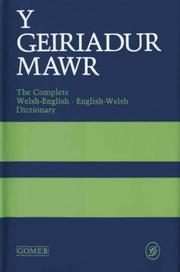
The standard Welsh–English / English–Welsh dictionary used by learners and native speakers alike. At this stage, moving from learner glossaries to a full bilingual dictionary is essential for reading authentic material independently.
Discussion
Keep reading
Paths that share books, cover the same subject, or open a related topic.