Learn Cantonese: Best Books to Read, in Order
This curriculum takes a complete beginner from zero Cantonese all the way to confident Hong Kong Cantonese conversation, reading, and writing. It is structured in four stages: first building tonal awareness and survival phrases, then tackling the writing system and core grammar, then deepening vocabulary and authentic usage, and finally refining fluency with native-level resources. Each stage's books are sequenced so that earlier titles supply the phonetic and conceptual scaffolding needed to get full value from the ones that follow.
Foundations: Tones, Sounds & Survival Cantonese
BeginnerMaster the six tones of Cantonese, learn the Jyutping romanisation system, and acquire enough spoken phrases to navigate everyday Hong Kong situations.
▸ Study plan for this stage
Pace: 4–5 weeks, ~20–25 pages/day (approximately 140–175 pages total across both books, with daily tone practice and conversation drills)
- The six Cantonese tones (high, mid, low, high-rising, mid-rising, low-falling) and their pitch contours, with tonal marks in Jyutping notation
- Jyutping romanisation system: initial consonants, final vowels, and tone numbers (1–6) for accurate pronunciation representation
- Cantonese phonology: initial and final combinations, syllable structure, and how they differ from Mandarin
- Essential survival phrases for Hong Kong contexts: greetings, polite expressions, numbers, basic questions, and ordering food/asking directions
- Practical listening and speaking strategies: tone discrimination drills, mimicking native speakers, and real-world situational dialogues
- The relationship between written Cantonese (traditional characters) and spoken Cantonese (colloquial forms and particles)
- Can you identify and produce all six Cantonese tones accurately, and explain the pitch contour of each?
- How does the Jyutping romanisation system work, and how do you use tone numbers to distinguish between homophonic syllables?
- What are the key phonetic differences between Cantonese and Mandarin Chinese, particularly in initial consonants and final vowels?
- Can you use 15–20 essential survival phrases (greetings, polite expressions, numbers, food ordering, directions) in appropriate Hong Kong contexts?
- How do you recognize and use common Cantonese particles (e.g., 啦, 咗, 嘅) in colloquial speech, and how do they differ from written Chinese?
- Can you listen to native Cantonese speakers and identify which tone is being used, and understand basic conversational exchanges in everyday situations?
- Daily tone drills: spend 10–15 minutes each day repeating the six tones in isolation and within syllables (e.g., ma1, ma2, ma3, ma4, ma5, ma6), using audio from the books or supplementary resources, until you can produce and distinguish them without hesitation
- Jyutping transcription practice: transcribe 10–15 common Cantonese phrases into Jyutping notation, then listen to native speakers and check your tone marking accuracy
- Minimal pair listening: listen to pairs of words that differ only in tone (e.g., 詩 si1 vs. 時 si4) and write down which tone you hear; repeat until you achieve 90%+ accuracy
- Survival phrase role-play: record yourself performing 5–6 realistic scenarios (ordering at a café, asking for directions, greeting a shopkeeper) using phrases from the books, then compare your pronunciation and intonation with native speaker audio
- Character-to-colloquial mapping: select 20 written Chinese sentences and rewrite them in colloquial Cantonese form, identifying particles and tone changes, then listen to how native speakers render them
- Shadowing exercise: listen to a 2–3 minute dialogue from 'Colloquial Cantonese', pause every few seconds, and repeat what you hear, focusing on tone accuracy and natural rhythm until your version matches the original
Next up: This foundation in tones, Jyutping, and survival phrases equips you to move into the next stage—where you'll expand your vocabulary, learn grammar structures, and build confidence in longer conversational exchanges beyond basic survival situations.

Although labelled a grammar, its opening chapters give the clearest systematic introduction to Cantonese phonology and tones in print, giving beginners a rigorous map of the sound system before anything else.

A structured, dialogue-driven course that drills the six tones in real conversational contexts; its audio component makes it the best standalone beginner course for building listening and speaking habits from day one.
The Writing System: Characters & Reading
BeginnerLearn to read and write Traditional Chinese characters as used in Hong Kong, understand stroke order and radicals, and begin recognising high-frequency characters in context.
▸ Study plan for this stage
Pace: 4–5 weeks, ~15–20 pages/day (approximately 1–2 characters studied in depth per day, with daily review cycles)
- The keyword system: using English keywords as memory anchors for character meanings
- Primitive elements (radicals and components) as building blocks for character recognition and memory
- Stroke order conventions and their role in character formation and handwriting
- The relationship between character structure and semantic meaning through visual storytelling
- How to construct vivid, personal mnemonics to encode character meanings durably
- Recognition of high-frequency characters and their primitive components across multiple characters
- The distinction between simplified and traditional forms (awareness for Hong Kong context)
- Progressive character building: how simpler characters combine to form more complex ones
- What is the keyword system, and how does it differ from rote memorization of character meanings?
- How do primitive elements (radicals) function as the foundation for learning and recognizing characters?
- Can you explain the stroke order rules and why they matter for both writing and character recognition?
- How do you create an effective mnemonic story for a character using its primitives and keyword?
- What are the most common primitive elements you've encountered, and which characters contain them?
- How does understanding character structure help you recognize and remember new characters you haven't seen before?
- What is the relationship between simplified and traditional character forms, and why is this relevant for Cantonese?
- Can you identify and write 50–100 high-frequency characters from the book with correct stroke order?
- Daily character study: select 1–2 characters per day from the book, create a personal mnemonic story using the keyword and primitives, then write the character 10–15 times while visualizing the story
- Primitive element flashcards: extract all primitive elements from characters studied so far and create flashcards showing the primitive, its meaning, and 3–4 example characters containing it
- Stroke order practice: write 5–10 characters daily in correct stroke order, using online stroke-order guides or the book's illustrations as reference, then check your work
- Character recognition drills: create a list of 20–30 characters studied so far and practice recognizing them in isolation and in simple Cantonese sentences or phrases
- Mnemonic storytelling: for every 10 characters learned, write out your personal mnemonic stories in a notebook, then review and refine them for clarity and memorability
- Radical grouping exercise: organize 30–50 characters by their primary radical, noting patterns in meaning and usage to deepen understanding of semantic relationships
- Weekly review and spacing: use spaced repetition (e.g., Anki or a physical card system) to review characters at increasing intervals (1 day, 3 days, 1 week, 2 weeks)
- Handwriting practice in context: once you've learned 20–30 characters, write simple Cantonese words or phrases using only those characters to reinforce both writing and meaning
Next up: This stage equips you with a systematic method for encoding character meanings and recognizing their structural components, preparing you to move into the next stage where you'll learn pronunciation (Jyutping), tonal distinctions, and how to read and write characters in actual Cantonese sentences and everyday contexts.

Heisig's mnemonic keyword method gives beginners a fast, memorable framework for learning the visual form and meaning of Traditional characters before worrying about pronunciation—an ideal first step into the script.
Grammar & Structured Vocabulary
IntermediateUnderstand Cantonese sentence structure, particles, aspect markers, and classifiers at an intermediate level, and expand vocabulary to handle topics like shopping, transport, and social conversation.
▸ Study plan for this stage
Pace: 8–10 weeks, ~40–50 pages/week (approximately 6–8 pages/day). Start with "Basic Cantonese" (weeks 1–4), then transition to "Intermediate Cantonese" (weeks 5–10), with 1–2 review weeks built in.
- Cantonese sentence structure: SVO word order, topic-prominence, and the role of particles in marking sentence boundaries and mood
- Aspect markers (咗 zo2, 緊 gan2, 過 gwo3) and their use in expressing completed, ongoing, and experiential actions
- Particles (啦 laa1, 呀 aa1, 嘛 maa3, 喎 wo3, 吖 aa3) and their pragmatic functions in softening, emphasizing, or questioning statements
- Classifiers (個 go3, 隻 zek3, 條 tiu4, 張 zoeng1) and their obligatory use in noun phrases with numerals and demonstratives
- Intermediate vocabulary for shopping, transport, dining, and social interactions, including colloquial expressions and measure words
- Negation strategies: 唔 m4 vs. 冇 mou5 vs. 未 mei6 and their contextual applications
- Question formation: question particles (嗎 maa3, 呀 aa1) and interrogative words (邊 bin1, 幾 gei2, 點 dim2)
- Verb-object compounds and serial verb constructions common in Cantonese conversation
- What is the difference between 咗 zo2, 緊 gan2, and 過 gwo3, and when would you use each in a sentence?
- How do particles like 啦, 呀, 嘛, and 喎 change the tone or pragmatic meaning of a sentence, and can you provide examples?
- Why are classifiers mandatory in Cantonese noun phrases, and can you correctly classify common nouns (e.g., 人, 書, 貓, 杯)?
- What is the difference between 唔 m4, 冇 mou5, and 未 mei6 negation, and in what contexts would you use each?
- How do you form yes/no questions and information questions in Cantonese, and what role do particles play?
- Can you construct and understand sentences using serial verb constructions (e.g., 去買嘢, 坐車去)?
- How would you describe shopping, ordering food, or taking transport using intermediate Cantonese vocabulary and grammar?
- Complete all grammar drills and exercises in 'Basic Cantonese' chapters 1–6 (particles, aspect markers, classifiers, negation), focusing on written accuracy and oral repetition.
- Work through the dialogue sections in 'Intermediate Cantonese' (chapters 1–5), reading aloud and translating into English, then reverse-translating English prompts into Cantonese.
- Create a personal vocabulary notebook organized by topic (shopping, transport, food, social phrases) with example sentences from both books; add 10–15 new collocations per week.
- Practice classifier usage: given 20 common nouns (人, 書, 貓, 杯, 部車, 件衫, etc.), write or say the correct classifier + numeral + noun phrase (e.g., 三個人, 兩隻貓).
- Record yourself speaking: describe a shopping trip or transport journey using at least 5 aspect markers, 3 particles, and 2 serial verb constructions; listen back and self-correct.
- Sentence transformation drills: convert affirmative statements into negations using 唔, 冇, and 未; convert statements into yes/no questions and information questions using appropriate particles and interrogative words.
Next up: Mastery of intermediate grammar structures, particles, and topic-specific vocabulary equips you to engage in natural conversational exchanges and prepares you to move into advanced listening comprehension and authentic media exposure, where these patterns appear at natural speed and in unpredictable contexts.
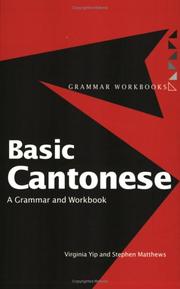
A university-level textbook co-authored by a leading Cantonese linguist; its graded dialogues and grammar notes systematically build intermediate competence in authentic Hong Kong speech patterns.

The direct sequel to Basic Cantonese, it extends grammar coverage to complex sentences, formal registers, and richer vocabulary, making it the natural next step in the same proven series.
Discussion
Keep reading
Paths that share books, cover the same subject, or open a related topic.