Chris Ware Reading Order: Where to Start With His Graphic Novels
Chris Ware is the most technically demanding cartoonist working, and the thing new readers bounce off is not the sadness — it is the page. A Ware page can carry forty panels, diagrams, cut-out models, false advertisements and a schematic that has to be read radially rather than left-to-right, and there is no reliable convention telling you which. So this path deliberately does not start with the famous book. It starts with the short work and one theory text that teach you how a comics page directs the eye, then goes to Jimmy Corrigan, then to the serial work, then to the two enormous late books, and ends with the criticism and the peers.
Learn the Page First
BeginnerAcquire the reading skills the big books assume — panel-to-panel transitions, non-linear layouts, and diagrammatic time.
▸ Study plan for this stage
Pace: Two weeks. Understanding Comics is around 215 pages, itself in comics form, and reads in three or four sittings — but read it with a pencil, because you are mining it for vocabulary rather than enjoying it. Quimby the Mouse is short, mostly wordless, and will take an hour to look at and considerably
- The gutter and closure: McCloud's argument that the reader supplies the motion between panels, which is the mechanism Ware manipulates more aggressively than anyone
- The six panel-to-panel transitions — moment-to-moment, action-to-action, subject-to-subject, scene-to-scene, aspect-to-aspect and non-sequitur — as a checklist you can apply to any Ware page
- Aspect-to-aspect transition specifically, which McCloud associates with mood over event, and which Ware uses to make time stall
- Time as space on the page: a wider panel reads as a longer beat, and Ware treats panel size as duration with unusual literalness
- Layout as a reading instruction. A Ware page may branch, loop, or need to be read radially, and the only cue is often a hairline rule or an arrow the width of a hair
- Quimby's grids as animation: near-identical panels repeated with tiny variations, so the reader's eye supplies motion the way a flipbook would
- The two-headed mouse and the cat's head as a way of putting caretaking, resentment and grief into a form with no dialogue at all
- Iconic abstraction — McCloud's point that simpler drawings invite more identification — and why Ware's flat, diagrammatic figures are affecting rather than cold
- Define closure in McCloud's sense and give an example from Quimby where the closure the reader performs is the joke or the wound.
- Take one Quimby page and identify every transition type on it. Which dominates, and what does that do to the pace?
- How does Ware use panel size as duration in Quimby? Point to a specific panel that reads as longer than its neighbours and say why.
- McCloud claims simpler figures increase reader identification. Does Quimby support that claim or complicate it?
- Quimby is nearly wordless. What information is carried by layout that would otherwise need a caption?
- Take a single Quimby page and, on tracing paper or a photocopy, number the panels in the order you actually read them. Then do it again a day later. Where the two numberings differ is where Ware has left the path ambiguous on purpose.
- Annotate one page with McCloud's transition types, panel by panel, writing the label in the gutter. It feels pedantic and it is the single most useful hour on this path — the vocabulary has to be automatic before Jimmy Corrigan.
- Time yourself reading one Quimby grid at your natural pace, then reread it forcing yourself to spend five seconds per panel. Write down what appeared on the slow pass.
- Redraw a four-panel Quimby sequence with the panels resized — make the short one large and the large one small. Nothing else changed; describe what happened to the beat.
Next up: You now have explicit names for what a comics page does to the eye, which is the equipment Jimmy Corrigan assumes and never explains.

The standard theory text, in comics form, and the fastest way to get an explicit vocabulary for what a gutter and a transition do. Ware is the cartoonist who most rewards having that vocabulary consciously.
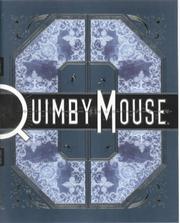
Ware's earliest sustained work, mostly wordless, in which a mouse with two heads goes through cycles of grief in grids that behave like animation. Short and formally pure — it is the training exercise for reading everything after.
The First Big Book
IntermediateRead the book Ware is known for, with the page-reading skills already in hand.
▸ Study plan for this stage
Pace: Three to four weeks. Jimmy Corrigan: The Smartest Kid on Earth runs to roughly 380 pages of extremely dense material and is not a book to read quickly — twenty pages a sitting is a reasonable pace and some pages take ten minutes on their own. Buy it knowing what the object is: the type is very small
- The two timelines: a middle-aged man meeting his father for the first time, intercut with his grandfather's childhood around the 1893 World's Columbian Exposition, with the cuts frequently unmarked
- Inherited abandonment as the book's actual subject — the same failure performed by three generations, which is why the historical strand is not decoration
- Colour as a structural signal. Ware assigns palettes to time and to emotional register, and the shifts are doing work that captions would otherwise do
- Diagrammatic pages: schematics, cutaways, fold-out-style constructions and reading paths that branch, all of which require the transition vocabulary from the last stage
- The Exposition as a symbol of American optimism set directly against the private wreckage, and Ware's refusal to editorialise about the contrast
- Silence and the empty panel — long wordless sequences of a building, a bird, a room, which read as duration and as suppression at once
- The paratext as text: covers, endpapers, indicia, fake ads and the cut-out models are inside the fiction, not around it
- Flatness of affect as technique. The drawing style is uniform and unemotive, which throws all the feeling onto structure and repetition
- How does Ware signal a cut between 1980s Jimmy and 1890s James? Name three cues that are not captions.
- What does the grandfather's strand explain about the father's behaviour, and does the book argue that explanation is an excuse?
- Find one page you had to read twice to navigate. What was ambiguous about it, and was the ambiguity productive?
- What is on the endpapers and the dust jacket, and how does it change the reading?
- The drawing is uniformly flat and controlled. Where does the emotional force actually come from — name the structural device, not the scene.
- Keep a two-column chronology as you read: one column for the 1890s strand, one for the present, logging what you learn in each and when. The book withholds the connection deliberately and the log makes visible exactly when you were told what.
- Pick the most complex single page in the book and map its reading path with numbered arrows on a photocopy. Then write two sentences on what a conventional grid layout would have lost.
- Log the colour palette shifts across any fifty-page stretch and note what each shift accompanies. Ware is consistent enough that you can derive the rule.
- Reread the first twenty pages immediately after finishing. Almost everything in them is a plant, and the reread is where the book's construction becomes visible.
- Assemble one of the cut-out models, or at least trace it. It is the most direct demonstration that the book does not consider itself a text with pictures.
Next up: Having read the finished monument, the serial work shows you the same material in its working state — issued in pieces, in a dozen formats, before it knew what it would become.
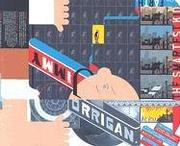
Published as Jimmy Corrigan: The Smartest Kid on Earth, and still the centre of the work: a middle-aged man meets his father for the first time, intercut with his grandfather's childhood at the 1893 Columbian Exposition. Read the front and back covers and the endpapers — they carry story, which is not a joke.
The Serial Ware
IntermediateSee where the material comes from — the ongoing comic-book series and the sketchbooks that feed it.
▸ Study plan for this stage
Pace: Three to four weeks, and the most awkward stage to buy. The ACME Novelty Library is the self-published series in which nearly everything Ware has made first appeared, each issue designed in a different physical format — some are pocket-sized, some are broadsheets — and the collected volumes vary in
- Design as content: each ACME issue's format, trim size, typography and mock-catalogue apparatus is part of the work, which is why the series resists collection
- The self-publishing economy behind it — one man doing writing, drawing, colouring, lettering, design and production, and what that total control makes possible
- Serialisation as a method: Rusty Brown and Building Stories both appeared here in pieces over years, so you can watch Ware discover the shape
- The mock-advertisement and fake-catalogue mode, a sustained parody of early twentieth-century commercial print that is also a genuine expression of longing for it
- The Datebook's evidence: unguarded drawings, self-loathing marginalia, colour studies and complaints, showing how much of the finished coldness is deliberately constructed
- Eisner's craft categories — framing, timing, body language, the panel border as expression, the splash page — written from the drawing board rather than the seminar
- The rules Ware violates knowingly: Eisner's advice on legibility, reading flow and panel-to-panel clarity is exactly what Ware suspends, and the violations are only legible once the rule is stated
- Ware's relationship to early comics history — Frank King's Gasoline Alley, the Chicago Sunday page tradition — as the formal inheritance the ACME design is quoting
- Take any two ACME issues of different format. What does each format make possible that the other does not?
- Which finished book does each ACME issue you have feed into, and how much changed between serial and collected form?
- What does the Datebook show that the finished work conceals? Give a specific page.
- Name three of Eisner's rules and find a Ware page that breaks each one. What is gained by the break?
- Eisner writes as a professional teaching a trade; Ware operates as an author-designer with total control. How does that difference show up on the page?
- Before buying an ACME volume, write down which issues it collects and check them against a bibliography. This is a genuinely necessary step with this series and doing it once teaches you how the work is distributed.
- Find one sequence that exists in both an ACME issue and a collected book and compare them panel for panel. What was recoloured, recut or dropped?
- Read Eisner's chapter on timing, then immediately reread the most stalled sequence you can find in Jimmy Corrigan and describe the difference in Eisner's own terms.
- Copy three Datebook pages by hand — the drawings and the handwritten complaints alike. Reproducing the informality makes the control of the finished work measurable.
- Design a single mock advertisement in Ware's ACME manner for something in your own life. It is a half-hour exercise and it teaches how much of the tone comes from typography rather than drawing.
Next up: You have seen the material in its raw and serial states and you know the craft rules being suspended, which is the only sensible preparation for the two books where the page stops being a page.
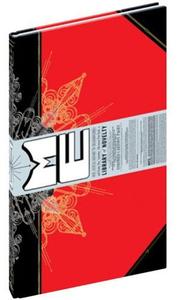
The self-published series in which nearly everything Ware has made first appeared, each issue in a different format. Collected volumes vary in what they gather, so check the contents before buying; the design of the object is part of the work.
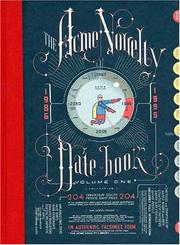
Facsimile sketchbook pages — drawings, complaints, colour studies, self-loathing. It is the best evidence for how much of the finished work's coldness is deliberate construction rather than temperament.

Eisner's craft manual, written from the drawing board rather than the theory seminar. Placed here rather than in stage one because it is most useful once you have seen Ware break the rules Eisner is codifying.
The Late Long Form
BeginnerTake on the two books where Ware pushes the form furthest, and where the page stops being a page.
▸ Study plan for this stage
Pace: Six to eight weeks, and this stage needs a table. Building Stories is fourteen separate printed objects in a large box — a broadsheet, a board-game board, cloth-bound booklets, a strip the size of a Little Golden Book — with no prescribed order and no way to read it on public transport. Give it thre
- Building Stories' unordered structure as an argument about memory: no chronology is authoritative, and the order you happen to pick becomes your version of the character's life
- The physical variety of the fourteen pieces as characterisation — the format of each object tells you its register before you read a word
- The brownstone itself as narrator, and the decision to give a building interiority alongside its tenants
- The unnamed protagonist with a prosthetic leg, and Ware's sustained attention to an ordinary interior life that comics conventionally has no room for
- Rusty Brown's viewpoint architecture: one day retold from several characters, each section formally distinct, so the reader assembles the day rather than following it
- The science-fiction section attributed to a character within Rusty Brown — a story inside the story, in a different visual idiom, and the most formally audacious sequence Ware has made
- Cruelty and complicity as Rusty Brown's subject, including Ware's decision to write himself into the book as a character
- Incompleteness as a condition of both books: Building Stories has no ending because it has no order, and Rusty Brown has no ending because the second half is not published
- What order did you read Building Stories in, and what did that order make you believe about the protagonist that a different order would not have?
- Take three of the fourteen objects and say what their physical format contributes. Would the same content in a normal book do the same work?
- What does the brownstone know that the tenants do not, and why does giving the building a voice change the book's argument about memory?
- In Rusty Brown, what does each viewpoint section conceal about the character narrating it? Ware is unusually harsh here — pick the section you found hardest to sit with and say why.
- The embedded science-fiction story is in a different idiom. What is it doing for the novel besides showing off?
- Read Building Stories, then write down the order you read the fourteen pieces in and construct the chronology of the protagonist's life from it. Then ask a second reader to do the same. Comparing the two reconstructions is the entire point of the object and cannot be done alone.
- Lay all fourteen Building Stories pieces out at once and photograph the arrangement. You will not otherwise see it as one work, because you can never read it as one.
- Chart Rusty Brown's snow day on a single timeline, marking where each viewpoint section starts and stops. The overlaps are where the book does its work.
- Reread the school corridor scenes from two different characters' sections consecutively and note every fact that changes.
- Take the embedded science-fiction section on its own terms and analyse three of its pages with McCloud's transition vocabulary. It reads differently from everything around it and naming how is a real test of stage one.
Next up: With the difficult books behind you, the criticism and the peers give you an outside position from which to judge choices you have only experienced from inside.
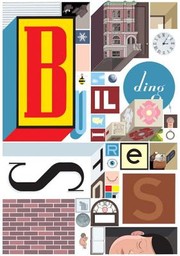
Fourteen separate printed objects in a box — a broadsheet, a board-game board, small booklets — with no prescribed order. The design is an argument about how memory is stored, and it only works if you have already learned to trust Ware's layouts.

The first half of a projected two-part novel, serialised over roughly two decades and running to a single snow day told from several viewpoints. The middle section, a science-fiction story attributed to a character, is the most formally audacious thing here.
Around Ware, and After
BeginnerRead the criticism, then the two contemporaries who make Ware's choices legible by contrast.
▸ Study plan for this stage
Pace: Three to four weeks. Monograph by Chris Ware is an enormous oversized retrospective — genuinely a two-hand book, closer to a piece of furniture than a paperback — and is best worked through over two weeks in short sessions. The short critical monograph in the Monographics series, which our catalogue
- Ware's own annotations in Monograph on process, printing, failure and embarrassment, which make it autobiography disguised as a catalogue
- Printing and production as authorial decisions: ink, registration, paper stock and trim are choices Ware discusses at length and which most cartoonists never control
- The value and the limits of an artist's self-commentary, and why the short critical monograph is needed alongside it
- Clowes as the contrast case: comparable formal exactness, comparable generation, and an entirely different relationship to the reader's comfort — The Death-Ray gives a bored teenager real power and then declines to moralise
- The superhero premise used as a formal device by Clowes, against Ware's complete refusal of genre material
- Seth's shared obsession with the book as designed object and with a vanished mid-century North America, pursued through nostalgia rather than through Ware's diagrammatic dissection
- Three ways of being a cartoonist-designer, which is the actual comparison this stage is for: Ware's engineering, Clowes's cool malice, Seth's melancholy craftsmanship
- Where the criticism places Ware — the recurring charges of coldness, of misery as a default, of formal complexity for its own sake — and whether the reading you have just done supports them
- What does Ware say in Monograph about a piece of his own work that you had read differently? Did his account change your reading or just add to it?
- The critical monograph offers an outside view. What does it see that Ware's own commentary cannot?
- How does Clowes handle the reader's sympathy in The Death-Ray, and what does his refusal to condemn Andy do that a moral ending would not?
- Seth and Ware both fetishise the designed book object. What is each of them nostalgic for, and are they the same thing?
- State the strongest critical case against Ware's work, using the criticism you have read, and then answer it from the books themselves.
- Find the Monograph pages on Jimmy Corrigan and reread your own two-column chronology from stage two against Ware's account of how he built it. Note every place he says the structure was accidental.
- Take the same premise — a lonely adolescent with a secret power — and write a paragraph on how Ware, Clowes and Seth would each handle it, citing a specific formal habit of each.
- Analyse one page of The Death-Ray and one page of Rusty Brown with the same transition vocabulary. Same generation, same seriousness, and the results should look nothing alike.
- Handle a Palookaville volume as an object before reading it: note the binding, the endpapers, the trim, the typography. Then do the same with a Ware book. Write 200 words on what each is trying to be.
- Write your own 800-word assessment of Ware, taking a position on the coldness charge. You have now read the work, the sketchbooks, the self-commentary and the criticism, which is more than most people who make that charge have done.
Next up: You can read the most formally difficult pages in contemporary comics and argue about them from evidence, which means any cartoonist you pick up next is legible on their own terms.

An oversized retrospective of the whole career, with Ware's own annotations on process, printing and failure. It is autobiography disguised as a catalogue and the single best commentary on the work.
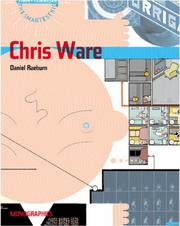
The short critical monograph in the Monographics series, with an interview and a career overview. Read it for an outside view after Ware's own; our catalogue holds the author and title in shouting capitals.
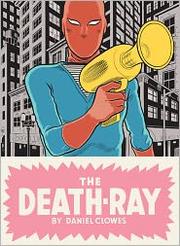
Clowes doing formal experiment on a superhero premise, in a single volume. The natural comparison: same generation, similar exactness, an entirely different relationship to the reader's comfort.

Seth's long-running series, which shares Ware's obsession with the book as a designed object and with vanished mid-century North America. Our catalogue holds a specific numbered issue; any volume of Palookaville makes the point.
Discussion
Keep reading
Paths that share books, cover the same subject, or open a related topic.