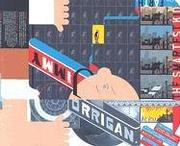
Start with Jimmy Corrigan. Published in 2000 as Jimmy Corrigan: The Smartest Kid on Earth, it is the book that made the case for Ware to readers outside comics, it tells one continuous story, and it is the most conventionally novel-shaped thing he has made. The alternative people reach for is Building stories, because it is the famous one — but Building stories is not a book in the sense that word usually means, and starting there is how people bounce off Ware entirely.
Before anything else, the thing nobody tells buyers.
These are physical objects first
Ware designs the object as part of the work, and the design is not decorative. Expect oversized trims that do not fit a normal shelf, fold-out pages, die-cut covers, printing that runs to the edge, and type set small enough that some readers genuinely need a magnifier for the marginal text. Panels are often the size of a postage stamp and are meant to be read that way; the diagrams and the tiny type are the content, not ornament.
Building stories takes this furthest: it is a large box containing fourteen separate printed pieces — pamphlets, a hardcover, a broadsheet, a strip on a board — with no numbering and no prescribed sequence. It requires a table. It cannot be read on a train, in bed, or on a screen. This is by design; the fragments assemble into the life of one woman in a Chicago apartment building, and the order you find them in changes what you know when. But you should decide whether you want that experience before you pay for it.
Digital editions of Ware are, for the same reasons, close to useless. Buy print.
The reading order
Scott McCloud's Understanding Comics opens the path deliberately. Ware's pages use diagrammatic layouts, branching arrows and non-linear reading paths more aggressively than almost anyone, and McCloud's book gives you the vocabulary for what those pages are asking you to do. Will Eisner's Comics and Sequential Art is the older and more craft-focused companion to it.
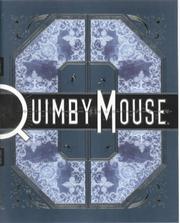
Quimby the Mouse collects the early strips: formally inventive, emotionally bleak, and much harder going than Jimmy Corrigan despite being shorter. Read it after, not before.
Jimmy Corrigan follows a lonely, passive man in his thirties meeting the father who abandoned him, braided with his grandfather's childhood in 1890s Chicago. It is a book about inherited cruelty and it is very slow on purpose.
The ACME novelty library is the serial Ware self-published, each issue in a different format and size — the source material for much of the rest of his work and the best demonstration of him as a designer. The Acme Novelty Datebook reproduces his sketchbooks, which are more revealing than most artists' and considerably more self-lacerating.
Building stories comes next, once you know what you are handling. Rusty Brown is the most recent long work: a large, heavy hardcover following several people connected to a Nebraska school, one of whose sections is a full science-fiction novella. It is unfinished — a second half is intended.
The reference books and the neighbours
Monograph by Chris Ware is a career retrospective in a very large format, more art book than reading. Daniel Raeburn's short critical study, catalogued here simply as Chris Ware, is the concise scholarly account. Daniel Clowes's The Death-Ray and Seth's Palookaville #20 are the obvious neighbours: the same generation, the same publisher, the same interest in design, very different temperaments.
Content
Ware writes about loneliness, depression, cruelty within families, disability and suicide, and he does not offer relief at the end. Readers regularly describe the books as the saddest thing they have read in the medium. That is an accurate description rather than a warning.
Where to stop
Jimmy Corrigan alone is a complete encounter with what Ware does. If it works on you, go to Building stories; if it does not, the rest will not change your mind. More comics reading orders are on Discover.
Follow the full ordered path here: Chris Ware Reading Order: Where to Start With His Graphic Novels.