What to Read Before Godel, Escher, Bach: The Books That Unlock Hofstadter, in Order
Godel, Escher, Bach is famously bought and famously unfinished, and the reason is specific: Hofstadter alternates playful dialogues with genuine formal logic, and readers who cannot follow the formal chapters lose the thread that the dialogues are illustrating. This path supplies the mathematics, the biography and the music in advance, so the book reads as a single argument rather than as a clever miscellany, and Godel, Escher, Bach itself comes last. If you want the conclusion without the work, read I Am a Strange Loop instead and skip this entirely — that is a legitimate choice, not a failure.
Play with self-reference before you formalise it
BeginnerGet comfortable with paradox, self-reference and the puzzle-as-argument style that the whole book runs on
▸ Study plan for this stage
Pace: Two to three weeks. Logicomix is 350 pages of comics and goes down in an afternoon — read it first, in one sitting, for the story. What Is the Name of This Book? is 249 pages and must not be read at that speed: do the puzzles, roughly a dozen a sitting, and do not read the solutions until you have w
- Smullyan's knights and knaves are a training device: on the island every inhabitant either always tells the truth or always lies, and every puzzle is solved by reasoning about what a statement implies about the speaker. This is self-reference with the formality stripped out.
- The puzzles are ordered so that each chapter's trick becomes the next chapter's assumed vocabulary, and the book ends by constructing Gödel's argument out of the island machinery. It is the same escalation Hofstadter uses.
- A puzzle that has no consistent solution is not a broken puzzle. Learning to say 'no inhabitant of this island could make that statement' is the first move toward understanding why a formal system can fail to settle a question.
- Logicomix supplies the story the mathematics belongs to: Frege's system, Cantor's infinities, Russell's paradox arriving as Frege's second volume was in press, Hilbert's programme demanding a proof of consistency, and Gödel walking into the Vienna Circle with the answer nobody wanted.
- The comic's real subject is the cost — the recurring link it draws between the pursuit of certainty and personal collapse. Read that as a thesis the authors argue, which they stage explicitly by putting themselves in the book arguing about it.
- Hofstadter's alternating dialogues are doing exactly what these two books do: making a formal move playable before it is formalised. Reading them in this order is what stops the dialogues looking like decoration.
- On Smullyan's island, why can nobody say 'I am a knave'? What general principle about statements and speakers does that establish?
- Where in What Is the Name of This Book? does a puzzle stop being about liars and start being about provability? Name the chapter.
- What exactly did Russell's paradox break in Frege's system, and why could Frege not simply patch it?
- What was Hilbert asking for, and in what sense is Gödel's theorem an answer rather than a refusal?
- Logicomix links logic and madness repeatedly. Is that a claim the authors demonstrate, or a mood they impose on the material?
- Work the first three chapters of Smullyan with a pencil, writing your reasoning out in full sentences before checking any solution. If your written reasoning does not survive being read back, you guessed.
- Draw the timeline Logicomix implies — Frege, Cantor, Russell, Hilbert, Wittgenstein, Gödel — with one line each on what they wanted. Keep it; every later book on this path plugs into it.
- Take a Smullyan puzzle whose answer is 'the question is unanswerable' and write 150 words on what makes it unanswerable rather than merely hard.
- Find the point in Smullyan where a machine that prints sentences replaces the island. Write down what the machine's sentences correspond to on the island, item by item.
Next up: You can now handle self-reference as play; the next stage makes you handle it as proof, which is the exact skill the hard chapters of Hofstadter's book assume.
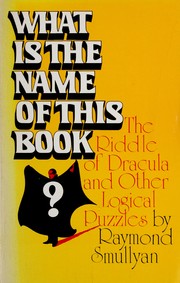
Logic puzzles that build from knights and knaves to Godel's theorem, and the gentlest possible introduction to the machinery. Hofstadter's dialogues are doing the same thing; do these first and the dialogues stop looking like decoration.

A graphic novel about Russell, Frege, Hilbert and the crisis in foundations that Godel ended. It is the fastest way to acquire the story the mathematics belongs to, and it takes an afternoon.
The incompleteness theorem, properly
IntermediateUnderstand what Godel actually proved, how the proof works, and what it does not mean
▸ Study plan for this stage
Pace: Six to eight weeks, and this is the stage that decides whether the path works. Goldstein's Incompleteness is 260 pages and reads at normal speed. Gödel's Proof is 104 pages and will take two full weeks — five pages a sitting with a pencil is not slow here, it is correct. Franzén is 172 pages of argu
- Goldstein's context first: Gödel was a Platonist surrounded by logical positivists who read his theorem as confirming their own programme when he intended it as evidence that mathematical truth outruns any formal system. That intent is the thing most popular accounts lose.
- Nagel and Newman's core move is the arithmetisation of syntax — assigning numbers to symbols, formulas and proofs so that statements about a formal system become statements about numbers, which the system itself can express. Hofstadter calls this Gödel numbering, and it is the single hinge of the wh
- The constructed sentence does not say 'I am false'. It says, via that numbering, that a particular number is not the number of a proof of a particular formula — and that formula is itself. The difference between that and the liar paradox is what separates a theorem from a trick.
- Consistency is the price of incompleteness: the theorem does not say every system is incomplete, it says a consistent, effectively axiomatised system strong enough for arithmetic cannot prove every truth of arithmetic. Drop any of those three conditions and the theorem does not apply.
- The second theorem — that such a system cannot prove its own consistency — is what killed Hilbert's programme, and it is the one Franzén finds most often misdescribed.
- Franzén's corrective is the reason he sits before Hofstadter rather than after: the theorem does not license conclusions about minds exceeding machines, about theology, about the limits of reason in general, or about anything outside sufficiently strong formal systems. Read him and you can tell wher
- Smullyan's reasoners convert the second theorem into something you can feel: a consistent reasoner who believes his own consistency is thereby inconsistent. Playing that out on the island is the best preparation there is for Hofstadter's strange loops.
- Describe Gödel numbering to somebody who has not read Nagel and Newman, in five sentences, without using the phrase 'this sentence'.
- What does the Gödel sentence actually assert about numbers, and how does the coding make that an assertion about itself?
- State the three conditions a system must meet for the first theorem to apply, and give a system that fails one of them.
- Pick two misuses of incompleteness that Franzén dismantles. What is the specific error in each, in his account?
- Smullyan's reasoner cannot consistently believe in his own consistency. Which of Gödel's two theorems is that, and how is the correspondence set up?
- Work through Gödel's Proof with a notebook, writing out the numbering scheme yourself and coding three short formulas by hand. Do not proceed past the arithmetisation chapter until you can do this unaided.
- Write a one-page statement of the first theorem with every technical term defined. Then cut it to 150 words without losing a condition.
- For each of Franzén's chapters, write down in one sentence the claim he is refuting. Keep the list beside you while reading Hofstadter.
- In Forever Undecided, do the chapters on reasoners of increasing type and record where each new type's self-knowledge starts causing trouble.
- Set Goldstein's account of what Gödel believed his theorem showed against Franzén's account of what it shows. Write 200 words on whether they conflict.
Next up: Incompleteness is only half of what Hofstadter builds on; the other half is undecidability, and it comes from Turing rather than Gödel.

Godel's life and the Vienna Circle context, with the theorem explained for a general reader. Read it before Nagel: it supplies the motive, which makes the proof easier to hold on to.

Under a hundred pages and still the best short walk through the actual proof, including the arithmetisation of syntax that Hofstadter calls Godel numbering. This is the single most load-bearing book on the path; if you follow it, the hard chapters of GEB will hold.
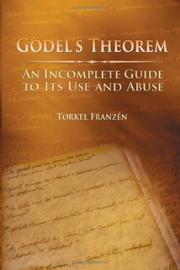
A short corrective on what incompleteness does not imply, from a logician tired of the misuse. Read it after Nagel and before Hofstadter, so you can tell where GEB is arguing carefully and where it is being suggestive.

Smullyan's puzzle-book construction of Godel's argument and modal logic, ending with self-referential reasoners. It rehearses in play the exact move — a system that talks about itself — that GEB's strange loops depend on.
Computation, the half most readers skip
IntermediateMeet Turing machines and undecidability, which are what let Hofstadter connect formal systems to minds
▸ Study plan for this stage
Pace: Three to four weeks. The Annotated Turing is 300 pages but roughly half of it is Turing's own 1936 paper, printed in fragments with Petzold's commentary around each. Read one section a sitting and read the paper's lines before the commentary, even when they defeat you.
- Turing's paper is about computable numbers — real numbers whose digits a machine could grind out — and the undecidability result falls out of that framing rather than being the announced subject. Petzold's commentary keeps flagging where the paper's real target is arriving.
- A Turing machine is a table of instructions over a tape, and Turing's claim is that this austere thing captures everything a human 'computer' following rules could do. The claim is philosophical; the machine is not.
- The universal machine is the crucial construction: a single machine that reads a description of any other machine and behaves like it. Program and data become the same kind of object, which is the move that makes both computers and Hofstadter's argument possible.
- The undecidability argument is a diagonal argument, structurally the same as Cantor's in Logicomix and cousin to Gödel's construction. Once you see all three as the same manoeuvre, the whole stage pays off.
- The Entscheidungsproblem — is there a procedure that decides whether any given statement of logic is provable — is what Turing set out to answer, and the answer is no. That is the second impossibility result Hofstadter assumes you have.
- Turing's paper contains errors and awkward notation, and Petzold points them out rather than tidying them. Reading a real paper as a real object, mistakes included, is part of the value.
- What is a computable number, and why does Turing define his subject that way rather than starting from functions?
- Describe the universal machine and explain why the ability to treat a machine's description as data is the pivotal idea.
- Reconstruct the diagonal argument in the paper. Where exactly does the contradiction arise?
- What is the Entscheidungsproblem, and what is the relationship between Turing's answer and Gödel's first theorem?
- Petzold flags places where Turing's argument is loose. Pick one and say what a modern presentation does differently.
- Hand-simulate one of the machine tables from the paper on paper for a dozen steps, writing out the tape at each step. This is tedious and it is the only way the definition becomes concrete.
- Write the diagonal argument out three times — Cantor's from Logicomix, Gödel's from Nagel and Newman, Turing's from this book — in the same notation. The shared skeleton should be visible on one page.
- Summarise in 200 words what changes about the notion of a machine once the universal machine exists.
- Cover Petzold's commentary and read three consecutive paragraphs of Turing unaided. Note which sentence stopped you, then read the commentary on it.
Next up: You now hold both impossibility results; the remaining preparation is the visual and musical material, which is the third of the book most readers skim.
Turing's 1936 paper, printed in full with a line-by-line explanation. Godel gives you incompleteness and Turing gives you undecidability; GEB assumes both, and this is the only accessible route to the second.
The Escher and the Bach
BeginnerAcquire the visual and musical material the book uses as its other two voices, which readers usually skim
▸ Study plan for this stage
Pace: Two weeks, and it is the light stage — take it as relief after Turing. The Graphic Work is 96 pages, mostly plates, and rewards several short sittings rather than one long one. Evening in the Palace of Reason is 368 pages of narrative history and reads at speed; listen to the Musical Offering while
- Escher grouped his own prints by problem — regular division of the plane, the depiction of infinite space, inversion, impossible buildings — and his commentary explains what each group was trying to solve. Seen that way the famous images are results, not curiosities.
- Three prints do most of the work in Hofstadter's book: Drawing Hands, where each hand draws the other; Print Gallery, where the picture contains the gallery containing the picture; and Ascending and Descending, where a staircase rises forever. These are strange loops rendered visually.
- The tessellations matter as much as the paradoxes. Figure and ground swapping — birds becoming fish, black becoming white — is the visual form of an idea Hofstadter uses formally when he asks whether the non-theorems of a system are themselves a system.
- In Hofstadter's book the prints are reproduced small and in black and white. Having Escher's own plates and his account of his intent changes them from illustrations into evidence.
- Gaines's book is built around the 1747 meeting at Potsdam where Frederick the Great gave Bach a theme and asked him to improvise on it, and the Musical Offering Bach wrote and sent back. That work is what Hofstadter opens with and keeps returning to.
- Two pieces in the Offering are the musical core of the analogy: the crab canon, which is the same line played forwards and backwards simultaneously, and the canon that modulates upward through the keys and arrives back where it started an octave higher. Hofstadter's endlessly rising canon is that pi
- Gaines frames the meeting as a collision between Frederick's Enlightenment rationalism and Bach's older religious craft, which is a reading you should weigh rather than adopt — but it does explain why the Offering is so demonstrative a piece of counterpoint.
- Take Escher's own grouping of his work. Which group do Drawing Hands and Print Gallery belong to, and what problem is that group solving?
- What is the difference between an impossible object like the Penrose stairs and a genuine visual paradox of self-reference like Drawing Hands?
- In a tessellation where birds become fish, which is the figure and which is the ground? What makes the question ill-posed, and why is that the point?
- What is a crab canon, and what does it sound like when the two voices are played together?
- Gaines reads the Potsdam meeting as a confrontation between two worldviews. What evidence does he offer, and what would a sceptic say?
- Choose five Escher prints, and for each write one sentence on the formal trick and one on the visual effect. Keep the sheet open when Hofstadter reproduces them.
- Listen to the crab canon of the Musical Offering twice, once following one voice and once the other. Then write down what you actually heard rather than what you were told to hear.
- Listen to the canon per tonos through its full cycle and mark on paper where each modulation lands. The return an octave up should be audible, not merely asserted.
- Write 200 words setting Drawing Hands beside the crab canon: what is the same structure in each, stated without the words 'strange loop'?
Next up: All three voices are now yours in their own right, which means the book can be read as one argument instead of as a clever miscellany.
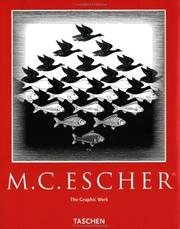
Escher's own selection with his commentary. GEB reproduces the prints small and in black and white; having the real images, and Escher's account of what he was trying to do, changes them from illustrations into arguments.
Bach's meeting with Frederick the Great and the composition of the Musical Offering — the exact piece GEB opens with and returns to. Included because the musical third of the book is the one most readers cannot follow, and this fixes it in one narrative.
Godel, Escher, Bach
IntermediateRead the book itself with the mathematics already in hand, and follow the argument rather than admiring the puzzles
▸ Study plan for this stage
Pace: Four to six months, and treat that as normal rather than slow. The book runs 777 pages and alternates dialogue and chapter; read each dialogue and the chapter it introduces as one unit, one unit a sitting, and stop when a formal exercise defeats you rather than reading on.
- The alternation is the design, not a stylistic flourish. Each dialogue performs, in play, the structure the following chapter then formalises — which is exactly the Smullyan-then-Nagel movement you have already done twice.
- The MU-puzzle opens the book and is the whole method in miniature: work inside the formal system and you cannot settle it, step outside and reason about the system and you can. That inside-outside distinction runs to the last page.
- Typographical Number Theory is where most readers stop, and it is where the Nagel and Newman work pays off — TNT is a system built precisely so that Gödel's construction can be carried out in front of you rather than described.
- The record-player argument in the early dialogue is Gödel's theorem told as a story: any player sufficiently high-fidelity to play any record can be destroyed by a record engineered to resonate it apart. Substitute 'formal system' and 'sentence' and you have the first theorem.
- The ant colony dialogue is the book's central positive claim: a colony has purposes no ant has, and the levels are related by description rather than by mechanism. That is Hofstadter's model for a self arising from neurons.
- The chapters on genetics, on self-replication and on artificial intelligence are not digressions. They are further instances of the same pattern — a code that describes the machinery that reads it — and the Turing material is what makes them legible.
- Hofstadter has complained for decades that readers take the book to be about coincidences between three clever men. His stated subject is how a self can arise from parts that are not selves, and the twentieth-anniversary preface says so directly. Read the preface first, then again at the end.
- Is MU a theorem of the MIU system? Give the proof, and say why the proof cannot be carried out inside the system.
- Where in the book does the Gödel construction get performed on TNT, and which step corresponds to Nagel and Newman's arithmetisation of syntax?
- The record-player dialogue, Drawing Hands and the Gödel sentence are offered as the same structure. Are they? Where does the analogy actually strain?
- What does the ant-colony dialogue claim about levels of description, and what would have to be true of brains for the claim to transfer?
- Take one place where Hofstadter draws a conclusion about minds from a formal result. Using Franzén, say whether the inference is licensed, suggestive, or wrong.
- Having finished, what is the book's argument in five sentences with no reference to Escher or Bach?
- Do the MU-puzzle before reading the resolution, and write down at what point you decided to reason about the system instead of within it.
- Derive three theorems of TNT by hand from the axioms. Skipping this is the single commonest reason the later chapters feel like assertions.
- Keep a two-column log as you read: dialogue on the left, the formal move it performed on the right. By the halfway point the pattern should be predictable, which is a sign you are reading it correctly.
- Every time Hofstadter invokes incompleteness, write the invocation down and check it against your Franzén list. Note the ones you would defend and the ones you would not.
- At the end, write 500 words answering Hofstadter's own complaint: state what the book is about, in your words, without mentioning any of the three title figures.
Next up: This is the destination; from here the honest next move is Hofstadter's later work on the same question, read as a restatement by an author who thought his first attempt had been misread.
The destination. Read the dialogue and the chapter it precedes as a pair, do the formal exercises rather than skimming them, and remember Hofstadter's own complaint that people miss the point: the book is about how a self arises from meaningless parts, not about clever coincidences between three men.
Discussion
Keep reading
Paths that share books, cover the same subject, or open a related topic.