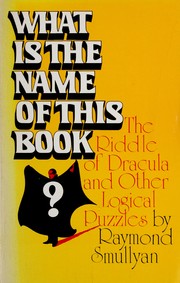
Start with Raymond Smullyan's What is the name of this book?. It is a collection of knights-and-knaves logic puzzles that gets steadily stranger until, in its closing chapters, it walks you into Gödel's incompleteness theorem without ever announcing that it has done so. That theorem is the load-bearing idea of the book you are aiming at, Douglas Hofstadter's Gödel, Escher, Bach, and Smullyan teaches it as play rather than as proof.
Know what you are signing up for. Gödel, Escher, Bach runs to roughly eight hundred pages, alternates expository chapters with Carrollian dialogues that carry real technical weight rather than comic relief, and expects you to hand-execute a formal system before it pays you back. Hofstadter has complained for decades that readers miss the thesis: it is a book about how meaning and selfhood arise from meaningless parts, not a book about three clever men. If what you actually want is an account of Gödel's proof, or of Escher, or of Bach, this path holds better and much shorter books for each. Read those and skip the big one without guilt.
Learn the theorem before you meet the metaphor
Godel's Proof, by Ernest Nagel and James R. Newman, is the technical spine of the sequence: under a hundred pages, and it actually walks through the arithmetization and the diagonal argument rather than gesturing at them. Read it slowly, with a pencil.
Around it sit three books that make the same material stick by other routes. Logicomix - An Epic Search for Truth, published as Logicomix: An Epic Search for Truth, is a graphic novel about Russell, Whitehead and the foundational crisis Gödel detonated; it is drama rather than history, openly loose with chronology, and it supplies the stakes. Rebecca Goldstein's Incompleteness gives you the biography and the philosophical meaning, including Gödel's own Platonism, which cuts against the way the theorem is usually popularised. And Forever undecided is Smullyan again, this time building a puzzle apparatus designed to get you to prove incompleteness yourself.
Then read Torkel Franzén's Godel's Theorem, which is the antidote. Its subject is the abuse of the theorem — the confident claims that it refutes artificial intelligence, or objectivity, or determinism. Hofstadter's book is not one of those abuses, but reading it without Franzén leaves you an easy mark for the ones that are.
The other two names in the title
Hofstadter is not decorating a mathematics book with art and music. The parallels are the argument, so the visual and musical halves deserve real preparation.
The Graphic Work collects Escher with his own commentary, and seeing the lithographs at print size, rather than as the thumbnails reproduced inside Hofstadter, is the difference between recognising a picture and reading it. Evening in the Palace of Reason covers the 1747 meeting between Bach and Frederick the Great that produced the Musical Offering, whose endlessly rising canon gives the book its central metaphor. Have the music playing while you read it.
The Annotated Turing is the optional heavyweight, and the most useful of the three. Charles Petzold reprints Turing's 1936 paper in full and explicates it line by line, which sets computability beside Gödel's result and prepares the artificial-intelligence argument that occupies Hofstadter's last third.
Reading the book itself
Gödel, Escher, Bach rewards going slowly and in order: a chapter a sitting, each dialogue read before the chapter it introduces, and the formal-system exercises actually done rather than skimmed. Readers who bounce off it almost always bounce in the MU-puzzle and typographical-number-theory stretch early on, which is exactly the part the preparation above makes survivable.
If you want the shape of the argument without the apparatus, Hofstadter's later I Am a Strange Loop states the thesis directly; it is not in our catalogue, and it is a summary rather than a substitute. Work through the full sequence in order and the big book stops being an endurance test.
Follow the full ordered path here: What to Read Before Godel, Escher, Bach: The Books That Unlock Hofstadter, in Order.