Best Books to Understand Chomsky, in Reading Order
This curriculum moves from accessible introductions to Chomsky's life and ideas, through his landmark works on language and media, and finally into his deeper political philosophy and activism. Each stage builds the conceptual vocabulary needed for the next, ensuring that by the end the reader can engage with Chomsky's most demanding texts on their own terms.
Who Is Chomsky? — The Big Picture
BeginnerGain a clear, accessible overview of Chomsky's life, the range of his thought, and why he matters — in both linguistics and politics — before diving into his own writing.
▸ Study plan for this stage
Pace: 4–5 weeks, ~25–30 pages/day, with 2–3 days per week for reflection and exercises
- Chomsky's dual intellectual identity: his revolutionary work in linguistics (generative grammar, universal grammar) and his role as a political dissident and public intellectual
- The core insight of generative grammar: language is an innate, rule-based system that all humans share, not primarily learned from environment
- How Chomsky's linguistic theory challenged behaviorism and transformed the cognitive sciences
- Chomsky's critique of power, media, and state propaganda, and how it connects to his view of language and human nature
- The relationship between Chomsky's descriptive work (what language is) and his normative/political work (how society should be)
- Key historical moments and intellectual influences that shaped Chomsky's thinking across both domains
- Chomsky's method: close textual analysis, logical argumentation, and systematic critique of unstated assumptions
- What is generative grammar, and how did Chomsky's theory fundamentally challenge the behaviorist view of language learning?
- What is universal grammar, and what does Chomsky mean by saying language is 'innate'?
- How does Chomsky's political critique of media and power relate to his linguistic theories about human nature?
- What are the main phases or turning points in Chomsky's intellectual development, as presented in *The Chomsky Reader*?
- What does Chomsky mean by 'manufacturing consent,' and how does this concept apply to both language and politics?
- Why does Chomsky believe that studying language reveals something fundamental about human nature and freedom?
- Create a two-column chart: on one side, list Chomsky's major contributions to linguistics; on the other, his major political/social critiques. Then draw arrows showing how they connect or inform each other.
- Select one short essay or excerpt from *The Chomsky Reader* and annotate it, marking: (1) the main claim, (2) the evidence or reasoning, (3) any assumptions Chomsky makes, and (4) one question you have.
- Write a 1–2 page 'biography of ideas': trace how one of Chomsky's core concepts (e.g., universal grammar, or critique of propaganda) developed over time, using specific passages from the book.
- Debate exercise: take one of Chomsky's political arguments from the Reader and argue against it in writing, then respond to your own counterargument. This forces you to understand his logic deeply.
- Collect 3–5 examples of media coverage or political rhetoric from current events, and analyze them using Chomsky's framework of power and propaganda. Write a short analysis for each.
- Create a visual timeline or mind map showing the major intellectual influences on Chomsky (e.g., Descartes, Humboldt, Wittgenstein) and how they appear in *The Chomsky Reader*.
Next up: This stage establishes Chomsky as a thinker and shows why his ideas matter; the next stage will dive into his actual theoretical texts, where you'll encounter the technical details and arguments in his own words, building on the conceptual foundation you've now laid.
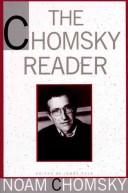
A curated anthology of Chomsky's own essays spanning both linguistics and politics, edited for accessibility — ideal as a first taste of his actual voice before tackling full-length works.
The Linguistics Revolution
BeginnerUnderstand Chomsky's core claims about language — universal grammar, the innateness hypothesis, and why his ideas overturned behaviorism — without needing a technical linguistics background.
▸ Study plan for this stage
Pace: 4–5 weeks, ~40–50 pages/day. Start with "Language and Mind" (3 weeks, ~25 pages/day for the core chapters), then move to "The Language Instinct" (2 weeks, ~50 pages/day for the most relevant chapters on universal grammar and innateness).
- Universal Grammar (UG): the idea that all human languages share a deep, innate structure that enables children to acquire language rapidly without explicit instruction
- The innateness hypothesis: language capacity is biologically hardwired into the human brain, not learned solely from environmental input or behavioral conditioning
- The poverty of the stimulus: children learn language from limited, imperfect input, yet achieve sophisticated competence—suggesting innate knowledge fills the gap
- Chomsky's critique of behaviorism: language learning cannot be explained by stimulus-response mechanisms or imitation alone; it requires an internal generative system
- Generative grammar: language is produced by finite rules that can generate infinite sentences, distinguishing human language from animal communication
- Competence vs. performance: the distinction between our underlying linguistic knowledge and how we actually use language in real situations
- The language instinct: language is an evolved biological capacity, not a cultural invention, shaped by natural selection for communication and thought
- What is universal grammar, and why did Chomsky propose it as a solution to the problem of language acquisition?
- How does the poverty of the stimulus argument support the innateness hypothesis?
- What are the main weaknesses of behaviorism as an explanation for how children learn language, according to Chomsky?
- What is the difference between linguistic competence and performance, and why does this distinction matter?
- How does Pinker's concept of the 'language instinct' build on or extend Chomsky's ideas about innate language capacity?
- What evidence suggests that language is a biological adaptation rather than a cultural tool?
- After reading Chomsky's critique of behaviorism in 'Language and Mind,' write a 1-page explanation of why a child learning the sentence 'The cat sat on the mat' cannot rely solely on imitation and reinforcement—what must be innate?
- Create a simple diagram or flowchart showing how universal grammar might explain why a 3-year-old can produce grammatically correct sentences they've never heard before.
- Collect 5–10 examples of sentences from everyday speech (books, conversations, media) and identify which grammatical rules they follow; then explain which rules a child would need to know innately vs. learn from input.
- Write a short dialogue (1 page) between a behaviorist and Chomsky debating how a child learns to form questions in English (e.g., 'Does the cat like fish?'). Use specific examples from the books.
- Listen to a young child (age 2–4) speak for 10 minutes, record 5 utterances, and analyze them for signs of rule-governed behavior vs. pure imitation. Reflect on what this reveals about innate structure.
- Summarize in 2–3 pages how Pinker's examples in 'The Language Instinct' (e.g., pidgins, creoles, blind children) support the innateness hypothesis and universal grammar.
Next up: This stage establishes the foundational claim that language is an innate, universal human capacity governed by deep structural principles—preparing you to explore how these principles are organized into specific grammatical systems and how they vary across languages in the next stage.
Chomsky's own accessible account of his linguistic theory written for a general audience; it introduces universal grammar and the idea that language is a biological endowment, laying the conceptual groundwork for his more technical work.

Pinker, a former student of Chomsky's, explains the Chomskyan revolution in vivid, popular prose — reading this after Chomsky's own introduction helps the reader see the ideas through a second, highly clarifying lens.
Manufacturing Consent — The Media Critique
IntermediateMaster Chomsky's 'propaganda model' of mass media, understand how consent is engineered in democratic societies, and be able to apply the framework critically to news and information.
▸ Study plan for this stage
Pace: 8–10 weeks, ~40–50 pages/day (with 2–3 days per week for reflection and exercises)
- The propaganda model: five structural filters (ownership, advertising, sourcing, flak, and anti-communist ideology) that shape media content
- How consent is manufactured through media gatekeeping in ostensibly 'free' democracies
- The distinction between 'worthy' and 'unworthy' victims in news coverage and how this reflects elite interests
- The role of official sources and expert consensus in legitimizing state and corporate narratives
- Necessary illusions: how manufactured consent requires the public to hold false beliefs that serve power
- Media performance in crisis moments (wars, coups, economic crises) as a test case for the propaganda model
- The difference between overt censorship and structural/systemic media bias that requires no conspiracy
- What are the five filters of the propaganda model, and how does each one constrain media content?
- How does the propaganda model explain why democracies do not require overt censorship to control public opinion?
- What is the distinction between 'worthy' and 'unworthy' victims in media coverage, and what does this reveal about whose interests the media serves?
- How do official sources and expert consensus function as mechanisms of consent-manufacturing?
- What does Chomsky mean by 'necessary illusions,' and how are they maintained through media narratives?
- How does the propaganda model apply to a specific historical case study (e.g., Cold War coverage, intervention in Central America, or a contemporary conflict)?
- Track coverage of a single international event across 3–5 major news outlets over one week; document differences in framing, sources cited, and which actors are portrayed as 'worthy' vs. 'unworthy' victims.
- Analyze a major news story using the five-filter framework: identify the ownership structure, advertising pressures, official sources relied upon, flak mechanisms, and ideological assumptions embedded in the coverage.
- Compare how two competing narratives about the same event (e.g., from mainstream and independent media) reflect different filter pressures; write a 2–3 page analysis.
- Create a media diet audit: document your own news consumption for one week and categorize sources by ownership, advertising model, and likely filter pressures; reflect on what narratives you're exposed to.
- Select a historical case from the books (e.g., U.S. intervention in Central America, Cold War framing) and find 3–4 primary sources and contemporary news articles; compare how the propaganda model explains the coverage patterns.
- Conduct a 'flak test': identify a story that challenges elite interests and track how it is attacked, marginalized, or ignored across mainstream outlets; document the mechanisms of flak.
Next up: This stage equips you with a critical lens for deconstructing media narratives and recognizing structural bias, preparing you to explore Chomsky's deeper analyses of specific geopolitical interventions and to engage with his broader critique of U.S. foreign policy and imperial power.
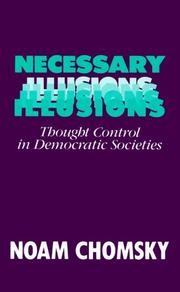
A slightly shorter and more accessible entry point into Chomsky's media critique than Manufacturing Consent; reading it first builds the core vocabulary of the propaganda model with ample concrete examples.

The landmark co-authored work that formally presents the propaganda model with systematic evidence; having read Necessary Illusions first, the reader can now engage with the full theoretical apparatus and case studies.
Political Philosophy & American Power
IntermediateUnderstand Chomsky's broader critique of U.S. foreign policy, state power, and capitalism, and see how his political ethics connect to his linguistic and media work.
▸ Study plan for this stage
Pace: 8–10 weeks, ~40–50 pages/day. Read "Hegemony or Survival" (3–4 weeks), then "Failed States" (2–3 weeks), then "Who Rules the World?" (2–3 weeks). Allow 1 week for integration and review.
- U.S. hegemony as a destabilizing force: how American military and economic dominance creates global instability rather than security
- The state as an instrument of corporate and elite interests: how domestic and foreign policy serve concentrated power rather than public welfare
- Failed states vs. rogue states: Chomsky's distinction between states that cannot control their territory (failed) and those that defy U.S. interests (rogue), and how this framing masks U.S. responsibility
- Manufacturing consent in foreign policy: how media, think tanks, and political elites construct narratives that justify imperial interventions
- Structural imperialism and resource extraction: how U.S. policy maintains economic dominance through military force, debt, and institutional control rather than direct colonialism
- The interconnection between linguistic theory and political analysis: how understanding language structures reveals how power structures are naturalized and made invisible
- Alternatives to hegemony: Chomsky's vision of a multipolar world, international law, and democratic accountability as prerequisites for survival
- What does Chomsky mean by 'hegemony or survival,' and why does he argue that U.S. hegemony threatens global survival?
- How does Chomsky distinguish between 'failed states' and 'rogue states,' and what does this distinction reveal about U.S. foreign policy rhetoric?
- What are the mechanisms through which the U.S. maintains economic and political dominance without formal colonialism, according to these three books?
- How do media, intellectuals, and state institutions work together to manufacture consent for U.S. foreign interventions?
- What is the relationship between Chomsky's linguistic work on universal grammar and his political analysis of how power structures are naturalized?
- What concrete alternatives to U.S. hegemony does Chomsky propose, and what would a genuinely democratic foreign policy look like?
- Track U.S. military interventions: Create a timeline of 5–10 U.S. military actions discussed across the three books (e.g., Iraq, Afghanistan, Latin America). For each, note Chomsky's explanation of the stated rationale vs. the actual strategic/economic interests served.
- Analyze a recent foreign policy speech or document: Select a speech by a U.S. president or State Department official on a current conflict. Identify the rhetorical frames used (e.g., 'spreading democracy,' 'humanitarian intervention') and evaluate them against Chomsky's critique of how these narratives mask imperial interests.
- Map corporate-state connections: Research 3–5 major defense contractors or multinational corporations mentioned in the books. Trace their connections to U.S. foreign policy decisions and show how policy serves their interests.
- Comparative media analysis: Find coverage of the same international event (e.g., a U.S.-backed coup, sanctions regime, or military action) in mainstream U.S. media and in international/alternative sources. Document how framing differs and which Chomskyan mechanisms of consent-manufacturing you observe.
- Debate exercise: Prepare arguments for and against Chomsky's claim that U.S. foreign policy is fundamentally driven by elite economic interests rather than stated humanitarian or security goals. Use specific examples from the books.
- Write a policy brief: Imagine you are advising a government on how to reduce reliance on military hegemony. Draft a 2–3 page alternative foreign policy framework drawing on Chomsky's vision of international law, multilateralism, and democratic accountability.
Next up: This stage equips you with Chomsky's systemic critique of power, preparing you to examine how these structures operate at the level of language, culture, and everyday discourse in the next stage.
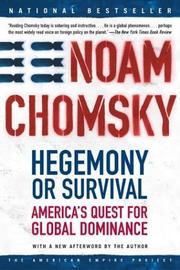
One of Chomsky's most focused and widely-read political books, examining U.S. imperial strategy in accessible prose — a natural bridge from the media critique to his deeper geopolitical arguments.

Extends the analysis of Hegemony or Survival to the concept of state failure and democracy's erosion, deepening the reader's grasp of Chomsky's political framework with updated evidence.

A mature, synthesizing work that draws together decades of Chomsky's political thought on power, empire, and global order — best read after the earlier political books so the reader can appreciate how the arguments have evolved.
Deeper Roots — Anarchism, Human Nature & Intellectual Foundations
ExpertEngage with the philosophical and ethical foundations underlying all of Chomsky's work — his anarchist political theory, his view of human nature, and his place in the broader tradition of Enlightenment rationalism.
▸ Study plan for this stage
Pace: 4–5 weeks, ~25–30 pages/day with 2–3 reflection days per week
- Chomsky's critique of behaviorism and Cartesian linguistics as foundations for understanding human freedom and cognitive autonomy
- The relationship between human nature (innate linguistic and rational capacities) and anarchist political theory
- Chomsky's anarchist critique of hierarchical institutions and centralized authority as violations of human nature
- The Enlightenment rationalist tradition as intellectual grounding for both linguistics and anarchism
- The concept of 'natural rights' and human dignity as derived from our rational, creative capacities
- Chomsky's distinction between justified and unjustified authority, and the burden of proof on those claiming power
- The role of intellectuals and the responsibility to challenge illegitimate power structures
- Freedom as both negative (absence of coercion) and positive (capacity for self-directed creative activity)
- How does Chomsky's critique of behaviorism in 'Problems of Knowledge and Freedom' connect to his anarchist rejection of social conditioning and manipulation?
- What does Chomsky mean by 'human nature' and how does he argue it supports anarchist principles rather than justifying hierarchy?
- According to Chomsky, what is the burden of proof regarding authority, and how does this principle undermine most existing political structures?
- How does Chomsky position himself within the Enlightenment rationalist tradition, and what does he draw from thinkers like Descartes and Humboldt?
- What is Chomsky's critique of the intellectual's role in legitimizing power, and what alternative does he propose?
- How does Chomsky distinguish between 'natural' authority (justified by genuine expertise or consent) and illegitimate authority imposed through coercion?
- Map out Chomsky's argument in 'Problems of Knowledge and Freedom': trace how his critique of behaviorism logically leads to anarchist conclusions about freedom and human potential
- Create a comparative chart of Chomsky's view of human nature versus behaviorist and authoritarian views—identify where they diverge and why those differences matter politically
- Write a 2–3 page response: 'Does Chomsky successfully prove that human nature is incompatible with hierarchical authority?' Use specific passages from both texts
- Identify 3–4 instances in 'Chomsky On Anarchism' where he invokes Enlightenment thinkers; analyze what he borrows from them and how he adapts their ideas
- Debate exercise: Take the position that 'some authority is justified' and argue against Chomsky's burden-of-proof principle using his own logic; then reverse and defend his position
- Close reading: Select one key passage from each book (one on human nature, one on anarchism) and write a detailed exegesis explaining how they reinforce each other
Next up: This stage establishes the philosophical bedrock of Chomsky's entire intellectual project—once you understand how his views on human nature, freedom, and justified authority ground his thinking, you are prepared to examine how these principles apply to specific domains like linguistics, media critique, and foreign policy in subsequent stages.
Based on his Bertrand Russell lectures, this slim book explicitly connects Chomsky's linguistics (the nature of mind and knowledge) to his political philosophy, revealing the unified intellectual vision behind both.
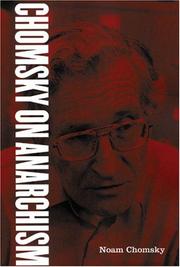
A collection of essays and interviews in which Chomsky articulates his libertarian socialist and anarchist commitments in depth — the ideal capstone that shows the ethical core animating everything the reader has studied.
Discussion
Keep reading
Paths that share books, cover the same subject, or open a related topic.