Best Books on the Riemann Hypothesis and the Prime Numbers
There is a prerequisite cliff in this subject and a reading list that hides it is useless. The popular books about the Riemann hypothesis can be read by anyone and will genuinely teach you what the statement means and why it matters; the books that let you actually work with the zeta function require complex analysis at the level of a mathematics degree, plus analytic number theory on top of that. Nothing bridges the gap in one step. This path is therefore built in two halves with the cliff marked: stages one and two are readable with school mathematics, stages three onward assume real university coursework, and every entry says what it expects of you. Most readers should stop after stage two, and that is a perfectly good outcome rather than a failure.
The popular accounts — no mathematics required
BeginnerBe able to state the hypothesis correctly, explain what the zeta function is and what its non-trivial zeros have to do with prime numbers, and understand why a statement about a complex-valued function counts as the deepest open question about the integers.
▸ Study plan for this stage
Pace: Six to eight weeks for 1,443 pages, and this stage is genuinely readable by anyone with secondary-school algebra — no calculus, no proof-writing, nothing else assumed. Derbyshire's Prime Obsession is 435 pages and comes first: its odd-numbered chapters carry the history and its even-numbered chapter
- The statement itself, said correctly: all non-trivial zeros of the Riemann zeta function have real part one half. Every word of that is doing work, and being able to say what each word means is the entire goal of this stage.
- The zeta function as a sum over the integers where it converges, and the Euler product over primes that equals it — the identity that makes an analytic object carry arithmetic information.
- Analytic continuation as the move that makes the question sensible: the defining series diverges where the interesting zeros live, and the function is extended by a procedure that is uniquely determined even though the series is not.
- The trivial zeros at the negative even integers, which come from the functional equation, and the non-trivial zeros in the critical strip, which are the subject of the conjecture.
- The connection to primes: the zeros control the error term in the prime counting function, so the hypothesis is equivalent to a statement about how regularly the primes are distributed.
- Why it is called the deepest open question about the integers — a great many published theorems are conditional on it, so a proof would settle a body of results at once and a disproof would unsettle it.
- The random-matrix connection Rockmore develops: the statistical spacing of the zeros matches the spacing of eigenvalues of certain random matrices from quantum physics, a coincidence nobody has explained.
- What it is like to assess a claimed proof, which Sabbagh is good on — including that repeated claims by serious mathematicians have not been accepted, and why acceptance is a community process rather than a verdict.
- State the Riemann hypothesis precisely. Then define every technical term in your statement without circularity.
- Explain the Euler product and why it is the bridge between an analytic function and the prime numbers.
- What is analytic continuation, informally? Why can the extension be unique when the original series does not converge there?
- How do the zeros relate to the distribution of primes? Give the shape of the relationship even if you cannot yet write the formula.
- What would change if the hypothesis were proved? What would change if it were disproved? The two answers are not symmetric.
- What is the random-matrix connection, and what makes it surprising rather than merely curious?
- Work through Derbyshire's even-numbered chapters with a pen. Where he asks you to compute something, compute it — the informal understanding of continuation only arrives if you do.
- Compute the first several partial sums of the zeta series at a couple of real arguments and watch the convergence behaviour change as the argument approaches one. It makes the divergence problem concrete in ten minutes.
- Draw the complex plane and mark the critical strip, the critical line, the trivial zeros and the region where the defining series converges. Keep the diagram; it orients everything in the later stages.
- Write a one-page explanation of the hypothesis for someone who has not read any of these books. If you cannot do it without hand-waving at continuation, reread that part of Derbyshire.
- From Sabbagh, write half a page on how a claimed proof is actually assessed. It is a better description of how mathematics works than most accounts of the subject.
Next up: You can now state the problem and say why it matters, which is the point at which the path stops being readable without a mathematics degree.

The best popular book on the subject and the one to start with. Its structure is the trick: odd-numbered chapters tell the history, even-numbered chapters do the actual mathematics, so you can go as deep as you want and skip the rest without losing the thread. Assumes secondary-school algebra and genuinely nothing else; by the end you will understand the analytic continuation of zeta at a real if informal level.
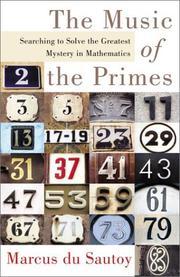
More history and personality, less mathematics — Riemann, Hilbert, Hardy and Littlewood, Selberg, Erdos, Connes, and the random-matrix connection to quantum physics. Read it after Derbyshire and as a complement: du Sautoy is better on why mathematicians care and on the community, Derbyshire is better on what the thing actually says.
The third popular treatment, and the one that goes furthest into the connection with random matrix theory and the Montgomery-Dyson pair-correlation story. More demanding than du Sautoy and less systematic than Derbyshire; worth it if the physics link is what caught you.
A journalist's account built around the mathematicians hunting the proof, including Louis de Branges, whose repeated claims have not been accepted. Good on what research mathematics is like as a working life and on how the community assesses a claimed proof. Published in the United States as The Riemann Hypothesis; the two titles are catalogued separately, so buy one only.
The mathematics you actually need — the cliff
IntermediateAcquire the two prerequisites everything past this point assumes: elementary number theory, and complex analysis through contour integration, analytic continuation and the argument principle. Expect this stage to take longer than all the others combined.
▸ Study plan for this stage
Pace: This stage is the prerequisite cliff and it should be described honestly rather than scheduled optimistically. The three books total 1,320 pages, but the number is misleading: this is two university courses, and worked properly with the exercises done it is six months to two years of part-time study
- From Burton: divisibility, the Euclidean algorithm, congruences, the Chinese remainder theorem, Fermat and Euler's theorems, primitive roots and quadratic reciprocity.
- Arithmetic functions and their elementary theory — the divisor and totient functions, multiplicativity, Möbius inversion — which is the vocabulary analytic number theory manipulates, together with the elementary results on prime distribution Burton reaches, so you know what can be proved without com
- From Needham: holomorphic functions understood as locally amplitwist mappings, and the geometric meaning of the Cauchy-Riemann equations rather than the formal statement of them.
- Contour integration and the residue theorem, first as Needham makes them visible and then as Ahlfors proves them, because you need both the picture and the proof.
- Analytic continuation done rigorously: the identity theorem, why a holomorphic function is determined by its values on a set with a limit point, and how that makes the continuation of zeta unique.
- The argument principle and Rouché's theorem, which are the tools by which zeros get counted — and counting zeros is what the whole subject consists of.
- Conformal mapping and the maximum modulus principle, which are Ahlfors's core and which recur constantly in estimates of the zeta function.
- That Ahlfors's later chapters already treat the zeta function and prove the prime number theorem, so the cliff has a view from the top.
- Prove quadratic reciprocity, or work carefully through a proof. What does the theorem actually say about which primes are squares modulo which?
- State and prove the Cauchy integral formula. Then explain in words why holomorphicity is such a strong condition.
- State the identity theorem and use it to argue that analytic continuation, where it exists, is unique.
- Use the argument principle to count the zeros of a function inside a contour. What information does the contour integral of the logarithmic derivative carry?
- Read Ahlfors's treatment of the prime number theorem. Which step is the analytic one, and where exactly does the non-vanishing of zeta on the line of real part one get used?
- Honest self-assessment: can you work Ahlfors's exercises unaided? If not, stage four will not be readable, and knowing that now is worth more than optimism.
- Do the exercises. In both Burton and Ahlfors the exercises are the course, and reading either book without them produces recognition rather than ability.
- Take one theorem — the residue theorem is the natural choice — and write out Needham's geometric account and Ahlfors's proof side by side. The pair is the best single demonstration of what rigour adds to intuition and what it costs.
- Compute a genuinely nontrivial contour integral using residues, by hand, from first principles. Then do a second one where the contour has to be chosen rather than given.
- Continue a simple function beyond its disc of convergence explicitly, by re-expanding at a new centre. Doing this once makes continuation an operation rather than a word.
- Write out, in one page, exactly which results from these three books stage four will assume. Then mark the ones you could reproduce. The unmarked ones are your remaining work.
Next up: With number theory and complex analysis in hand you can finally read the machinery in which the hypothesis is stated and used, rather than descriptions of it.
The standard first course: divisibility, congruences, quadratic reciprocity, arithmetic functions, an elementary treatment of prime distribution. Assumes only mathematical maturity and a willingness to write proofs. You need this before analytic number theory, and it is the friendliest of the standard options.
The unconventional route into complex analysis, built on geometry and pictures rather than on epsilon arguments, and the book that makes analytic continuation feel like something rather than a definition. Assumes single-variable calculus. Read it first, for intuition — it is not a substitute for a rigorous course and does not claim to be.
The rigorous course, and the classic: Cauchy's theorem, residues, conformal mapping, analytic continuation, and a treatment of the zeta function and the prime number theorem in the later chapters. Terse and demanding, and assumes real analysis. Once you can work through Ahlfors you can read stage four; until then you cannot, and no amount of enthusiasm substitutes.
Analytic number theory
IntermediateLearn the machinery in which the hypothesis is actually stated and used: Dirichlet series, the Euler product, characters and L-functions, the explicit formula, and a full proof of the prime number theorem with error term.
▸ Study plan for this stage
Pace: This is a graduate course and takes months, not weeks. The three books total only 630 pages — the fewest of any stage on this path — and they will take longer than stage one's 1,443, which is the clearest available illustration of what changed at the cliff. Assumed: everything in stage two, worked r
- Dirichlet series as the natural generating objects of multiplicative number theory, their half-planes of convergence, and the correspondence between the series and the arithmetic function it encodes.
- The Euler product in its general form, and why multiplicativity of an arithmetic function is exactly the condition for its Dirichlet series to factor over primes.
- Dirichlet characters, L-functions, and the proof of primes in arithmetic progressions — the first place where the analytic method delivers something elementary methods could not.
- The prime number theorem proved in full, and the location of the analytic crux: the non-vanishing of zeta on the line of real part one.
- Zero-free regions as the quantitative form of that non-vanishing, and the direct translation between the width of a zero-free region and the size of the error term in the prime counting function.
- The explicit formula, which makes the relationship exact: the prime counting function expressed as a main term plus a sum over the zeros, so that each zero contributes an oscillation of known frequency and amplitude.
- What the Riemann hypothesis buys once you have the explicit formula: it is precisely the statement that all those oscillations are as small as they could be, which is why it is an error-term statement rather than a mystical one.
- The wider landscape Tenenbaum and Mendes France map: sieve methods, the large sieve, probabilistic heuristics for prime distribution, and where each fits relative to the analytic machinery you have just learned.
- Derive the Euler product for a general multiplicative function and say exactly where multiplicativity is used.
- Prove, or work carefully through the proof, that there are infinitely many primes in any arithmetic progression with coprime modulus. Where does the non-vanishing of the relevant L-function at one enter?
- Write out the explicit formula and explain each term. What does a single zero contribute to the prime counting function?
- State the correspondence between a zero-free region and an error term. What error term does the Riemann hypothesis give, and what is currently known unconditionally?
- Why is the non-vanishing of zeta on the line of real part one the crux of the prime number theorem? What breaks if it fails?
- From Tenenbaum and Mendes France: name two approaches to prime distribution that are not analytic, and say what each is good for.
- Work Apostol's proof of the prime number theorem line by line and produce a one-page dependency diagram of the lemmas it uses. The diagram tells you which parts of stage two were load-bearing.
- Derive the functional equation for zeta from Davenport, then check it numerically at a few points. Numerical confirmation of a proved identity is a good habit and catches misunderstandings quickly.
- Compute the first several non-trivial zeros numerically and use the explicit formula with only those zeros to approximate the prime counting function. Watch the approximation improve as you add terms — this is the single most illuminating computation in the subject.
- Take a published theorem stated as conditional on the Riemann hypothesis and trace exactly where the hypothesis is used. Usually it is one error-term estimate, and seeing that demystifies the conditionality.
- Write out what an unconditional proof of the prime number theorem gives you and what the hypothesis would add, as two error bounds side by side.
Next up: You can now read statements about zeta rather than descriptions of them, which is what is required to approach the function as a research object.
The gentlest genuine entry into the subject: arithmetical functions, averages, Dirichlet characters, and a complete proof of the prime number theorem. Assumes stage two. Apostol writes the clearest prose of anyone in this area, and this is the book that makes the transition from popular accounts to research mathematics survivable.
The classic short graduate course, focused exactly where this path needs it: the zeta and L-functions, zero-free regions, the explicit formula, primes in arithmetic progressions. Under two hundred pages and extremely dense. Assumes Apostol or equivalent. This is where the Riemann hypothesis stops being a curiosity and starts being a tool you can see the shape of.
A short survey by two masters of the field — Tenenbaum and Mendes France — that sets what you have just learned in the wider landscape of prime distribution: sieves, the large sieve, probabilistic heuristics. Read it as a map after Davenport, to see which direction to go next.
The zeta function itself, and the research frontier
IntermediateWork directly with the zeta function and the hypothesis as a research object: the functional equation, the critical strip, zero-density and zero-free results, computational verification, and the equivalent formulations.
▸ Study plan for this stage
Pace: This stage is not a reading list with a schedule; it is where a research career would begin, and the honest estimate is years rather than months. The four books total 1,878 pages and only the first is read cover to cover. Assumed: stage three, worked properly, plus real graduate coursework in analys
- The functional equation relating zeta at s and at one minus s, the completed function that makes the symmetry manifest, and the critical line as the axis of that symmetry — which is why one half is the natural place for the zeros to be.
- What Riemann actually did in his memoir, which Edwards makes clear: several results asserted without proof, one of which is the hypothesis, and a programme that took the following century to carry out.
- The Riemann-von Mangoldt formula counting zeros up to a given height, and what it means that the count is known precisely while their real parts are not.
- The two forms of partial progress the subject has actually made: zero-density estimates, which bound how many zeros can lie off the critical line and so bound how badly the hypothesis could fail, and results on the proportion of zeros on the line — Hardy's infinitude, then Selberg's positive proport
- Mean value theorems for zeta on the critical line, which are the technical heart of Titchmarsh and the tool most of the partial results are built from.
- Computational verification: the Riemann-Siegel formula, the Odlyzko-Schönhage algorithm, and the enormous heights to which zeros have been checked — together with the honest observation that no amount of verification is evidence of a proof.
- The equivalent formulations collected by Borwein and colleagues — statements about the Möbius function, the divisor function, the Farey sequence, the Redheffer matrix — which show that the hypothesis is a load-bearing statement across the subject rather than an isolated conjecture.
- The generalisation Iwaniec and Kowalski make central: the hypothesis is one case of a family of conjectures about general L-functions, and the modern field works on the family rather than on the single case.
- Derive the functional equation, or work through Edwards's derivation. Why does the completed function make the symmetry obvious?
- Which claims in Riemann's memoir did he prove, and which did he assert? What is the state of each today?
- State the Riemann-von Mangoldt counting formula. What do we know exactly, and what do we not know at all?
- What does a zero-density estimate assert, and how does it constrain the possible failure of the hypothesis?
- Summarise the results on the proportion of zeros on the critical line. What technique does each rest on?
- Why is computational verification not evidence in the mathematical sense? Give the argument carefully, since the intuition runs the other way.
- Work Edwards's treatment of Riemann's memoir with the translation open, and produce your own annotated list of Riemann's claims marked proved, later proved, or still open.
- Derive the Riemann-Siegel formula's leading behaviour and use it to compute zeros yourself. Then compare your heights against published tables.
- Take three equivalent formulations from Borwein and colleagues and prove the equivalence of one of them, or work through the proof. Seeing an equivalence established is what makes the hypothesis's centrality concrete rather than asserted.
- Read one of the original papers reprinted in Borwein — Hardy's or Selberg's — in the original rather than in summary, and write a page on what the argument actually does.
- Using Iwaniec and Kowalski, write out the generalised statement for a family of L-functions and say which parts of the classical theory survive the generalisation intact.
Next up: The path ends at the working literature, with a bibliography and the sources attached, so that wherever you stopped you know where the open work actually is.
The book to read first here, and the most unusual on the path: Edwards works through Riemann's 1859 memoir line by line, including a translation of it, showing what Riemann actually proved and what he asserted without proof. Historically grounded and mathematically complete. Assumes stage three; rewarding in a way no other treatment is.
The standard monograph, revised by Heath-Brown, and still the reference: the functional equation, mean value theorems, zero-density estimates, the theory of the critical line. Not a book to read through — a book to work in. Assumes real graduate coursework in analysis and analytic number theory.
Iwaniec and Kowalski's large treatise is where the modern field lives: automorphic forms, the spectral theory, sieves, the analytic theory of general L-functions. Read it to understand that the Riemann hypothesis is one case of a family of conjectures about L-functions. Genuinely research-level and will take years.

Borwein and colleagues collected the key original papers — Riemann's memoir, Hardy, Selberg, Levinson, Conrey, the computational verifications — with expository chapters framing them, plus the equivalent formulations and the probabilistic evidence. The right last entry: a bibliography with the sources attached, so wherever you stop, you know where the work actually is. Catalogued under the short title The Riemann Hypothesis.
Discussion
Keep reading
Paths that share books, cover the same subject, or open a related topic.