There is a prerequisite cliff in this subject, and any reading list that hides it is useless. The popular books about the Riemann hypothesis can be read by anyone and will genuinely teach you what the statement means and why mathematicians care about it. The books that let you actually work with the zeta function require complex analysis at the level of a mathematics degree, and then analytic number theory on top of that. Nothing bridges the gap in one step, and no amount of enthusiasm substitutes for the coursework.
So this path is built in two halves with the cliff marked. The first two stages — the popular accounts, and the prerequisite mathematics — are where most readers should stop, and stopping there is a good outcome rather than a failure. You will end up able to state the hypothesis correctly, explain what the non-trivial zeros of the zeta function have to do with prime numbers, and understand why a claim about a complex-valued function counts as the deepest open question about the integers. That is a real thing to know. The two stages after it assume genuine university coursework and are honestly labelled expert.
The popular accounts: no mathematics required
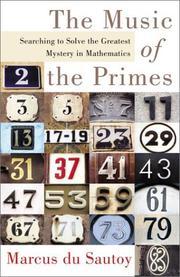
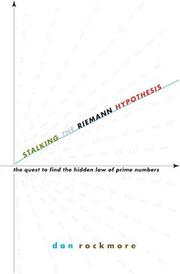
Prime Obsession (John Derbyshire, 435 pages) is the one to start with, and its structure is the trick: odd-numbered chapters tell the history, even-numbered chapters do the actual mathematics, so you can go as deep as you like without losing the thread. It assumes secondary-school algebra and nothing else. The music of the primes (Marcus du Sautoy, 368 pages) is more history and personality and less mathematics — Riemann, Hilbert, Hardy and Littlewood, Selberg, Connes, and the random-matrix link to quantum physics. Read it as a complement: du Sautoy is better on why mathematicians care, Derbyshire on what the thing says. Stalking the Riemann Hypothesis (Dan Rockmore, 304 pages) goes furthest into the pair-correlation story and random matrix theory; more demanding than du Sautoy, less systematic than Derbyshire.
Dr.Riemann's Zeros (336 pages) is Karl Sabbagh's journalistic account, built around the mathematicians hunting a proof, including Louis de Branges, whose repeated claims have not been accepted. It is good on what research mathematics is like as a working life. Two warnings on this one. Our record drops the space after the abbreviation, which is how it appears above. And the book was published in the United States as The Riemann Hypothesis, which is also the title of a completely different and far more technical book at the end of this path — so check the author before buying, and do not buy Sabbagh twice under two titles.
The cliff
Expect this stage to take longer than all the others combined. Elementary number theory (David Burton, 411 pages) is the standard first course — divisibility, congruences, quadratic reciprocity, arithmetic functions — and the friendliest of the options; you need it before any analytic number theory. Visual complex analysis (Tristan Needham, 592 pages) is the unconventional route in, built on geometry and pictures rather than epsilon arguments, and it is the book that makes analytic continuation feel like something rather than a definition. It assumes single-variable calculus, and it is explicitly not a substitute for a rigorous course. Complex Analysis (Lars Ahlfors, 317 pages) is that rigorous course: Cauchy's theorem, residues, conformal mapping, analytic continuation, and a treatment of the zeta function in the later chapters. It is terse and assumes real analysis. Working through Ahlfors is the actual gate — until you can, the rest of this path is not readable.
Analytic number theory, and the zeta function itself
Introduction to analytic number theory (Tom Apostol, 338 pages) is the gentlest genuine entry: arithmetical functions, Dirichlet characters, and a complete proof of the prime number theorem. Multiplicative number theory (Harold Davenport, 177 pages) is the classic short graduate course, aimed exactly where this path needs it — zeta and L-functions, zero-free regions, the explicit formula — and extremely dense for its length. The prime numbers and their distribution (115 pages) by Tenenbaum and Mendes France is a short survey to read afterwards as a map of where to go next.
Riemann's zeta function (Harold Edwards, 323 pages) is the most unusual book here: it works through Riemann's 1859 memoir line by line, including a translation, showing what he proved and what he asserted. The theory of the Riemann zeta-function (E. C. Titchmarsh, 379 pages), revised by Heath-Brown, is the standard monograph — a book to work in rather than read through. Analytic number theory (Iwaniec and Kowalski, 615 pages) is where the modern field lives and will take years. The Riemann hypothesis (Peter Borwein and colleagues, 561 pages) closes the path: the key original papers collected with expository framing, so wherever you stop you know where the work actually is.
The full sequence, with the prerequisites for each stage spelled out, is at /paths/pt_ai_the-riemann-hypothesis.