Learn Mathematical Physics: The Best Books, in Order
This curriculum is designed for an expert-level learner who wants to master the mathematical structures underlying physics — from the rigorous foundations of vector calculus and linear algebra through the deep machinery of complex analysis, differential geometry, and functional analysis. Each stage builds the formal language needed for the next, culminating in the sophisticated mathematical frameworks used in modern theoretical physics.
Rigorous Foundations Revisited
ExpertSolidify and formalize the core mathematical toolkit — linear algebra, vector calculus, and real analysis — at a level of rigor appropriate for theoretical physics.
▸ Study plan for this stage
Pace: 12–14 weeks, ~40–50 pages/day (alternating between books: 2–3 weeks on LADR chapters, then 2–3 weeks on Calculus on Manifolds sections)
- Vector spaces, subspaces, and linear independence as the foundational language for describing physical state spaces
- Linear maps and their matrix representations; change of basis and invariance under coordinate transformations
- Eigenvalues, eigenvectors, and diagonalization—essential for understanding normal modes, symmetries, and conserved quantities in physics
- Inner product spaces and orthogonality; the geometry underlying quantum mechanics and Fourier analysis
- Differentiation on manifolds: differential forms, exterior derivatives, and pullbacks as coordinate-free descriptions of physical fields
- Integration on manifolds and Stokes' theorem (including divergence and curl theorems) as unified statements of conservation laws
- Rigorous real analysis foundations: limits, continuity, compactness, and uniform convergence—ensuring arguments in physics are logically sound
- What is a vector space, and why is the concept of linear independence more fundamental than the notion of a basis?
- How do linear maps relate to matrices, and what does it mean for two matrices to represent the same linear map in different bases?
- What are eigenvalues and eigenvectors, and why do they appear naturally in the study of oscillations and quantum mechanics?
- How does the inner product structure on a vector space encode geometric and physical intuition, and what role does orthogonality play?
- What is a differential form, and how does the exterior derivative generalize the gradient, curl, and divergence operators?
- State and explain Stokes' theorem in its general form, and show how the divergence theorem and Kelvin–Stokes theorem are special cases.
- Why is the distinction between open and closed sets, and the concept of compactness, important for rigorous analysis of physical systems?
- Work through all computational exercises in LADR Chapters 1–8 (vector spaces, linear maps, polynomials, eigenvalues, inner products). Aim for fluency in determining linear independence, computing rank, and finding eigendecompositions by hand.
- For each major theorem in LADR (e.g., the Fundamental Theorem of Linear Maps, the Spectral Theorem), write out a one-page proof from memory, then verify against the text.
- Construct explicit examples: find a 3×3 matrix with complex eigenvalues, diagonalize a symmetric matrix, and verify orthogonality of eigenvectors.
- Work through Spivak's Chapters 1–3 (calculus on Euclidean space): compute partial derivatives, verify the chain rule, and practice change-of-variables in integrals.
- Compute exterior derivatives of 1-forms and 2-forms in ℝ³; verify that d(dω) = 0 for concrete examples, and relate the result to curl(grad f) = 0.
- Prove Stokes' theorem for a specific 2-dimensional surface in ℝ³ (e.g., a hemisphere), computing both the surface integral and the boundary integral explicitly.
- Write a short essay (2–3 pages) explaining how the abstract notion of a linear map in LADR connects to the concept of a differential map between manifolds in Spivak.
- Solve 5–10 problems from Spivak's Chapters 4–5 (manifolds and integration) that involve computing integrals of differential forms and applying Stokes' theorem.
Next up: This stage equips you with the rigorous mathematical language and formal tools—linear algebra, manifold calculus, and real analysis—that form the bedrock for advanced topics in theoretical physics, such as Hamiltonian mechanics, differential geometry in general relativity, and the functional analysis underlying quantum field theory.
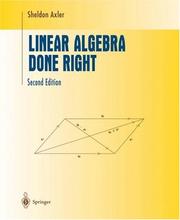
Rebuilds linear algebra from a proof-based, operator-theoretic perspective that directly mirrors how physicists use spectral theory and Hilbert spaces. Reading this first sharpens the algebraic intuition needed for everything that follows.

Provides a terse, rigorous treatment of multivariable calculus and differential forms on Euclidean space, bridging the gap between standard vector calculus and the manifold language used throughout modern physics.
The Core of Mathematical Physics
ExpertMaster the canonical methods of mathematical physics — complex analysis, ODEs/PDEs, special functions, and Green's functions — as they are actually applied in quantum mechanics, electrodynamics, and classical field theory.
▸ Study plan for this stage
Pace: 12–14 weeks, ~40–50 pages/day (mix of theory and worked examples), with 2–3 days per week dedicated to problem-solving and integration across books
- Complex analysis as a foundation: analyticity, Cauchy–Riemann equations, contour integration, and residue calculus for evaluating real integrals and series
- Ordinary differential equations (ODEs) and their solutions: linear systems, eigenvalue problems, and special function solutions (Bessel, Legendre, Hermite)
- Partial differential equations (PDEs) in physics: separation of variables, boundary value problems, and the role of orthogonal function expansions
- Green's functions and integral equations: constructing solutions to inhomogeneous differential equations and their physical interpretation in quantum mechanics and electrodynamics
- Special functions as solutions to canonical PDEs: understanding their properties, orthogonality relations, and generating functions
- Operator methods and functional analysis: linear operators, eigenvalue problems, and the connection between abstract mathematics and physical observables
- Practical integration of complex analysis with PDEs: using contour integration and residue theory to solve physical problems
- Asymptotic methods and approximations: WKB, saddle-point integration, and their application to quantum and classical systems
- How do the Cauchy–Riemann equations ensure analyticity, and why is analyticity essential for contour integration in evaluating physical integrals?
- Explain the residue theorem and demonstrate how to use it to evaluate a real integral that appears in a quantum mechanical or electrodynamic calculation.
- What is a Green's function, and how does it convert an inhomogeneous differential equation into an integral equation? Give a concrete example from electrostatics or quantum mechanics.
- How do separation of variables and orthogonal function expansions (Fourier, Bessel, Legendre) solve PDEs with boundary conditions, and why are orthogonality relations crucial?
- Derive the generating function for Legendre polynomials (or Bessel functions) and use it to establish an orthogonality relation.
- How does the eigenvalue problem for a Sturm–Liouville operator connect to the appearance of special functions in physical PDEs?
- Compare and contrast the roles of complex analysis, ODEs, and PDEs in solving a specific problem in electrodynamics (e.g., potential in a conductor) or quantum mechanics (e.g., scattering amplitude).
- What is the WKB approximation, and how does it use asymptotic analysis to extract physical insight from an ODE or integral?
- Work through Stone's Chapter 2 (complex analysis) problems: compute derivatives using Cauchy–Riemann equations, verify analyticity in simple domains, and sketch level curves of harmonic functions.
- Evaluate at least 5 real integrals using contour integration and the residue theorem (e.g., ∫₀^∞ x/(x⁴+1) dx, Gaussian integrals with poles, Fourier transforms of rational functions).
- Solve 3–4 canonical ODEs from Arfken (linear first/second order, constant coefficients, and one with variable coefficients) and identify the special function solutions.
- Construct the Green's function for the 1D Poisson equation (d²u/dx² = f) with Dirichlet boundary conditions; verify it satisfies the defining properties and use it to solve an inhomogeneous problem.
- Solve the 2D Laplace equation on a rectangular domain using separation of variables; expand the solution in Fourier series and verify convergence at boundaries.
- Derive orthogonality relations for two different special functions (e.g., Legendre polynomials and Bessel functions) and use them to expand a given function in that basis.
- Work a complete scattering or diffraction problem (e.g., scalar wave scattering from a sphere, or EM wave in a waveguide) that requires combining ODEs, PDEs, special functions, and boundary conditions.
- Apply WKB approximation to a 1D quantum potential (e.g., tunneling through a barrier or bound states in a potential well) and compare with exact results where available.
Next up: This stage equips you with the canonical mathematical machinery—complex analysis, ODEs, PDEs, special functions, and Green's functions—that form the rigorous foundation for the next stage, which will apply these tools to deep problems in quantum mechanics, field theory, and advanced electrodynamics, where you will encounter path integrals, scattering theory, and renormalization.

A modern, graduate-level tour of the mathematical methods most essential to physics, written by physicists for physicists, with exceptional clarity on complex analysis, differential equations, and functional methods.

The definitive reference compendium for special functions, integral transforms, Green's functions, and tensor analysis; read after Stone to fill in encyclopedic detail and sharpen problem-solving technique.
The gold-standard rigorous treatment of complex analysis; placed here so the learner can revisit contour integration, analytic continuation, and Riemann surfaces with full mathematical depth after seeing their physical applications.
Geometry and Topology for Physics
ExpertDevelop fluency in differential geometry, fiber bundles, and topology — the geometric language of gauge theory, general relativity, and topological field theory.
▸ Study plan for this stage
Pace: 12–14 weeks, ~40–50 pages/day (Nakahara first: 6–7 weeks; Spivak second: 6–7 weeks). Allocate extra time for worked examples and problem sets in Spivak's volumes.
- Manifolds and smooth structures: definitions, charts, atlases, and the notion of smoothness as the foundation for all subsequent geometric objects
- Tangent spaces, vector fields, and the differential: how to linearize geometry and define directional derivatives on curved spaces
- Differential forms and exterior calculus: wedge product, exterior derivative, and integration on manifolds (Stokes' theorem)
- Fiber bundles and principal bundles: the geometric framework for gauge fields, connections, and curvature
- Connections and curvature: covariant derivatives, Riemann curvature tensor, and their role in general relativity and Yang–Mills theory
- Homology and cohomology: topological invariants and de Rham cohomology connecting analysis to topology
- Characteristic classes and topological field theory: how topology constrains physics through Chern classes and winding numbers
- Homotopy and fundamental groups: understanding global topological structure and obstructions to lifting sections
- What is a smooth manifold, and how do charts and transition functions encode the notion of smoothness without reference to an ambient Euclidean space?
- How do tangent spaces and the differential map allow you to linearize problems on curved spaces, and what is the relationship between vector fields and flows?
- What is the exterior derivative, and how does Stokes' theorem generalize integration by parts to manifolds of arbitrary dimension?
- What is a fiber bundle, and how do connections on principal bundles encode gauge symmetries in physics?
- How does curvature measure the failure of parallel transport to be path-independent, and what role does the Riemann tensor play in general relativity?
- What is de Rham cohomology, and how does it relate closed and exact forms to topological properties of the manifold?
- How do characteristic classes like Chern classes detect topological obstructions, and why are they important in topological field theory?
- What is the fundamental group, and how does it constrain the existence of global sections of bundles?
- Work through Nakahara's examples of manifolds (spheres, tori, projective spaces, Lie groups) and verify the transition functions between charts explicitly.
- Compute tangent spaces and differentials for standard maps (e.g., stereographic projection, the exponential map on Lie groups) and verify the chain rule.
- Practice exterior calculus: compute wedge products, exterior derivatives, and verify Stokes' theorem on simple domains (e.g., parameterized surfaces in ℝ³).
- Construct explicit fiber bundles (e.g., the Hopf fibration, tangent and cotangent bundles) and identify their structure groups and transition functions.
- Compute connection 1-forms and curvature 2-forms for standard bundles (e.g., the Levi-Civita connection on the sphere, Yang–Mills connections on SU(2) bundles).
- Calculate the Riemann curvature tensor for simple metrics (e.g., the sphere, hyperbolic space, the Schwarzschild metric) and verify the Bianchi identities.
- Compute de Rham cohomology groups for standard manifolds (spheres, tori, projective spaces) using the Mayer–Vietoris sequence and Poincaré duality.
- Work out Chern classes for line bundles and verify their topological meaning (e.g., relating the first Chern class to winding numbers and degree).
Next up: Mastery of differential geometry, fiber bundles, and topology equips you with the precise mathematical language to formulate gauge theory, general relativity, and topological field theory, enabling the next stage to focus on physical applications and quantization without pausing for geometric foundations.
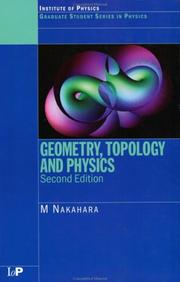
The most widely used bridge text connecting pure mathematics (manifolds, forms, bundles, characteristic classes) to physics; its self-contained style makes it the ideal entry point into geometric physics.
Provides the deep, rigorous geometric foundation — curvature, connections, Riemannian geometry — that Nakahara surveys; reading it here cements the structures needed for general relativity and gauge theory.
Functional Analysis and Operator Theory
ExpertCommand the infinite-dimensional linear algebra underlying quantum mechanics and quantum field theory: Hilbert spaces, spectral theory, distributions, and unbounded operators.
▸ Study plan for this stage
Pace: 12–14 weeks, ~40–50 pages/day (Rudin: weeks 1–6; Reed: weeks 7–14). Allocate 2–3 days per major theorem in Rudin; spend weeks 7–14 on Reed's volumes I–II with emphasis on spectral theory and unbounded operators.
- Hilbert space structure: completeness, orthonormality, and the Riesz representation theorem as the foundation for quantum state spaces
- Bounded linear operators and the operator norm; adjoint operators and self-adjoint operators central to observables
- Spectral theory for bounded self-adjoint operators: eigenvalues, eigenvectors, and the spectral decomposition theorem
- Unbounded operators, domains of definition, and essential self-adjointness—critical for Hamiltonians and momentum operators
- Distributions (generalized functions) and weak derivatives via Rudin's treatment of locally convex spaces
- The spectral theorem for unbounded self-adjoint operators and functional calculus
- Sobolev spaces and their role in quantum mechanics; weak solutions to differential equations
- Resolvents, spectrum (point, continuous, residual), and the resolvent formula in Reed's framework
- What is a Hilbert space, and why is the Riesz representation theorem fundamental to quantum mechanics?
- Explain the difference between bounded and unbounded operators, and why unbounded operators are necessary for quantum Hamiltonians.
- State and interpret the spectral theorem for bounded self-adjoint operators; how does it extend to unbounded operators?
- What is a distribution in the sense of Schwartz, and how do distributions generalize classical derivatives?
- Describe the spectrum of an operator and distinguish between point, continuous, and residual spectrum with physical examples.
- What does it mean for an unbounded operator to be essentially self-adjoint, and why is this essential for quantum mechanics?
- Work through Rudin's exercises on Hilbert spaces (Ch. 4): prove the Riesz representation theorem from scratch; verify orthonormality of eigenbases in ℓ².
- Compute the adjoint operator A* for concrete examples (e.g., multiplication operator, differentiation on appropriate domains) and verify (A*)* = A.
- Construct the spectral decomposition of a compact self-adjoint operator (e.g., an integral operator with symmetric kernel) using Rudin's spectral theory.
- Prove essential self-adjointness for the momentum operator p = −i(d/dx) on C₀^∞(ℝ) using deficiency indices (Reed Vol. I, Ch. 8).
- Solve a boundary value problem (e.g., Sturm–Liouville) using weak derivatives and Sobolev spaces; verify the solution in the distributional sense.
- Compute the resolvent (A − λI)⁻¹ for a simple operator (e.g., multiplication by x on L²) and sketch the spectrum using the resolvent formula.
Next up: Mastery of Hilbert spaces, spectral theory, and unbounded operators equips you to rigorously construct quantum Hamiltonians, analyze their spectra, and apply functional calculus—the technical foundation for perturbation theory, scattering theory, and the path integral formalism in quantum field theory.
Rudin's rigorous treatment of topological vector spaces, Banach and Hilbert spaces, and the spectral theorem provides the analytic backbone for quantum theory and PDE methods.

The four-volume masterwork on functional analysis, operator theory, and scattering theory as applied to physics; reading it after Rudin allows the learner to see every abstract theorem realized in a physical context.
Synthesis: Modern Theoretical Structures
ExpertIntegrate all prior mathematics into the unified frameworks of classical mechanics, quantum field theory, and string theory, seeing how geometry, analysis, and algebra converge in cutting-edge physics.
▸ Study plan for this stage
Pace: 12–14 weeks, ~40–50 pages/day (with 2–3 days/week for problem-solving and synthesis). Arnold: 6–7 weeks (~400 pages); Hori: 5–6 weeks (~350 pages); final week for integration and capstone project.
- Symplectic geometry as the foundation of classical mechanics: phase space, Hamiltonian flows, and canonical transformations
- Lagrangian mechanics and the principle of least action as geometric variational problems on configuration manifolds
- Integrable systems and action-angle variables: how symmetry and conservation laws structure dynamical systems
- Mirror symmetry as a duality between symplectic and complex geometry: Floer homology, Fukaya categories, and A-model/B-model correspondence
- Homological algebra and derived categories as tools for understanding geometric dualities in physics
- Quantum cohomology and Gromov–Witten invariants: how classical geometry encodes quantum information
- Convergence of geometric structures: how symplectic topology, algebraic geometry, and homological algebra unify in modern theoretical physics
- What is a symplectic manifold, and why is it the natural geometric setting for Hamiltonian mechanics rather than Riemannian geometry?
- How do canonical transformations relate to symmetries in classical mechanics, and what role do they play in solving integrable systems?
- What is the action-angle formalism, and how does it reveal the hidden structure of integrable systems?
- State and explain the principle of least action (Hamilton's principle) and its role as a bridge between Lagrangian and Hamiltonian mechanics.
- What is mirror symmetry, and how does it relate the symplectic geometry of one space to the complex geometry of another?
- Describe the A-model and B-model in mirror symmetry: what geometric structures do they capture, and why are they dual?
- What are Gromov–Witten invariants, and how do they encode quantum corrections to classical geometry?
- How do Floer homology and Fukaya categories formalize the symplectic side of mirror symmetry?
- Work through Arnold's canonical examples (harmonic oscillator, pendulum, rigid body) in symplectic coordinates; compute Poisson brackets and verify Hamiltonian flows explicitly.
- Solve 5–8 integrable systems from Arnold (e.g., Kepler problem, symmetric top) using action-angle variables; verify that actions are adiabatic invariants.
- Perform canonical transformations (generating functions, Legendre transforms) on concrete systems; verify that symplectic structure is preserved.
- Compute the Lagrangian and Hamiltonian for a constrained mechanical system (e.g., particle on a surface); verify equivalence via Legendre transform.
- Study a mirror pair from Hori (e.g., toric varieties and their symplectic duals); compute Gromov–Witten invariants on the A-model side and verify against B-model periods.
- Work through a Floer homology computation for a simple symplectic manifold; understand how it encodes intersection theory of Lagrangian submanifolds.
- Compute quantum cohomology ring relations for a classical variety; relate them to Gromov–Witten invariants via the quantum product.
- Write a 3–5 page synthesis essay: 'How Symplectic Geometry Unifies Classical Mechanics and Quantum Field Theory' using examples from both Arnold and Hori.
Next up: This stage establishes the geometric and homological foundations—symplectic topology, mirror symmetry, and derived categories—that will be essential for understanding how quantum field theory and string theory emerge as natural extensions of classical geometry, preparing you to study the role of these structures in gauge theory, topological field theories, and the AdS/CFT correspondence.
Arnold's geometric reformulation of mechanics — using symplectic manifolds, Lie groups, and variational calculus — is the perfect synthesis text, showing how all the prior mathematics lives inside a single physical theory.
A landmark collaborative text that exposes the deep interplay between algebraic geometry, topology, and string theory; serves as a capstone showing the frontier where mathematics and physics are indistinguishable.
Discussion
Keep reading
Paths that share books, cover the same subject, or open a related topic.