Best Books on the History of Thailand, in Order
This curriculum traces Thai history from its earliest kingdoms through the remarkable story of avoiding colonization, to the complex dance between monarchy, military, and democracy in modern times. The four stages move from accessible narrative overviews to deeper political and cultural analysis, ensuring each book builds the conceptual vocabulary needed for the next.
Foundations: The Land and Its Story
BeginnerGain a confident, chronological overview of Thai history — from the early Tai kingdoms through Ayutthaya, Bangkok, and into the 20th century — before diving into specialist topics.
▸ Study plan for this stage
Pace: 4–5 weeks, ~40–50 pages/day (approximately 280–350 pages total across both books)
- The early Tai migrations and the formation of distinct Thai kingdoms (Sukhothai, Lanna, Lao kingdoms) before centralization
- Ayutthaya's rise as a cosmopolitan, multi-ethnic trading empire and its role as the longest-lasting Thai capital (1351–1767)
- The Chakri Dynasty's founding and the establishment of Bangkok as the new capital in response to Burmese threats
- The concept of *Thainess* and Thai identity as constructed through Buddhism, the monarchy, and the state apparatus
- Thailand's unique position in Southeast Asia: never colonized, yet shaped by colonial pressures and diplomatic maneuvering
- The transition from absolute monarchy to constitutional monarchy in the 20th century and the role of the military
- The relationship between Thai kingship, Buddhist cosmology, and political legitimacy across different eras
- Regional variations in Thai culture, governance, and historical experience (central, northern, northeastern, southern Thailand)
- What were the major early Tai kingdoms before Ayutthaya, and how did they differ in geography, governance, and cultural influence?
- Why did Ayutthaya become the dominant Thai power, and what made it a significant regional trading hub?
- How did the fall of Ayutthaya in 1767 reshape Thai political geography, and what role did the Chakri Dynasty play in recovery?
- What does it mean to say Thailand was never colonized? How did Thai rulers navigate colonial pressures from Britain and France?
- How has Buddhism functioned as a pillar of Thai identity and political legitimacy across different historical periods?
- What were the major political transitions in 20th-century Thailand, and why did the monarchy remain central to Thai governance?
- Create a timeline poster or digital map showing the rise and fall of Sukhothai, Lanna, Ayutthaya, and the founding of Bangkok—mark key dates, rulers, and territorial shifts
- Read Baker's and Wyatt's accounts of Ayutthaya side by side; write a 500-word comparative analysis of how each author emphasizes different aspects (trade, culture, politics, decline)
- Trace the concept of *Thainess* through the books: collect 5–7 passages where the authors discuss Thai identity, monarchy, or Buddhism as nation-building tools, then synthesize your findings
- Create a genealogical chart of the Chakri Dynasty's early rulers (Rama I–IV) and annotate it with their major policies, conflicts, and achievements based on Wyatt's account
- Write a short essay (800–1000 words) answering: 'Why was Thailand never colonized?' Use specific evidence from both books about diplomatic strategy, geography, and leadership
- Map the regional diversity of Thailand (north, northeast, south, central) using examples from the books; note how each region's history, culture, and relationship to the Thai state differs
Next up: This foundational chronological and thematic overview equips you to explore specialist topics—whether deep dives into specific reigns, regional histories, cultural institutions, or modern political movements—with a secure understanding of how each piece fits into Thailand's larger historical arc.

The single best one-volume introduction to Thai history, written by two leading scholars in clear, engaging prose. Read this first to build the full chronological skeleton everything else will hang on.
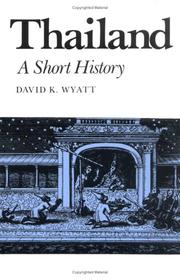
Wyatt is the dean of Thai historical studies and this classic narrative deepens the chronological foundation, with particular strength on the Sukhothai and Ayutthaya eras. Read it second to reinforce and enrich what Baker and Phongpaichit introduced.
The Kingdoms: Siam's Deep Roots
BeginnerUnderstand the pre-modern kingdoms — Sukhothai, Ayutthaya, and early Bangkok — their culture, trade networks, and the world they inhabited before Western pressure arrived.
▸ Study plan for this stage
Pace: 4–5 weeks, ~40–50 pages/day (total ~250 pages)
- How Siam's territorial boundaries were conceptualized and mapped differently across time periods, from loose tributary networks to fixed nation-state borders
- The role of cartography and geographic knowledge as tools of state power and colonial resistance in Southeast Asia
- The relationship between physical geography (rivers, mountains, coastlines) and political organization in pre-modern Siam
- How Western colonial mapping practices influenced Thai self-perception and national identity formation
- The distinction between Siam's historical fluid, overlapping spheres of influence and the modern nation-state concept
- The cultural and political significance of major kingdoms (Sukhothai, Ayutthaya) and their spatial relationships
- How Winichakul's approach reveals the constructed nature of 'Thailand' as a geographic and political entity
- How did Siam's territorial conception change from the pre-modern period through the colonial era, and what role did mapping play in this transformation?
- What is the difference between tributary networks and fixed borders, and why was this distinction important for Siam's survival during the colonial period?
- How did Western cartographic practices challenge Thai understanding of their own territory, and how did Siam respond?
- What does Winichakul mean by 'geo-body,' and how does this concept help explain the relationship between geography, identity, and state power?
- How did the physical geography of Siam (river systems, mountain ranges) shape the organization and reach of pre-modern kingdoms?
- Why is understanding Siam's historical spatial fluidity essential for grasping modern Thailand's borders and national identity?
- Create a comparative timeline: sketch or describe how Siam's territorial extent appeared in three different periods (e.g., Sukhothai era, Ayutthaya peak, early Bangkok/pre-colonial, and post-colonial). Annotate what changed and why.
- Map exercise: Using historical maps from the book, redraw one pre-modern Siam map showing tributary relationships and spheres of influence, then redraw the same region as a modern nation-state map. Write a paragraph explaining what was gained and lost in this translation.
- Close reading: Select one chapter on cartography or boundary-making and annotate key passages that show how Western maps were used as political tools. Discuss how Siam's rulers responded.
- Comparative analysis: Choose one major pre-modern kingdom (Sukhothai or Ayutthaya) and write a 2–3 page essay on how its geographic reach and political organization differed from the modern Thai nation-state.
- Visual analysis: Find or reproduce 3–4 historical maps of Siam from different time periods (from the book or external sources cited by Winichakul). Write captions explaining what each map reveals about how Siam was understood at that moment.
- Reflection essay: After finishing the book, write 2–3 pages on how understanding Siam's 'geo-body' changes your perception of modern Thailand's borders and national identity. What feels natural versus constructed?
Next up: This stage establishes how Siam's pre-modern kingdoms occupied fluid, overlapping geographic and political spaces, setting up the next stage to explore how external pressures and modernization forced the creation of fixed borders and a unified nation-state identity.

A landmark work showing how the modern idea of 'Thailand' as a bounded nation was itself constructed — essential for understanding what the earlier kingdoms actually were before that concept existed.
Modern Thailand: Military, Monarchy, and Democracy
ExpertGrapple with the turbulent 20th and 21st centuries — the 1932 revolution, the cycle of coups, the political role of the palace, and the ongoing struggle over what Thai democracy means.
▸ Study plan for this stage
Pace: 4–5 weeks, ~40–50 pages/day (approximately 280–350 pages total)
- Western influence as a contested and ambiguous force in Thai modernization, not a simple imposition or adoption
- How Thai intellectuals, writers, and cultural figures navigated the tension between Western ideas and Thai identity during the 20th century
- The role of cultural anxiety and selective appropriation in Thailand's engagement with modernity
- The relationship between Western political ideals (democracy, nationalism) and their Thai interpretations during periods of instability
- How the palace, military, and intellectual elites used or rejected Western models to legitimize their authority
- The gendered and class dimensions of Thailand's encounter with Western culture and values
- How does Harrison characterize the relationship between Thailand and 'the West' — is it one of simple imitation, resistance, or something more complex?
- What role did Thai intellectuals and cultural producers play in shaping how Western ideas were understood and adapted in Thailand?
- How did the 1932 revolution and subsequent political upheaval influence Thai attitudes toward Western democratic models?
- What does Harrison mean by 'ambiguous allure,' and what specific examples does she use to illustrate this concept?
- How did different Thai social groups (elites, intellectuals, ordinary citizens) experience or interpret Western influence differently?
- What is the relationship between Thailand's modernization project and its attempts to preserve a distinct Thai identity?
- Create a timeline mapping key moments of Western influence in Thailand (1932 onward) alongside major political events; annotate which figures or groups embraced or resisted Western ideas at each point
- Select 2–3 primary sources or cultural artifacts Harrison discusses (literary works, political speeches, etc.) and write a 500-word analysis of how they reveal ambivalence toward the West
- Construct a comparison chart of how the palace, military, and democratic reformers each invoked or rejected Western concepts (rule of law, nationalism, progress) to justify their positions
- Write a reflective essay (800–1000 words) on how Harrison's framework of 'ambiguous allure' helps explain a specific political or cultural moment in 20th-century Thailand
- Engage in a structured debate or discussion: one side argues Thailand eagerly adopted Western models; the other argues it fundamentally resisted them. Use Harrison's evidence to complicate both positions
- Create an annotated reading journal identifying passages where Harrison reveals tension, contradiction, or nuance in Thai-Western relations; group them by theme and reflect on what patterns emerge
Next up: This stage establishes how Western ideas and models became entangled in Thai political and cultural identity, providing essential context for understanding why subsequent stages must examine how the military, monarchy, and competing visions of democracy each claim legitimacy by selectively invoking or rejecting these Western frameworks.

Explores how Thai culture and identity were reshaped by engagement with Western modernity, providing crucial cultural context for understanding political and social tensions in contemporary Thailand.
Discussion
Keep reading
Paths that share books, cover the same subject, or open a related topic.