Learn Thai: the best beginner books in reading order
This curriculum takes a complete beginner from zero Thai to genuine reading and listening fluency across four carefully sequenced stages. It begins with the Thai script and tonal system — the non-negotiable foundation — then builds core grammar and vocabulary, moves into structured self-study and sentence mining, and finally graduates the learner into graded readers and authentic Thai texts. Each stage unlocks the next: you cannot read real Thai without the script, cannot parse sentences without grammar, and cannot sustain motivation without a proven self-study method.
Script & Sounds — Cracking the Code
BeginnerRead and write all 44 Thai consonants, 32 vowel forms, and 5 tones with confidence; sound out any Thai word even before knowing its meaning.
▸ Study plan for this stage
Pace: 4–5 weeks, ~15–20 pages/day (focusing on script sections; can be accelerated with daily practice)
- The Thai consonant alphabet: all 44 consonants organized by class (high, mid, low) and their romanization equivalents
- Thai vowel forms: 32 distinct vowel symbols, their placement (above, below, before, after consonants), and corresponding sounds
- The 5 Thai tones (mid, high, low, rising, falling) and how tone marks (mai tho, mai tri, mai chattawa) modify consonant sounds
- Tone rules: how consonant class and tone marks interact to determine the actual tone of a syllable
- Reading Thai script from left to right: combining consonants, vowels, and tone marks into pronounceable syllables
- Practical sound-out technique: breaking down unfamiliar Thai words into components and reconstructing their pronunciation
- Common Thai phonetic patterns and consonant clusters that appear in real words
- Can you identify all 44 Thai consonants by sight and produce their correct sounds without romanization?
- How do you determine which tone a syllable carries based on its consonant class and any tone marks present?
- What are the 32 vowel forms in Thai, and can you recognize their position relative to the consonant (above, below, before, after)?
- Given an unfamiliar Thai word written in script, can you sound it out syllable by syllable using the consonant, vowel, and tone rules you've learned?
- What is the difference between high-class, mid-class, and low-class consonants, and why does this distinction matter for tone assignment?
- Can you write out Thai consonants and vowels from dictation and construct simple Thai syllables correctly?
- Daily consonant flashcard drills: work through all 44 consonants in groups of 10–12, testing recognition and pronunciation until you can name them instantly without hesitation
- Vowel placement mapping: create a visual chart showing all 32 vowel forms with their positions (above, below, left, right) and practice writing them in combination with sample consonants
- Tone mark identification: practice identifying and pronouncing the same consonant–vowel combination with each of the 5 tones, focusing on how tone marks change the sound
- Sound-out drills: work through the word lists and example sentences in 'Thai for Beginners,' covering 10–15 new words daily, sounding out each syllable before checking the romanization
- Consonant class sorting: categorize all 44 consonants by class (high, mid, low) and practice applying tone rules to predict the tone of syllables with and without tone marks
- Script writing practice: copy Thai consonants and vowels by hand daily (5–10 minutes), focusing on stroke order and proper spacing, then write out simple syllables from dictation
Next up: Mastering the script and sounds in this stage gives you the phonetic foundation to move into the next stage—learning basic vocabulary and grammar—where you'll recognize written Thai words instantly and understand how they're constructed, allowing you to focus on meaning rather than decoding.
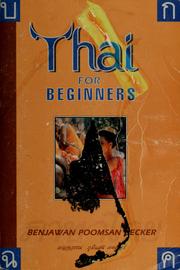
After cracking the script, this book consolidates pronunciation, tones, and everyday vocabulary with audio support. It bridges pure alphabet drilling into usable spoken phrases, so script knowledge becomes immediately functional.
Grammar & Core Vocabulary — Building the Engine
BeginnerUnderstand Thai sentence structure, particles, classifiers, and tense markers; hold basic conversations and construct original sentences.
▸ Study plan for this stage
Pace: 6–8 weeks, ~25–30 pages/day (alternating between both books; ~1 week per major grammar topic)
- Thai sentence structure: Subject-Verb-Object word order and the role of particles (ที่, ว่า, ก็, เพราะ) in clarifying relationships
- Thai classifiers (ตัว, ตัว, คน, เล่ม, ใบ, etc.) and their obligatory use with numbers and demonstratives
- Tense and aspect markers (จะ for future, ได้ for past/ability, กำลัง for progressive, แล้ว for completion) and their positioning
- Personal pronouns and politeness levels (ผม, ดิฉัน, เขา, คุณ) and their social context
- Negation patterns (ไม่, ยัง, ไม่ได้) and their interaction with tense markers
- Question formation using particles (ไหม, หรือ, ใคร, อะไร, ที่ไหน) without subject-auxiliary inversion
- Basic verb patterns and the absence of infinitives; gerunds and nominalization with การ
- Adjectives as verbs and the use of intensifiers (มาก, นิด, เหลือเกิน) in Thai predication
- How does Thai word order differ from English, and what role do particles play in clarifying sentence relationships?
- Why are classifiers mandatory in Thai, and how do you select the correct classifier for a given noun?
- What are the four main tense/aspect markers in Thai, and how do their positions in the sentence change meaning?
- How do you form questions in Thai without inverting word order, and what particles signal different question types?
- What are the three main negation patterns in Thai, and when is each one used?
- How do personal pronouns reflect politeness and social relationships in Thai, and when would you use each one?
- How do adjectives function differently in Thai than in English, and what role do intensifiers play?
- Work through the classifier drills in 'Teach Yourself Thai' (Unit 3–4); create flashcards for 10 common classifiers and practice pairing them with nouns from both books
- Take 5 sentences from 'Thai' by Lexus and diagram their structure, identifying the subject, verb, object, and all particles; rewrite each with different tense markers and note how meaning shifts
- Construct 20 original sentences using the tense markers (จะ, ได้, กำลัง, แล้ว) from the vocabulary in both books; record yourself saying them aloud and listen for natural rhythm
- Write 10 questions using different question particles (ไหม, หรือ, ใคร, อะไร, ที่ไหน) based on sample dialogues in 'Teach Yourself Thai'; practice asking a language partner or tutor
- Create a 'pronoun matrix' showing when to use ผม, ดิฉัน, เขา, คุณ in different social contexts; role-play 3 scenarios (formal, casual, intimate) using the correct pronouns
- Translate 15 English sentences with negation (I don't go, I haven't gone, I'm not going) into Thai, paying attention to the correct negation particle and its position relative to tense markers
Next up: Mastery of these core grammatical structures and vocabulary patterns equips you to move into conversational fluency, where you'll apply these sentence-building blocks to real-world dialogues, listening comprehension, and cultural communication norms.
The most respected concise reference grammar of Thai in English, written by a leading scholar. Reading it cover-to-cover at this stage gives a clear mental map of how Thai works — word order, particles, aspect markers — before bad habits form.
Smyth's course-style companion pairs naturally with his grammar book, providing dialogues, exercises, and vocabulary lists that put the grammar rules into communicative practice. Using the same author back-to-back reinforces consistent terminology.
Self-Study Method & Vocabulary Scaling
IntermediateAdopt a sustainable, evidence-based self-study system using spaced repetition and comprehensible input to push vocabulary toward the 2,000–5,000 word range.
▸ Study plan for this stage
Pace: 6–8 weeks, ~25–30 pages/day (alternating between Fluent Forever and Thai Reference Grammar; expect 2–3 weeks on Fluent Forever, then 3–4 weeks integrating Thai Reference Grammar into active practice)
- Spaced repetition systems (SRS) as the foundation for vocabulary retention and long-term memory encoding
- Comprehensible input principle: consuming Thai content slightly above your current level with context clues and glossing
- Mnemonic imagery and personal connection techniques to anchor vocabulary to memory (Wyner's core method)
- Thai phonetic and tonal foundations from Reference Grammar to ensure accurate pronunciation and recognition in SRS
- Building a sustainable daily habit loop: SRS review (15–20 min) + comprehensible input consumption (20–30 min) + active output practice
- Scaling vocabulary efficiently from 1,500 to 2,000–5,000 words through targeted, frequency-based word selection
- Thai grammar patterns (Reference Grammar) applied to real sentences in your SRS deck, not isolated rules
- How does spaced repetition optimize memory retention, and what are the key intervals Wyner recommends in Fluent Forever?
- What is comprehensible input, and how do you identify Thai content that is appropriately challenging for your current vocabulary level?
- Describe Wyner's mnemonic imagery technique: how do you create a memorable image to anchor a Thai word to long-term memory?
- What are the core Thai phonetic and tonal distinctions covered in Noss's Reference Grammar, and why are they critical for SRS accuracy?
- How do you structure a daily self-study routine that balances SRS review, comprehensible input, and grammar application?
- What are frequency-based word lists, and how do you use them to prioritize which 2,000–5,000 words to learn?
- Create a 50-word SRS deck using Wyner's mnemonic imagery method: for each word, design a vivid, personal image linking the Thai word to its meaning, then add it to Anki or a similar SRS tool
- Audit your current Thai vocabulary: list the 500–1,000 words you already know, then cross-reference against a Thai frequency list (e.g., from Thai corpus data) to identify your next 500 target words
- Select one Thai grammar pattern from Noss's Reference Grammar (e.g., the structure of Thai classifiers or tense markers) and create 10–15 example sentences; add these to your SRS deck with context
- Consume 3–5 pieces of comprehensible Thai input (e.g., children's stories, slow-speech podcasts, or subtitled videos) at your current level; annotate unknown words and add the most frequent ones to your SRS deck
- Build a 2-week daily routine schedule: allocate 15–20 min for SRS review, 20–30 min for comprehensible input, and 10–15 min for grammar-focused output (writing simple sentences or speaking aloud)
- Conduct a spaced repetition audit: review your SRS deck after 1 day, 3 days, 1 week, and 2 weeks; track which words you consistently forget and adjust your mnemonic images or sentence contexts accordingly
Next up: This stage equips you with a self-sustaining system (SRS + comprehensible input + grammar anchoring) and a vocabulary base of 2,000–5,000 words, positioning you to move into the next stage—likely immersive reading or conversation practice—where you will apply these words and patterns to authentic, unsimplified Thai texts and real-world communication.

Wyner's method — building a personal spaced-repetition deck from images and native audio rather than translations — is directly applicable to Thai and prevents the common plateau after textbook study. Read this now, before vocabulary learning becomes a grind.

A deeper, more comprehensive structural grammar originally produced for the Foreign Service Institute. At the intermediate stage it fills gaps left by Smyth, especially on formal registers, complex particles, and written versus spoken Thai distinctions.
Graded Reading & Real Thai
IntermediateRead continuous Thai prose — first graded, then authentic — with a dictionary as the only aid; develop the reading stamina needed for real-world Thai media.
▸ Study plan for this stage
Pace: 8–10 weeks, ~25–35 pages/day (approximately 200–250 pages/week)
- Reading Thai historical narrative prose with minimal external support—building fluency with complex sentence structures, passive constructions, and formal register
- Recognizing and inferring meaning from context when encountering unfamiliar vocabulary, rather than stopping to look up every word
- Understanding Thai historical terminology and proper nouns (place names, royal titles, historical periods) that appear repeatedly throughout the text
- Developing stamina for sustained reading sessions of 45–60 minutes without fatigue or comprehension breakdown
- Distinguishing between essential vocabulary (high-frequency historical terms) and peripheral vocabulary (one-off descriptive words) to optimize dictionary use
- Identifying text structure and narrative patterns in Thai historical writing—chronological progression, cause-and-effect relationships, thematic organization
- Gaining cultural and historical knowledge of Thailand that reinforces vocabulary retention and contextual understanding
- What are the major historical periods covered in 'A History of Thailand,' and what Thai vocabulary and proper nouns are associated with each?
- How does Baker's Thai prose style differ from conversational Thai you may have encountered? What grammatical structures (passive voice, formal particles, complex sentences) appear most frequently?
- Without looking back at the text, summarize a key historical event or transition described in the book in Thai or English—what contextual clues helped you understand it despite unfamiliar words?
- Which historical terms or place names recur throughout the book, and how did your understanding of them deepen as you encountered them multiple times?
- How has your reading speed and comprehension changed from the beginning to the end of the book? What strategies helped you maintain stamina during longer reading sessions?
- What patterns do you notice in how Baker structures explanations of cause-and-effect in Thai historical narrative?
- Read 25–35 pages daily with a Thai-English dictionary as your only reference tool; mark unfamiliar words but attempt to infer meaning from context first before looking them up
- After each reading session (45–60 minutes), write a 1–2 paragraph summary in English of what you read, focusing on main ideas rather than word-for-word translation
- Create a running glossary of recurring historical terms, place names, and royal titles as they appear; note the page where you first encounter each and how your understanding evolves
- Every 50 pages, pause and re-read a section from 10–15 pages earlier without consulting your notes; measure how much more smoothly and quickly you can read it now
- Select one 2–3 page section per week and read it aloud, focusing on natural pacing and intonation; record yourself to identify where you stumble or lose comprehension
- After finishing the book, write a 500–750 word reflection in Thai (or English, then translate key sections to Thai) on a historical theme or period that interested you most
Next up: Completing 'A History of Thailand' equips you with the stamina, vocabulary density, and cultural context needed to transition to other authentic Thai media—whether contemporary news articles, essays, or literary works—where you'll apply the same dictionary-light reading strategy to increasingly varied and less historically-focused prose.

Reading a serious, content-rich book about Thailand in English at this stage deepens cultural and historical context, making authentic Thai texts — news, literature, signs — far more interpretable. Cultural literacy is inseparable from true language fluency.
Discussion
Keep reading
Paths that share books, cover the same subject, or open a related topic.