Learn Quantum Field Theory: The Best Books, in Order
This curriculum is designed for expert-level learners who already have a strong foundation in quantum mechanics, classical field theory, and advanced mathematics. The path moves from the physical and conceptual underpinnings of QFT through canonical quantization and Feynman diagrams, into renormalization and the full machinery of gauge theories, and finally into the modern geometric and non-perturbative perspectives that define cutting-edge theoretical physics.
Conceptual & Structural Foundations
IntermediateSolidify the physical intuition behind fields, particles, and second quantization, and establish the conceptual bridge from quantum mechanics to quantum field theory before diving into formalism.
▸ Study plan for this stage
Pace: 4–5 weeks, ~25–30 pages/day (focusing on Parts I–II and early Part III of Zee's Nutshell)
- Fields as fundamental objects: why we move from particles to fields as the primary ontology in relativistic quantum mechanics
- Second quantization: reinterpreting the quantum harmonic oscillator as a field with creation and annihilation operators
- Particle-field duality: how particles emerge as excitations (quanta) of underlying fields
- Symmetries and conservation laws: how global and local symmetries constrain field dynamics and lead to interactions
- Path integrals and functional methods: the conceptual shift from operator formalism to sum-over-histories thinking
- Effective field theory perspective: understanding why QFT works as a low-energy effective description without requiring fundamental UV completion
- Renormalization intuition: why infinities arise and how they reflect the theory's effective nature rather than physical pathology
- Coupling constants and running: how interaction strengths depend on the energy scale at which they are measured
- Why is a field-based description necessary for relativistic quantum mechanics, and what problems does it solve that particle-based quantum mechanics cannot?
- Explain second quantization: how does reinterpreting the quantum harmonic oscillator as a field lead to the concept of creation and annihilation operators, and what do they physically represent?
- What is the relationship between a quantum field and particles? How do particles emerge as excitations of fields, and what does the vacuum state represent?
- How do symmetries (global and local) constrain the form of field Lagrangians, and what is the connection between symmetries and conservation laws?
- What is the path integral formulation, and how does it provide an alternative conceptual framework to operator-based quantization?
- What does it mean to say QFT is an effective field theory, and why does this perspective help us understand renormalization and infinities?
- Work through the harmonic oscillator in quantum mechanics, then reinterpret it as a scalar field in 1+1 dimensions: derive the commutation relations for creation/annihilation operators and verify they satisfy the canonical commutation relations
- Construct a simple Lagrangian density for a free scalar field, derive the Euler–Lagrange equations of motion, and identify the dispersion relation; repeat for a massive field
- Calculate the vacuum energy of a free scalar field using the zero-point energy of infinitely many harmonic oscillators; discuss why this is infinite and what it means physically
- Explore a global U(1) symmetry: write down a Lagrangian with this symmetry, identify the conserved current using Noether's theorem, and interpret the conserved charge
- Set up and evaluate a simple path integral for a free particle in quantum mechanics (1D); then sketch how this generalizes to fields and explain the conceptual advantages
- Read and summarize Zee's discussion of renormalization in the context of the Coulomb potential or a simple scalar theory; explain why infinities appear and how effective field theory resolves the concern
Next up: This stage equips you with the conceptual scaffolding and physical intuition needed to tackle the technical machinery of perturbation theory, Feynman diagrams, and loop calculations, which form the practical computational heart of QFT.

Zee builds physical intuition for why QFT is the way it is — from the path integral to spin statistics — with wit and clarity. Reading this first gives expert learners a bird's-eye map of the entire subject before the technical machinery takes over.
Core Formalism: Feynman Diagrams & Renormalization
ExpertMaster the canonical and path-integral approaches to QFT, learn to compute S-matrix elements and cross-sections using Feynman diagrams, and understand perturbative renormalization at one and higher loops.
▸ Study plan for this stage
Pace: 12–14 weeks, ~40–50 pages/day (Peskin chapters 2–7, then Srednicki chapters 5–6, 9–13, 16–18)
- Canonical quantization of scalar, spinor, and vector fields; creation/annihilation operators and the Fock space structure
- Path-integral formulation of QFT and the generating functional Z[J]; equivalence with canonical quantization
- Feynman diagrams as a systematic perturbative expansion; Feynman rules for vertices, propagators, and external legs
- S-matrix elements, LSZ reduction formula, and the connection between correlation functions and scattering amplitudes
- One-loop and higher-loop Feynman diagram calculations; loop integrals and dimensional regularization
- Renormalization: divergences, counterterms, and the renormalization group; running coupling constants
- Physical vs. bare parameters; renormalization schemes (minimal subtraction, on-shell) and their interpretation
- How do creation and annihilation operators encode the excitations of a quantum field, and what is the physical meaning of the Fock space?
- Derive the path-integral representation of the partition function Z[J] for a scalar field and explain why it reproduces canonical quantization results.
- State the Feynman rules for a given theory (e.g., φ⁴ or QED) and use them to compute the amplitude for a specific tree-level process.
- What is the LSZ reduction formula and how does it connect n-point correlation functions to S-matrix elements?
- Calculate a one-loop diagram (e.g., box, triangle, or bubble integral) using dimensional regularization and extract the divergent structure.
- Explain the origin of ultraviolet divergences in loop diagrams and how renormalization removes them via counterterms.
- How does the renormalization group equation describe the running of coupling constants, and what is the physical significance of the beta function?
- Work through Peskin & Schroeder's detailed derivation of the canonical commutation relations for a free scalar field (Chapter 2) and verify them explicitly for a few modes.
- Compute the two-point correlation function ⟨0|T{φ(x)φ(y)}|0⟩ using both canonical quantization and the path integral; verify they agree.
- Derive the Feynman rules for φ⁴ theory from scratch using the path integral and the interaction picture; cross-check against Peskin Chapter 4.
- Calculate the tree-level amplitude for φ + φ → φ + φ scattering in φ⁴ theory using Feynman diagrams and verify dimensional analysis.
- Compute a one-loop box diagram (e.g., φ + φ → φ + φ at one loop) in d = 4 − 2ε dimensions; extract the pole structure and identify the counterterm needed.
- Work through a complete renormalization calculation for φ⁴ theory at one loop: compute the vertex correction, identify divergences, apply a renormalization scheme (MS or on-shell), and verify the result against Srednicki Chapter 16.
- Derive the one-loop beta function for φ⁴ theory using the renormalization group equation; interpret the sign and discuss asymptotic freedom or infrared slavery.
- Solve the renormalization group equation to find the running coupling α(μ) and plot it as a function of energy scale; discuss the physical interpretation.
Next up: This stage equips you with the technical machinery to compute observable predictions (cross-sections, decay rates) in realistic theories; the next stage will apply these tools to the Standard Model and explore non-perturbative phenomena, effective field theories, and modern computational techniques.
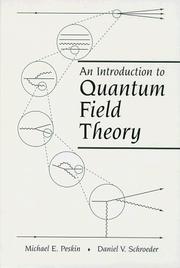
Peskin & Schroeder is the standard graduate workhorse: it covers canonical quantization, the LSZ formalism, Feynman rules, QED calculations, and renormalization in a systematic and problem-rich way. It is the essential technical backbone of any serious QFT curriculum.
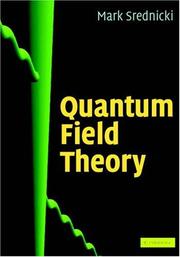
Srednicki's path-integral-first approach and bite-sized chapter structure complement Peskin perfectly, reinforcing renormalization and spin-statistics from a different angle and filling gaps with exceptional clarity on the LSZ reduction and functional methods.
Gauge Theories & the Standard Model
ExpertDevelop full command of non-Abelian gauge theories, spontaneous symmetry breaking, the Higgs mechanism, BRST quantization, and the structure of the Standard Model of particle physics.
▸ Study plan for this stage
Pace: 12–14 weeks, ~40–50 pages/day (Weinberg Vol. 2: weeks 1–8, ~45 pages/day; Cheng: weeks 9–14, ~40 pages/day)
- Non-Abelian gauge symmetries: SU(2) and SU(3) structure, Lie algebras, and commutation relations
- Covariant derivatives, field strength tensors, and gauge-covariant formulations for non-Abelian theories
- Spontaneous symmetry breaking: vacuum expectation values, Goldstone's theorem, and the Higgs mechanism
- Electroweak unification: SU(2)×U(1) gauge structure, weak isospin, hypercharge, and the Weinberg angle
- BRST symmetry and ghost fields: quantization of gauge theories and the path integral formalism
- QCD and SU(3) color gauge theory: asymptotic freedom, confinement, and running coupling constants
- The Standard Model Lagrangian: fermion representations, Yukawa couplings, and CKM matrix
- Renormalization in gauge theories: divergences, counterterms, and beta functions in non-Abelian theories
- Explain the structure of non-Abelian gauge theories: how do covariant derivatives and field strength tensors differ from Abelian QED, and why is this difference crucial?
- Derive the Higgs mechanism from first principles: how does spontaneous symmetry breaking in an SU(2)×U(1) gauge theory generate masses for W and Z bosons while keeping the photon massless?
- What is the role of BRST symmetry in quantizing non-Abelian gauge theories, and how do ghost fields ensure unitarity in the path integral?
- Describe the Standard Model gauge structure: what are the quantum numbers (weak isospin, hypercharge) of leptons and quarks, and how do they fit into SU(2)×U(1)?
- How does asymptotic freedom emerge in QCD, and what does the running coupling constant tell us about the behavior of the strong force at different energy scales?
- Write down the Standard Model Lagrangian and identify each term; explain the physical significance of Yukawa couplings and the CKM matrix.
- Compute the commutation relations for SU(2) and SU(3) generators; verify the structure constants and construct the Casimir operators.
- Derive the covariant derivative and field strength tensor for an SU(2) gauge theory; show how the non-Abelian structure introduces self-interactions absent in QED.
- Work through the Higgs mechanism in SU(2)×U(1): start with the Lagrangian, identify the vacuum expectation value, and calculate the masses of W, Z, and photon.
- Construct the Standard Model fermion representations: assign leptons and quarks to SU(2) doublets and singlets, compute their hypercharges from the Gell-Mann–Nishijima formula.
- Perform a one-loop renormalization calculation in a non-Abelian gauge theory (e.g., compute the beta function for SU(2) Yang–Mills); compare with QED.
- Solve for the running coupling constant α_s(Q²) in QCD using the renormalization group equation; sketch how asymptotic freedom manifests at high and low energies.
Next up: Mastery of the Standard Model's gauge structure and quantization methods now positions you to explore physics beyond the Standard Model—supersymmetry, grand unification, and anomalies—or to deepen your understanding of precision electroweak tests and collider phenomenology.
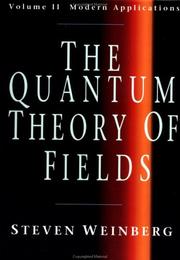
Weinberg's second volume is the definitive treatment of non-Abelian gauge theories, spontaneous symmetry breaking, and the path to the Standard Model, written by one of its architects. It deepens everything learned in Vol. 1 with full rigor.

Cheng & Li provides a highly practical and explicit treatment of gauge theories and the Standard Model with worked calculations, making it the ideal companion to Weinberg's more formal Vol. 2 for cementing computational fluency.
Renormalization Group & Non-Perturbative Methods
ExpertUnderstand the Wilsonian renormalization group, effective field theories, anomalies, instantons, and the deeper non-perturbative structure of quantum field theories.
▸ Study plan for this stage
Pace: 8–10 weeks, ~40–50 pages/day (Zinn-Justin first 3–4 weeks; Coleman 4–5 weeks; overlap and review 1–2 weeks)
- Wilsonian renormalization group: block-spin transformations, flow equations, and the conceptual shift from perturbative to non-perturbative thinking
- Effective field theories: matching, decoupling, and the power of working with low-energy degrees of freedom
- Fixed points and critical phenomena: scaling behavior, universality classes, and the connection to phase transitions
- Symmetries and anomalies: classical vs. quantum symmetries, the axial anomaly, and implications for conservation laws
- Instantons and topological effects: non-perturbative tunneling, theta-vacua, and the structure of the QCD vacuum
- Non-perturbative methods: large-N limits, 1/N expansions, and semi-classical approximations beyond loop diagrams
- Asymptotic freedom and infrared slavery: running couplings, beta functions, and the physical meaning of renormalization group flows
- Symmetry breaking and the effective potential: how to extract non-perturbative information from the effective action
- Explain the Wilsonian renormalization group procedure: how does integrating out high-momentum modes lead to a flow equation for the effective coupling?
- What is an effective field theory, and why is it justified to neglect heavy degrees of freedom when computing low-energy observables?
- Describe the relationship between renormalization group fixed points and critical phenomena; what do scaling exponents tell us about universality?
- What is the axial anomaly? Why does the classical U(1)_A symmetry not survive quantization, and what are the physical consequences?
- How do instantons contribute to the QCD vacuum structure? Explain the role of the theta parameter and why θ ≈ 0 empirically.
- What is meant by asymptotic freedom, and how does it emerge from the running of the strong coupling constant in QCD?
- Compare perturbative and non-perturbative approaches to QFT: when is each appropriate, and what does the 1/N expansion reveal about gauge theories?
- Work through Zinn-Justin's derivation of the Wilsonian RG equations for a scalar field theory; reproduce the beta function at one loop and verify scaling dimensions.
- Compute the running of the coupling constant in φ⁴ theory and λϕ⁶ theory using the RG flow; identify fixed points and determine their stability.
- Perform a matching calculation: integrate out a heavy scalar field from a theory and derive the effective coupling in the low-energy theory; check that observables agree above and below the matching scale.
- Calculate the axial anomaly in QED using the path integral or triangle diagram; verify the divergence of the axial current and relate it to the topological charge.
- Study Coleman's treatment of instantons: compute the instanton action in a simple model (e.g., double-well potential or Yang–Mills), and estimate the tunneling amplitude.
- Analyze the effective potential in a theory with spontaneous symmetry breaking; use the RG to understand how the potential flows and how to extract the vacuum expectation value non-perturbatively.
- Solve a simple large-N model (e.g., O(N) sigma model or matrix model) and compare the 1/N expansion to perturbation theory; identify which observables are captured at leading order.
- Examine a concrete example of asymptotic freedom: derive the beta function for non-Abelian gauge theory and show that α_s(Q²) → 0 as Q² → ∞.
Next up: Mastery of the renormalization group, effective field theories, and non-perturbative methods provides the conceptual and technical foundation for understanding modern applications—such as the Standard Model at high precision, lattice QCD simulations, and the role of symmetries in particle physics—preparing you to engage with specialized topics like electroweak symmetry breaking, strong dynamics, a

Zinn-Justin is the most thorough reference on the path integral, renormalization group, and functional methods, connecting QFT to statistical mechanics and critical phenomena. It is indispensable for mastering the RG at a deep level.
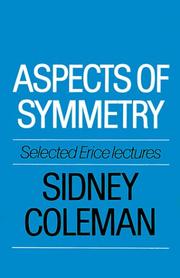
Coleman's legendary Erice lectures cover instantons, the 1/N expansion, and the uses of symmetry in QFT with unmatched physical insight. Reading Coleman is essential for understanding non-perturbative phenomena and the lore of the field.
Modern Geometric & Advanced Perspectives
ExpertEngage with the modern mathematical structures underlying QFT — including topological field theory, anomalies, and the geometry of gauge fields — to reach the frontier of theoretical physics.
▸ Study plan for this stage
Pace: 12–16 weeks, ~40–50 pages/day (Weinberg Vol. 3: 8–10 weeks; Mirror Symmetry: 4–6 weeks)
- Topological field theory (TFT) and its role in understanding global structures and anomalies in QFT
- Anomalies: gravitational, gauge, and mixed anomalies; their geometric interpretation and cancellation conditions
- Gauge field geometry: principal bundles, connections, curvature, and characteristic classes as physical observables
- Effective field theory and the renormalization group from a modern geometric perspective
- Mirror symmetry as a duality between Kähler and complex moduli spaces; A-model and B-model formulations
- Derived categories, D-branes, and homological mirror symmetry as tools for understanding quantum geometry
- Supersymmetry and supersymmetric field theories as a bridge between classical geometry and quantum physics
- Instanton calculus and non-perturbative effects in gauge theories via geometric methods
- What is a topological field theory, and how do anomalies constrain the consistency of quantum field theories?
- Explain the geometric meaning of gauge field connections and curvature; how do characteristic classes encode physical information?
- What is mirror symmetry, and how does it relate the A-model and B-model formulations of topological string theory?
- How do derived categories and D-branes provide a homological perspective on mirror symmetry?
- Describe the role of supersymmetry in making geometric structures manifest in quantum field theory.
- What is the relationship between instanton solutions and non-perturbative effects in gauge theories?
- Work through Weinberg Vol. 3's treatment of anomalies: compute the triangle anomaly diagram for a specific gauge group and verify anomaly cancellation using characteristic classes.
- Construct a principal U(1) bundle over S² and explicitly compute the connection and curvature forms; relate the first Chern number to the magnetic monopole charge.
- Study the topological field theory structure of Chern–Simons theory: compute partition functions and link invariants for simple knots.
- Work through Mirror Symmetry chapters on A-model and B-model: compute Gromov–Witten invariants for a simple Calabi–Yau manifold and verify mirror predictions.
- Derive the Picard–Fuchs equation for the mirror family and solve it to extract genus-zero instanton numbers.
- Analyze a supersymmetric gauge theory (e.g., N=4 SYM or N=2 SYM): compute the prepotential and relate it to the geometry of the Coulomb branch using mirror symmetry insights.
Next up: This stage equips you with the modern geometric language—topological structures, anomalies, mirror symmetry, and derived categories—that form the foundation for understanding contemporary developments in quantum gravity, string theory dualities, and higher categorical structures in physics.
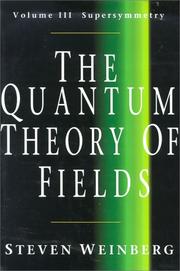
Weinberg's third volume extends the gauge theory framework to supersymmetry, one of the most important structural extensions of QFT, and rounds out the trilogy into a complete and self-consistent treatment of modern field theory.

This Clay Mathematics Institute volume bridges QFT and modern mathematics — covering topological field theories, sigma models, and string-inspired dualities — exposing the reader to the geometric frontier where QFT and pure mathematics meet.
Discussion
Keep reading
Paths that share books, cover the same subject, or open a related topic.