Particle physics: a reading path from atoms to the Standard Model
This curriculum takes an intermediate learner from a solid conceptual grounding in particle physics all the way through the mathematical structure of the Standard Model and cutting-edge open questions. Each stage builds directly on the last: first sharpening intuition and historical context, then mastering the core theoretical framework, and finally confronting the experimental frontier and physics beyond the Standard Model.
Foundations & Physical Intuition
IntermediateBuild a confident, experiment-grounded picture of quarks, leptons, and the four forces before touching formalism — establishing the vocabulary and physical intuition needed for everything that follows.
▸ Study plan for this stage
Pace: 8–10 weeks, ~40–50 pages/day (with 2–3 reflection days per week). Close: 3 weeks (~25 pages/day); Ford: 3 weeks (~35 pages/day); Fritzsch: 2–3 weeks (~40 pages/day).
- The Standard Model's particle zoo: quarks (up, down, charm, strange, top, bottom), leptons (electron, muon, tau, neutrinos), and their antiparticles—what they are and why we need them
- The four fundamental forces (strong, weak, electromagnetic, gravity) and their relative strengths, ranges, and roles in binding or decaying particles
- Symmetry and conservation laws (charge, baryon number, lepton number, strangeness) as the language underlying particle interactions and decay modes
- Quarks as confined constituents of hadrons (protons, neutrons, pions, kaons); color charge and why quarks cannot be isolated
- The experimental evidence trail: from cosmic rays and accelerators to the discovery of new particles, showing how theory and experiment co-evolve
- Antiparticles and matter–antimatter asymmetry as a profound open question hinting at physics beyond the Standard Model
- Quantum numbers (spin, parity, strangeness, charm, beauty) as labels that organize the particle spectrum and predict allowed interactions
- The conceptual bridge from classical forces to quantum field theory: why particles are excitations, not tiny balls
- What are the six quarks and six leptons in the Standard Model, and how do they differ in mass, charge, and interaction strength?
- Explain the four fundamental forces: which particles mediate each, what is their relative strength, and why is gravity so weak compared to the others?
- Why can't quarks be observed as free particles, and what does 'color confinement' mean in simple terms?
- How do conservation laws (charge, baryon number, lepton number, strangeness) constrain which particle decays and interactions are allowed?
- What is the evidence that quarks exist, and how did experiments (cosmic rays, accelerators, deep inelastic scattering) reveal them?
- What is antimatter, and why is the matter–antimatter asymmetry of the universe a puzzle the Standard Model cannot fully explain?
- Build a particle classification chart: organize all quarks and leptons by generation, mass, charge, and spin; note which are stable and which decay, and to what.
- Decay-mode detective work: given a particle (e.g., muon, kaon, neutron), use conservation laws to predict or explain its decay products; verify against data in the books.
- Force comparison table: for each of the four forces, list the mediating particle (photon, W/Z, gluon, graviton), range, strength relative to electromagnetism, and one example interaction.
- Cosmic ray timeline: trace the historical discovery of particles (positron, muon, kaon, strange particles, charm, bottom, top) using Close's narrative; note what each discovery revealed about nature.
- Quark model puzzle: given a hadron (proton, neutron, pion, kaon), identify its quark content and predict its quantum numbers (charge, baryon number, strangeness); check against known values.
- Symmetry and selection rules: write out 3–4 allowed and forbidden particle decays, explaining which conservation law permits or forbids each using quantum numbers from the books.
Next up: This stage equips you with the experimental facts, particle vocabulary, and physical intuition about forces and symmetries that the next stage will formalize into quantum field theory and the mathematical machinery of the Standard Model.
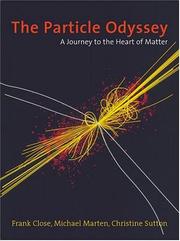
A richly illustrated, historically organized tour of how particles were discovered one by one; perfect for an intermediate reader to anchor abstract names (pion, muon, quark) to real experimental moments.
Bridges everyday quantum mechanics to particle physics concepts — spin, antimatter, exchange forces — giving the reader the quantum vocabulary they will need before tackling field theory.

Written by one of the architects of QCD, this accessible book explains the quark model and color charge with physical clarity, directly preparing the reader for the gauge-theory stage ahead.
The Standard Model — Concepts & Structure
IntermediateUnderstand the full logical architecture of the Standard Model — gauge symmetries, the electroweak unification, QCD, and the Higgs mechanism — at a level that connects equations to physical meaning.
▸ Study plan for this stage
Pace: 8–10 weeks, ~40–50 pages/day (with 2–3 days per week for review and exercises). Week 1–2: Coughlan (foundational concepts); Week 3–5: Schumm (detailed mechanics); Week 6–8: Baggott (Higgs mechanism synthesis); Week 9–10: integration and problem-solving.
- Gauge symmetries (U(1), SU(2), SU(3)) as the organizing principle of the Standard Model — why local symmetries demand force carriers
- The electroweak unification: how electromagnetic and weak forces merge at high energies through SU(2)×U(1) symmetry breaking
- Quantum Chromodynamics (QCD): color charge, gluons, asymptotic freedom, and confinement as consequences of SU(3) gauge theory
- The Higgs mechanism: how spontaneous symmetry breaking generates mass for W/Z bosons and fermions while preserving gauge invariance
- Fermion families and the Standard Model particle content: quarks, leptons, and their quantum numbers under the gauge groups
- Running coupling constants and the renormalization group: how coupling strengths evolve with energy scale
- Experimental signatures: how the three forces and Higgs mechanism manifest in collider physics and precision measurements
- What is a gauge symmetry, and why does requiring local gauge invariance necessitate the existence of force-carrying bosons?
- Explain the electroweak unification: how do the electromagnetic and weak interactions emerge from a single SU(2)×U(1) symmetry, and what role does the Higgs field play?
- What is spontaneous symmetry breaking, and how does it differ from explicit symmetry breaking? Give the Higgs mechanism as an example.
- Describe QCD: what is color charge, how do gluons interact, and what is asymptotic freedom? Why does confinement occur?
- How do the three coupling constants of the Standard Model (electromagnetic, weak, strong) evolve with energy, and what does this tell us about unification?
- What is the physical meaning of the Higgs field, and how does its vacuum expectation value generate mass for particles while preserving gauge symmetry?
- After Coughlan: Create a concept map linking gauge symmetries → force carriers → Standard Model structure. Identify which symmetry group governs each fundamental force.
- Work through Schumm's derivations of how the W and Z boson masses arise from electroweak symmetry breaking; verify dimensional analysis and Higgs coupling relationships.
- Solve 3–4 problems on QCD: calculate color charge combinations, trace gluon interactions in simple Feynman diagrams, and explain why quarks cannot be isolated.
- Construct a table comparing U(1), SU(2), and SU(3): list generators, number of gauge bosons, coupling constants, and physical manifestations for each.
- After Baggott: Write a 2–3 page synthesis explaining how the Higgs mechanism unifies the weak and electromagnetic forces—connect the mathematics to experimental discovery.
- Sketch Feynman diagrams for key processes: electron-positron annihilation to Z boson, quark-gluon scattering, and Higgs production via gluon fusion. Label all quantum numbers.
Next up: This stage establishes the complete mathematical and conceptual framework of the Standard Model, preparing you to explore its limitations—beyond-Standard-Model physics, grand unification, supersymmetry, and quantum gravity—in the next stage.
A concise, semi-quantitative overview of the entire Standard Model written for readers with some physics background; serves as the ideal conceptual map before diving into deeper texts.
Unusually rigorous for a popular text, this book carefully explains Lie groups, gauge invariance, and spontaneous symmetry breaking — the mathematical spine of the Standard Model — without requiring graduate coursework.

Focuses the Higgs mechanism and its 2012 experimental discovery at the LHC, tying together the theoretical threads from the previous books and grounding them in a landmark real experiment.
Rigorous Theory — Quantum Field Theory & Gauge Physics
ExpertDevelop working knowledge of quantum field theory, Feynman diagrams, renormalization, and the gauge theories (QED, QCD, electroweak) that constitute the Standard Model at a graduate-introductory level.
▸ Study plan for this stage
Pace: 12–14 weeks, ~40–50 pages/day (Peskin: 8–9 weeks, ~50 pages/day for Chapters 1–7; Aitchison: 4–5 weeks, ~40 pages/day for Chapters 1–6)
- Canonical quantization of scalar and spinor fields: creation/annihilation operators, Fock space, and the connection between particles and field excitations
- Interacting field theory and perturbation theory: interaction Hamiltonian, time-ordered products, and the S-matrix formalism
- Feynman diagrams as computational tools: vertices, propagators, external legs, and momentum conservation; translation between diagrams and amplitude calculations
- Renormalization and effective field theory: loop divergences, counterterms, running coupling constants, and the renormalization group
- Gauge invariance and local symmetry: U(1), SU(2), and SU(3) gauge groups; covariant derivatives and minimal coupling
- Quantum Electrodynamics (QED): Dirac equation, electron-photon interactions, one-loop corrections, and physical observables (anomalous magnetic moment, Lamb shift)
- Quantum Chromodynamics (QCD): color charge, gluon self-interactions, asymptotic freedom, and confinement phenomenology
- Electroweak unification: spontaneous symmetry breaking, Higgs mechanism, W and Z bosons, and fermion mass generation
- Explain the difference between classical and quantum fields, and how particle states emerge as excitations of the quantum vacuum in the Fock space formalism.
- Derive or explain the relationship between a Feynman diagram and the corresponding amplitude; what do vertices, propagators, and loops represent mathematically?
- What is renormalization, why is it necessary in QFT, and how do counterterms and the renormalization group address divergences in loop integrals?
- Describe the role of gauge invariance in constructing QED and QCD; how does the requirement of local U(1) and SU(3) symmetry determine the form of interactions?
- Calculate or explain a one-loop QED process (e.g., electron self-energy or vertex correction) and interpret its physical significance.
- What is the Higgs mechanism and how does it generate masses for gauge bosons and fermions in the electroweak theory?
- Work through Peskin's canonical quantization of the free scalar field (Chapter 2): derive the commutation relations, construct creation/annihilation operators, and verify the Fock space structure.
- Compute 2→2 scattering amplitudes at tree level for φ⁴ theory and e⁺e⁻ → μ⁺μ⁻ in QED using Feynman rules; check dimensional analysis and crossing symmetry.
- Draw all Feynman diagrams for a given process (e.g., electron-electron scattering at one loop) and identify which diverge; classify divergences as UV or IR.
- Perform a one-loop calculation in QED (e.g., electron self-energy or photon vacuum polarization): regulate divergences using dimensional regularization, extract counterterms, and compute the running coupling.
- Verify gauge invariance explicitly for a QED amplitude by checking that the amplitude vanishes when external photon polarization is replaced by its four-momentum.
- Solve the renormalization group equations for the running coupling constant in QED and QCD; plot the coupling as a function of energy scale and interpret asymptotic freedom.
Next up: This stage establishes the mathematical and conceptual foundation of the Standard Model, equipping you to move into phenomenological applications—precision tests, collider physics, and beyond-Standard-Model extensions—where you will apply these tools to real experimental data and theoretical predictions.
The canonical graduate QFT textbook; starting here after the conceptual stages means the reader arrives with enough intuition to absorb path integrals, Feynman rules, and renormalization without being lost from page one.

Specifically focused on the gauge theories of the Standard Model (QED, QCD, electroweak) with explicit worked examples; complements Peskin by keeping the physics of real particles always in view.
Experiments, Detectors & the LHC Era
ExpertUnderstand how particle physics is actually done — accelerator design, detector technology, data analysis — and appreciate how the theoretical Standard Model is tested and measured in practice.
▸ Study plan for this stage
Pace: 8–10 weeks, ~25–30 pages/day (mix of Griffiths' technical chapters and Halpern's narrative sections)
- Accelerator physics fundamentals: how particles are accelerated, collided, and why higher energies reveal new physics
- Detector architecture and function: tracking systems, calorimeters, muon chambers, and how they reconstruct particle events
- The Standard Model as an experimental framework: how symmetries, conservation laws, and quantum numbers constrain what we observe
- Event reconstruction and data analysis: from raw detector signals to identifying particle decays and measuring cross-sections
- The LHC as a discovery machine: design choices, collision geometry, and how experiments like ATLAS and CMS work in practice
- Systematic and statistical uncertainties: how physicists quantify confidence in measurements and distinguish signal from background
- Historical context of detector evolution: bubble chambers → electronic detectors → modern silicon tracking, showing why current designs exist
- How does increasing collision energy in an accelerator allow physicists to probe shorter distance scales and discover new particles?
- Describe the main subsystems of a modern particle detector (tracking, calorimetry, muon identification) and explain what physics each measures.
- Why is the Higgs boson difficult to detect directly, and how do the ATLAS and CMS experiments overcome this challenge?
- What is a 'background' in particle physics, and how do physicists distinguish a real signal (e.g., a new particle decay) from background noise?
- Explain the role of symmetries and conservation laws (energy, momentum, charge, flavor) in constraining particle interactions and decays.
- How do systematic uncertainties (detector calibration, energy scale, efficiency) differ from statistical uncertainties, and why do both matter for discovery claims?
- Work through Griffiths' problems on cross-sections and decay widths (Chapters 6–7) to build intuition for how collision rates scale with energy and coupling strength.
- Sketch a detector layout (tracking → calorimeter → muon system) and trace the path of a simulated Z → e⁺e⁻ decay event, identifying what each detector layer records.
- Using a real or simulated dataset (e.g., from the CERN Open Data portal or a simplified Monte Carlo), reconstruct the invariant mass of a two-lepton system and identify the Z boson peak above background.
- Calculate the expected number of Higgs → γγ events at the LHC given a production cross-section, branching ratio, detector efficiency, and integrated luminosity.
- Read a simplified ATLAS or CMS physics paper (e.g., a measurement of the W boson mass or top quark properties) and extract: the signal process, background sources, systematic uncertainties, and final result.
- Create a flowchart showing how a high-energy collision event flows from the accelerator through detector subsystems to final data storage, labeling energy losses and information bottlenecks.
Next up: This stage grounds you in the experimental reality of particle physics, equipping you to critically evaluate how theoretical predictions (from the Standard Model or beyond) are tested against real data—preparing you to engage with modern searches for physics beyond the Standard Model and advanced topics like precision measurements and rare decays.

The most widely used undergraduate particle physics textbook; read at this stage it consolidates theory with concrete cross-section calculations and decay rates that mirror what experimentalists actually measure.

A readable, accurate account of the LHC's construction, the experiments (ATLAS, CMS), and the search for the Higgs — connecting the abstract Standard Model directly to the world's largest scientific instrument.
Beyond the Standard Model — Open Frontiers
ExpertEngage seriously with the known failures of the Standard Model — neutrino masses, dark matter, matter-antimatter asymmetry, gravity — and the leading theoretical proposals that attempt to go beyond it.
▸ Study plan for this stage
Pace: 8–10 weeks, ~40–50 pages/day (accounting for dense theoretical content and re-reading passages)
- The hierarchy problem: why the Higgs mass is unnaturally small and what mechanisms might stabilize it
- Neutrino masses and oscillations: experimental evidence, mass generation mechanisms (seesaw models), and implications for physics beyond the Standard Model
- Dark matter as a fundamental particle: WIMP candidates, axions, and how supersymmetry provides natural dark matter candidates
- Matter-antimatter asymmetry (baryogenesis): CP violation, leptogenesis, and why the universe contains matter rather than equal amounts of antimatter
- Supersymmetry (SUSY) as a unifying framework: superpartners, gauge coupling unification, naturalness, and the minimal supersymmetric standard model (MSSM)
- Electroweak symmetry breaking and the role of the Higgs mechanism in both the Standard Model and beyond
- Coupling unification and grand unified theories (GUTs): how SUSY enables precision unification at high scales
- Cosmological implications of beyond-SM physics: inflation, dark energy, and connections to particle physics
- What is the hierarchy problem, and why do naturalness arguments suggest new physics must exist near the TeV scale?
- How do neutrino oscillations prove that neutrinos have mass, and what are the main mechanisms proposed to generate neutrino masses?
- What observational evidence points to dark matter, and how do supersymmetric theories naturally provide dark matter candidates?
- Explain the matter-antimatter asymmetry problem: why is it a problem, and what are the leading theoretical explanations (e.g., leptogenesis)?
- What is supersymmetry, and how does it address key problems in the Standard Model (hierarchy problem, coupling unification, dark matter)?
- How do the running of gauge couplings and their unification differ between the Standard Model and supersymmetric extensions?
- Map out the Standard Model's known failures: create a table listing each problem (hierarchy, neutrino masses, dark matter, matter-antimatter asymmetry, gravity), the experimental evidence for each, and the theoretical challenges it poses.
- Work through a simplified calculation of the Higgs mass in the Standard Model versus SUSY: show how quadratic divergences appear in the SM and how they cancel in SUSY (use dimensional analysis and loop-counting arguments).
- Diagram the particle content of the MSSM: draw the superpartners for each Standard Model particle and label their quantum numbers; explain why each superpartner is necessary for consistency.
- Analyze neutrino oscillation data: using the mixing matrix formalism, calculate oscillation probabilities for electron, muon, and tau neutrinos; discuss what mass hierarchies the data favor.
- Research and summarize one specific dark matter candidate (e.g., neutralino, axion, or sterile neutrino): write a 2–3 page summary of its properties, how it arises in beyond-SM theories, and current experimental search strategies.
- Construct a coupling unification diagram: plot the running of α₁, α₂, and α₃ in both the Standard Model and MSSM; explain why SUSY improves unification and what this suggests about GUTs.
Next up: This stage establishes the theoretical landscape of beyond-SM physics and the main candidates (SUSY, dark matter, neutrino physics) that will be explored in greater depth in subsequent stages, preparing readers to engage with more specialized topics like specific GUT models, string theory connections, or experimental searches at colliders and in cosmology.

Nobel laureate Wilczek explores the deep structure of QCD and mass, and speculates on supersymmetry and unification — a beautifully written bridge from mastered theory to open questions.

A clear, expert-authored introduction to supersymmetry — the most studied extension of the Standard Model — covering the theoretical motivation and the experimental signatures being hunted at the LHC.
Discussion
Keep reading
Paths that share books, cover the same subject, or open a related topic.