Learn Plasma Physics: The Best Books, in Order
This curriculum is designed for expert-level learners who already have strong physics and mathematics backgrounds. It begins with the canonical theoretical and kinetic foundations of plasma physics, then advances through magnetohydrodynamics, waves, and instabilities, before branching into the three major application domains: magnetic confinement fusion, astrophysical plasmas, and laboratory/experimental plasmas. Each stage builds the conceptual and mathematical machinery required for the next.
Canonical Foundations
ExpertMaster the core theoretical framework of plasma physics: single-particle motion, kinetic theory, fluid descriptions, Debye shielding, plasma waves, and the Vlasov–Maxwell system — the shared language of every subfield.
▸ Study plan for this stage
Pace: 8–10 weeks, ~40–50 pages/day from Chen, then 2–3 weeks of simulation work with Birdsall (~20 pages/day theory review + 10–15 hours/week hands-on coding)
- Single-particle motion in electric and magnetic fields: guiding center approximation, cyclotron motion, drift velocities (E×B, gradient, curvature), adiabatic invariants
- Kinetic theory and distribution functions: the Vlasov equation, collisionless plasma dynamics, phase-space structure, and the connection to macroscopic observables
- Debye shielding and plasma parameter: screening length, quasi-neutrality, the Debye sphere, and the criterion for plasma behavior
- Plasma waves and dispersion relations: ion-acoustic, Langmuir, and electromagnetic waves; phase and group velocity; wave-particle interactions
- Fluid descriptions of plasma: continuity, momentum, and energy equations; pressure tensor; closure problems and transport coefficients
- The Vlasov–Maxwell system: self-consistent field equations coupling particle dynamics to electromagnetic fields; the foundation for kinetic simulations
- Numerical methods for plasma simulation: particle-in-cell (PIC) methods, force calculation, time integration, and boundary conditions
- Validation and interpretation of simulations: comparing kinetic simulations to theory, identifying physical phenomena, and debugging numerical artifacts
- Derive the equations of motion for a charged particle in crossed electric and magnetic fields, and explain the physical meaning of the E×B drift velocity.
- What is the Debye length, why does it matter for plasma behavior, and how does it relate to the plasma parameter?
- Write down the Vlasov equation and explain what it describes; how does it differ from a fluid equation?
- Sketch the dispersion relation for Langmuir waves and ion-acoustic waves; what determines the cutoff frequencies and why?
- Explain the particle-in-cell (PIC) method: how are particles advanced, how are fields computed, and what are the main sources of numerical error?
- How do you set up and run a kinetic simulation to study a specific plasma phenomenon (e.g., two-stream instability or ion-acoustic turbulence)?
- Work through Chen's derivations of single-particle drifts (E×B, ∇B, curvature) by hand; sketch the trajectories for different field configurations.
- Solve Chen's problems on Debye shielding and plasma parameter; compute these quantities for realistic plasma conditions (tokamak, solar wind, laboratory discharge).
- Derive the dispersion relation for ion-acoustic waves from the Vlasov–Maxwell system; plot it and identify the acoustic and Landau-damped branches.
- Implement a simple 1D electrostatic PIC code (following Birdsall's guidance) to simulate Langmuir oscillations or a two-stream instability; compare growth rates and frequencies to linear theory.
- Run a kinetic simulation of ion-acoustic wave damping; extract the damping rate from the simulation and compare to Landau damping theory.
- Extend a PIC simulation to include a new physics feature (e.g., collisions, a different initial condition, or a driven wave); document the changes and validate against theory.
Next up: This stage establishes the Vlasov–Maxwell framework and numerical tools needed to study specific plasma instabilities, nonlinear phenomena, and applications (magnetic confinement, inertial confinement, astrophysical plasmas), which form the focus of subsequent specialized topics.
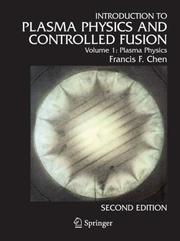
The definitive starting reference even for experts returning to first principles; its clean derivations of basic plasma phenomena, waves, and diffusion establish the vocabulary and physical intuition used throughout the field.
Bridges analytic theory and computational practice; reading it alongside Chen deepens understanding of kinetic effects and particle-in-cell methods that underpin modern plasma research.
MHD, Stability, and Transport
ExpertAchieve deep mastery of magnetohydrodynamics, equilibrium and stability theory, and cross-field transport — the theoretical backbone of both magnetic confinement fusion and large-scale astrophysical plasma dynamics.
▸ Study plan for this stage
Pace: 8–10 weeks, ~40–50 pages/day with 2–3 days per week for problem-solving and numerical work
- MHD equations and their derivation from kinetic theory: continuity, momentum, energy, and induction equations as the foundation for plasma dynamics
- Magnetic pressure and tension: understanding how magnetic fields store energy and exert forces on plasma, central to equilibrium configurations
- Equilibrium and force balance: the pressure-balance equation (∇p = J × B) and how it determines plasma confinement geometry
- Stability analysis: linear perturbation theory, growth rates, and the distinction between ideal and resistive instabilities
- Reconnection and current sheets: magnetic topology changes, energy release mechanisms, and their role in solar flares and eruptive phenomena
- Transport processes: anomalous diffusion, viscosity, and heat transport across magnetic field lines in collisional and collisionless regimes
- Application to solar corona and flares: how MHD theory explains observed solar phenomena, from quiet-Sun heating to explosive energy release
- Derive the MHD momentum equation from first principles and explain the physical meaning of each term (pressure gradient, Lorentz force, viscosity)
- What is the relationship between magnetic pressure and magnetic tension, and how do they constrain plasma equilibrium in a tokamak or solar loop?
- Explain the pressure-balance equation ∇p = J × B and describe how it determines the shape and stability of confined plasma
- What is the difference between ideal and resistive instabilities, and why does finite resistivity enable magnetic reconnection?
- Describe the mechanism of magnetic reconnection and explain how it releases energy in solar flares
- How do anomalous transport processes arise in magnetized plasmas, and what role do turbulence and instabilities play?
- Apply MHD stability theory to explain why certain plasma configurations (e.g., tokamaks) are more stable than others
- Derive the full set of ideal MHD equations starting from the Vlasov equation and moment conservation laws; identify assumptions and their validity
- Solve the pressure-balance equation for a cylindrical plasma column with a given current profile; sketch the resulting magnetic field and pressure distribution
- Perform a linear stability analysis on a simple equilibrium (e.g., a slab or cylindrical pinch); calculate growth rates and identify the fastest-growing mode
- Implement a 1D or 2D MHD code (using a finite-difference or finite-volume scheme) to simulate the evolution of a magnetic reconnection event; compare with analytical predictions
- Analyze a solar flare observation (e.g., from SOHO or SDO data) and interpret it using MHD theory: identify the pre-flare equilibrium, the trigger mechanism, and the energy release
- Calculate the anomalous diffusion coefficient for a given turbulent spectrum; estimate transport timescales and compare with collisional predictions
- Work through Priest's detailed examples on solar coronal loops: compute equilibrium profiles, estimate heating requirements, and assess stability against kink and torus modes
Next up: This stage provides the theoretical and mathematical framework—MHD equations, equilibrium, stability, and transport—that will be applied in the next stage to specific confinement devices (tokamaks, stellarators) and astrophysical systems (accretion disks, jets), where you will learn how to design, optimize, and predict the behavior of real plasma systems.
While solar-focused, this is the most thorough modern treatment of MHD equilibria, reconnection, and instabilities available; its mathematical rigor makes it the best MHD deep-dive before specialized fusion or astrophysics texts.
Magnetic Confinement Fusion
ExpertUnderstand the physics of tokamaks and stellarators in depth — from equilibrium and neoclassical transport to turbulence, heating, and the path to ignition — at the level required for active fusion research.
▸ Study plan for this stage
Pace: 12–14 weeks, ~40–50 pages/day (with 2–3 days per week for problem-solving and review)
- Tokamak equilibrium: the balance between plasma pressure, magnetic field geometry, and the safety factor q(r) — why q > 1 is essential for stability
- Magnetic field topology and confinement: toroidal geometry, poloidal and toroidal field coils, rotational transform, and how they suppress particle loss
- Neoclassical transport: collisional transport in a toroidal geometry, banana orbits, and the difference between collisional and collisionless regimes
- Plasma instabilities and MHD: kink and ballooning modes, their growth rates, and why q-profile control prevents catastrophic disruptions
- Turbulence and anomalous transport: ion-temperature-gradient (ITG) and trapped-electron modes (TEM), their role in energy loss, and scaling laws
- Auxiliary heating systems: neutral beam injection (NBI) and radiofrequency (RF) heating — power deposition profiles and efficiency
- The path to ignition: fusion triple product (nTτ), Lawson criterion, and the engineering and physics challenges of reaching net energy gain
- Stellarator design principles: rotational transform without a net toroidal current, 3D optimization, and advantages/disadvantages versus tokamaks
- What is the safety factor q(r), why must it exceed 1 at the plasma center, and how does its radial profile control MHD stability?
- Explain the physical mechanism of neoclassical transport in a tokamak: what are banana orbits, and why is the collision frequency critical?
- Describe the difference between ideal MHD instabilities (kink, ballooning) and resistive instabilities; what role does plasma resistivity play?
- What are the primary sources of anomalous transport in tokamak plasmas, and how do ITG and TEM modes contribute to energy loss?
- Compare the heating efficiency and power deposition profiles of neutral beam injection versus RF heating in tokamaks.
- Define the fusion triple product and Lawson criterion; what are the current gaps between achieved and required values for ignition?
- How do stellarators achieve confinement without a net toroidal plasma current, and what are the trade-offs in 3D optimization?
- What are the main causes of plasma disruptions, and how do control systems mitigate them?
- Work through Wesson's derivations of the Grad–Shafranov equation and solve it numerically for a simple tokamak equilibrium (e.g., circular cross-section); plot the resulting q-profile and pressure distribution.
- Calculate the neoclassical transport coefficient (viscosity or diffusivity) for a given collision frequency and magnetic field strength; compare collisional and collisionless limits.
- Analyze the growth rate of a kink mode using the energy principle; determine the condition for stability in terms of q and plasma beta.
- Simulate a simple turbulence model (e.g., 2D Hasegawa–Wakatani equations) to observe ITG-driven transport; measure the scaling of anomalous diffusivity with temperature gradient.
- Design a heating scenario for a tokamak: specify NBI and RF power, calculate power deposition profiles, and estimate the resulting temperature and density evolution.
- Evaluate the fusion triple product for ITER and a hypothetical demonstration reactor; identify the limiting factor (density, temperature, or confinement time) and propose mitigation strategies.
- Compare equilibrium and transport properties of a tokamak and a stellarator using published data (e.g., from DIII-D and Wendelstein 7-X); discuss design trade-offs.
- Implement a simple disruption prediction algorithm based on q-profile evolution and beta limits; test it against synthetic or real tokamak discharge data.
Next up: This stage establishes the fundamental physics of magnetic confinement and the engineering challenges of reaching ignition, preparing you to explore advanced topics such as divertor physics, plasma-wall interactions, and the engineering design of demonstration reactors.

The canonical fusion reference; its encyclopedic yet rigorous coverage of tokamak physics — equilibrium, stability, disruptions, heating, and diagnostics — makes it the essential desk reference for fusion researchers.

Complements Wesson with a more pedagogically structured treatment of MHD stability and fusion reactor design, reinforcing the theoretical underpinnings with an eye toward engineering feasibility.
Astrophysical and Space Plasmas
ExpertApply plasma physics to the cosmos — from solar wind and magnetospheres to accretion disks, relativistic jets, and cosmic-ray acceleration — synthesizing all prior theory in astrophysical contexts.
▸ Study plan for this stage
Pace: 8–10 weeks, ~40–50 pages/day (Parks first: 3–4 weeks on foundational chapters 1–6; Longair second: 5–6 weeks on chapters 2–8 covering high-energy phenomena)
- Solar wind structure, acceleration mechanisms, and interaction with planetary magnetospheres (Parks Ch. 1–3)
- Magnetospheric plasma dynamics: reconnection, substorms, and particle trapping in dipole fields (Parks Ch. 4–5)
- Collisionless shock physics and particle acceleration in astrophysical contexts (Parks Ch. 6; Longair Ch. 3)
- Accretion disk physics: viscosity, magnetic instability, and plasma heating in strong gravity (Longair Ch. 5–6)
- Relativistic jets and synchrotron radiation from compact objects and AGN (Longair Ch. 7–8)
- Cosmic-ray acceleration and propagation in turbulent plasmas and shock fronts (Longair Ch. 4)
- Radiation mechanisms in hot plasmas: bremsstrahlung, inverse Compton, and synchrotron processes (Longair Ch. 2)
- Plasma instabilities and turbulence driving energy dissipation in astrophysical systems (Parks Ch. 5; Longair Ch. 6)
- How does the solar wind originate from the corona, and what mechanisms accelerate it to supersonic speeds? What role do magnetic reconnection and wave heating play?
- Explain the structure of Earth's magnetosphere and the physical processes governing plasma entry, trapping, and loss during magnetospheric substorms.
- What are the key differences between collisional and collisionless shocks, and how do they accelerate particles to relativistic energies via the Fermi mechanism?
- Describe the role of magnetic instabilities (MRI, turbulence) in accretion disks and how they generate viscosity and heat transport in the absence of collisions.
- How do relativistic jets form near compact objects, and what plasma physics principles explain their collimation, acceleration, and synchrotron radiation signatures?
- Compare cosmic-ray acceleration at supernova remnant shocks versus active galactic nuclei jets—what plasma conditions differ, and how do they affect particle energization?
- Work through Parks Ch. 1–2 problems on solar wind equations of motion and energy balance; derive the Parker solar wind solution and compare with observational data from WIND or SOHO satellites.
- Simulate magnetospheric particle trapping using guiding center equations (Parks Ch. 4): compute bounce periods and drift frequencies for electrons and ions in a dipole field; visualize trapped orbits.
- Analyze a collisionless shock crossing from MMS or Cluster satellite data: identify the shock ramp, measure compression ratio, and estimate particle acceleration efficiency using velocity distributions.
- Reproduce the magnetorotational instability (MRI) growth rate calculation for accretion disk parameters (Longair Ch. 6); vary magnetic field strength and disk angular velocity to understand turbulence onset.
- Model synchrotron radiation from a relativistic jet: compute spectral energy distribution (SED) for given electron energy distribution, magnetic field, and Doppler boosting; compare with AGN observations.
- Calculate cosmic-ray acceleration timescales at a supernova remnant shock using diffusive shock acceleration theory (Longair Ch. 4); estimate maximum energy achievable for different shock speeds and magnetic turbulence levels.
Next up: This stage synthesizes plasma physics across the full cosmos—from near-Earth space to the most extreme astrophysical environments—positioning you to either specialize in a particular domain (solar physics, magnetospheric research, high-energy astrophysics) or to tackle advanced topics like plasma turbulence theory, kinetic simulations, or multi-messenger astrophysics in subsequent study.

A rigorous bridge from laboratory plasma theory to space and magnetospheric environments; its treatment of shocks, reconnection, and particle acceleration ties directly to the kinetic and MHD tools built in earlier stages.

Provides the astrophysical context — synchrotron radiation, relativistic plasmas, jets, and cosmic rays — that places plasma physics within the broader universe, serving as the capstone of the curriculum.
Discussion
Keep reading
Paths that share books, cover the same subject, or open a related topic.