Best Books on Psychiatry, in Reading Order
Psychiatry is the branch of medicine with the least settled foundations: practitioners disagree, in public and in print, about what its diagnoses are, what its drugs do, and whether its history is one of progress. This path is built to represent that disagreement rather than resolve it — it pairs an insider's defence with a historian's sceptical account, spends a full stage on what severe mental illness is actually like from the inside, reads the field's serious critics on their own terms, and ends with how the work is taught and practised today. It is a path for understanding a contested discipline, not for diagnosing or treating anyone.
Two Accounts of the Same Discipline
BeginnerGet the mainstream story of psychiatry's history and a historian's revision of it side by side, so you can see where the profession's self-image and the documentary record part company.
▸ Study plan for this stage
Pace: 3–4 weeks. Shrinks is 342 pages and Mind Fixers 384; read them back to back with a fortnight for each, because the whole value of the pairing is in holding both accounts of the same century in mind at once. Keep a running list of events both books cover, with the page reference in each — you will us
- The century as the profession narrates it: asylums, the psychoanalytic ascendancy, the 1980 DSM-III break, and the biological turn — Lieberman's arc, told by a former president of the American Psychiatric Association
- The same century as Harrington narrates it: repeated cycles of a biological promise announced, oversold, and quietly retired, from focal sepsis and insulin coma to the serotonin hypothesis
- DSM-III in 1980 as the hinge event both books agree on — operational criteria, improved diagnostic reliability, and the deliberate abandonment of aetiology
- The distinction between reliability and validity, which is the single most important technical idea in this path: DSM-III made diagnosis repeatable without establishing that the categories carve anything at a joint
- Chlorpromazine in 1952 and the deinstitutionalisation that followed, and the argument over how much of the emptying of the asylums was drugs and how much was policy and money
- The chemical-imbalance account of depression: where it came from, how it functioned in public communication, and what the profession's own leadership now says about it
- Harrington's specific charge — that psychiatry promised mechanisms it has not delivered, and that the promise was made for institutional reasons as much as scientific ones
- Neither author is a fringe figure, which is precisely why the disagreement is worth the reader's time
- Give Lieberman's account of DSM-III and Harrington's account of the same event in one paragraph each. What do they agree happened, and where does the weighting differ?
- Explain reliability and validity as they apply to a psychiatric diagnosis, and say why improving one does nothing for the other.
- What is the evidence for and against the claim that antipsychotics caused deinstitutionalisation? Which non-pharmacological factors does each author weight?
- Where did the chemical-imbalance framing of depression come from, who propagated it, and what is its current standing?
- Both books are written by people with institutional positions. What interest does each author have, and where can you see it shaping the selection of evidence?
- Build a two-column timeline of psychiatry from 1900 to the present: Lieberman's version on the left, Harrington's on the right, same rows. Where they include different events, mark it. Keep this document for the rest of the path.
- Take one episode both books cover — the lobotomy era is the sharpest test — and write 500 words comparing the two accounts: what facts each includes, what each omits, and what judgement each reaches.
- Write 300 words on the strongest case for Lieberman's optimism, then 300 words on the strongest case for Harrington's scepticism, each using only that author's own evidence.
- List every therapeutic intervention Harrington describes as having been adopted and later abandoned, with the decade of each. The pattern is the argument.
Next up: Before arguing further about diagnostic categories, it is worth knowing concretely what the conditions they name are actually like, which is the next stage.

A former president of the American Psychiatric Association narrates psychiatry's history as a hard-won escape from asylums and Freud into biological medicine. Read it first as the profession's own account of itself — the position everything later in the path is arguing with or defending.
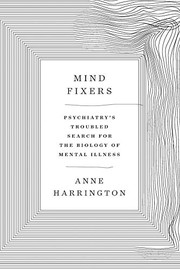
A Harvard historian of science covers the same century and reaches a much more qualified verdict: the biological revolution promised mechanisms it has not delivered. Read immediately after Lieberman, because the value is in the contrast — same events, different weighting of the evidence, and neither author is a fringe figure.
What Severe Mental Illness Is Like
BeginnerBuild a concrete sense of the conditions psychiatry treats, from people who have lived inside them, before arguing about the categories used to name them.
▸ Study plan for this stage
Pace: 3–4 weeks. The Center Cannot Hold is 352 pages, An Unquiet Mind 223, The Collected Schizophrenias 224. All three read quickly; the difficulty is not length. Take them in the order given, and read the essays in Wang's collection with gaps rather than straight through.
- Saks's account of psychosis from inside: disorganised thought described precisely by someone who is a professor of law and psychiatry and can describe it precisely
- Involuntary restraint and hospitalisation as Saks experienced them, and her sustained argument about mechanical restraint specifically
- Saks's own conclusion about medication, which she reaches after repeated attempts to stop, and which sits awkwardly with several critiques in the next stage
- Jamison's double position — a clinical psychologist who studies bipolar disorder and has it — and her ambivalence about lithium, including what she believed she lost
- Wang on diagnosis as an event: how a label arrives, what it licenses institutionally, and what it costs socially
- Schizoaffective disorder as a category on a boundary, which makes Wang's essays a case study in the reliability/validity problem made personal
- The methodological question the stage raises: what a first-person account can establish, and what it cannot
- The honest limit — three writers, all unusually articulate and highly educated, are not a representative sample of anything
- How does Saks describe disorganised thinking from inside? Find the passage and say what it adds to a clinical description of thought disorder.
- Jamison writes about what lithium took away as well as what it gave. Set out her account of that trade-off in her own terms.
- Wang describes receiving a diagnosis. What changed practically, and what changed in how she was seen? Distinguish the two.
- All three authors are highly educated professionals with good insurance and strong support. How does that limit what these books can tell you about severe mental illness generally?
- Saks concludes that she needs medication indefinitely. How should a reader hold that alongside a critique arguing that long-term outcomes on medication are worse?
- Write a 400-word description of an episode of psychosis using only Saks's own vocabulary, then rewrite it in DSM criterion language. Note precisely what each version captures and loses.
- Take Jamison's account of a manic episode and mark every sentence that is description, every one that is retrospective interpretation, and every one that is argument. The proportions tell you what kind of book it is.
- Read Wang's essay on diagnosis and write 300 words on the difference between a diagnosis as a clinical judgement and as a social fact.
- Return to your stage-one timeline and add a row for patient testimony: where in the century do first-person accounts appear at all, and who was permitted to publish them?
Next up: You now have concrete cases in mind, which is the only responsible position from which to read the field's sharpest critics.

A law professor's account of living and working with schizophrenia, including forced restraint and hospitalisation. It is the single most useful corrective to reading psychiatry only through clinicians, and Saks writes analytically enough to be argued with.
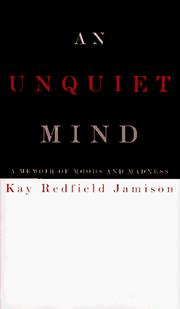
A clinical psychologist who studies bipolar disorder describes having it, including her own ambivalence about lithium. Read after Saks for the rare double vision of someone on both sides of the consultation.

Essays on living with schizoaffective disorder that are unusually sharp about diagnosis itself — how a label arrives, what it licenses, and what it costs. It bridges this stage to the next by making the critique of categories personal before it becomes theoretical.
The Critics, Read Seriously
IntermediateEngage the major critical literature on its own terms — the historical, sociological and pharmacological challenges to psychiatric authority — and understand what each critic is and is not claiming.
▸ Study plan for this stage
Pace: 8–10 weeks. Desperate Remedies is 424 pages, Asylums 386, The Myth of Mental Illness 320, Anatomy of an Epidemic 404. Read them in this order — Scull first sets the evidentiary standard, and reading Szasz or Whitaker cold makes it much harder to separate the argument from the rhetoric. This stage is
- Scull's method: archival history of what the profession actually did, treatment by treatment — malaria therapy, focal sepsis, insulin coma, lobotomy — with the contemporaneous justifications intact
- The distinction Scull maintains between documented institutional history and claims about what mental illness fundamentally is
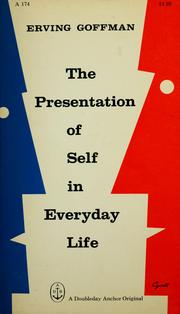
- Goffman's total institution: the mortification of self, the batch handling of inmates, and the secondary adjustments by which people survive institutions
- Szasz's actual thesis, which is narrower than its reputation: that 'illness' properly applies to bodily lesion, that psychiatric diagnoses are judgements about behaviour in a medical vocabulary, and that psychiatric coercion is therefore unjustified
- What Szasz is not claiming — he does not deny that people suffer, and his target is the medical framing and the coercion it licenses
- Whitaker's argument: that long-term outcome data for several drug classes are worse than the field acknowledges, and that some drugs may induce supersensitivity that worsens the long course
- Why Whitaker is contested — the causal reading of observational long-term data, confounding by indication (sicker patients stay medicated), and the specific studies each side leans on
- How to read a contested empirical claim: identify the study design, ask what confound would explain the result, and check whether the critic addresses it
- List five treatments Scull documents as adopted and later abandoned. In each case, what evidence was offered at the time, and what does that pattern imply for treatments currently in use?
- State Szasz's thesis precisely, in a form he would accept. Then apply it to Saks's account and say whether it survives the encounter.
- What is a total institution, and what are the four features Goffman identifies? Apply the framework to an institution that is not a hospital.
- Whitaker's central inference is causal. What is the alternative explanation for the same data, and how does he attempt to rule it out? Is the attempt successful?
- Which of these four critics argues from archival evidence, which from ethnographic observation, which from conceptual analysis, and which from epidemiological data? What can each method establish?
- Where would Lieberman most strongly disagree with each of the four, and where would he have to concede?
- Build a four-row table: for each critic, record the claim, the evidence type, the strongest objection, and what would falsify it. This is the analytic core of the path.
- Take one study Whitaker relies on heavily, find the paper itself, and read the methods section. Write 500 words on what it establishes, what the authors themselves claim, and how Whitaker's use compares.
- Write a 600-word reply to Szasz on behalf of a psychiatrist who has read Saks and Jamison, using their accounts as evidence. Then write a 300-word rejoinder as Szasz.
- Apply Goffman's framework to a full description of a modern inpatient unit as it appears in Saks's memoir. Which features persist and which have gone?
- Return to your timeline and mark every point at which one of these four critics intervened in the history. Note how often the critique preceded the profession's own reversal.
Next up: Having heard the strongest criticism, the last stage asks how diagnosis is actually made and how the work is actually done and taught today.

The leading sociologist-historian of psychiatry gives a long, documented account of the treatments the field adopted and later abandoned. Start the stage here because Scull argues from archival history rather than polemic, which sets the standard for evaluating the sharper claims that follow.
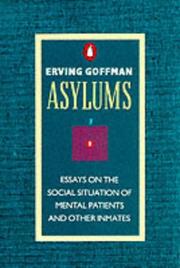
The 1961 ethnography of the mental hospital as a total institution, and the origin of most later thinking about institutionalisation. It is a study of institutions rather than of illness, which is precisely why it survives as evidence regardless of your view of psychiatry.
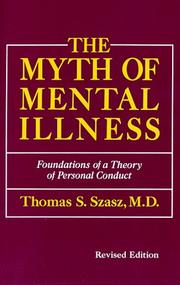
The most famous frontal attack on the concept of mental illness itself, published the same year as Asylums. Read it as an argument to examine rather than adopt — Saks's and Jamison's accounts in the previous stage are the obvious test case against it, and the path deliberately gives you both.
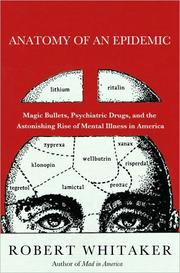
A journalist's case that long-term outcomes for psychiatric drugs are worse than the field acknowledges, built on published long-term data. It is contested — many psychiatrists reject the causal reading — so read it alongside Lieberman rather than instead of him, and pay attention to which studies each side leans on.
Diagnosis, Drugs and Practice Today
IntermediateUnderstand how diagnostic categories are actually made, how psychiatrists are trained to think, and what the standard clinical reference contains.
▸ Study plan for this stage
Pace: 8–10 weeks. Saving Normal is 344 pages, Of Two Minds 337, and Kaplan and Sadock's Synopsis of Psychiatry is a 1,472-page clinical reference to be read selectively rather than through. ⚠ The catalogue record here is an older edition and it is a textbook written for supervised trainees — read it as a
- How a diagnostic manual is actually made: work groups, field trials, thresholds set by committee, and the negotiation between clinical utility and empirical support
- Frances chaired DSM-IV and criticises DSM-5 from that position — internal criticism from the centre of the profession, which is a different genre from Szasz or Whitaker
- Diagnostic inflation: the specific expansions Frances identifies, the threshold changes that produce them, and the prevalence consequences that follow mechanically from a criterion change
- Luhrmann's ethnographic finding: residents learn two incompatible frameworks, biomedical and psychodynamic, and choose between them case by case rather than integrating them
- How training shapes what a clinician sees — the same patient described differently depending on which framework the trainee has most recently been rewarded for using
- The economics Luhrmann documents: managed care, shortened admissions, and the pressure toward the framework that fits a fifteen-minute appointment
- What the Synopsis actually contains — phenomenology, differential diagnosis, epidemiology, psychopharmacology — and how it handles the controversies you have spent three stages reading about, which is usually briefly or not at all
- RDoC and the post-DSM research programmes, and the open question of whether a dimensional or mechanistic framework will replace categorical diagnosis
- Explain in mechanical terms how lowering a diagnostic threshold changes prevalence. Then find one example Frances gives and estimate the effect.
- Frances chaired DSM-IV and says it made mistakes. Which ones does he own, and does the admission strengthen or weaken his critique of DSM-5?
- Describe the two frameworks Luhrmann's residents learn. What does each explain well, and what makes them incompatible rather than complementary?
- Pick one condition and read its entry in the Synopsis. How does the text handle aetiology, and how does that treatment compare with what Harrington and Scull said about the same evidence?
- After all twelve books: what is a psychiatric diagnosis? Give the most defensible answer you can, and state what would make you revise it.
- Which of the critics from the previous stage does the current mainstream appear to have partly absorbed, and which has it ignored?
- Take one DSM criterion set and write out exactly what a clinician has to judge to apply it. Mark each judgement as observable, reported, or interpretive, and count the three.
- Write 500 words on a single diagnostic category tracing it across the editions of the DSM — when it appeared, how the criteria changed, and what happened to prevalence — using Frances for the narrative.
- Read Luhrmann's chapters on residency and write a 400-word account of one case as a biomedically-trained resident would present it, then as a psychodynamically-trained one would. Use the same facts.
- Choose three controversies from stage three and look up how the Synopsis handles each. Write a paragraph on each about what a trainee reading only this text would and would not know.
- Write a final 1,000-word position paper: what you now think psychiatry is, what you think it does well, where the evidence is weakest, and which author on this path you found least convincing and why.
Next up: This is the end of the path; the natural continuations are the primary literature on any single condition, the history of medicine more broadly, or the philosophy of psychiatry and the debate over what counts as a mental disorder.
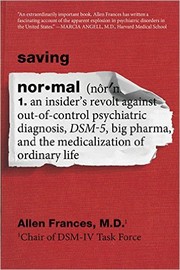
The psychiatrist who chaired the DSM-IV task force argues that diagnostic expansion has gone too far. This is internal criticism from the centre of the profession, which makes it a useful check on both Lieberman's optimism and Whitaker's indictment.
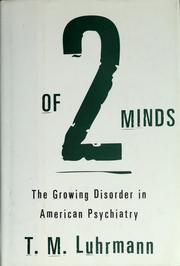
An anthropologist embedded in psychiatric residency shows trainees learning two incompatible frameworks, biological and psychodynamic, and choosing between them case by case. It explains why the field's public disagreements are reproduced inside every practitioner.
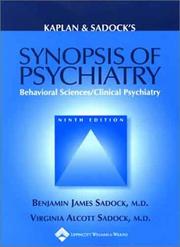
The standard clinical reference, and the last stop for a reason: read selectively to see how the disputes above are handled in a text written for people in supervised training. Treat it as a map of what the profession teaches, not as guidance for anyone's care.
Discussion
Keep reading
Paths that share books, cover the same subject, or open a related topic.