Antidepressants: The Best Books on Psychiatric Medication and the Evidence, in Order
This is one of the few medical subjects where competent, credentialled people reach opposite conclusions from the same trial data, and any reading list that resolves the argument for you is misleading you. This path is built to be read as a debate: the case for the drugs as it was originally made, the statistical challenge to that case, the collapse of the chemical-imbalance explanation, the dispute over long-term outcomes and industry influence, and finally the argument about diagnosis itself. Several authors here directly rebut each other, and they are placed so the rebuttals land in order. None of this is guidance about starting, changing or stopping a medication — that decision belongs with a prescriber who knows the individual case, and stopping abruptly is specifically dangerous.
The Case as It Was Made
BeginnerUnderstand why the SSRIs were received as they were in the early 1990s, and what the drugs looked like to a thoughtful clinician and to a patient at the time.
▸ Study plan for this stage
Pace: About three weeks. Kramer's Listening to Prozac is 409 pages of clinical argument and case description and takes two; Wurtzel's Prozac Nation is 352 pages of memoir and reads faster. Read Kramer first — he is the position the rest of the path argues with. These are professional and journalistic book
- What the SSRIs offered over the tricyclics and MAOIs: not greater efficacy but a different side-effect and overdose profile
- Kramer's central observation — patients reporting not only relief but personality change — and why he treats it as philosophically loaded
- "Cosmetic psychopharmacology": Kramer's own term for the question of treating traits rather than illness
- Clinical anecdote as evidence: what a case series can and cannot establish, which is the seam every later author pulls at
- The 1990s cultural reception of the drugs, which Wurtzel documents from inside and Kramer from across the desk
- The difference between a psychiatrist arguing a thesis and a patient describing an experience, and why both are primary rather than neutral
- What exactly did Kramer's patients report that he found could not be described as recovery from depression?
- What does Kramer mean by cosmetic psychopharmacology, and does he endorse it?
- What kind of evidence is Listening to Prozac built on, and what claims can that kind of evidence support?
- Where does Wurtzel's account of taking the drug differ from Kramer's account of prescribing it?
- By the end of this stage, what is the strongest version of the case for antidepressants, stated in one paragraph?
- Write out, in one paragraph and in the most favourable terms you can manage, the argument Listening to Prozac actually makes. Keep it — every later stage is a challenge to some part of it, and you will want the original wording rather than your memory of it.
- List the specific claims Kramer supports with case description and the specific claims he supports with trial data. The proportions are the point, and Kirsch's book in the next stage attacks only one of the two columns.
- Mark every place in Prozac Nation where Wurtzel describes a change she attributes to medication, and note what else was happening in her life at the same time. This is the confounding problem that the trial literature exists to solve.
- Find the passages where Kramer anticipates an objection to his own thesis and note which objections he raises and which he does not. The ones he does not raise are the shape of the next twenty years of argument.
Next up: Kramer's case rests on what clinicians observe; the next stage is the statistical challenge to what the trials actually showed, and Kramer's own reply to it a quarter of a century later.
The book that defined the public conversation: a psychiatrist observing patients who became not merely less depressed but different, and asking what that means. Read it first — nearly every critic on this list is arguing with it, sometimes explicitly.

The patient-side memoir of the same moment, and a useful counterweight to Kramer's clinical distance. Read it second for what treatment felt like from inside rather than across the desk.
The Statistical Challenge
IntermediateFollow the meta-analytic argument about effect sizes and the placebo response, and read the most careful defence written in response to it.
▸ Study plan for this stage
Pace: Three to four weeks, and read these two as one unit — Kirsch's The Emperor's New Drugs (240 pages) then Kramer's Ordinarily Well (323 pages), in that order and without a gap. This is the live centre of the dispute and it is genuinely unresolved: Kirsch's meta-analyses of the FDA trial data, includin
- Effect size and the drug-placebo difference: what a mean difference on a depression rating scale is and is not
- The clinical-significance threshold — the question of how large a rating-scale change has to be before it means anything to a patient
- Publication bias and the significance of Kirsch obtaining unpublished trials through freedom-of-information requests
- Why an active placebo matters: if a drug has noticeable side effects, blinding may fail and expectation may do work the drug is credited with
- Kramer's counter-arguments — trial populations, symptom-severity floors and ceilings, dropout, and recruitment of patients unlike those a clinician sees
- Averages versus responders: whether a small mean difference conceals a subgroup for whom the effect is large
- That both authors are arguing from the same body of trials, which is what makes this a dispute about method rather than about data
- Which trials did Kirsch include that earlier analyses had not, and how did their inclusion change the pooled result?
- What clinical-significance threshold does Kirsch measure the drug-placebo difference against, and where does that threshold come from?
- What is the active-placebo objection, and what would settle it?
- Which specific step in Kirsch's argument does each of Kramer's counter-arguments attack — the data, the pooling, the threshold, or the inference to practice?
- After both books, what would you need to see in order to be persuaded either way?
- Write out Kirsch's argument as a numbered chain of steps from the trial data to his conclusion. Then read Ordinarily Well with that list beside you and mark, against each step, which of Kramer's objections targets it. Several steps will attract nothing — those are the parts of the case Kramer concedes, and they are more informative than the contested ones.
- Copy down the effect size Kirsch reports and the clinical-significance criterion he compares it against, exactly as he states them. Then find what Kramer says about that same criterion. Much of the disagreement lives in this single comparison.
- Find Kirsch's account of the unpublished trials and write a paragraph on what publication bias does to a literature, using his own numbers rather than a general description.
- List every methodological feature of a depression trial that Kramer says biases results downward. For each, note whether it would also apply to the trials Kirsch obtained through FOI, or only to the published ones.
- Return to the paragraph you wrote in stage one summarising Kramer's original case and mark which sentences survive Kirsch intact.
Next up: The efficacy dispute is about whether the drugs work; the next stage is about the explanation that was offered for how they work, which turns out to be a separate question with a much less contested answer.

Kirsch's meta-analyses of the FDA trial data, including unpublished trials, arguing that the drug-placebo difference is small and clinically marginal for most patients. The single most consequential critique in the field, and it must be read before its rebuttals.

Kramer's direct answer twenty-four years after Listening to Prozac: an argument that the trial methodology systematically understates effects. Read it immediately after Kirsch — it is the best-argued defence available, and the pairing is the core of this path.
The Chemical-Imbalance Story
IntermediateTrace where the serotonin-deficiency explanation came from, why specialists abandoned it long before the public did, and what replaced it.
▸ Study plan for this stage
Pace: Four to five weeks. Valenstein's Blaming the Brain (292 pages) first, then Moncrieff's The Myth of the Chemical Cure (278 pages), then her Chemically Imbalanced (288 pages). Valenstein reads as history of science; both Moncrieff books are academic psychiatry written for a general audience and argue
- Where the monoamine hypothesis came from — reasoning backward from what drugs did, not forward from observed deficiency
- The distinction between a drug having an effect on serotonin and a disorder being caused by a serotonin deficit
- How the chemical-imbalance account reached the public: marketing, patient-education material, and clinical shorthand
- Moncrieff's drug-centred model — that psychiatric drugs produce altered states which may or may not be useful — set against the disease-centred model
- That specialists had abandoned simple serotonin-deficiency accounts long before the public explanation changed
- Valenstein's wider point about how biological explanations of mental illness acquire authority ahead of their evidence
- Why a wrong mechanism does not by itself make a treatment ineffective
- What was the original evidence for the monoamine hypothesis, and what was the inferential step Valenstein says was never justified?
- How does Moncrieff's drug-centred model differ from saying the drugs do not work?
- Who was actually making the chemical-imbalance claim, and in what settings?
- What does Chemically Imbalanced add about why the story persisted after the evidence thinned?
- If the serotonin explanation is abandoned, which of Kirsch's and Kramer's arguments from the previous stage are affected, and which are untouched?
- Reconstruct the monoamine hypothesis from Blaming the Brain as an argument with premises and a conclusion, and mark the point at which Valenstein says the reasoning ran backwards.
- Set Moncrieff's drug-centred and disease-centred models side by side in two columns, and then place each of the earlier books on the path in the column its assumptions belong to. Kramer and Kirsch do not land where a first reading suggests.
- Take one specific claim about serotonin from Chemically Imbalanced, follow Moncrieff's citation, and describe what the cited work actually measured.
- Write half a page answering the question these three books never quite ask directly: what would change about clinical practice if the mechanism story were abandoned entirely?
Next up: Mechanism aside, the sharpest remaining claim on the critical side is empirical rather than theoretical — that outcomes over years have not improved — and that, with the history of how the evidence base was produced, is the next stage.
A neuroscientist showing, in 1998, that the biochemical theories of mental illness were never as well supported as their popular presentation implied. The earliest sustained version of this argument and the foundation for the two that follow.

Moncrieff's drug-centred model: psychiatric drugs produce altered states that may or may not be useful, rather than correcting a specific deficit. Read it second — it proposes an alternative framework rather than only attacking the existing one.

Her recent book on how the serotonin story spread and persisted after the evidence for it thinned. Read it last in this stage as the up-to-date account, and note that being the newest book here does not settle the argument.
Long-Term Outcomes and the Industry
IntermediateEngage with the most serious claim on the critical side — that long-term outcomes have not improved — and with the documented history of how trial evidence was shaped.
▸ Study plan for this stage
Pace: Six to eight weeks — this is the longest stage, at roughly 1,380 pages across four books. Whitaker's Anatomy of an Epidemic (404 pages) first; it is the most disputed book on the path, and its critics attack specifically its use of population disability data to support a claim about individual drug
- The distinction between short-term symptom reduction, which the trials measure, and long-term course, which they mostly do not
- Whitaker's ecological argument — rising disability rates alongside rising treatment rates — and why an ecological correlation is weak evidence about individual causation
- Oppositional tolerance and drug-induced chronicity as hypotheses, and what evidence would test them
- Healy's historical claim that the antidepressant category and the disease concept were constructed together, with the drug arriving first
- Ghostwriting, selective publication and trial registration as documented features of the literature, established through court disclosure rather than inference
- The specific case of suicidality signals in trial data and what happened when they were raised
- That the industry history and the outcomes claim are logically independent — one can be fully established while the other remains unproven
- What data does Whitaker use, and what is the strongest technical objection to using them for his conclusion?
- On Healy's account, in what order did the drug, the diagnosis and the market appear?
- What did the disclosed documents in Let Them Eat Prozac actually show, and about which trials?
- How does Pharmageddon's argument apply outside psychiatry, and does that strengthen or weaken it as a claim about antidepressants?
- Which of the claims in this stage are matters of documented record, and which are contested interpretations? Sort every major claim into one of the two.
- Build a two-column ledger for this whole stage: documented record on the left, contested interpretation on the right. Ghostwriting of specific papers goes left; drug-induced chronicity goes right. Doing this properly is the main work of the stage.
- Take Whitaker's central chart or table of disability and treatment rates and write down every alternative explanation for the same trend — diagnostic expansion, disability-benefit criteria, help-seeking, unemployment. Then check which of them Whitaker addresses and which he does not.
- Trace one drug across The Antidepressant Era and Let Them Eat Prozac and note what the historical chapter and the participant account each contribute to the picture.
- Read one published critique of Anatomy of an Epidemic with the book open, and mark in the margin which chapters the critique engages and which it ignores.
- Return to the numbered chain of Kirsch's argument from stage two and ask, for each step, whether Healy's industry history strengthens it, weakens it, or is irrelevant to it.
Next up: Four stages have questioned the drugs, the mechanism and the evidence; the last widens the frame to the diagnoses themselves, and then closes with the strongest defence of the discipline anyone has written.
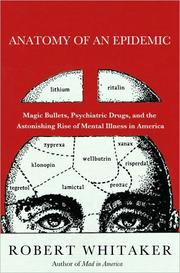
Whitaker's argument that disability rates rose alongside treatment rates, and that long-term medication may worsen some courses of illness. The most disputed book on this list; read it, and read the criticism of its use of epidemiological data alongside it.

A historian-psychiatrist's account of how the antidepressant category was constructed — the drugs came before the disease concept, not after. The scholarly foundation for the two Healy books that follow.
Healy on the suppressed suicidality data and what happened to him professionally for raising it. Read it after The Antidepressant Era, when you can see it as a case study in a pattern he has already documented.

The general argument about ghostwriting, trial registration and how prescription drug evidence is produced. Broadest and last of the three, and the one whose conclusions extend well beyond psychiatry.
The Argument About Diagnosis Itself
IntermediateStep back from the drugs to the categories they treat, and finish with a defence of psychiatry as a discipline so the path does not end one-sided.
▸ Study plan for this stage
Pace: Four to five weeks, roughly 1,000 pages. Horwitz and Wakefield's The Loss of Sadness (312 pages) is the most technical of the three and takes two weeks; Frances's Saving Normal (344 pages) makes a similar case from inside the institution that wrote the criteria, and reads faster; Lieberman's Shrinks
- The DSM's operational criteria and what was gained — reliability — and at what cost to validity
- Horwitz and Wakefield's central claim that the criteria cannot distinguish disorder from proportionate response to loss
- The bereavement exclusion, its narrowing and its removal, as the concrete test case for the whole argument
- Diagnostic inflation: how a broadened category changes prevalence, prescribing and research populations simultaneously
- Frances's position as chair of the DSM-IV task force, and what it means for a critique to come from the author of the thing criticised
- Lieberman's counter-case: the historical harm of untreated severe illness, and the risk that criticism of over-diagnosis is generalised to conditions where treatment is not in doubt
- That the over-diagnosis argument concerns the mild end of the range and does not, in any of these books, extend to severe illness
- What is the difference between reliability and validity in a diagnostic system, and which did the DSM's operational criteria improve?
- What does the bereavement exclusion do, and what did its removal change?
- Frances and Horwitz reach a similar conclusion from very different positions — what does each have that the other lacks?
- What is Lieberman's strongest argument, stated in the form he would accept?
- Having read all five stages, which claims on this subject do you consider settled and which remain genuinely open?
- Write out the DSM criteria for a major depressive episode as Horwitz and Wakefield present them, and apply them to a case of ordinary bereavement as they describe it. The exercise is theirs; doing it rather than reading it is what makes the argument concrete.
- Read Frances on diagnostic inflation and list each mechanism he identifies, marking which he witnessed as task-force chair and which he infers. His standing applies to only some of them.
- Write the strongest single-page case for psychiatric medication using only Lieberman and Kramer, and then the strongest single-page case against using only Kirsch, Whitaker and Moncrieff. Neither page should contain a claim the cited author does not make.
- Finish by revisiting the ledger from stage four and the paragraph from stage one, and write a short statement of what you now think is established, what is disputed, and what you personally cannot yet judge. The point of the path is to be able to write that honestly, not to have picked a side.
Next up: This closes the path: the case for the drugs, the statistical challenge, the mechanism story, the long-term dispute and the argument about diagnosis, left standing as the live disagreement it actually is.
Horwitz and Wakefield argue that the DSM criteria cannot distinguish depressive disorder from proportionate grief, which inflates prevalence at the mild end. The most rigorous version of the over-diagnosis case.
Frances chaired the DSM-IV task force and is warning about diagnostic inflation from inside the establishment that produced it. Read it after Horwitz: same conclusion, entirely different standing.

A former APA president's history of psychiatry, arguing it has become a genuine medical discipline and that the critics understate the harm of untreated illness. The right last book — it is the strongest institutional defence, and reading it after four stages of criticism is the whole point of the sequence.
Discussion
Keep reading
Paths that share books, cover the same subject, or open a related topic.