Erving Goffman: The Best Books to Read, in Order
Goffman took the smallest unit of social life — two people in a room managing an impression — and made it a rigorous object of study, and almost everything sociology now says about self-presentation, stigma and institutional life descends from him. The path runs in roughly the order he wrote: the famous dramaturgical book first, then the fieldwork that made his reputation, then the sustained programme on face-to-face interaction, then the difficult late work, and finally the secondary literature that tells you what he was doing and what he never quite explained. His books are primary texts throughout; the way-in and the critical studies are marked as such.
The famous one, and a way in
BeginnerLearn the dramaturgical vocabulary — front and back region, impression management, teams, the working consensus — and understand that Goffman is offering a perspective rather than a theory with predictions. Note what he assumes and never argues for: that the interaction order is a domain in its own right, not a residue of social structure.
▸ Study plan for this stage
Pace: Two to three weeks for 407 pages, and the order matters more than the pace. Goffman's The presentation of self in everyday life (255pp) first, over ten days at 25 pages a session — it is a primary text but written to be read, with hotel kitchens and Shetland crofting as its data, and it assumes no p
- Front region and back region, and the labour of keeping them separate
- Impression management and the working consensus that participants tacitly maintain
- Teams — the discovery that performances are usually collective rather than individual
- Dramaturgy as a perspective rather than a theory: it organises observation and makes no predictions
- The interaction order as a domain in its own right, which Goffman assumes throughout and never argues for
- Discrepant roles and the ways a performance can fail
- What is the working consensus, and what does it cost the participants to sustain?
- Give an example from your own week of a front region and its back region, and say what would happen if the boundary broke.
- Why is dramaturgy a perspective rather than a theory? What would it look like if it made predictions?
- What does Goffman assume about the interaction order, and where in the book would an argument for it have belonged?
- What does Smith say the main disagreements about reading Goffman are, and which one is most visible in Presentation of Self?
- Spend one hour in a café or a shop and write field notes in Goffman's vocabulary: regions, teams, the audience, the performance being maintained.
- Take three of Goffman's own examples and identify what kind of evidence each is — his observation, a published study, an anecdote, a novel.
- Build the glossary: every term Goffman coins in this book, with his definition and your own example. Extend it at each later stage.
- After Smith, go back to one chapter of Presentation of Self and mark where the introduction's framing changed what you saw.
Next up: The dramaturgical vocabulary is now in place; the next stage watches it do empirical work in the settings where managing an impression is hardest.
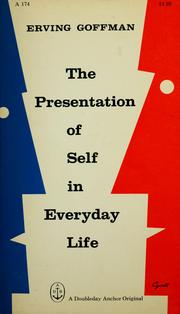
His 1956 breakthrough and the right entry point: the theatrical metaphor is stated fully here and every later book presupposes it. Written to be readable, with hotel kitchens and Shetland crofts as data, and it needs no prior sociology. Primary text.

The standard short introduction in Routledge's Key Sociologists series, published as Erving Goffman, which maps the whole body of work and flags the arguments about how to read him. Secondary — use it as a companion rather than a substitute, ideally after Presentation of Self so it has something to organise.
The fieldwork that made his name
IntermediateSee the dramaturgical framework doing empirical work in the places where self-presentation is hardest. Understand the concept of the total institution and of spoiled identity, and how much of Goffman's evidence is participant observation rather than systematic sampling — the standard methodological objection to him.
▸ Study plan for this stage
Pace: Four to five weeks for 709 pages, all three primary texts and in this order. Asylums (386pp) is the longest and takes two and a half weeks at 30 pages a session — participant observation inside a psychiatric hospital, four essays rather than a continuous book, and the essay on the moral career of th
- The total institution: its defining features and the range of places that meet them
- The moral career of the mental patient, and mortification of the self as a process with stages
- Secondary adjustments — the small manoeuvres by which inmates hold a self the institution is dismantling
- Spoiled identity, and the distinction between the discredited and the discreditable
- Passing and covering as different strategies with different costs
- Role distance, and what Encounters adds to the dramaturgical picture
- The methodological objection: participant observation without sampling, and what Goffman's claims do and do not need
- What makes an institution total, on Goffman's criteria, and which of his criteria does the hardest work?
- Trace the moral career of the mental patient through its stages, citing the evidence he gives at each.
- What is the difference between the discredited and the discreditable, and why does the distinction change the strategy available?
- Stigma uses published case material rather than fieldwork. What does that do to the strength of its claims?
- What is role distance, and why does Goffman need it after Presentation of Self?
- State the methodological objection to Asylums as strongly as you can, then say which of its conclusions survives it.
- List the features Goffman uses to define a total institution and test them against three real institutions. Note which features are present and which are not.
- Take the secondary adjustments Goffman catalogues and group them by what part of the self each protects.
- For Stigma, find every case Goffman draws on and record its original source. Count how many are studies and how many are memoirs.
- Apply role distance from Encounters to two of the performances you described in your stage-one field notes.
Next up: Encounters ends by treating a gathering as a thing with its own rules, which is the programme the next four books build out systematically.

His fieldwork inside St Elizabeths psychiatric hospital and the origin of the total institution — the essay on the moral career of the mental patient is the most influential thing he wrote. It shaped deinstitutionalisation policy, which is why the questions about its evidential base matter. Primary text.

The book that gave the social sciences the vocabulary of stigma, passing, and the discredited versus the discreditable. Read it after Asylums, whose material it generalises, and note that it is a conceptual essay built from published case material rather than from new fieldwork. Primary text.
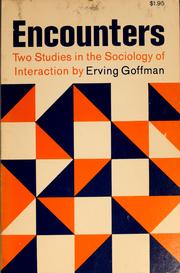
Two essays — on role distance and on fun in games — that introduce the idea of a focused gathering with its own rules and boundaries. The hinge between the dramaturgical books and the formal analysis of interaction that follows. Primary text.
The interaction order as a programme
IntermediateFollow Goffman's real life's work: building a systematic grammar of face-to-face conduct — face-work, deference and demeanour, civil inattention, territories of the self. These four are the most repetitive stretch of the path and the most original; read them for the accumulating apparatus rather than for individual arguments.
▸ Study plan for this stage
Pace: Seven to eight weeks for 1,067 pages, and this is the most repetitive stretch of the path — read it for the accumulating apparatus rather than for individual arguments. Behavior in public places (248pp) first, ten days, and it is the most concretely observational of the four; it is the source of civ
- Civil inattention: the practised non-look that makes crowded public space workable
- Focused versus unfocused interaction, and the different rules each carries
- Face and face-work — losing face, saving face, and the corrective interchange as a sequence
- Deference and demeanour as two separable forms of ritual regard
- Expression games: the moves and countermoves once each party knows the other is managing impressions
- Territories of the self, from personal space to informational and conversational preserves
- Supportive and remedial interchanges, and the grammar of apology, excuse and request
- What it means to build a grammar of conduct rather than a theory of society
- Define civil inattention and describe a situation where its failure is immediately noticeable.
- Reconstruct the corrective interchange from Interaction ritual as a numbered sequence. What can go wrong at each step?
- How do deference and demeanour come apart? Give a case where one is offered and the other withheld.
- What do expression games show about the limits of the dramaturgical model?
- Name Goffman's territories of the self and rank them by how easily each is violated.
- Does Relations in Public amount to a framework, or an unusually well-organised catalogue? Argue from the text.
- Observe one crowded public space for thirty minutes and record every instance of civil inattention and every breach of it.
- Take a real apology you witnessed and code it against the remedial interchange sequence from Relations in Public.
- Build a single index of the apparatus across these four books: term, book, definition. Note every term that gets redefined.
- Take one of Goffman's expression-game examples and rewrite it as a dramaturgical account from Presentation of Self. Say what the earlier vocabulary cannot capture.
- Compare his treatment of embarrassment in Interaction ritual with the performance failures described in Presentation of Self.
Next up: Every book so far assumes participants already know what kind of situation they are in — which is precisely the question the late work refuses to leave assumed.
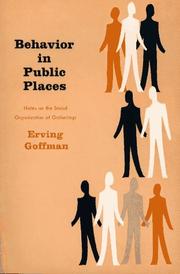
The first attempt to state rules for unfocused interaction among strangers, and the source of civil inattention — the practised non-look that makes crowded public space possible. Primary text, and the most concretely observational of the four.
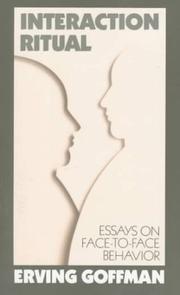
Six essays including On Face-Work and Embarrassment and Social Organization, which are his most-cited pieces after Presentation of Self. Directly Durkheimian — ritual respect paid to persons rather than to gods — so read it as the theoretical core of the programme. Primary text.

Goffman turning to expression games, deception and espionage, and his closest engagement with game theory. The outlier in the sequence and useful for showing the limits of the dramaturgical model when both parties know it is being used. Primary text.
The most systematic statement of the programme — territories of the self, supportive and remedial interchanges, tie-signs — and the fullest answer to the charge that his work is a set of brilliant essays with no framework. Dense; read it last in this stage. Primary text.
The late, difficult work
IntermediateMeet the Goffman who is genuinely hard. Frame Analysis asks how participants know what is going on at all — the question the earlier books assume answered — and Forms of Talk applies the same machinery to speech. Expect to work; expect also to see the whole earlier project reframed.
▸ Study plan for this stage
Pace: Six to seven weeks for 921 pages, and the difficulty is concentrated in one of the two. Frame analysis is 586pp, his longest and most demanding book, and four or five weeks at 20 pages a session is honest — it is written in a compressed, example-dense style and the machinery of keyings, fabrications
- The organising question — what is it that's going on here — and why it cannot be answered from within a performance
- Primary frameworks, natural and social, as the base layer of understanding
- Keying: transforming an activity into something patterned on it but understood differently
- Fabrication, and the asymmetry between those in on it and those not
- Laminations and the layering of frames, and how many layers ordinary talk carries
- Footing, and the decomposition of speaker and hearer into finer roles
- How framing theory travelled from here into media studies and social movements, usually shorn of the machinery
- What is a primary framework, and why does Goffman need two kinds?
- Distinguish a keying from a fabrication and give a case of each from ordinary life.
- What does footing add that the earlier notion of role could not carry?
- Take one of the radio blunders in Forms of talk and analyse it with the frame apparatus.
- Does Frame analysis reframe the earlier books, replace them, or sit beside them? Argue it.
- What did framing theory keep from this book, and what did it drop?
- Keep a frame diary for a week: five situations, each written up with its primary framework and any keyings layered on it.
- Take a single conversation and decompose the speaker role using footing from Forms of talk. Note every shift.
- Reread the section of Presentation of Self on discrepant roles and rewrite it in the vocabulary of Frame analysis.
- Find a current use of the word framing in journalism or political analysis and check which of Goffman's distinctions it has lost.
Next up: With the whole corpus read in the original, you are finally in a position to judge the objections that are usually made to Goffman by people who have read one book of his.
His longest and most demanding book, on the frameworks that let people answer 'what is it that's going on here' — keyings, fabrications, laminations. It became the foundation of framing theory across sociology, media studies and social movements. Genuinely difficult and best attempted only after the interaction-order books. Primary text.

Five essays applying frame analysis to speech — footing, response cries, radio announcers' blunders — and his most direct engagement with linguistics and conversation analysis. Shorter and much more enjoyable than Frame Analysis, and it repays reading immediately after. Primary text.
Reading him critically
IntermediateFinish with the secondary literature, which is where the durable objections live: that Goffman's method cannot be replicated, that his actors are cynical manipulators, that he described mid-century American middle-class manners and called them the interaction order. Be able to state the strongest version of each and say what in the primary texts answers it.
▸ Study plan for this stage
Pace: Four to five weeks. The two books whose lengths we hold are The Goffman reader (285pp) and Manning's Erving Goffman and modern sociology (200pp), which is 485 pages between them; Trevino's edited collection Goffman's Legacy has no length recorded in our catalogue, so budget it as an additional fortn
- The replication objection: a method that depends on the observer's acuity and cannot be handed to someone else
- The cynical-actor charge, and what in Goffman's own texts answers it
- Scope: whether he described mid-century American middle-class manners and named it the interaction order
- The unsettled methodology, traced by Manning from dramaturgy through to frame analysis
- Absorption without citation — the sign of a concept that won so completely it stopped needing attribution
- How to use an edited reader without letting an editor's selection become your Goffman
- State the replication objection as strongly as you can. Which of Goffman's books is most vulnerable to it and which least?
- Is Goffman's actor a cynic? Find the passages on both sides and settle it from the text.
- How much of the interaction order is culturally specific? Name a concept that clearly travels and one that clearly does not.
- What does Manning say changed between the early and the late work, and does he think it was a change of method or of subject?
- Which of Goffman's concepts are now used without attribution, and what did they lose on the way?
- For each of the three standard objections, write the strongest version and then the best answer drawn from a primary text you have read, quoting both.
- Take one editorial essay from the reader and check its account against the primary book it introduces. Note anything the framing adds.
- Using Manning, chart the corpus in publication order with the methodological commitment of each book beside it, and mark where it shifts.
- Write 1,000 words on which parts of Goffman you would now teach and which you would treat as period evidence, citing at least four of his own books.
Next up: You have read the corpus in order and the criticism after it, which is the position from which to use Goffman as an instrument rather than as a source of quotations.

Lemert and Branaman's selection with substantial editorial essays, useful both as a way back into passages you want to reread and as an argument about how the corpus hangs together. The catalogue credits it to Goffman rather than to its editors. Secondary.
The most careful critical study of the whole body of work, tracing the shift from dramaturgy to frame analysis and taking seriously the objection that Goffman never settled his own methodology. Secondary, and the best single companion for a rereading.

An edited collection assessing his influence across sociology, and the right place to end because it shows which of his concepts survived intact and which were absorbed so completely that people stopped citing him. Secondary, and uneven in the way collections are.
Discussion
Keep reading
Paths that share books, cover the same subject, or open a related topic.