Probability & randomness: think in odds
This curriculum takes a beginner from gut-level intuition about chance all the way to rigorous probabilistic thinking and real-world risk reasoning. Each stage builds on the last: first you rewire your intuitions, then you learn the formal rules, then you stress-test your thinking against the hardest real-world problems.
Rewiring Your Intuition
BeginnerRecognize how badly human intuition handles chance, randomness, and risk — and why that matters in everyday life.
▸ Study plan for this stage
Pace: 6–8 weeks total: Weeks 1–3 for "The Drunkard's Walk" (~25–30 pages/day, including 2–3 reflection days per week); Weeks 4–6 for "Fooled by Randomness" (~20–25 pages/day, slower pace due to denser, essay-style prose); Weeks 7–8 reserved for cross-book review, journaling, and exercises.
- Regression to the mean — Mlodinow shows how extreme outcomes naturally drift back toward average, and how we wrongly attribute that drift to skill or intervention
- The law of large numbers vs. small samples — why short runs of data are dominated by noise, not signal (central to both books)
- Survivorship bias — Taleb's core warning: we only see winners, not the vast graveyard of failed traders, businesses, and strategies that used identical methods
- Conditional probability and Bayes' theorem — Mlodinow's accessible treatment of how new evidence should update our beliefs, and why our gut updates are systematically wrong
- Randomness masquerading as skill — Taleb's argument that in high-luck domains (finance, publishing, war), many 'geniuses' are simply lucky monkeys on typewriters
- Narrative fallacy and hindsight bias — our compulsive need to build causal stories around random events after the fact, making the past feel inevitable
- The role of path dependence — Mlodinow's examples (VHS vs. Betamax, QWERTY) showing how history's winners are often locked in by chance, not quality
- Asymmetry of outcomes and black swan sensitivity — Taleb's insistence that rare, high-impact events are systematically underweighted by human intuition
- After reading Mlodinow, can you explain in plain language why a student who scores 100 on one test and 70 on the next has probably not 'gotten worse' — and what regression to the mean actually predicts?
- Taleb argues that a dentist and a successful trader may have identical underlying skill, yet wildly different outcomes. What mechanism drives this, and what does it imply about judging people by results?
- How does survivorship bias distort our perception of business advice, investment strategies, and self-help success stories? Use a concrete example from 'Fooled by Randomness'.
- Mlodinow walks through the Monty Hall problem and medical testing to illustrate conditional probability. Why does our intuition fail so badly in these cases, and what mental habit corrects it?
- Both authors argue that humans are wired to see patterns in noise. What evolutionary or psychological explanation do they offer, and what is the cost of this tendency in modern life?
- What is the difference between a world governed mostly by Gaussian (bell-curve) randomness and one governed by 'wild' randomness, and why does Taleb think most people — including experts — live in the wrong mental model?
- Coin-flip journal: Flip a coin 50 times and record the results. Find the longest streak of heads or tails. Then write a one-paragraph 'narrative' explaining that streak as if it were meaningful — then debunk your own story. This mirrors Mlodinow's hot-hand discussion.
- Survivorship audit: Pick any field you admire (startups, athletes, authors). Spend 30 minutes researching 'failures' — companies that tried the same strategy as a famous success but disappeared. List at least five. Reflect on how your prior view of the success was distorted.
- Regression-to-the-mean tracker: Choose a real metric you can observe over 4+ weeks (your daily step count, a sports team's weekly score, a stock's weekly close). Log it, identify the highest and lowest points, and predict — before looking — what the next reading will be. Check whether regression holds.
- Bayes in daily life: Each week, pick one belief you hold (about a person, a news story, a health claim). Write down your prior confidence (0–100%). Then find one new piece of evidence and formally update your estimate. Write a sentence explaining the update. Do this for four consecutive weeks.
- Taleb's 'alternative histories' exercise: Take one recent personal success or failure. Write three plausible alternative histories — parallel worlds where the same decisions led to opposite outcomes due to luck. Ask: does this change how much credit or blame you assign?
- Noise vs. signal log: For two weeks, each time you read a news headline about a market move, a sports result, or a political poll, write down whether you think it reflects a real trend or random noise — and why. Review at the end of week two to see how your calibration evolved.
Next up: By dismantling overconfidence in intuition and exposing the mechanics of randomness, this stage creates the essential intellectual humility and vocabulary — probability, bias, noise, rare events — needed to engage rigorously with the formal and quantitative tools introduced in the next stage of the curriculum.

A perfect first book: it reveals how randomness secretly drives outcomes we attribute to skill or fate, using vivid stories and zero required math. It builds the core vocabulary — probability, distributions, regression to the mean — painlessly.
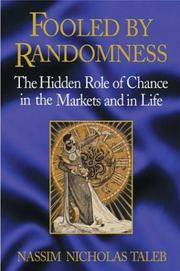
Deepens the intuition-busting started by Mlodinow by focusing on how we confuse luck with skill, especially in high-stakes domains. Read second so Taleb's provocations land on already-prepared ground.
Thinking in Probabilities
BeginnerLearn to assign probabilities to beliefs, update them with new evidence, and avoid the classic cognitive traps (base-rate neglect, conjunction fallacy, availability bias).
▸ Study plan for this stage
Pace: 10–12 weeks total, reading ~25–35 pages per day on weekdays with weekends reserved for review and exercises. Suggested split: Weeks 1–3 for "How to Measure Anything" (focus on chapters covering uncertainty, calibration, and decomposition); Weeks 4–8 for "Thinking, Fast and Slow" (the longest and den
- Calibrated uncertainty: expressing beliefs as probability ranges rather than binary yes/no answers (Hubbard's core thesis — 'you know more than you think, and you can measure it')
- The Fermi decomposition method: breaking unmeasurable-seeming problems into estimable components to assign rough but useful probabilities (Hubbard)
- Bayesian updating in plain language: starting with a prior belief and revising it systematically as new evidence arrives, without formal math (Hubbard + Kahneman)
- System 1 vs. System 2 thinking: fast intuitive judgments vs. slow deliberate reasoning, and why System 1 is the engine of most probabilistic errors (Kahneman)
- Base-rate neglect: the tendency to ignore prior probabilities in favor of vivid, specific information — illustrated through Kahneman's lawyer/engineer and medical diagnosis examples
- Conjunction fallacy: the 'Linda problem' — why people rate a specific scenario as more probable than a general one, violating the basic law of probability
- Availability bias: judging the likelihood of events by how easily examples come to mind, leading to systematic over- and under-estimation of risk (Kahneman + Dobelli)
- Cognitive error catalog: Dobelli's 99 thinking errors — including survivorship bias, the narrative fallacy, and the swimmer's body illusion — as a practical checklist for spotting distorted probability judgments in everyday life
- After reading Hubbard, can you explain why 'I can't measure that' is almost always wrong, and demonstrate a Fermi-style decomposition on an uncertain quantity in your own life?
- What is a calibration test, and how would you use Hubbard's 90% confidence interval technique to assess whether your probability estimates are systematically overconfident or underconfident?
- Using Kahneman's framework, describe a real situation where your System 1 produced a probability judgment — what heuristic was at work, and how would System 2 correct it?
- What is base-rate neglect? Walk through the 'cab problem' or 'disease screening' example from Kahneman and explain step-by-step how to incorporate the base rate into the correct probability estimate.
- Why does the conjunction fallacy occur, and what simple rule of probability does it violate? Give an original example (not the Linda problem) where you might fall into this trap.
- From Dobelli's catalog, identify three cognitive biases beyond those covered by Kahneman that distort probability estimates, and for each one describe a concrete real-world scenario where it leads to a bad decision.
- Calibration drill (Hubbard): Take a 10-question trivia quiz where for each answer you provide a 90% confidence interval rather than a single number. Score yourself — if you are well-calibrated, roughly 9 of 10 true answers should fall inside your intervals. Repeat weekly and track improvement over the 12 weeks.
- Fermi estimation journal (Hubbard): Once per week, pick an uncertain quantity from your daily life (e.g., 'How many hours will this project take?', 'What is the chance my flight is delayed?') and decompose it into sub-components to arrive at a probability estimate. Write down your reasoning and revisit the outcome.
- Bias spotting log (Kahneman + Dobelli): Keep a running journal for 4 weeks. Each day, record one decision or news story where you can identify a specific cognitive bias from Kahneman or Dobelli at work. Name the bias, explain the distortion, and write what a corrected probability estimate would look like.
- Linda-style conjunction test (Kahneman): Write five of your own 'conjunction fallacy' scenarios for friends or colleagues — craft a character description and ask them to rank probabilities. Record how many fall into the trap, then debrief them using Kahneman's explanation. Reflect on what made the trap compelling.
- Base-rate practice problems (Kahneman): Find or create 5 medical/legal/social screening scenarios (e.g., disease prevalence + test accuracy). Use a simple 2x2 frequency table — as Kahneman recommends — to compute the correct posterior probability. Compare your intuitive first guess to the calculated answer.
- Bias pre-mortem (Dobelli): Before making a significant upcoming decision (career, financial, personal), write a one-page 'bias audit': list every bias from Dobelli's book that could be distorting your view of the probabilities involved, and explicitly state how you are correcting for each one.
Next up: By the end of this stage the reader can assign, communicate, and defend calibrated probability estimates while actively guarding against the most common cognitive traps — the exact mental foundation needed to engage with more formal probabilistic and statistical reasoning in a subsequent stage on quantitative probability models and data-driven inference.
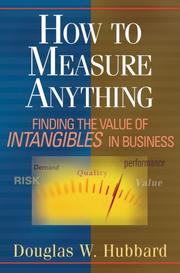
Bridges intuition and measurement: teaches that almost anything uncertain can be quantified with calibrated estimates. Introduces practical probability thinking before formal theory.

The definitive account of the cognitive biases that distort probabilistic judgment. Reading it here — after you already care about randomness — makes its lessons stick far more deeply.

A concise catalog of reasoning errors, many probability-related, that consolidates and reinforces the bias-awareness built in the previous two books before moving to formal methods.
The Formal Rules of Chance
IntermediateUnderstand the actual mathematical machinery of probability — Bayes' theorem, distributions, expected value, the law of large numbers — with enough rigor to apply it correctly.
▸ Study plan for this stage
Pace: 10–13 weeks total: "Naked Statistics" in weeks 1–3 (~25–30 pages/day, reading intuitively first); "The Theory That Would Not Die" in weeks 4–6 (~20–25 pages/day, read narratively but pause to reconstruct each Bayesian update described); "Probability Theory" by Jaynes in weeks 7–13 (~15–20 pages/day
- Sample spaces, events, and the axioms of probability (Kolmogorov foundations as implicit backdrop to Wheelan's intuitive framing)
- Conditional probability and independence — P(A|B) as the engine behind nearly every real-world inference
- Bayes' theorem: prior, likelihood, posterior, and how evidence updates belief (traced from Bayes' original insight through McGrayne's historical arc to Jaynes' formal treatment)
- Probability distributions (normal, binomial, Poisson) — their shapes, parameters, and when each applies, as introduced in Naked Statistics
- Expected value and variance — linearity of expectation, why variance matters as much as the mean
- The Law of Large Numbers and the Central Limit Theorem — why large samples converge and what 'converge' actually means mathematically
- Jaynes' Cox–Jaynes derivation: probability as an extension of logic, not merely a frequency count — the philosophical shift from frequentist to Bayesian reasoning
- Common misapplications: the prosecutor's fallacy, base-rate neglect, and confusing P(E|H) with P(H|E) — all illustrated across the three books
- After reading Naked Statistics, can you explain in plain language what a probability distribution is, what its mean and variance measure, and why the Central Limit Theorem makes the normal distribution so ubiquitous?
- McGrayne traces decades of resistance to Bayesian methods — what is the core philosophical disagreement between frequentists and Bayesians, and what practical consequences does that disagreement have?
- State Bayes' theorem symbolically (P(H|E) = P(E|H)·P(H) / P(E)) and walk through a concrete numerical example — such as a medical screening test — updating a prior to a posterior step by step.
- Jaynes argues that probability is the unique consistent extension of Boolean logic to degrees of belief — what are Cox's desiderata, and why does Jaynes consider the frequentist interpretation unnecessarily restrictive?
- What is the Law of Large Numbers, and how does it differ from the (commonly confused) Gambler's Fallacy? Use an example from Naked Statistics to illustrate.
- Given a binomial distribution with parameters n and p, how do you compute its expected value and variance, and what does each quantity tell you about the underlying random process?
- Naked Statistics warm-up drill: For five real datasets of your choice (sports scores, stock returns, exam grades), compute the mean, variance, and standard deviation by hand or in a spreadsheet, then sketch the distribution and judge whether it looks approximately normal.
- Bayes' theorem calculator: Build a simple spreadsheet (or Python script) that takes a prior probability, a likelihood, and a false-positive rate as inputs and outputs the posterior. Run it on the medical-test scenario, the spam-filter scenario, and one historical case from McGrayne (e.g., the Thresher submarine search).
- McGrayne reflection journal: After each chapter of 'The Theory That Would Not Die', write one paragraph identifying (a) what prior the protagonist held, (b) what evidence arrived, and (c) how the posterior changed — keeping the language explicitly probabilistic.
- Jaynes derivation notebook: Reproduce, on paper without looking, at least three key derivations from 'Probability Theory' — the product rule, the sum rule, and the derivation of the maximum-entropy distribution for a given mean and variance. Check your work against the text.
- Law of Large Numbers simulation: Write a short simulation (coin flips, dice rolls, or random draws from a known distribution) that plots the running average against the number of trials. Observe convergence and note how many trials are needed before the average stabilizes within 1% of the true mean.
- Fallacy audit: Collect three real news articles or court cases that involve probabilistic claims. Identify whether each commits the base-rate fallacy, the prosecutor's fallacy, or a confusion of conditional probabilities, and rewrite the claim correctly using Bayes' theorem.
Next up: By internalizing the formal rules — distributions, Bayes' theorem, expected value, and the logic-of-belief framework from Jaynes — the reader has the mathematical vocabulary needed to move from calculating probabilities in isolation to understanding how randomness and uncertainty propagate through decisions, models, and real-world systems in the next stage.
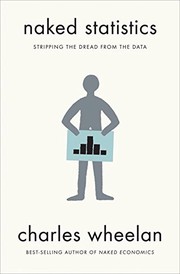
A friendly, equation-light introduction to probability and statistics that builds the formal vocabulary (distributions, variance, the central limit theorem) without overwhelming a beginner-to-intermediate reader.
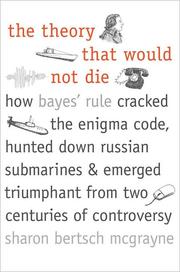
Tells the dramatic history of Bayes' theorem, making the concept deeply memorable. Reading the story before the math ensures the most important rule in probability feels meaningful, not mechanical.

The rigorous capstone of this stage: Jaynes rebuilds probability from first principles as an extension of logic. Challenging but transformative — only attempt after the prior books have built solid intuition.
Risk, Uncertainty & the Real World
ExpertApply probabilistic thinking to complex, high-stakes real-world domains — finance, science, forecasting — and understand the limits of probability models themselves.
▸ Study plan for this stage
Pace: 6–8 weeks total: ~3 weeks on "Superforecasting" (~25–30 pages/day) followed by ~3–4 weeks on "The Black Swan" (~20–25 pages/day), with a 2–3 day reflection gap between books to journal connections and contrasts.
- Superforecasting — The Brier Score and calibration: how to measure forecast accuracy quantitatively and distinguish skill from luck
- Superforecasting — Foxes vs. Hedgehogs: the cognitive style of broad, self-correcting thinkers outperforms narrow ideological experts in real-world prediction
- Superforecasting — Probabilistic thinking as a discipline: translating vague hunches into precise numerical probabilities and updating them via Bayesian reasoning as new evidence arrives
- Superforecasting — The outside view (base rates) vs. the inside view (case-specific detail), and how superforecasters blend both systematically
- The Black Swan — Black Swan events: rare, high-impact, retrospectively rationalized events that lie outside the realm of regular expectations and dominate outcomes in Extremistan
- The Black Swan — Mediocristan vs. Extremistan: domains governed by Gaussian statistics (height, weight) vs. domains with power-law dynamics (wealth, book sales, financial returns) where tail risk is decisive
- The Black Swan — The Narrative Fallacy and Ludic Fallacy: the human tendency to impose causal stories on random events and the danger of mistaking casino-style known probabilities for real-world uncertainty
- The Black Swan — The limits of probability models: why standard risk models (e.g., Gaussian VaR in finance) systematically underestimate catastrophic risk, and the distinction between risk (quantifiable) and true Knightian uncertainty (unquantifiable)
- After reading Superforecasting, can you explain what a Brier score is, calculate a simple example, and describe what 'good calibration' looks like versus overconfidence or underconfidence?
- How does Tetlock's fox/hedgehog distinction map onto real forecasting performance — what specific cognitive habits separate superforecasters from expert pundits, and why does ideological commitment hurt accuracy?
- How do Taleb's concepts of Mediocristan and Extremistan challenge the standard probabilistic toolkit taught in earlier curriculum stages — which domains are safe to model with Gaussians, and which are not?
- What is a Black Swan according to Taleb's precise definition (all three criteria), and why does he argue that Black Swans are fundamentally a property of the observer's knowledge rather than of nature itself?
- Where do Tetlock and Taleb agree and where do they fundamentally disagree about the value and limits of probabilistic forecasting? Can both views be reconciled, and if so, how?
- How do the Narrative Fallacy and the Ludic Fallacy (Taleb) relate to the cognitive biases Tetlock identifies as obstacles to good forecasting — and what practical habits do both authors recommend to counteract them?
- Forecasting log (Superforecasting): Over the reading period, make at least 15 concrete, time-bound predictions on verifiable real-world events (elections, economic indicators, sports outcomes). Assign explicit numerical probabilities (e.g., 72%), record your reasoning, and score yourself with Brier scores once outcomes are known.
- Calibration self-audit (Superforecasting): Take an online calibration quiz (e.g., Metaculus, Good Judgment Open, or PredictionBook). After finishing Superforecasting, retake it and compare scores — identify which question types reveal systematic over- or underconfidence.
- Domain classification exercise (The Black Swan): List 20 real-world phenomena (e.g., city population sizes, individual salaries, earthquake magnitudes, movie revenues, human lifespans). Classify each as Mediocristan or Extremistan, justify your reasoning, and identify which standard probability tools apply or break down for each.
- Narrative Fallacy deconstruction (The Black Swan): Find three financial or geopolitical post-mortems in news archives (e.g., a market crash, a political upset). Write a one-page analysis of each identifying the retrospective narrative imposed, what information was actually available beforehand, and whether the event meets Taleb's three-part Black Swan criteria.
- Tetlock vs. Taleb synthesis essay: Write a 600–900 word essay arguing for a unified framework: in which domains and time horizons should a practitioner follow Tetlock's disciplined probabilistic forecasting, and in which should they follow Taleb's 'be robust to what you cannot model' heuristic? Use specific examples from both books.
- Model fragility audit: Take any probabilistic model you use professionally or academically (a financial model, a scientific estimate, a business forecast). Stress-test it by asking: What are its distributional assumptions? What happens if the tail is power-law rather than Gaussian? What is the single biggest Black Swan that would invalidate it entirely? Write up your findings in a one-page memo.
Next up: By internalizing both the power and the hard limits of probabilistic models — through Tetlock's disciplined forecasting craft and Taleb's radical skepticism of thin-tailed assumptions — the reader is now equipped to engage with the deeper mathematical and philosophical foundations of probability itself, including formal decision theory, information theory, and the epistemology of uncertainty.
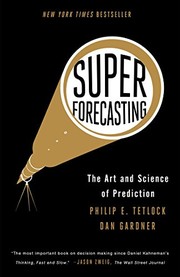
Shows what rigorous probabilistic thinking looks like in practice: how the best forecasters assign and update probabilities, and how to measure and improve your own calibration.
Challenges the limits of standard probability models by focusing on rare, high-impact events our models systematically miss. A necessary corrective after learning formal probability, not before.
Discussion
Keep reading
Paths that share books, cover the same subject, or open a related topic.