Game theory: the strategy of everything
This curriculum takes you from playful strategic intuition all the way to the formal mathematical machinery of game theory, in four carefully sequenced stages. Each stage builds on the vocabulary and mental models of the last — you'll move from storytelling and puzzles, through economic applications, into rigorous theory and cutting-edge frontiers.
Foundations: Intuition & Strategic Thinking
BeginnerDevelop a vivid, intuitive feel for strategic interaction — what it means to think about what others are thinking — without any formal math.
▸ Study plan for this stage
Pace: 8–10 weeks total (~25–30 pages/day, 5 days/week). Spend weeks 1–5 on "The Art of Strategy" (more accessible, modern examples, ideal entry point) and weeks 6–10 on "Thinking Strategically" (richer case studies and deeper strategic logic that reinforces and extends the first book).
- Strategic interdependence: your best move depends on what others do, and they know you know this
- Dominant strategies and why rational players gravitate toward them
- The Prisoner's Dilemma as the archetype of conflict between individual and collective rationality
- Backward induction: reasoning forward by thinking backward from the end of a game
- Credible commitments and threats — why burning bridges can be a power move
- First-mover vs. last-mover advantage and when each applies
- Mixed strategies and the logic of deliberate unpredictability
- Repeated games and how the 'shadow of the future' enables cooperation
- In your own words, what makes a situation 'strategic' rather than just a personal decision problem? Use a concrete example from either book.
- Why does a dominant strategy dominate, and why should a rational player always choose it even without knowing what the other player will do?
- Walk through the Prisoner's Dilemma: what outcome do individually rational players reach, why is it collectively worse, and what real-world situations does Dixit map onto this structure?
- Explain backward induction using the example of a sequential game from 'The Art of Strategy'. Where does the reasoning start, and how does it determine the first move?
- What makes a threat or commitment credible? Give one example from 'Thinking Strategically' where a player made a commitment credible and explain the mechanism.
- How does repetition change the strategic calculus of the Prisoner's Dilemma, and what conditions (from 'Thinking Strategically') make cooperation sustainable over time?
- **Game diary (ongoing):** Each day, identify one real interaction (negotiation, a sports play, a workplace decision) and write 3–5 sentences mapping it onto a concept from the current reading — who the players are, what their strategies are, and what the likely outcome is.
- **Prisoner's Dilemma role-play:** Find a partner and play 10 rounds of a simple Prisoner's Dilemma (use a coin or written notes). First 5 rounds with no communication, last 5 with pre-round talk. Record outcomes and compare them to Dixit's predictions in 'The Art of Strategy'.
- **Backward induction tree:** Draw a full game tree for a simple sequential game of your choice (e.g., Tic-Tac-Toe opening, a salary negotiation with two offers). Solve it by backward induction and write one paragraph on what the 'rational' first move is and whether it matches intuition.
- **Commitment audit:** List three commitments or threats you have made (or witnessed) in the past month. For each, evaluate its credibility using the criteria discussed in 'Thinking Strategically' — did it work? Why or why not?
- **Strategy matrix builder:** For any two-player situation you encounter (a bidding war, choosing a meeting time, a competitive project), construct a simple 2×2 payoff matrix, label the strategies, and identify any dominant strategies or Nash-like outcomes.
- **Chapter summary flashcards:** After finishing each chapter in both books, write one flashcard: front = the central strategic concept of the chapter; back = a one-sentence definition plus a real-world example you invented yourself (not one from the book).
Next up: By the end of this stage the reader has a rich library of strategic intuitions and vivid examples from Dixit's work; the next stage can now attach precise mathematical language — payoff functions, formal Nash Equilibrium, and solution concepts — to ideas the reader already feels comfortable with, making the formalism feel like a natural sharpening of intuition rather than an alien imposition.
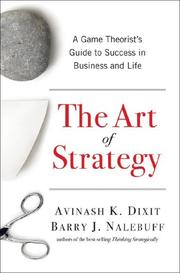
A perfect entry point: written for a general audience, it introduces core ideas like backward induction, commitment, and credible threats through everyday examples and stories. Builds the essential vocabulary you'll need for everything that follows.
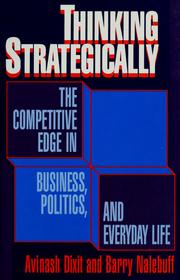
Dixit's earlier, slightly more structured companion covers a broader range of strategic situations — rivalry, cooperation, bargaining — and sharpens the intuitions from the first book with more worked examples.
Cooperation, Conflict & Social Dynamics
BeginnerUnderstand how cooperation emerges (or fails) among self-interested agents, and see game theory applied to evolution, politics, and social life.
▸ Study plan for this stage
Pace: 8–10 weeks total. Week 1–3: "The Evolution of Cooperation" (~20–25 pages/day, including re-reading the tournament chapters slowly). Week 4–6: "The Selfish Gene" (~25–30 pages/day; focus chapters on genes, altruism, and memes). Week 7–10: "Prisoner's Dilemma" (~20 pages/day; this is the most narrativ
- The Prisoner's Dilemma: the canonical two-player game where individual rationality leads to mutual defection, even though mutual cooperation would benefit both players (foundational to all three books)
- Tit-for-Tat strategy: Axelrod's tournament-winning strategy — cooperate on the first move, then mirror your opponent's last move — and why its simplicity, niceness, provocability, and forgiveness make it robust
- Iterated vs. one-shot games: how repeated interaction (the 'shadow of the future') fundamentally changes incentives and enables cooperation to emerge among self-interested agents
- Kin selection and inclusive fitness (Hamilton's rule): Dawkins' explanation of how genes 'selfishly' propagate through cooperation with genetic relatives, reframing altruism as gene-level self-interest
- Reciprocal altruism: cooperation between non-relatives sustained by the expectation of future return favors — the biological parallel to Axelrod's iterated game results
- Evolutionarily Stable Strategies (ESS): a strategy that, once adopted by a population, cannot be invaded by a mutant alternative — linking evolutionary biology to game-theoretic equilibrium
- The gene's-eye view of evolution: Dawkins' central reframing that genes, not organisms or groups, are the primary unit of selection, which explains seemingly selfless behavior without invoking group benefit
- The historical and Cold War context of game theory: Poundstone's account of how RAND Corporation, von Neumann, and the nuclear arms race gave the Prisoner's Dilemma its urgency and shaped real-world strategy
- According to Axelrod's computer tournaments, what four properties made Tit-for-Tat the winning strategy, and why did complexity and cleverness tend to backfire in competing strategies?
- How does the 'shadow of the future' — the probability that two players will meet again — change the rational choice in a Prisoner's Dilemma, and what does this imply for cooperation in anonymous vs. repeated social settings?
- What is Hamilton's Rule (rb > c), and how does Dawkins use it in 'The Selfish Gene' to explain why a gene can 'benefit' by causing an organism to sacrifice itself for close relatives?
- How do Axelrod's findings about iterated cooperation and Dawkins' concept of reciprocal altruism reinforce each other, and where do they differ in their level of analysis (strategic vs. genetic)?
- Poundstone traces how the Prisoner's Dilemma was used to model nuclear deterrence. In what ways does the arms race resemble a multi-round Prisoner's Dilemma, and where does the analogy break down?
- What is an Evolutionarily Stable Strategy, and why is a population of Tit-for-Tat players considered stable against invasion by pure defectors — but potentially vulnerable to invasion by unconditional cooperators?
- Run your own Tit-for-Tat tournament: using a spreadsheet or free online Prisoner's Dilemma simulators (e.g., Nicky Case's 'The Evolution of Trust'), pit at least 5 strategies (Always Cooperate, Always Defect, Tit-for-Tat, Grudger, Random) against each other across 20+ rounds and record which accumulates the most points — then reflect on whether your results match Axelrod's findings.
- Map a real-world conflict to the Prisoner's Dilemma matrix: choose a scenario (trade tariffs between two countries, two businesses in a price war, or roommates splitting chores) and explicitly write out the four payoff outcomes (CC, CD, DC, DD). Decide whether it is a one-shot or iterated game and predict what strategy rational actors would choose.
- Reframe three everyday cooperative behaviors (e.g., tipping at a restaurant you'll never revisit, holding a door open, sharing notes with classmates) using Dawkins' gene's-eye view and Axelrod's reciprocity framework. Write a short paragraph for each explaining which theory better accounts for the behavior and why.
- Draw a concept map connecting the key terms across all three books: place 'Prisoner's Dilemma' at the center, then branch out to Axelrod's strategies, Dawkins' kin selection and reciprocal altruism, Poundstone's historical figures (von Neumann, Nash, RAND), and ESS. Draw arrows showing how each concept supports or challenges the others.
- Write a one-page 'strategy memo' as if you are advising a government negotiator entering a multi-year trade dispute. Drawing explicitly on Axelrod's rules for promoting cooperation and Poundstone's Cold War lessons, recommend a negotiating posture and justify each element with evidence from the books.
- Keep a 'defection diary' for one week: each day, note one instance where you or someone around you defected (broke a cooperative norm) and one where cooperation was maintained. At the end of the week, analyze each case — was it a one-shot or repeated game? Was there a shadow of the future? Which book's framework best explains the outcome?
Next up: By internalizing how cooperation emerges from self-interest through repetition, reputation, and genetic logic, the reader is now equipped to tackle more formal and mathematically rigorous treatments of strategic interaction — such as Nash equilibria, mixed strategies, and mechanism design — where these intuitions are given precise, generalized structure.
Axelrod's famous tournament study of the Prisoner's Dilemma shows concretely how cooperation can evolve without central authority — a landmark result that makes iterated games feel real and important.

Introduces evolutionary game theory (ESS, hawks vs. doves) through the lens of biology. Reading it here deepens your understanding of strategic equilibria as stable outcomes, not just rational choices.

A narrative history of game theory centered on the Prisoner's Dilemma and the RAND Corporation. Provides crucial historical and human context — who invented these ideas and why — before you dive into formal models.
The Core Theory: Nash, Auctions & Bargaining
IntermediateMaster the central formal concepts — Nash equilibrium, dominant strategies, auctions, and negotiation — and be able to model and solve standard games.
▸ Study plan for this stage
Pace: 10–12 weeks total. Weeks 1–7: "Games of Strategy" by Dixit (~25–35 pages/day, covering sequential and simultaneous games, Nash equilibrium, dominant strategies, and bargaining chapters). Weeks 8–12: "Auction Theory" by Krishna (~20–25 pages/day, working through single-object auctions, revenue equiva
- Nash Equilibrium: definition, existence conditions, and how to find all pure and mixed-strategy equilibria in normal-form games (Dixit, Ch. 4–5)
- Dominant and Dominated Strategies: iterated elimination of dominated strategies (IESDS) and its relationship to rationalizability (Dixit, Ch. 4)
- Sequential Games & Backward Induction: game trees, subgame perfect equilibrium, and credible threats vs. empty threats (Dixit, Ch. 3 & 6)
- Mixed Strategies: when and why players randomize, computing mixed Nash equilibria, and interpreting them as beliefs (Dixit, Ch. 7)
- Bargaining Theory: Nash bargaining solution, alternating-offers (Rubinstein) framework, and the role of outside options and patience (Dixit, Ch. 17)
- Auction Formats: English, Dutch, first-price sealed-bid, and second-price (Vickrey) auctions — rules, strategic behavior, and equilibrium bidding (Krishna, Ch. 1–2)
- Revenue Equivalence Theorem: conditions under which all standard auction formats yield the same expected revenue to the seller (Krishna, Ch. 3)
- Optimal Auctions & Mechanism Design Basics: reserve prices, the revelation principle, and Myerson's optimal auction framework (Krishna, Ch. 5)
- Given a payoff matrix, can you identify all dominant strategies, apply IESDS, and find every pure- and mixed-strategy Nash equilibrium — and explain why each qualifies as an equilibrium?
- How does backward induction in Dixit's sequential-game framework eliminate non-credible threats, and what distinguishes a subgame perfect equilibrium from a plain Nash equilibrium?
- What is the intuition and formal result of the Revenue Equivalence Theorem in Krishna, and what assumptions (symmetric bidders, independent private values) must hold for it to apply?
- How do bidding strategies differ between a first-price sealed-bid auction and a second-price auction according to Krishna's equilibrium analysis, and why does truthful bidding dominate in the Vickrey format?
- Using Dixit's bargaining chapter, how do discount factors and outside options determine the split of surplus in an alternating-offers bargaining game, and what happens as the time between offers shrinks?
- What is Myerson's optimal reserve price, how is it derived from the virtual valuation concept in Krishna, and why might a seller ever exclude a positive-value buyer?
- Matrix Drills (Dixit Ch. 4–5): Write out 5 original 2×2 and 2×3 payoff matrices. For each, perform IESDS, find all Nash equilibria (pure and mixed), and verify each equilibrium by checking unilateral deviation.
- Game Tree Construction (Dixit Ch. 3 & 6): Model a real-world sequential interaction (e.g., an entry-deterrence scenario or a salary negotiation) as an extensive-form game tree. Apply backward induction, identify the subgame perfect equilibrium, and flag any non-credible threats.
- Bargaining Simulation (Dixit Ch. 17): Pair up with a study partner and run a 5-round alternating-offers bargaining game with a fixed 'pie' and a chosen discount factor δ. Solve analytically for the equilibrium split, then compare to your actual negotiated outcome and discuss discrepancies.
- Auction Bidding Lab (Krishna Ch. 1–3): Simulate a 4-bidder private-value auction in a spreadsheet. Assign random valuations drawn from U[0,1], compute equilibrium bids for first-price and second-price formats, record revenues across 50 rounds, and verify that average revenues converge as predicted by the Revenue Equivalence Theorem.
- Virtual Valuation Worksheet (Krishna Ch. 5): For a uniform distribution F(v) = v on [0,1] and a linear distribution of your choice, derive the virtual valuation function ψ(v), solve for Myerson's optimal reserve price, and show algebraically how the reserve changes as the valuation distribution becomes more dispersed.
- Concept Mapping Synthesis: After finishing both books, draw a single concept map linking Nash equilibrium → dominant strategies → auction equilibria → revenue equivalence → optimal mechanism design. Annotate each link with the key theorem or result from Dixit or Krishna that justifies it.
Next up: Mastering Nash equilibrium, auction formats, and bargaining here gives you the formal toolkit — payoff matrices, equilibrium concepts, and mechanism design logic — needed to tackle the richer, more complex settings of repeated games, incomplete information, and signaling that characterize advanced game theory study.
The ideal bridge to formal game theory: a rigorous but accessible undergraduate textbook that covers Nash equilibrium, sequential games, repeated games, and auctions with clear exposition and rich problem sets.

The definitive graduate-level text on auction design and bidding strategy. Reading it after Games of Strategy lets you apply equilibrium thinking to one of game theory's most practically important domains.
The Real Machinery: Graduate-Level Rigor
ExpertCommand the full mathematical framework of game theory — including Bayesian games, mechanism design, and equilibrium refinements — at the level expected of researchers and advanced practitioners.
▸ Study plan for this stage
Pace: 20–26 weeks total. Weeks 1–14: Fudenberg's "Game Theory" (~25–35 pages/day, 5 days/week) — work through chapters sequentially, pausing an extra day on technically dense sections (e.g., perfect Bayesian equilibrium, reputation, repeated games). Weeks 15–26: Tirole's "The Theory of Industrial Organiza
- Nash equilibrium existence and uniqueness proofs (fixed-point theorems, Kakutani's theorem) as developed in Fudenberg
- Extensive-form games: subgame perfect equilibrium, backward induction, and the one-deviation principle (Fudenberg)
- Bayesian games and Bayesian Nash equilibrium: incomplete information, type spaces, and interim vs. ex-ante payoffs (Fudenberg)
- Perfect Bayesian equilibrium and sequential equilibrium: belief consistency, Bayes' rule on and off the equilibrium path (Fudenberg)
- Equilibrium refinements: trembling-hand perfection, proper equilibrium, forward induction, and the intuitive criterion (Fudenberg)
- Repeated games: folk theorems, discounting, trigger strategies, and reputation effects in finite vs. infinite horizons (Fudenberg)
- Mechanism design and implementation theory: revelation principle, incentive compatibility, individual rationality, and the Myerson–Satterthwaite theorem (Fudenberg)
- Industrial organization applications: market structure, entry deterrence, vertical restraints, price discrimination, and R&D competition analyzed through the lens of strategic interaction (Tirole)
- Given a multi-stage game of incomplete information, how do you construct a perfect Bayesian equilibrium, and what belief-consistency conditions must hold both on and off the equilibrium path — as formalized in Fudenberg?
- What is the intuitive criterion, and how does it refine the set of PBE in signaling games? Walk through a concrete signaling example from Fudenberg and verify which equilibria survive.
- State and prove (or carefully sketch) the folk theorem for infinitely repeated games with discounting as presented in Fudenberg: what discount factor thresholds are required, and how do trigger strategies sustain cooperation?
- How does Tirole use the tools of subgame perfect equilibrium and commitment to model entry deterrence and limit pricing? What distinguishes separating from pooling equilibria in these industrial settings?
- Explain the revelation principle and its role in mechanism design (Fudenberg). How does Tirole apply incentive-compatibility constraints in models of regulation and vertical contracting?
- Compare trembling-hand perfect equilibrium and sequential equilibrium as refinement concepts in Fudenberg: when do they agree, when do they diverge, and why does the distinction matter for applied modeling in Tirole?
- Proof-writing drill (Fudenberg): Reproduce the proof of Nash equilibrium existence via Kakutani's fixed-point theorem from scratch, then construct a 3-player game and verify all Nash equilibria by hand using best-response correspondences.
- Equilibrium refinement audit (Fudenberg): Take three signaling games from the text, enumerate all PBE, then apply the intuitive criterion and Cho–Kreps D1 criterion to prune them — document exactly which beliefs are eliminated and why.
- Folk theorem simulation (Fudenberg): For a symmetric Prisoner's Dilemma, derive analytically the minimum discount factor δ* that sustains cooperation under grim-trigger and tit-for-tat strategies; then extend to an asymmetric payoff matrix and compare δ* values.
- Mechanism design construction (Fudenberg): Design an optimal auction for two bidders with uniformly distributed valuations — derive the optimal reserve price using the Myerson framework, verify incentive compatibility and individual rationality constraints algebraically.
- Industrial organization modeling (Tirole): Replicate Tirole's Stackelberg entry-deterrence model — set up the extensive form, solve by backward induction for the incumbent's capacity choice, and perform comparative statics on entry costs and demand elasticity.
- Integrated research memo: Choose one topic where Fudenberg's theory and Tirole's application directly intersect (e.g., reputation in repeated games ↔ Tirole's models of predatory pricing) — write a 3–5 page technical memo that states the relevant theorems from Fudenberg, maps them onto Tirole's model assumptions, and identifies one assumption in Tirole that, if relaxed, would change the equilibriu
Next up: Mastering the full mathematical apparatus in Fudenberg and seeing it deployed in Tirole's rich industrial settings equips the reader to engage with frontier research literature — empirical industrial organization, auction design, market design, and behavioral game theory — where these tools are taken as prerequisites and extended or challenged.
The canonical graduate textbook (Fudenberg & Tirole) covering the complete formal theory: extensive forms, repeated games, reputation, and equilibrium refinements. This is the standard reference for serious study.
Tirole applies game-theoretic tools to markets, competition, and regulation with extraordinary depth. Reading it last shows you how the full machinery is deployed to explain real economic phenomena — a fitting capstone.
Discussion
Keep reading
Paths that share books, cover the same subject, or open a related topic.