Learn calculus: intuition before the machinery
This curriculum starts with pure intuition and visual storytelling before introducing any formulas, then layers in technique, and finally builds toward genuine mathematical fluency. Each stage assumes the previous one is complete, so the vocabulary and mental models needed for each new book are already in place by the time you open it.
Intuition First
BeginnerUnderstand WHY calculus exists, what limits, derivatives, and integrals actually mean in plain English, and feel comfortable with the core ideas before seeing a single formal definition.
▸ Study plan for this stage
Pace: 6–8 weeks total: Weeks 1–2 on "The Joy of X" (~20–25 pages/day, reading leisurely and reflectively); Weeks 3–7 on "Infinite Powers" (~15–20 pages/day, pausing to sketch diagrams and re-read key passages); Week 8 as a consolidation week for review, journaling, and exercises — no new reading required.
- Why calculus was invented: the need to handle continuously changing quantities that algebra alone cannot capture, as motivated throughout Infinite Powers by the 'infinity principle'
- The idea of infinity as a tool, not a problem: slicing things into infinitely many tiny pieces to make hard problems tractable (Strogatz's 'Infinity Principle' in Infinite Powers)
- Limits as the bridge between the finite and the infinite: the intuition that you can get arbitrarily close to an answer without ever causing a contradiction
- The derivative as the instantaneous rate of change: understanding slope not as 'rise over run' on a straight line but as the limit of smaller and smaller secant lines on a curve
- The integral as accumulated area (or accumulated change): summing infinitely many infinitely thin slices to find totals — area, distance, volume, etc.
- The Fundamental Theorem of Calculus at an intuitive level: differentiation and integration are opposites of each other, like zooming in and zooming out
- Real-world meaning over symbol manipulation: Strogatz consistently grounds every idea in physics, biology, medicine, and everyday life — the reader should internalize this habit of asking 'what does this MEAN?'
- Mathematical humility and playfulness: both books model the attitude that confusion is normal, intuition comes before rigor, and curiosity is the engine of understanding
- In your own words — no formulas allowed — why did Newton and Leibniz need to invent calculus? What kinds of problems were impossible to solve without it, according to Infinite Powers?
- Strogatz describes the 'Infinity Principle' as the secret heart of calculus. What is it, and can you give one example from the book where slicing something infinitely small actually solves a real problem?
- What is a derivative trying to tell you about a curve? If someone asked you 'what is the speed of a falling ball at exactly 3 seconds?' how would you explain — in plain English — why that question even needs calculus to answer?
- What does an integral represent physically? Using an example from Infinite Powers (such as area under a curve or accumulated distance), explain why adding up infinitely many slices gives you a meaningful, finite answer.
- What is the relationship between a derivative and an integral? Without using the phrase 'Fundamental Theorem,' describe in a sentence or two why these two operations undo each other.
- The Joy of X argues that mathematics is deeply connected to the rest of human experience. How did reading it change (or reinforce) your attitude toward math as a subject — and how does that mindset prepare you for studying calculus formally?
- Sketch-the-idea journal: After every reading session, close the book and draw one diagram or doodle that captures the main idea in purely visual terms — no equations. By the end of the stage you should have 20+ sketches forming a personal visual glossary of calculus intuition.
- The shrinking-secant experiment: Draw any smooth curve on graph paper (a hill, a wave, anything). Draw a straight line connecting two points on it. Now move the points closer together and redraw the line. Do this 5–6 times. Write one sentence describing what you notice — this is the derivative, lived experience first.
- Slice-and-sum estimation: Pick a simple irregular shape (trace your hand, cut out a map of a lake). Overlay a grid and count squares to estimate the area. Then use a finer grid. Record your estimates. Reflect in writing on how this connects to Strogatz's description of integration in Infinite Powers.
- Real-world rate-of-change hunt: For one week, collect 5 real-life examples of quantities that change continuously (temperature through the day, phone battery %, your walking speed). For each, write one sentence about what its derivative would mean and one sentence about what its integral would mean — in plain English only.
- Explain-it-to-a-friend challenge: After finishing Infinite Powers, write a 1-page letter to a curious 14-year-old explaining what calculus is and why it matters. You may not use a single formula. Draw on specific stories and examples from the two books.
- Concept-connection map: On a blank page, write the five words — INFINITY, LIMIT, DERIVATIVE, INTEGRAL, CHANGE — and draw lines between any two that are related. Label each line with a phrase explaining the connection. Compare your map before and after the stage to see how your understanding deepened.
Next up: By the end of this stage the reader has a vivid mental picture of what calculus is trying to do and why it works, which means the formal definitions, algebraic rules, and symbolic notation introduced in a standard calculus textbook will feel like precise language for ideas already understood — not mysterious abstractions to be memorized.

A warm, story-driven tour of mathematical thinking that dissolves math anxiety and builds the mindset needed to engage with calculus seriously. Read this first to get comfortable thinking like a mathematician.

Strogatz tells the full human story of calculus — why it was invented, what problems it solves, and what derivatives and integrals really mean — entirely through intuition and narrative, with almost no formulas. The perfect conceptual foundation before any technique.
Gentle Technique
BeginnerLearn to actually compute limits, derivatives, and integrals using friendly, example-driven explanations, building procedural confidence alongside conceptual understanding.
▸ Study plan for this stage
Pace: 8–10 weeks total: Weeks 1–3 cover "Calculus Made Easy" (~20–25 pages/day, reading slowly and working every example by hand); Weeks 4–10 cover "The Calculus Lifesaver" (~30–35 pages/day, pausing at each worked example to attempt it independently before reading Banner's solution).
- Limits as the foundation of calculus — understanding what it means for a function to approach a value, introduced intuitively in Thompson's 'What Is a Limit?' chapters before Banner's formal ε-δ framing
- The derivative as a rate of change — Thompson's 'dy/dx' notation demystified through his 'small quantities' philosophy, reinforced by Banner's systematic differentiation rules
- Core differentiation rules — power rule, product rule, quotient rule, and chain rule, all developed with concrete examples in both books
- Derivatives of transcendental functions — exponential, logarithmic, and trigonometric functions, covered procedurally in Thompson and consolidated with more variety in Banner
- The integral as the reverse of differentiation (antiderivative) and as a sum of infinitely thin slices — Thompson's 'Integrating as the Reverse of Differentiating' chapters paired with Banner's area-under-the-curve treatment
- Fundamental Theorem of Calculus — the bridge connecting differentiation and integration, made explicit in Banner's structured exposition after Thompson builds the intuition
- Techniques of integration — basic substitution and simple standard forms introduced in Thompson, expanded by Banner into a reliable procedural toolkit
- Reading and trusting mathematical notation — both books together train the reader to decode dy/dx, ∫f(x)dx, and limit notation without fear
- Given a simple polynomial or trigonometric function, can you compute its derivative step-by-step using the rules Thompson introduces, and verify your answer using Banner's more formal presentation of the same rules?
- Can you explain in plain language — as Thompson demands throughout 'Calculus Made Easy' — what a derivative actually represents, and give a real-world example of a rate of change?
- Can you apply the chain rule correctly to a composite function, following the worked examples in both Thompson and Banner, and identify where errors most commonly occur?
- Can you evaluate a definite integral by finding the antiderivative and applying the limits of integration, as demonstrated in Thompson's integration chapters and Banner's Fundamental Theorem section?
- Can you use basic u-substitution to simplify and solve an integral that does not fit a standard form directly, following the method Banner lays out?
- Can you describe, in your own words, why the Fundamental Theorem of Calculus means that differentiation and integration are inverse operations — using the intuition Thompson builds and the structure Banner provides?
- **Thompson Transcription Drill:** For every worked example in 'Calculus Made Easy', close the book after reading the setup, derive the answer yourself on paper, then open the book to compare — note every step where your reasoning diverged.
- **Rate-of-Change Journal:** Pick 5 real-world scenarios (e.g., distance/speed, water filling a tank, cooling coffee) and write out the function, its derivative, and a one-sentence interpretation in Thompson's plain-English style.
- **Rule Isolation Practice:** Create a set of 20 functions — 5 each requiring the power rule, product rule, quotient rule, and chain rule — and differentiate each, then check against Banner's examples and rule summaries.
- **Banner Example Race:** Before reading each of Banner's fully worked examples, attempt the problem cold with a timer (5–10 minutes). Record whether you got it right, got stuck on setup, or got stuck on algebra — track your pattern over the 7 weeks.
- **Integration Reversal Check:** Take 10 derivatives you computed from Thompson, then integrate the resulting expressions to recover the original function — this cements the Fundamental Theorem as a lived experience rather than an abstract statement.
- **Weekly One-Page Summary:** At the end of each week, write a single handwritten page (no more) summarizing what you learned in your own words, with one example you found hard and one you found satisfying — this mirrors Thompson's conversational philosophy and forces active recall.
Next up: By the end of this stage the reader can fluently compute limits, derivatives, and integrals on routine functions and has the procedural confidence to engage with rigorous definitions — setting the stage for a more formal, proof-oriented treatment of calculus where the "why" behind every rule is established with mathematical precision.

Written in 1910 and still unbeaten for clarity, this book strips calculus down to its simplest mechanical core. After Strogatz's intuition, Thompson shows you the rules without intimidation — the ideal bridge to formal study.

A comprehensive, conversational walkthrough of a full first-year calculus course. Banner anticipates every point of confusion and explains it in plain language, making this the best single 'friendly textbook' to cement technique after Thompson.
Standard Fluency
IntermediateWork through a rigorous, complete calculus curriculum — including multivariable calculus — with proper definitions, proofs, and a wide range of problems, achieving the fluency expected of a math or science undergraduate.
▸ Study plan for this stage
Pace: 6–9 months total. Phase 1 — Spivak's "Calculus": 4–5 months at ~15–20 pages/day, 5 days/week (the density of Spivak demands slow, proof-focused reading; budget extra time for problem sets, which are non-negotiable). Phase 2 — Stewart's "Multivariable Calculus, Hybrid": 2–3 months at ~20–25 pages/day
- The epsilon-delta definition of limits and its use in rigorous proofs (Spivak Ch. 5–6): understanding limits not as intuition but as a precise logical statement
- Continuity, the Intermediate Value Theorem, and the Extreme Value Theorem with full proofs — appreciating why completeness of the reals is essential (Spivak Ch. 7–8)
- The derivative defined as a limit of difference quotients, differentiation rules derived from first principles, and the Mean Value Theorem with its consequences (Spivak Ch. 9–11)
- Riemann integration: upper and lower sums, integrability criteria, and the proof of the Fundamental Theorem of Calculus in both directions (Spivak Ch. 13–15)
- Sequences and series of functions, convergence tests, Taylor series with remainder (Lagrange form), and the radius of convergence (Spivak Ch. 22–24)
- Vectors, dot and cross products, lines and planes in ℝ³, and the geometry of three-dimensional space as the foundation for multivariable work (Stewart Ch. 12)
- Partial derivatives, the gradient, directional derivatives, the Chain Rule for multivariable functions, and Lagrange multipliers for constrained optimization (Stewart Ch. 14)
- Multiple integrals (double and triple) in Cartesian, polar, cylindrical, and spherical coordinates, plus line integrals, surface integrals, and the theorems of Green, Stokes, and Gauss (Stewart Ch. 15–16)
- Given an epsilon > 0, can you construct a delta > 0 from scratch to prove that a specific limit holds, and can you identify where the argument would fail for a discontinuous function?
- Can you state and prove the Fundamental Theorem of Calculus (both parts) using Spivak's definitions of the integral, and explain what hypotheses are truly necessary?
- Can you explain why a function can be differentiable everywhere yet have a divergent Taylor series, and what conditions (e.g., analyticity) prevent this?
- Given a multivariable function f(x, y, z), can you compute the gradient, interpret it geometrically, find critical points, classify them using the second-derivative test, and solve a constrained optimization problem with Lagrange multipliers?
- Can you set up and evaluate a triple integral by choosing the most efficient coordinate system (Cartesian, cylindrical, or spherical) for a given solid region, including correctly determining the limits of integration?
- Can you state Green's Theorem, Stokes' Theorem, and the Divergence Theorem, identify which applies to a given problem, and use them to convert between difficult line/surface integrals and easier double/triple integrals?
- Spivak problem sets (non-negotiable): Complete at least 60–70% of the problems at the end of each chapter in Spivak, prioritizing the starred problems on limits, derivatives, and integration — these are where the real learning happens; keep a dedicated proof-writing notebook.
- Epsilon-delta drill: For at least 10 functions of increasing complexity (polynomials → rational → trigonometric), write out a complete formal epsilon-delta proof of a limit from scratch, then self-critique for logical gaps before checking any solution.
- FTC reconstruction exercise: Without looking at the book, re-derive both parts of the Fundamental Theorem of Calculus, writing every step and every hypothesis explicitly; then construct a counterexample showing what breaks if a hypothesis is dropped.
- Taylor series laboratory: For sin(x), cos(x), eˣ, and ln(1+x), derive the Taylor series from the definition, compute the Lagrange remainder for a specific truncation, and use it to bound the approximation error for a concrete numerical value.
- Gradient and optimization workshop (Stewart): For 8–10 multivariable functions, compute the gradient by hand, sketch level curves, find and classify all critical points, then solve a related Lagrange multiplier problem — verify answers using the second-derivative test matrix (Hessian).
- Vector calculus theorem circuit: Choose one closed curve and one surface per theorem (Green's, Stokes', Divergence); compute both sides of each theorem independently, verify they agree, and write a one-paragraph explanation of what the equality is geometrically saying — this forces both computational fluency and conceptual understanding.
Next up: By mastering rigorous single-variable proofs in Spivak and developing computational fluency across multivariable and vector calculus in Stewart, the reader has the mathematical maturity and toolkit — epsilon-delta reasoning, convergence theory, and integral theorems — needed to transition into real analysis and advanced mathematics, where these ideas are generalized to abstract metric spaces and m

Spivak's book is the gold standard for understanding calculus the way mathematicians do. It introduces real rigor — epsilon-delta limits, careful proofs — while remaining beautifully written. Coming after Banner, the reader now has the technique to appreciate the depth.

The world's most widely used calculus textbook, covering single- and multivariable calculus with exhaustive examples and problem sets. Use it alongside or after Spivak as a comprehensive reference and problem-solving resource.
Deeper Foundations — Real Analysis
ExpertUnderstand calculus from the ground up as a rigorous mathematical theory — mastering the formal definitions of limits, continuity, differentiation, and integration that make everything provably true.
▸ Study plan for this stage
Pace: 16–20 weeks total: Weeks 1–9 on Abbott's "Understanding Analysis" (~25–30 pages/day, 3–4 days/week — read slowly, prove every theorem independently before reading Abbott's proof); Weeks 10–20 on Rudin's "Principles of Mathematical Analysis" (~15–20 pages/day, 4–5 days/week — Rudin is dense; budget e
- The ε–δ (epsilon-delta) definition of limits and its logical structure — quantifier order matters (∀ε>0, ∃δ>0 …)
- Completeness of the real numbers: the Axiom of Completeness, least upper bounds (suprema), and why ℝ is fundamentally different from ℚ (Abbott Ch. 1–2; Rudin Ch. 1)
- Sequences and series: convergence, Cauchy sequences, absolute vs. conditional convergence, and the Cauchy criterion (Abbott Ch. 2; Rudin Ch. 3)
- Rigorous continuity: the ε–δ definition, equivalent sequential characterization, uniform continuity, and the Extreme and Intermediate Value Theorems as consequences of completeness (Abbott Ch. 4; Rudin Ch. 4)
- Formal differentiation: the derivative as a limit of difference quotients, Mean Value Theorem, and Taylor's Theorem with remainder (Abbott Ch. 5; Rudin Ch. 5)
- The Riemann integral: Darboux/Riemann sum construction, integrability criteria, and the Fundamental Theorem of Calculus proved rigorously (Abbott Ch. 7; Rudin Ch. 6)
- Sequences and series of functions: pointwise vs. uniform convergence, the Weierstrass M-test, and interchange of limits with differentiation/integration (Abbott Ch. 6; Rudin Ch. 7)
- Metric space topology (Rudin Ch. 2): open/closed sets, compactness, connectedness, and how these abstract concepts unify and generalize all earlier theorems
- State the ε–δ definition of lim_{x→c} f(x) = L precisely. Why does the order of the quantifiers ∀ε and ∃δ matter, and what goes wrong if you swap them?
- What is the Axiom of Completeness, and how does Abbott use it in Chapter 1 to prove that ℚ has 'gaps'? How does Rudin's construction of ℝ in Chapter 1 make this rigorous?
- Prove that a continuous function on a closed, bounded interval [a, b] attains its maximum. Which properties of ℝ (completeness, compactness in Rudin's language) are essential to the proof?
- What is the difference between pointwise and uniform convergence of a sequence of functions? Give an example (from Abbott Ch. 6) where pointwise convergence fails to preserve continuity, and explain why uniform convergence saves it.
- State and prove the Fundamental Theorem of Calculus (both parts) using the Riemann integral as defined via Darboux sums. What hypothesis is essential for each part?
- How does Rudin's treatment of compactness in metric spaces (Ch. 2) generalize the Heine-Borel theorem, and why does this matter for proving theorems about continuous functions?
- Abbott proof-writing warm-up: For each of the first 20 theorems in Abbott (Chs. 1–3), close the book and write a complete ε–δ or supremum-based proof from scratch, then compare line-by-line with Abbott's version. Note every logical gap in your attempt.
- Rudin problem sets: Complete every exercise in Rudin Chapters 1–4 (approximately 80 problems). These are non-negotiable — Rudin's exercises are where the real learning happens. Keep a dedicated notebook; revisit any problem you cannot solve within 30 minutes after a 24-hour break.
- Convergence zoo: Construct your own personal 'example library' — find or invent one concrete example for each of these: (a) a sequence that is Cauchy but whose limit is irrational, (b) a series that converges conditionally but not absolutely, (c) a function that is integrable but not continuous, (d) a sequence of continuous functions converging pointwise to a discontinuous limit. Write a one-parag
- Uniform vs. pointwise experiment: Take f_n(x) = x^n on [0,1]. Compute the pointwise limit, verify it is discontinuous at x=1, then prove rigorously (using Abbott's Ch. 6 definitions) that the convergence is NOT uniform. Then find a sub-interval [0, r] with r < 1 where it IS uniform and prove it.
- FTC reconstruction: Without looking at either book, write a self-contained 2-page proof of both parts of the Fundamental Theorem of Calculus starting from the Darboux sum definition of the integral. Identify exactly which lemmas you need and prove them too.
- Metric space translation exercise: Take any three theorems you proved using ℝ-specific arguments (e.g., Extreme Value Theorem, Bolzano-Weierstrass) and re-derive them using only Rudin's metric space / compactness language from Chapter 2. This forces you to see which properties of ℝ are truly essential.
Next up: Mastering Abbott's intuition-first approach and Rudin's austere metric-space formalism equips the reader with the proof fluency and topological vocabulary needed to tackle multivariable calculus, measure theory, or complex analysis — fields where the single-variable scaffolding built here is extended, abstracted, and stress-tested in higher dimensions.

The most readable introduction to real analysis, written explicitly for students who have done calculus and now want to understand WHY it works. Abbott's conversational style makes the leap to rigorous proof feel natural rather than brutal.
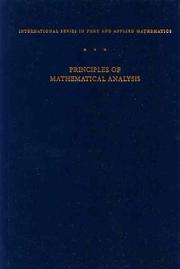
Known simply as 'Baby Rudin,' this is the canonical advanced text that every serious mathematician has worked through. Terse, elegant, and complete — the final destination for anyone who wants genuine, uncompromising fluency in the foundations of calculus.
Discussion
Keep reading
Paths that share books, cover the same subject, or open a related topic.