Peter Ackroyd Reading Order: Where to Start
Peter Ackroyd has written more than fifty books, and they divide into three kinds: the great biographies of places, the literary biographies of Londoners, and a six-volume narrative history of England. He also writes novels, but the non-fiction is the spine and the right place to start. This path opens with the biography of London itself, moves to the river and the two best literary lives, then takes the History of England in its proper volume order and closes with the novels.
Start With the City
BeginnerRead the book Ackroyd is best known for and learn his central idea — that places have continuous character across centuries.
▸ Study plan for this stage
Pace: Two big books, about 1,340 pages together, and six to eight weeks is honest. London: The Biography is 828 pages and is the one that determines whether the rest of this path is for you. Read it slowly and out of order if you like — this is important enough to say plainly: it is arranged thematically,
- The central Ackroyd claim, which every other book on this path assumes: that a place has a continuous character across centuries, and that the same activity recurs on the same ground regardless of who is doing it
- Thematic organisation as an argument, not a filing choice — by refusing chronology he is asserting that 1350 and 1850 are contemporaries in the same street
- The city as an organism, which is why the book is called a biography: it eats, it grows, it has a childhood, it has diseases, and the metaphor is pressed literally rather than decoratively
- The Thames as a spine rather than a boundary, and the difference between a river read from source to sea and a city read by theme
- Ackroyd's evidence base is overwhelmingly literary and anecdotal rather than statistical, which is a real methodological choice with real costs — professional historians have said so — and noticing where he quotes a pamphlet instead of a record is part of reading him well
- The recurring London types: the mob, the antiquary, the child worker, the visionary. Each returns across chapters in different centuries and they are the book's actual characters
- Repetition as a structural device. The same anecdote will surface twice in different chapters doing different work, and this is deliberate rather than sloppy
- What does Ackroyd mean when he says London is a body, and where does the metaphor stop being useful?
- Pick one thematic chapter. What does organising it that way reveal that a chronological account would have buried, and what does it cost in causation?
- How does he handle the periods where London genuinely changed rather than repeated — the Fire, the Blitz, the Victorian rebuilding? Does the continuity thesis survive them?
- The Thames covers a much narrower subject with the same method. Does the technique work better or worse when the subject is smaller?
- What kind of evidence does Ackroyd trust most, and what would a social historian working from parish records say about that?
- After both books, can you state his thesis about England in one sentence? You will need it for the next four hundred pages of biography and the next six volumes of history.
- Read the contents page of London: The Biography before anything else, and pick three chapters that interest you to read first. Reading it front to back is not required and is often how people abandon it.
- Keep a note of every anecdote that appears more than once. By the end you will have a list of about a dozen, and that list is a fair summary of what Ackroyd thinks London is.
- After The Thames, walk or trace on a map a stretch of the river he describes and check what is still there. The books are twenty-five and eighteen years old and the tidal Thames has changed in specific ways.
- Stop after The Thames and decide honestly whether you want the History of England. If the thematic method irritated you rather than delighted you, the six volumes will be a slog and the biographies are the better continuation.
Next up: With the city established as a character, the two biographies that follow are the same argument narrowed to one man each — London seen through the two Londoners who did most to shape how it imagines itself.
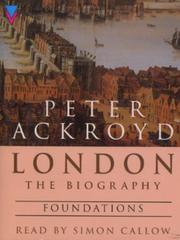
Eight hundred pages on London arranged by theme rather than chronology — plague, noise, drink, light, the river. Start here without hesitation: it is his masterpiece and it establishes the method every other book on this path uses.
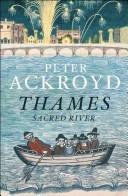
The companion volume, following the river from source to sea and treating it as a living thing. Read second — same technique, smaller subject, and it works as a check on whether you like the method enough for the History of England. Published in the United States as Thames: Sacred River.
The Two Great Lives
IntermediateRead the literary biographies, where Ackroyd's Londoners are treated as expressions of the city he has just described.
▸ Study plan for this stage
Pace: Roughly 1,580 pages across two books, and Dickens alone is over 1,100 of them. Give the Dickens three months and do not pretend otherwise; it is one of the longest literary biographies in English and it is not skimmable. Blake, at 400 pages, is a month and is much the easier read. Read Dickens first
- Dickens as a walker: he covered enormous distances through London at night, and Ackroyd builds the whole biography on the claim that the novels are a record of that walking
- The invented interludes and what they are for — Ackroyd is arguing that a biography of an imaginative writer that stays inside the documents misses the subject, which is a defensible position and also the book's most attacked feature
- The public reading tours, the mesmerism, the theatricals: Dickens as a performer whose work was written to be spoken, and how that changes the way you should read the prose
- Ellen Ternan, the separation from Catherine, and the destruction of correspondence — an example of a biographer working around a deliberate hole in the record, and worth watching for how he signals what he cannot know
- Blake's Londonness as the purest case of the continuity thesis: an engraver who barely left the city and saw eternity in it, which is exactly the argument Ackroyd wants to make about English imagination
- The illuminated books as objects. Blake printed and coloured them himself, so the poems cannot be read properly as plain text, and Ackroyd is good on the physical craft
- The English visionary tradition as Ackroyd constructs it — a line running through Blake and Dickens and forward, which is a real critical claim and one you should be able to state and doubt
- Do the invented interludes in Dickens earn their place? Answer it after reading at least three of them, not after the first.
- What does Ackroyd's Dickens spend his energy on that a conventional literary biography would have compressed, and what does he compress that you expected at length?
- How does Ackroyd handle the separation from Catherine Dickens and the relationship with Ellen Ternan, given how much evidence Dickens destroyed?
- Blake is far shorter than Dickens. Is that a judgement about the subject, about the surviving material, or about the biographer's interest?
- What exactly is the visionary tradition Ackroyd claims links these two men, and would either of them have recognised the description?
- Having read both, has your reading of London: The Biography changed? Which of its claims do the lives support and which do they strain?
- Read one Dickens novel alongside the biography rather than before it — Bleak House or Our Mutual Friend if you have a choice, because both are the London book in fiction. The biography is much richer with a novel running in parallel.
- Look at reproductions of Blake's illuminated plates while reading the Blake, not afterwards. The Songs are available in facsimile everywhere online and the text alone is half the work.
- Trace one of Dickens's night walks on a modern London map. Ackroyd gives you enough detail to do it and it makes the central argument physical.
- Mark every interlude in Dickens as you reach it and write one line on what it is doing. By the fourth you will have a settled opinion, which is more than most of the book's reviewers managed.
- Budget the Dickens properly. Three chapters a week, finished in three months, beats two heroic weekends and an abandoned book at page 400.
Next up: Two lives lived inside one city have shown the continuity argument at human scale, which is the right preparation for the six volumes where Ackroyd tries to run the same argument across the whole country and fifteen hundred years.
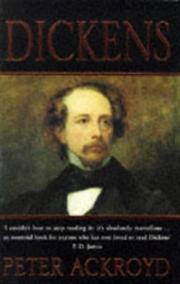
A thousand pages on the novelist who invented how we picture Victorian London, with invented dream-interludes that are either the best or worst thing in the book. Read it directly after London: it is the same city with one man walking through it.
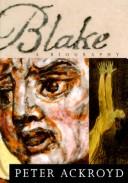
The engraver-visionary who never left London and saw angels in it. Shorter than Dickens and the purest expression of Ackroyd's argument that English imagination is a continuous inheritance.
The History of England, In Order
IntermediateRead the six-volume narrative history straight through, from prehistory to the twentieth century.
▸ Study plan for this stage
Pace: Three volumes, roughly 1,270 pages, two to three months. Read them strictly in order — these are sequential and each assumes the last. Before anything else, a catalogue problem you need to know about, because it will cost you money otherwise. Our listings show these books under bare titles: Foundati
- Ackroyd's history is narrative and characterological rather than analytical — he is interested in what it felt like and who did it, not in structural causation, and you should read it knowing that is the trade
- Continuity again, now as a claim about the nation: he keeps insisting that English institutions and habits persist under changing names, which is the thesis London: The Biography made about streets
- The Reformation as national trauma rather than as policy, which is the organising idea of Tudors and its most contested
- The compression of volume one. Fifteen hundred years in 250 pages means the Anglo-Saxon and Norman material is very thin, and this is the volume where a reader who wants depth should supplement
- The chapters on ordinary life that punctuate the political narrative in every volume — how people ate, worked, worshipped — which are where Ackroyd is at his best and where he most resembles the London book
- Kings as characters. He writes Henry VIII and Charles I as personalities driving events, a mode professional historians have largely abandoned, and the readability and the weakness come from the same choice
- The regicide in volume three as the hinge of the whole six-volume sequence: everything before builds to it and everything after is a country living with having done it
- What does Ackroyd think actually changed at the Reformation, and what does he think only appeared to?
- Volume one covers fifteen centuries in the length volume two spends on two. What suffers, and would you have made the same allocation?
- How does he narrate the execution of Charles I, and what does the choice of scene and detail tell you about his view of it?
- Pick one of the ordinary-life chapters. What is it doing in a political narrative, and is the book better for it?
- Where in these three volumes does the continuity thesis do real explanatory work, and where is it just an assertion laid over events?
- Reading Tudors after the Dickens biography, can you see the same writer? What carries over from the biography into the history?
- Buy or borrow all three at once and check you have volumes I, II and III on the spines. The bare titles make it genuinely easy to end up with the wrong book or a duplicate.
- Keep a single running timeline across the volumes — reigns, wars, one line each. Ackroyd's narrative mode means dates slide past and the sequence is easy to lose across a three-month read.
- After volume one, read a short conventional survey of Anglo-Saxon England. Volume one is too compressed there to stand alone and the rest of the series is better for the ballast.
- Read the Reformation chapters of Tudors and then ask what a Catholic historian would object to. Ackroyd's sympathies are visible and it is worth locating them.
- Mark the ordinary-life chapters as you go. If you find yourself preferring them to the political narrative, that is a real signal about which Ackroyd you like, and the novels at the end of this path are where that preference gets rewarded.
Next up: Three volumes have taken England to 1689 with the constitutional argument settled by force, which is exactly where the second half of the series begins — a country that has stopped fighting over its king and starts organising itself around commerce and empire instead.

Volume one: from the earliest settlements to the death of Henry VII. Read first — the volumes are sequential and Ackroyd assumes you have the previous one.

Volume two: Henry VIII to Elizabeth I, and the Reformation as a national trauma rather than a policy. The most narratively driven of the six.

Volume three: the Stuarts, the execution of a king, Cromwell and the Restoration. Read third.
The History Concluded
IntermediateFinish the six volumes, through empire and into the modern age.
▸ Study plan for this stage
Pace: Three volumes, roughly 1,260 pages, another two to three months. Same catalogue warning as the previous stage and it applies just as hard: our listings read Revolution, Dominion and Innovation, which are not the full titles. Ask for Revolution: The History of England from the Battle of the Boyne to
- The shift from dynastic to commercial history in volume four, and the way Ackroyd's character-driven method strains when the drivers are trade, credit and enclosure rather than personalities
- Empire handled at the periphery of the narrative rather than at its centre, which is a real and criticisable choice in a six-volume history of England covering these centuries — notice how much of the imperial story reaches the page and how it is framed
- The Victorian volume against Dickens: the same decades from a historian's vantage and a novelist's, and the discrepancies are the most instructive reading experience available on this path
- Industrialisation as lived experience rather than as economic process, which is where the ordinary-life chapters do their best work in the whole series
- The series' ending. Volume six is a conclusion to a sequence, not a standalone modern history, and it reads as thin to anyone who comes to it cold — read it as the last chapter of six
- Ackroyd's England is emphatically not Britain. Scotland, Wales and Ireland enter when they act on England, and the title is honest about this, but a reader should register the boundary rather than absorb it unnoticed
- Where in volume four does the character-driven method break down, and how does Ackroyd compensate when there is no monarch to narrate through?
- How much of the empire actually appears in volumes five and six, and what does its placement suggest about what Ackroyd thinks English history is?
- Set a Victorian chapter of Dominion against the corresponding stretch of the Dickens biography. Where do they disagree, and which do you believe?
- Does the continuity thesis still hold in the industrial period, or does the nineteenth century break it? Ackroyd has an answer; find where he gives it.
- Volume six ends the series. What is the series' conclusion, stated as a proposition, and did the previous five volumes earn it?
- Having read all six, would you recommend them as history, as literature, or as neither?
- Extend the timeline you started in the previous stage all the way to the end. Six volumes across five or six months is long enough that the shape only becomes visible if you have been recording it.
- Read the Dickens-era chapters of Dominion with the biography open beside you. Two accounts of the same decade by the same author in different modes is a rare thing and it is the single best exercise this path offers.
- After volume six, write down the argument of the whole series in one paragraph. If you cannot, that is itself a finding about a narrative history that avoids explicit thesis statements.
- Check one of Ackroyd's characterisations of a nineteenth-century figure against a specialist biography. The series is a general reader's history and it is worth knowing where it simplifies.
Next up: Fifteen hundred years of the continuity argument stated as history is exactly the preparation the novels need, because they make the same claim as plot rather than as assertion — and a claim you have to believe in fiction is tested differently than one you are told.
Volume four: the eighteenth century, from the Glorious Revolution's aftermath to the Regency. Where the series turns from kings to commerce.

Volume five: Waterloo to the Diamond Jubilee — industry, empire and Victoria. The volume that overlaps most with the Dickens biography, which is why that one comes earlier here.

Volume six and last: the Boer War to the twenty-first century. Read it sixth, and treat it as the end of the sequence rather than a standalone modern history.
The Novels
IntermediateMove to Ackroyd's fiction, which does in plot what the non-fiction argues in prose.
▸ Study plan for this stage
Pace: Two short novels, about 460 pages together, and after eight or nine months of biography and history this stage will feel like a holiday — three weeks, comfortably. Do not let the brevity fool you into speed, though. Hawksmoor is 224 pages written in two alternating registers, one of them a sustained
- The alternating structure of Hawksmoor: an eighteenth-century architect and a twentieth-century detective, in alternating chapters and alternating prose, with events echoing across two hundred years — the continuity thesis executed as plot mechanics
- The churches are real. Nicholas Hawksmoor built six London churches that still stand, and Ackroyd inverts the name — his eighteenth-century architect is called Dyer and his modern detective is called Hawksmoor, which is the novel's first and best joke
- Pastiche as argument. The period chapters are not decoration; the claim is that a voice from 1712 can be reconstructed and that doing so proves the past is reachable, which is the same claim London: The Biography makes about places
- Chatterton and the question of forgery: Thomas Chatterton really did forge medieval verse and really did die at seventeen, and the novel uses him to ask whether an imitation can be as real as an original
- The three braided periods in Chatterton and the way each one is engaged in some form of counterfeiting, so the structure itself is the argument
- Ackroyd's English visionary line, met first in Blake and Dickens, now appearing as a plot device — the novels assume the tradition the biographies described
- Neither novel resolves cleanly, and the refusal is deliberate: a book about continuity cannot have an ending without contradicting itself
- Why does Ackroyd give the detective the real architect's name and invent a name for the architect? What does the swap do to the reader?
- In Hawksmoor, are the two timelines the same story, parallel stories, or one story being remembered? The novel supports more than one answer — pick yours and defend it from the text.
- How does the eighteenth-century prose in Hawksmoor differ from the eighteenth century as it appears in Revolution, and what does the novel get at that the history cannot?
- Chatterton asks whether a forgery can be authentic. What is the novel's answer, and does Ackroyd's own method — reconstructing dead voices — make him an interested party?
- Both novels are set in London and both use the city as an agent rather than a backdrop. After London: The Biography, does the fiction add anything to that argument or simply illustrate it?
- Having read the whole path, is Ackroyd a historian who writes novels or a novelist who writes history? Where does the evidence sit?
- Look up photographs of the real Hawksmoor churches — Christ Church Spitalfields, St George in the East, St Anne Limehouse — before starting the novel. The buildings are genuinely strange and the book depends on you believing that.
- Read the first two chapters of Hawksmoor twice. The period voice becomes transparent on a second pass and the rest of the book is far easier once it has.
- Read the Chatterton entry in any reference work after finishing the novel, not before. Ackroyd is playing with the documented facts and the game is only visible once you know which parts he kept.
- Go back to one thematic chapter of London: The Biography and reread it. It reads as fiction now, which is either the final proof of Ackroyd's argument or the strongest objection to it.
- Write a paragraph on whether the continuity thesis convinced you. Ten books is enough evidence to have an opinion, and this is the point of the path.
Next up: This is the end of the path, and the natural continuations are the two Ackroyds it left out — the shorter Brief Lives of Chaucer, Turner, Newton and Poe if you want more of the biographer, or the remaining novels if the Hawksmoor register was the thing you came for.
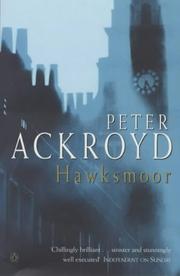
An eighteenth-century church architect and a twentieth-century detective, in alternating chapters and alternating prose. The best novel he wrote and the fictional twin of London: The Biography.
Three periods braided around the boy poet who forged medieval verse and died at seventeen. Read after Hawksmoor; it is his argument about authenticity and inheritance in narrative form, and a good place to stop.
Discussion
Keep reading
Paths that share books, cover the same subject, or open a related topic.