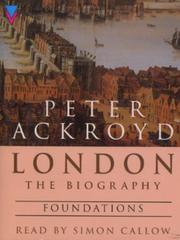
Start with London - The Biography, our untidy listing of London: The Biography. It is 828 pages and it decides whether the rest of Ackroyd is for you, because it contains the claim every other book on this path assumes: that a place has a continuous character across centuries, and that the same activity recurs on the same ground regardless of who is doing it. The obvious alternative is Dickens, which is magnificent and over 1,100 pages, or Hawksmoor, the novel — but the fiction and the biography both rest on an argument the London book makes outright.
One thing must be said before you open it. It is arranged thematically, not chronologically. There are chapters on smells, on noise, on drink, on light, on children, on suicide, and each runs from Roman London to the present and then starts again from the Romans in the next chapter. Readers who open it expecting a narrative history get about ninety pages in, lose their bearings and give up. It is not a book that goes anywhere; it is a book you accumulate. Read the contents page first, pick three chapters that interest you, and take twenty pages a night.
The Thames applies the same technique to a smaller subject and is the cheaper test of whether you have the taste for the method before committing to a six-volume history. It is published in the United States as Thames: Sacred River. Stop after it and decide honestly: if the thematic method irritated rather than delighted you, skip the history and go to the biographies.
The two great lives
Dickens first, despite the length — three months, and do not pretend otherwise. It is the direct continuation of the London book: the same city with one man walking through it at four miles an hour, which is a fact about Dickens's working method rather than a figure of speech. Be warned that Ackroyd interrupts his own biography with invented interludes in which he converses with Dickens, and in which Dickens's characters meet other characters and meet Ackroyd. They are entirely fictional, printed in the middle of a work of scholarship, and reviewers divided sharply over them; some abridgements cut them. Know they are coming so you do not think you have lost the thread.
Blake at 400 pages is a month and much the easier read, and it is the purest case of the continuity thesis: an engraver who barely left the city and saw eternity in it. Look at reproductions of the illuminated plates while you read rather than afterwards.
The History of England, in order — and how not to buy the wrong book
This is where our catalogue will cost you money if you are not careful. Our listings show bare titles: Foundation, Tudors, Civil War The History of England, then Revolution, Dominion, Innovation. Those are not the published titles. Search a bookshop for Foundation and you will be handed an Asimov novel. The real ones are Foundation: The History of England from Its Earliest Beginnings to the Tudors, Tudors: The History of England from Henry VIII to Elizabeth I, Civil War: The History of England from James I to the Glorious Revolution, Revolution, Dominion and Innovation with their own long subtitles. They are volumes one to six, and asking by volume number is the reliable way to get the right book — American editions word the subtitles slightly differently.
Read them strictly in order. Foundation covers fifteen centuries in about 250 pages, so the Anglo-Saxon and Norman material is thin and worth supplementing. Tudors is the most narratively driven and the easiest read. Civil War The History of England is the densest politically, because the 1640s do not simplify. Revolution is the hardest to hold, because eighteenth-century politics is factional rather than dynastic and there is no single figure to hang it on. Dominion overlaps heavily with the Dickens biography — which is exactly why the biography came earlier here — and Innovation is a conclusion to a sequence rather than a standalone modern history.
Two honest notes. Ackroyd's evidence base is overwhelmingly literary and anecdotal rather than statistical, a methodological choice professional historians have criticised. And empire sits at the periphery of the narrative rather than at its centre, which in a history covering these centuries is a real choice; the title says England rather than Britain, and it means it.
The novels, last
Hawksmoor and Chatterton come last by design: they do in plot exactly what the non-fiction spent a thousand pages arguing. Read first, they are clever ghost stories; read here, they are the conclusion. Hawksmoor alternates an eighteenth-century architect with a modern detective, one register a sustained pastiche with period spelling that takes thirty pages before the ear adjusts. The joke is that the real architect Nicholas Hawksmoor, whose six London churches still stand, is the name Ackroyd gives the detective. Chatterton braids three periods, each engaged in some form of counterfeiting.
Neither resolves cleanly, and the refusal is deliberate. Readers wanting more Ackroyd should look at the shorter Brief Lives of Chaucer, Turner and Poe, or try the neighbouring path on Peter Carey.
Follow the full ordered path here: Peter Ackroyd Reading Order: Where to Start.