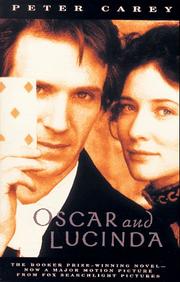
Start with Oscar and Lucinda, then True history of the Kelly gang. Both won the Booker Prize, and beginning here rather than at the start of the career is deliberate: the early novels are shaggier and wilder, the later ones cooler and more controlled, and these two are the point where the ambition and the warmth coincide. The obvious alternative is Bliss, his first novel, which is very funny and much less trustworthy as a sample of what he does.
Oscar and Lucinda pairs an English clergyman who cannot stop gambling with an Australian heiress who owns a glassworks, and drives them toward a wager involving a church made of glass carried up a river into country neither of them understands. It is 515 pages built from hundreds of very short chapters, some barely a page, so it takes interruption well. Read the first three in one sitting, though — they jump between two lives and a century, and the structure only makes sense in bulk.
True history of the Kelly gang is narrated entirely by the nineteenth-century bushranger, in a voice built from the surviving Jerilderie Letter: barely punctuated, ungrammatical, sustained across four hundred pages. It slows most readers by about a third for the first fifty pages and then stops mattering entirely. Read fifty pages before deciding — nearly everyone who abandons it does so in the first twenty. Ned Kelly is a live national argument in Australia, folk hero to some and murderer to others, and this novel is a claim in that argument rather than a neutral account of it.
The novels that talk back to England
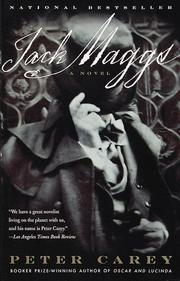
Jack Maggs takes the convict from Dickens's Great Expectations — the transported criminal who secretly funds a gentleman — and gives him the novel. He returns illegally to London to find the young man he has been paying for, and discovers that nobody wants him there. The Dickens figure in the book is a young, ruthlessly extractive novelist who mesmerises Maggs to steal his memories for a book, and Carey's charge is specific: English literature made its material out of colonial lives and then declined to give them a hearing. You do not need to have read Great Expectations, but the novel is considerably richer if you have.
Parrot and Olivier in America is the funniest thing he wrote: a French aristocrat plainly modelled on Tocqueville tours the young United States with an English servant who has had a far more interesting life than his master. The comedy comes from Olivier's earnest sociology of democracy being undercut by a man who has actually lived among the people being theorised.
Back to the early Carey
This stage sits late on purpose. The 1980s novels are wilder and less controlled, and they are far more enjoyable once you already trust the writer. Bliss is his first: an advertising executive dies for nine minutes, comes back convinced he is in Hell, and accumulates enough evidence that the reader starts to agree with him. Carey spent years in advertising, and the industry satire is written from inside.
Illywhacker is 600 pages and the hardest book here. Its narrator announces in the first paragraph that he is 139 years old and a liar, and then tells you the history of twentieth-century Australia — the argument being that a national history is itself a story sold by people with an interest in the sale.
The tax inspector is the counterweight and the bleakest thing in the catalogue: a failing car dealership, an audit, and a family whose damage the novel refuses to make funny. It contains material about the abuse of children that arrives hard and without warning. Do not schedule it for a bad fortnight.
The later books
My life as a fake and Theft are a matched pair about authenticity and should be read consecutively. The first is built out of the Ern Malley affair, a real Australian literary hoax, with the twist that the invented poet turns up alive demanding a life from the man who made him up; it is narrated at several removes, so nothing can be verified, which is the formal joke of a novel about forgery. Theft alternates a disgraced painter with his brother, whose narration is damaged, digressive and often the more reliable of the two, and it is unsentimental about the fact that a painting's value has almost nothing to do with the painting.
Finish with A long way from home, a 1950s car race around the whole continent that turns into a reckoning with what the race is driving across — the dispossession of Aboriginal people. Carey has said he approached that subject carefully and late; read it as a white Australian novelist writing about a history his earlier books skirted, and judge it on that basis.
Where to stop
The fat man in history, and other stories is his first book and belongs last, because the novels explain what he was reaching for in it. Cold, surreal, compressed, with no whimsy anywhere: one story a sitting with a day in between, because reading it straight through blunts everything after the second. Several of the novels are recognisably one of these stories with three hundred pages of characterisation added. For a neighbouring route, try Peter Ackroyd.
Follow the full ordered path here: Peter Carey Reading Order: Where to Start.