Patrick Modiano Reading Order: Where to Start
Patrick Modiano has written some thirty short novels and they are, by his own admission, versions of one book: someone searches Paris for a person who has disappeared, usually into the years of the German Occupation. That makes the reading order unusually forgiving — you cannot spoil anything — but it also makes the entry point matter, because starting with a minor one can leave you thinking he only ever does the same trick. This path uses the acknowledged entry points first, then the Occupation books, then the wider shelf, and does not try to cover everything.
Start Here
BeginnerMeet the Modiano situation — a narrator with an incomplete file, a Paris address book, and a past that will not fully resolve — in the two novels most readers name as the way in.
▸ Study plan for this stage
Pace: 1 week for Missing Person (168 pages) and In the Café of Lost Youth (118). Modiano's novels are short — most run 120 to 200 pages and can be read in a single evening — but they should not be raced. Read one, then leave two or three days before the next; they are atmospheric rather than plotted, and
- The Modiano situation, which recurs in nearly every book: a narrator with an incomplete file searches Paris for someone who has disappeared, usually into the years of the German Occupation
- Missing Person is the purest version — an amnesiac detective investigating his own identity — and it won the Prix Goncourt in 1978
- The novels are built from addresses, telephone numbers, hotel registers and old directories; the documentary texture is the substitute for plot
- Nothing fully resolves, by design. A reader waiting for the mystery to close will be disappointed in every book on this path
- In the Café of Lost Youth uses four narrators circling one woman, which shows the method's other mode: the same absence approached from several sides
- Paris is a real map in these books. Streets, arrondissements and métro stops are accurate and the geography is doing the work atmosphere usually does
- You cannot spoil Modiano, which makes the order unusually forgiving — but the entry point matters, because a minor novel first can leave you thinking he only has one trick
- What does Missing Person's amnesia device let Modiano do that a conventional search could not?
- How much is actually established by the end of each novel? List the confirmed facts — the list is very short.
- What role do documents — registers, directories, photographs — play in place of dialogue or action?
- In In the Café of Lost Youth, what does each of the four narrators know, and where do their accounts disagree?
- Why does Paris need to be geographically accurate for these books to work?
- Read one of the two with a Paris map open and follow the addresses. The novels change character when the geography is real.
- List every proper noun in the first twenty pages of Missing Person. The density of names against the absence of facts is the whole effect.
- Time yourself: most readers finish one of these in two hours. Knowing that makes the rest of the path easy to plan.
- After both, write two sentences describing a Modiano novel. You will test that description against eleven more.
Next up: The next stage moves from invented disappearances to a documented one, where Modiano works from real archives rather than imagination.
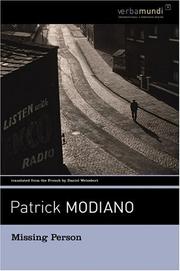
An amnesiac detective investigates his own identity through old photographs and forgotten addresses. It won the Goncourt, it is the purest statement of his method, and it is the standard first Modiano for good reason.

Four narrators circling one young woman in 1960s Paris. Read second because it shows he can build the same mystery out of memory alone, with no detective and no case; it is also his most immediately beautiful book.
The Occupation and the Archive
BeginnerRead the books where the disappearance is explicitly historical, and see what happens when Modiano stops inventing and works from real documents.
▸ Study plan for this stage
Pace: 2 weeks for Dora Bruder (145 pages), Suspended Sentences (213, three novellas) and Honeymoon. Dora Bruder should be read alone and slowly — it is the shortest and the heaviest. Roughly one book per four or five days.
- Dora Bruder began with a missing-person advertisement in a 1941 Paris newspaper, and Modiano spent years pursuing the real girl through archives; she was deported to Auschwitz
- It is not a novel: it is documentary, and it records the search's failures — the files he could not open, the years he could not fill — as part of the text
- The book reframes the whole shelf. The fictional disappearances are variations on a real historical mechanism: the French administration's records of deportation
- Modiano's own father was a Jew who survived the Occupation through black-market dealings, and the father-figure who evades explanation appears across the work
- Suspended Sentences collects three novellas that sit between memoir and fiction, and shows the boundary he works on deliberately
- Honeymoon is the clearest case of a fictional novel built from the same material as Dora Bruder — reading them together shows what fiction adds and what it costs
- This stage answers the question of why the repetition exists: he is circling something that cannot be recovered, and the circling is the form
- What can Dora Bruder establish about its subject, and what is permanently unavailable? Why does Modiano leave the gaps visible?
- How does the documentary book change your reading of the invented searches in the first stage?
- What is the ethical difference between writing Dora Bruder and writing a novel about a girl like her?
- In Suspended Sentences, where is the line between memoir and fiction, and does Modiano want you to find it?
- What does Honeymoon do with the same material that Dora Bruder cannot?
- Note every archival source Dora Bruder names and what each yielded. The research method is fully exposed in the text.
- Read the Vichy deportation timeline alongside the book; Modiano assumes a French reader's familiarity with it.
- Compare the first page of Dora Bruder with the first page of Missing Person. The same sentence rhythm is doing two very different jobs.
- Write one paragraph on why he never fictionalises Dora herself.
Next up: With the historical core exposed, the next stage ranges across four decades of short novels — and the repetition stops looking like a limitation.
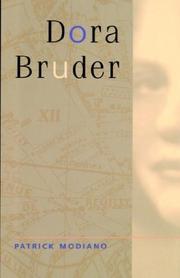
His reconstruction of a real fifteen-year-old who ran away from a Paris convent school in 1941 and was deported. Published in Britain as The Search Warrant; it is his most important book and the one the Nobel citation effectively described.

Three linked novellas about a Paris childhood among adults with unexplained pasts. The best demonstration of how little plot he needs, and the most useful single volume for understanding his obsession with his own father's war.

A documentary filmmaker abandons his life to trace a couple who hid in the south during the Occupation. Read after Dora Bruder and the mechanism of the search becomes explicit.
The Wider Shelf
IntermediateRange across four decades of short novels and notice how the same materials — a Riviera hotel, a nightclub, a missing mother, a car accident — recombine.
▸ Study plan for this stage
Pace: 3–4 weeks for Villa Triste (195 pages), Young Once (156), Little Jewel (176) and Paris Nocturne. Four short novels spanning 1975 to the 2000s. One a week, or two in a week if the rhythm suits you. Do not read them consecutively without pause — the similarity is the point, but it needs space to regis
- The same materials recombine across the four: a lakeside resort hotel, a nightclub, a missing mother, a car accident, an identity assumed and abandoned
- Modiano has said openly that he writes the same book repeatedly; the variation is in emphasis and in which detail is withheld, not in premise
- Villa Triste (1975) is early and the most novelistic — a resort town near the Swiss border, an ambiguous flight from something never specified
- Young Once follows a couple looking back at a formative period, and is the closest he comes to a straightforward story
- Little Jewel is narrated by a young woman who believes she has seen her supposedly dead mother in the métro, and is his best book about maternal abandonment
- Paris Nocturne opens with a night-time collision and pursues an encounter the narrator cannot verify happened as he remembers it
- Read as a set, the four demonstrate what the repetition earns: an accumulated atmosphere no single novel could establish, which is why reading four is different in kind from reading one
- Which recurring elements appear in all four, and which are unique to one?
- Does the repetition deepen the effect or exhaust it? Answer after the fourth book, not the second.
- Which of the four would you give to a new reader, and does it differ from your answer for the first stage?
- What does the earliest book, Villa Triste, do that the later ones stopped doing?
- Is the withholding in these novels a technique or a temperament?
- Build a grid: rows for the four novels, columns for hotel, nightclub, missing parent, accident, false name. Fill it in. The design becomes visible.
- Take one paragraph from each and try to identify which book it came from without the names. The difficulty is the finding.
- Note which novel you most wanted to resolve, and ask what you would have lost if it had.
- Read one of them twice in a week. Modiano rewards rereading more than almost any short-novel writer because so little is stated the first time.
Next up: The last stage takes the two most recent translated novels, written after the Nobel, in which the search has become almost entirely internal.
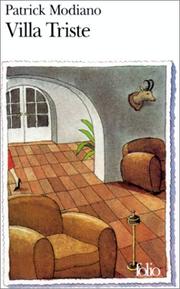
An early novel of a young man hiding out in a lakeside spa town during the Algerian war. The most conventionally atmospheric of his books and an easy read after the Occupation trio.

A couple at thirty-five looking back at the year they were nineteen and taken up by dangerous people. Structurally his clearest novel, which makes it a good palate cleanser.

A young woman sees a coat in the Métro and believes it is her mother, who is supposed to be dead. His best female narrator and the most emotionally direct book on this path.

A man hit by a car spends the novel trying to find the woman who was driving it. Short, dreamlike and the closest he comes to writing pure suspense.
Late Modiano
IntermediateFinish with the two most recent translated novels, written after the Nobel, where the search has become almost entirely internal.
▸ Study plan for this stage
Pace: 1–2 weeks for So You Don't Get Lost in the Neighbourhood (184 pages) and Invisible Ink (176). Both short. Read them in that order and leave a gap; they are quieter than anything earlier and the effect depends on not rushing.
- Modiano won the Nobel Prize in Literature in 2014, which brought most of his work into English translation and prompted the late novels' wider readership
- So You Don't Get Lost in the Neighbourhood is triggered by a stranger returning a lost address book, which sends an ageing writer back into a childhood he has protected himself from remembering
- Invisible Ink takes an unfinished case file from a former detective and follows an investigation across decades that the narrator himself keeps abandoning
- In both the search has moved inward: the disappeared person is a version of the narrator, and the archive is memory rather than a municipal register
- The late books are the most forgiving — the withholding is softer and the endings come closer to resolution than at any earlier point
- Read at the end of the path, they close a fifty-year project that never changed its subject and never needed to
- What is the address book in So You Don't Get Lost in the Neighbourhood actually doing structurally?
- How does Invisible Ink's ending differ from Missing Person's, and what has changed in forty years?
- Is the late softening an improvement or a loss?
- Having read twelve books, restate what a Modiano novel is. Compare it with the two sentences you wrote at the end of the first stage.
- Why is a body of work this repetitive worth reading in bulk rather than in samples?
- Reread the opening page of Missing Person after finishing Invisible Ink. The project is remarkably continuous.
- List the books on this path in the order you would recommend them to someone who will read only three.
- Write one page in Modiano's mode about a street you knew twenty years ago, using only concrete details and no explanation.
- Note which single novel you would keep, and why the answer is rarely the Goncourt or the most famous one.
Next up: This closes the path; readers who want more French fiction on the Occupation and its long aftermath will find it in the French-literature and Second World War paths on the site.

A reclusive writer is contacted by a stranger who has found his lost address book. The novel that appeared in English around the Nobel and the best of the late work.

A former private detective returns after decades to a case file with pages missing. A fitting last stop, because it is the book where he most openly admits the search will not conclude.
Discussion
Keep reading
Paths that share books, cover the same subject, or open a related topic.