Patrick Leigh Fermor Reading Order: Where to Start
Patrick Leigh Fermor is one of the great prose stylists in the English language, and his work rewards reading in a deliberate sequence: the walking trilogy traces a single epic journey across 1930s Europe in the order it was written (not the order it was walked), while his Greek books form a natural companion arc rooted in his deep love of the Hellenic world. Starting at an intermediate level, this curriculum moves from his most accessible and celebrated work through the full trilogy and then into the richer, more scholarly Greek writings, building the reader's feel for his layered allusions and baroque style at each stage.
The Heart of the Trilogy
IntermediateExperience Leigh Fermor at his most celebrated and accessible, establishing his voice, his method of travel-as-scholarship, and the Central European world he traversed.
▸ Study plan for this stage
Pace: 8–10 weeks total: spend 4–5 weeks on "A Time of Gifts" (~20–25 pages/day, pausing to consult maps and historical notes) and 4–5 weeks on "Between the Woods and the Water" at the same pace. Budget extra time for re-reading lyrical set-pieces and cross-referencing Leigh Fermor's footnotes.
- The walk as intellectual pilgrimage: Leigh Fermor's 1933–34 journey from the Hook of Holland to Constantinople as a framework for self-education and cultural immersion
- Prose style and the 'double exposure' technique: the adult writer's retrospective voice layered over the 18-year-old narrator's experience, creating irony, nostalgia, and depth
- Travel-as-scholarship: how Leigh Fermor uses each encounter — with architecture, language, heraldry, folklore, and history — as a springboard for erudite digressions
- The vanished Central European world: the Mitteleuropa of the Austro-Hungarian successor states, its aristocratic culture, linguistic patchwork, and the shadow of coming catastrophe
- Hospitality and the guest-friendship tradition: the recurring motif of strangers welcoming the young traveller into manor houses, monasteries, and peasant homes
- The Rhine, Danube, and their symbolic weight: rivers as narrative spines, historical arteries, and metaphors for the flow of civilisation
- Language acquisition as travel method: Leigh Fermor's absorption of German, then Hungarian and Romanian fragments, as a means of entering each culture
- Memory, reconstruction, and the ethics of memoir: the decades-long gap between journey and writing, and what that distance does to truth and texture
- How does Leigh Fermor's retrospective narration in 'A Time of Gifts' create a tension between youthful wonder and adult elegy, and where is this tension most visible in the text?
- In 'Between the Woods and the Water', how does the landscape of the Hungarian Plain and Transylvania shape both the physical journey and the thematic concerns of the book?
- What does Leigh Fermor's treatment of the Central European aristocracy — the schloss-owners and Magyar magnates who host him — reveal about his attitudes toward class, culture, and the pre-war order?
- How do the two books use rivers (the Rhine in 'A Time of Gifts', the Danube and its tributaries in 'Between the Woods and the Water') as more than geographical markers — what do they signify narratively and historically?
- Leigh Fermor wrote both books more than forty years after the journey. How does this temporal gap manifest in the prose, and does it strengthen or complicate his reliability as a narrator?
- Identify two or three extended digressions (on history, heraldry, language, or architecture) in either book. What is Leigh Fermor's method of weaving them into the travel narrative without losing momentum?
- Map the journey: draw or annotate a physical map tracing the route from the Hook of Holland through Germany, Austria, Hungary, and into Transylvania, marking every major stop named in both books — this makes the geography visceral and reveals the journey's true scale
- Voice imitation: choose one brief encounter from either book (a meal, a landscape description, a chance meeting) and rewrite it in your own words, then compare your version with Leigh Fermor's — note specifically what his sentence rhythms, vocabulary choices, and tonal shifts do that yours do not
- Digression audit: select any three of Leigh Fermor's scholarly digressions (e.g., the history of the Habsburgs, the origins of Hungarian, the architecture of a Baroque church) and fact-check or expand them using one outside source — assess how accurate and how selective his scholarship is
- Before-and-after reading journal: after finishing 'A Time of Gifts' but before opening 'Between the Woods and the Water', write a one-page prediction of how the tone, landscape, and themes will shift — then revisit and annotate your prediction once you have finished the second book
- Close-reading passage comparison: find one winter/northern scene in 'A Time of Gifts' and one summer/southern scene in 'Between the Woods and the Water' and write a comparative paragraph on how Leigh Fermor uses season and climate as emotional and cultural registers
- Research the 'vanished world': choose one specific place Leigh Fermor visits — a castle, a city, a village — and research what happened to it and its inhabitants between 1934 and 1945. Bring that knowledge back to the relevant passage and annotate it with what the text cannot yet know
Next up: Having absorbed Leigh Fermor's mature voice, his Central European obsessions, and his method of retrospective reconstruction across two sustained narratives, the reader is now equipped to explore his other major works and the wider critical and biographical context that illuminates why this trilogy — and the life behind it — became a defining monument of twentieth-century travel writing.
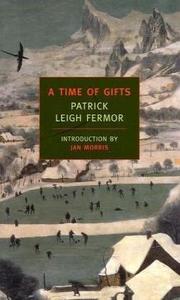
The first volume of the walking trilogy, covering his journey from the Hook of Holland to the Hungarian border in 1933–34. It is widely considered his masterpiece and the ideal entry point — the prose is exhilarating but the narrative momentum carries the reader through its density.
The direct sequel, picking up at the Hungarian border and carrying the journey through Romania toward the Iron Gates. Having just finished A Time of Gifts, the reader is fully attuned to his style and can savour the deepening melancholy and scholarship of this volume.
Completing the Walk
IntermediateFinish the trilogy and understand its elegiac arc — the walk ends, the pre-war world vanishes — while also encountering Leigh Fermor's wartime heroism in his own words.
▸ Study plan for this stage
Pace: 5–6 weeks total: Weeks 1–4 for The Broken Road (~25–30 pages/day, including re-reading dense descriptive passages), Weeks 5–6 for Abducting a General (~20 pages/day, a shorter but intense text best read slowly and annotated).
- The elegiac arc of the trilogy: The Broken Road was assembled posthumously from Leigh Fermor's unfinished manuscripts, and its incompleteness is itself thematically meaningful — the walk trails off rather than triumphantly concludes, mirroring the vanishing of the pre-war world it documents.
- The Mount Athos chapters as spiritual and aesthetic climax: Leigh Fermor's extended stay on the Holy Mountain functions as a meditative coda to the entire journey, raising questions of faith, solitude, and the sacred that reframe the whole trilogy.
- Memory, time, and the double perspective: As in the earlier volumes, the narrator is simultaneously the young walker of 1934–35 and the elderly writer looking back across the catastrophe of WWII, but in The Broken Road this tension is most acute because the manuscript was never fully resolved.
- The pre-war Balkans as a lost world: Bulgaria, Thrace, and the Greek borderlands are rendered with the same loving ethnographic precision as earlier volumes, but the reader now knows — as Leigh Fermor always knew — that these communities, cultures, and landscapes were about to be shattered by war, o
- From writer to man of action — the shift in register in Abducting a General: Leigh Fermor's own account of the 1944 kidnapping of General Heinrich Kreipe on Crete is written in a taut, operational prose utterly unlike the lyrical expansiveness of the trilogy, revealing a different facet of the same
- The Cretan resistance and the ethics of irregular warfare: Abducting a General raises implicit questions about risk, loyalty, and the cost borne by local populations for acts of Allied daring — Leigh Fermor is candid about the reprisals feared and the bonds forged with Cretan andartes.
- Heroism, memory, and self-mythologization: Read together, the two books invite scrutiny of how Leigh Fermor constructs his own legend — the romantic wanderer and the dashing SOE officer — and where autobiography shades into myth-making.
- The role of editors and posthumous publication: Because The Broken Road was shaped by editors Artemis Cooper and Colin Thubron after Leigh Fermor's death, readers should think critically about what it means to encounter an author's unfinished work and how editorial choices affect meaning.
- How does the unfinished, posthumously edited nature of The Broken Road affect your reading of it as the trilogy's conclusion — does incompleteness feel like a flaw or a fitting end, and why?
- What does the Mount Athos section of The Broken Road reveal about Leigh Fermor's inner life and spiritual preoccupations that the earlier volumes only hinted at?
- In Abducting a General, how does Leigh Fermor's prose style and narrative voice differ from that of The Broken Road, and what does that shift tell you about how he understood the two experiences?
- How does Leigh Fermor handle the moral complexity of the Kreipe operation in Abducting a General — particularly the question of reprisals against Cretan civilians — and do you find his treatment adequate?
- Taken together, how do The Broken Road and Abducting a General complete or complicate the portrait of Leigh Fermor as a figure who both witnessed and participated in the history of mid-twentieth-century Europe?
- By the end of both books, how would you characterize the 'elegiac arc' of the whole project — what exactly is being mourned, and how does Leigh Fermor balance grief for a lost world with celebration of it?
- Trace the double timeline: Create a two-column annotated timeline as you read The Broken Road — one column for events in 1934–35 (the walk), one for the implied moment of writing (post-WWII). Note every passage where the older narrator intrudes on the young walker's story, and write a paragraph on how this layering shapes the book's emotional tone.
- Close-read the Mount Athos chapters: Select two or three consecutive pages from the Mount Athos section and write a 400-word stylistic analysis focusing on sentence rhythm, imagery, and the handling of silence and sacred space. Compare your findings to a similarly dense descriptive passage from earlier in the trilogy if you have read it.
- Prose style comparison exercise: Choose one descriptive paragraph from The Broken Road and one action or dialogue passage from Abducting a General. Write a 300-word comparison of diction, sentence length, and narrative pace. What does each style reveal about how Leigh Fermor inhabited each experience?
- Map the Kreipe operation: Using the account in Abducting a General, sketch a rough map of the operation's key locations on Crete (the ambush site, the mountain crossing, the evacuation beach). Then write a short reflection on how the physical landscape functions in the narrative — is it obstacle, ally, or character?
- Interrogate the self-myth: Write a 500-word critical essay arguing either that Leigh Fermor is guilty of self-mythologization in Abducting a General, or that the book is a model of honest memoir. Use specific textual evidence from the book, paying particular attention to moments where he acknowledges doubt, fear, or moral ambiguity.
- Synthesize the full arc: After finishing both books, write a one-page 'obituary' for the pre-war world Leigh Fermor walked through — drawing on details from The Broken Road specifically — as if you were a journalist writing in 1945. This exercise forces you to identify what concretely was lost and to articulate the elegiac stakes of the entire project.
Next up: Completing the trilogy and Abducting a General gives the reader a full, rounded portrait of Leigh Fermor as both artist and actor in history, providing the biographical and textual foundation needed to engage critically with secondary scholarship, biography, and comparative travel writing in any subsequent stage.
The posthumously completed third volume, edited by Colin Thubron and Artemis Cooper, brings the walk to its conclusion in Constantinople. Reading it immediately after the first two volumes lets the reader feel both the completion and the poignant incompleteness of the trilogy.

Leigh Fermor's own account of the 1944 kidnapping of General Kreipe in Crete — his most famous wartime exploit. It bridges the pre-war trilogy and the Greek books, showing how the man of the walk became the man of Crete.
The Greek World — Mani
IntermediateEnter Leigh Fermor's Greek writing with his most beloved travel book, learning to read his blend of landscape, history, folklore, and digression that defines his Hellenic work.
▸ Study plan for this stage
Pace: 4–5 weeks, ~20–25 pages/day — Mani rewards slow, attentive reading; allow extra time for passages dense with history or Greek vocabulary
- The Mani Peninsula as a living palimpsest — Leigh Fermor treats the landscape as a layered text in which Byzantine, Ottoman, Frankish, and ancient Greek histories are simultaneously visible and readable
- Digressive structure as literary form — the book's narrative constantly spirals outward from a physical observation into myth, etymology, or history before returning to the journey, and recognising this spiral is key to following the argument
- The tower-house culture and Maniot clan warfare — understanding the social logic of the vendetta, the tower as status symbol, and the fierce independence of the Maniots is essential to reading the human portraits in the book
- Landscape ekphrasis — Leigh Fermor's extended set-piece descriptions of light, rock, sea, and ruin are not decoration but argument; they carry thematic weight about time, survival, and Hellenism
- The Deep Mani (Exo Mani vs. Mesa Mani) — the geographical distinction structures the book's emotional arc from the relatively accessible north to the austere, almost lunar south
- Oral tradition and folklore as historical evidence — Leigh Fermor treats songs, proverbs, laments (moirológia), and local legends as primary sources on a par with written chronicles
- The question of Greek continuity — the book engages seriously with the 19th-century Fallmerayer controversy about whether modern Greeks are the true descendants of the ancients, and Leigh Fermor's answer is woven through every chapter
- The role of the narrator-traveller — Leigh Fermor is a character in his own book; tracking his persona (polyglot, classically educated, warmly sociable) reveals how the authorial voice shapes what is seen and what is omitted
- How does Leigh Fermor use the physical architecture of the Maniot tower-house as a metaphor for the broader culture of the peninsula, and what does this reveal about his method of reading landscape?
- What is the Fallmerayer thesis, why did it provoke such outrage among Greeks, and how does Leigh Fermor implicitly or explicitly argue against it throughout Mani?
- Identify two or three extended digressions in the book and trace the associative logic that takes Leigh Fermor away from and back to the main narrative thread — what does this technique achieve that a straightforward travel account would not?
- How are women portrayed in Mani, particularly in relation to the moirológia (funeral laments)? What does Leigh Fermor suggest about the relationship between grief, poetry, and cultural memory?
- In what ways does the Deep Mani (Mesa Mani) differ in atmosphere, landscape, and human character from the regions encountered earlier in the journey, and how does Leigh Fermor signal this shift in his prose style?
- What is Leigh Fermor's attitude toward modernity and change in the Mani? Is he elegiac, celebratory, ambivalent — and can you find specific passages to support your reading?
- Keep a 'digression map' as you read: each time the narrative leaves the physical journey, jot down the trigger (a word, a ruin, a gesture), the territory covered in the digression, and the detail that brings it back — after finishing the book, review the map to identify Leigh Fermor's most frequent associative pathways
- Choose one of Leigh Fermor's landscape set-pieces (the approach to the Cape Matapan/Tainaron, the view from a tower, or a description of the sea at a particular hour) and write a one-page imitation in his style, attempting his characteristic long sentence with embedded classical allusion
- Research the Fallmerayer controversy independently using a short encyclopedia article or introductory essay, then re-read the relevant passages in Mani with fresh eyes and annotate where Leigh Fermor's counter-argument is explicit versus where it is implied through tone or example
- Locate Greece on a detailed map and trace the journey described in Mani from Kalamata southward through the Mani peninsula to Cape Tainaron and back; annotate the map with five to eight place-names from the book and one key event or observation attached to each
- Select one Maniot folk song or lament (moirolói) that Leigh Fermor quotes or paraphrases and, using any available translation resource, explore its imagery — then write a short paragraph on how Leigh Fermor frames it and what interpretive work he asks it to do in his argument
- Write a 400-word reflective response to the question: 'Is Mani a travel book, a work of history, or a prose poem — and does the distinction matter?' Use at least three specific passages from the text as evidence
Next up: Mastering Leigh Fermor's Greek method in Mani — his layered historical vision, his digressive confidence, and his deep engagement with Hellenic identity — equips the reader to appreciate how he applies and extends the same techniques to a second, contrasting Greek landscape in Roumeli, where the mainland interior replaces the austere peninsula and new questions about modern Greek nationhood come t
The first of his two great Greek travel books, exploring the remote Mani peninsula. It is more structured and immediately gripping than its companion volume and serves as the perfect introduction to his Greek voice and his love of Byzantine and Ottoman layers of history.
The Greek World — Roumeli and Beyond
ExpertComplete the Greek arc with his more digressive and scholarly companion volume, then encounter the critical and biographical literature that illuminates everything read so far.
▸ Study plan for this stage
Pace: 6–8 weeks total: Weeks 1–3 on Roumeli (~20–25 pages/day, allowing time to pause on digressions and footnotes); Weeks 4–7 on Patrick Leigh Fermor: An Adventure (~25–30 pages/day, cross-referencing passages from Roumeli as Cooper's biography illuminates them); Week 8 reserved for synthesis, re-reading
- Roumeli as a digressive, essayistic form: how PLF structures the book as a series of linked explorations rather than a linear travel narrative, and what this reveals about his mature prose style
- The Sarakatsani and Vlach communities: PLF's ethnographic attention to vanishing transhumant peoples of northern Greece, and the tension between scholarly documentation and lyrical elegy
- Hellenism layered through time: PLF's method of reading Byzantine, Ottoman, classical, and modern Greek history simultaneously in landscape, dialect, and custom — the 'time-collapsing' technique at its most concentrated
- The role of digression and the footnote as literary devices: how PLF uses extended asides, linguistic tangents, and footnotes not as interruptions but as the intellectual heart of the text
- Artemis Cooper's biographical method: how she triangulates PLF's life through letters, interviews, and archival research, and what her access to his private papers reveals about the gap between lived experience and published work
- The making of a literary persona: Cooper's portrait of how PLF consciously shaped his public image — the adventurer-scholar — and the personal costs (restlessness, delayed publication, complicated relationships) behind it
- Greece as spiritual homeland: both books, read together, illuminate why Greece — and specifically its non-Athenian, rural, and island margins — became PLF's defining subject and adopted country
- Critical reassessment: Cooper's biography invites the reader to interrogate PLF's romanticism, his occasional factual liberties, and the post-colonial critiques of the 'privileged wanderer' gaze
- How does Roumeli differ structurally and tonally from Mani, and what does that difference suggest about PLF's evolving ambitions as a writer of place?
- What does PLF's treatment of the Sarakatsani and Vlach peoples in Roumeli reveal about his attitude toward cultural extinction and modernity — and does Cooper's biography complicate or confirm that reading?
- According to Cooper, how did PLF's wartime experiences in Crete and his long residence in Greece shape the specific scholarly and emotional preoccupations visible in Roumeli?
- How does Cooper handle the tension between PLF's legendary self-mythologising and the documentary evidence she uncovered — where does she push back, and where does she defer?
- In what ways does reading Roumeli alongside Cooper's biography change your understanding of PLF's relationship to his Greek subjects — as an insider, an outsider, or something more ambiguous?
- What does Cooper's account of PLF's writing process — the decades-long delays, the obsessive revision — tell us about the relationship between his peripatetic life and the difficulty of turning it into finished prose?
- Comparative annotation: Select three passages in Roumeli where PLF makes a historical or ethnographic claim, then use Cooper's biography to trace where that knowledge came from — a specific friendship, a library, a journey. Write a one-paragraph note on each connecting the life to the page.
- Digression mapping: Choose one full chapter of Roumeli and diagram its structure — mark the primary narrative thread, every digression, and every footnote. Then write a short reflection on whether the digressions feel like detours or whether they ARE the destination.
- Voice and persona exercise: Cooper reveals the private PLF behind the published one. Write a 400-word passage describing a place you know well, first in PLF's published Roumeli style (expansive, allusive, scholarly), then as if writing a candid letter to a close friend — as Cooper shows PLF often did. Compare the two.
- Research a vanishing community: PLF elegises the Sarakatsani and Vlachs. Identify one comparable community (linguistic, pastoral, or nomadic) in any part of the world, and write a one-page reflection on what tools — ethnographic, lyrical, historical — a writer would need to document them responsibly.
- Biography-to-text scavenger hunt: Using Cooper's index and chapter notes, identify at least five specific real people, places, or events from PLF's life that appear in Roumeli in disguised, compressed, or fictionalised form. Present your findings as an annotated list.
- Evaluative essay: Drawing on both Roumeli and Cooper's biography, write a 600–800 word critical response to the following question: 'Is PLF's Greece a real place, a scholarly reconstruction, or a personal mythology — and does the distinction matter?'
Next up: Having completed PLF's Greek writings and grounded them in Cooper's authoritative biography, the reader now possesses both the textual and biographical framework needed to approach PLF's earlier, more autobiographical work — the great Central European trilogy — with fully informed critical eyes.

The companion to Mani, covering northern and central Greece, including a famous chapter on a monastery stay. It is more episodic and allusion-heavy than Mani, making it the right book to read once the reader has their Greek bearings from the previous stage.
The authorised biography by the scholar who also edited The Broken Road. Reading it last transforms the entire curriculum — every book already read is illuminated by the full life story, the friendships, the loves, and the long decades of writing and revision behind each page.
Discussion
Keep reading
Paths that share books, cover the same subject, or open a related topic.